Fears that activewear sheds plastics that penetrate the skin are giving people new reason to sweat over working out. Responsive entrepreneurs now advertise leggings, tanks and sports bras as “nontoxic,” “clean” and “safe.” They tout gym- and trail-ready garments made of merino wool, cotton, mulberry silk, bamboo and hemp.

However, these materials alone can’t smooth curves or hug muscles through squats and sun salutations; only synthetics achieve that coveted stretch factor. So companies quietly blend natural fibers with elastane (also known as spandex), nylon or polyester.

Activewear brands find themselves in a paradox: touting images of fresh-air lifestyles while they produce clothes from petrochemicals that feed the climate crisis and pollute the planet.

Changing that requires formulating stretchy materials with proven performance, sustainable origins and lower end-of-life impacts. It’s a big challenge, said Marcian Lee, an analyst with Lux Research: “I don’t think we have a perfect solution that satisfies all three of these considerations,” he said.

Enter Äktiiv

One Nike veteran is determined to clean up athletic wear with his Äktiiv brand. Tim Gobet spends about $27 to make a pair of $100 leggings — not a high enough margin for larger brands, he said. The materials are certified nontoxic, mixing plant fibers and fewer oil-based inputs than standard fare.

Portland-based Äktiiv is in a pre-profit growth phase. It has raised under a million dollars, with a chunk from former Nike co-worker Jeffrey Jordan — son of NBA legend Michael.

Gobet manages suppliers, designs garments and juggles ads on Meta while his wife, Paulina, handles fulfillment. And their kids help move inventory through their Beaverton, Oregon, garage. In the past 90 days, customers spent an average of $152, and two-thirds returned to buy more. Gross revenues are at six figures each month.

Äktiiv ads

Aktiiv's founder is finding traction with a direct-to-consumer approach and social media ads.
Äktiiv’s founder is finding traction with a direct-to-consumer approach and ads on Meta.
Source: Aktiiv / Trellis

How it started

Gobet’s 15-year career at Nike included leading the Jordan Brand, which topped $3 billion in sales when he left in 2017. He helped the corporation launch its first recycled polyester-spandex base layers for pro athletes for the 2016 Rio Olympics.

Yet Gobet was troubled by the industry’s hunger for virgin petroleum fabrics. “My materials developers started bringing alternatives: ‘Hey, this is made from recycled plastic.’ ‘Hey, this is made from corn input,’” he said. “My mind was like, ‘Why aren’t we using this anyway?’”

He soon caught entrepreneurial fever. “I quickly realized, we need to zig while everyone else is zagging,” Gobet said. “My goal was to create truly high performance, buttery-soft fabric that feels and looks like what is toxic but is good for the planet and good for health.”

First, he co-launched Zenkai Apparel with former NHL player Doug Lynch. Then Gobet moved on to start Äktiiv in 2020, hitting early snags with COVID-19 shutdowns and technical challenges.

“For two years, not a single supplier could get it right,” Gobet said. Then a former Nike materials developer quickly figured out how to blend Äktiiv’s proprietary Proterra fabric from three types of yarn.

Gobet found a partner in Sabrina Fashion Industrial. The Taipei company, which also serves major brands, knits and dyes Äktiiv’s material, then cuts and sews styles in Cambodia.

A Kickstarter campaign in 2022 raised $27,026 for Äktiiv, which made its first sale in 2023.

Other anti-plastic activewear

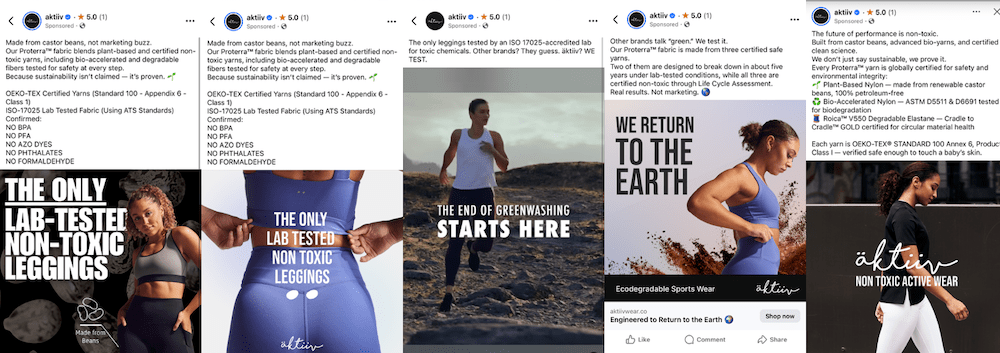
Various other brands are taking a similar tack by appealing to health-conscious consumers on Facebook, Instagram and elsewhere.
Various other brands are taking a similar tack to Äctiiv by appealing to health-conscious consumers on Facebook, Instagram and elsewhere.
Source: Aktiiv / Trellis

What’s in the fabric

Äktiiv’s Proterra fabric combines 42 percent petroleum-free nylon from castor beans or corn. Forty percent comes from a nylon 6,6 strain that biodegrades faster than traditional nylon. The final 18 percent is Roica V550 yarn, the only Cradle to Cradle Gold elastane.

All of Äktiiv’s yarns are OEKO-TEX 100 certified for “baby-safe” toxicity limits. Äktiiv tests the finished fabric, a step that other brands skip, according to Gobet. The company advertises clothes free of bisphenol A, per- and polyfluoroalkyl “forever chemicals,” azo dyes, phthalates or formaldehyde.

The tradeoffs

Äktiiv’s solution isn’t perfect: One yarn is fossil-fuel-free but doesn’t biodegrade. The other two may degrade quickly in landfills or oceans but are petroleum-based.

Gobet still dreams of finding a “holy grail” of biodegradable, plant-based activewear. “Both halves of the equation already exist,” he said. 

Meanwhile, he is thinking about how to help the industry complete that calculation, possibly by sharing learnings or launching an industry collaboration.

Every alternative to regular elastane comes with trade-offs on performance, price, scalability and recyclability, according to Bonie Shupe, founder of Rewildist, a sustainable apparel consultancy in Colorado. “Transparency is essential as the industry transitions.”

Äktiiv faces a circularity dilemma, too: As yet, mainstream technologies can’t recycle textile blends such as Proterra, even as startups compete to change that.

Toxic matters

Äktiiv is seizing on increasingly popular consumer suspicions, based on recent science, that tight, plastic-fiber clothes hurt their health.

Studies show that skin can absorb certain plastics, but it’s unclear if that’s even harmful or if clothing is a culprit. Plastic in arteries is associated with a higher heart attack risk, but does plastic easily migrate into the bloodstream from the skin?

For Gobet, Äktiiv’s chemical-safety certifications provide a competitive advantage and peace of mind. “I’m still not comfortable putting untested synthetic fabrics on people’s skin for hours a day, during workouts when pores are open and sweat glands are active,” he said.

Gobet worries that mainstream brands selling synthetics will face new risks if future research confirms consumers’ fears. “If it turns out we were overly cautious? Great.”

The post Former Nike insider challenges activewear’s plastic playbook appeared first on Trellis.

The opinions expressed here by Trellis expert contributors are their own, not those of Trellis.​

Manufacturing is in the headlines, both as a major goal of current U.S. policy and a point of competitive tension with China. It’s a surreal moment, which could be summarized as the world’s biggest consumer picking a fight with the world’s biggest producer. 

In 2024, America exported $140 billion of goods to China, while China exported $440 billion of goods to the U.S. One doesn’t sensibly pick a fight with their biggest customer. Instead of counterpunching, China has worked to address any structural weaknesses it could find to minimize the damage if its relationship to its biggest customer were to change

While the current U.S. policy direction suggests that green technologies are a scam that force more expensive and unproven technology into the market, China is demonstrating that green technology is a huge boost to economic growth. This is evidenced by its dominance in solar, battery and EV technology in global markets — a point that became clear during COP30 in Brazil earlier this month. 

Automaker BYD, for example, is building an EV plant larger than the entire city of San Francisco and seven times larger than the biggest Tesla gigafactory. Green manufacturing isn’t a dead end; it’s a huge economic boom. But it’s not happening here.

How we got here

The economic order since the fall of the Berlin wall has been one of ever-expanding international trade and rising prominence of multinational corporations. Military conflicts have been more regional (as opposed to global), and most international competition moved into the economic sphere. While any system has room for critique, the economic efficiencies that came from global production both provided cheaper goods and a reason for ongoing international cooperation. 

This approach was very good for business, and generally good for world peace. What it was less good at was guaranteeing jobs in any specific country, as global trade also meant the ability to offshore labor at lower costs. Some industries and national policies advanced their manufacturing with technology, which drove more productivity and sustained living wages even at the higher cost of living in industrialized nations.

Still, over the past two decades, domestic manufacturers have steadily ceded market share to imports: U.S. producers now supply roughly two-thirds of the home market for manufactured goods, down from more than three-quarters in the early 2000s, a shift worth on the order of $600 billion–$750 billion in annual sales now captured by factories overseas. At the same time, a growing reshoring push and “make it here” industrial policies show just how eager voters, workers and local leaders are to bring more of that production back onto domestic ground.

My venture firm invests in deep tech for productivity improvements to the industrial sector that also bring along massive ecological improvements — so I have a front row seat to the effort to “bring back manufacturing” to America. We’ve set up several new manufacturing facilities in the U.S. in the past five years and for a time, those production lines were humming. But now, thanks to recent policies, the U.S. is one of the worst places to manufacture in the world. 

Tariffs have crippled U.S. manufacturing

Tariffs aren’t categorically a bad thing. When used wisely, along with thoughtful investments in education, infrastructure and cultural incentives, they can bring valuable industries back into domestic production. But there’s a bad way to implement them and the worst way to use tariffs, which is what’s happening now: to have them be unstable, large and arbitrary. 

The instability actively punishes folks setting up manufacturing domestically because they cannot predict input costs, nor the cost of production equipment. If your team was waiting on best-in-class equipment to arrive from Germany or Japan the same week that a 50 percent tariff is imposed broadly on those nations, then you may have just accidentally bankrupted the effort, as capital expenditure costs are huge project budget line items. 

Almost no country except China has the luxury of sourcing its entire supply chain within their borders. So when tariffs are imposed on inputs, the cost of domestic production can go up to the point where it is no longer workable. 

When tariffs are unstable, they don’t encourage investment, because bold moves that set up new production could accidentally kill your business. 

When tariffs are large, they create expensive discoordination arising from having to halt production or re-route sourcing to new vendors in other geographies to get you back to gross margin positive while you incur costs from supply chain delays and production uncertainty. 

When tariffs are arbitrary, one cannot predict whether your government is wanting to support your industry or abandon it. This makes life harder for investors, business leaders and entrepreneurs that are the main personnel that establish domestic production.

Getting back on track

If you live in a higher-income nation, the operating band for labor costs will be higher than labor costs in lower-income ones. Given this, the labor cost disadvantage either needs to be made up for via higher individual productivity, which lowers labor cost fraction per unit, or you need to make higher-quality goods that command enough margin to justify the higher labor costs. 

In either case, you need a highly skilled workforce appropriately trained for better productivity or exceptional craft that improves product quality. 

To get here, a thoughtful approach for governments would be to lower the cost and improve the quality of educational options — from advanced degrees and four-year universities to trade schools and support of regional craft guilds and maker communities. The people, places and tools that enable mass-upskilling need to be well-resourced and respected. 

In other words, you’ll need to pay teachers more. (Which, if you’re counting, would be another source of meaningful work.) While these adjustments may sound expensive and time-consuming, in countries where they have been applied, the efforts have shown fantastic ROI. Beyond education and re-skilling, infrastructure investments in roads, bridges and ports, lower-cost energy, and clear labor laws that simplify bringing the best talent are all huge boosts to establishing robust industry.

Tariffs can positively contribute to this effort if they are stable, low and principled. 

A 5 to 10 percent tariff that is stable for 10 years provides enough time for new manufacturing to be established. It also signals to the workforce that those industries will likely be growing and that engaging in re-skilling into that industry is a worthwhile career investment. 

When tariffs are low, it also means that when they eventually expire, the country maintains an industrial base that can still produce near the globally competitive costs. This greatly strengthens the likelihood of strong export markets making use of that newly developed production capacity.

The good news is that we know where to put our attention and investment, if the intent is more manufacturing skill: education, infrastructure, social respect and low-intensity, time-stable tariffs (if needed). The countries that do this well will pull ahead in the coming decades and become net drivers and suppliers of the waves of economic transformation to come.

The post The green manufacturing boom is happening. Just not here appeared first on Trellis.
Nylon is the second most popular synthetic fabric behind polyester, yet less than 2 percent of it is recycled, mostly from fishing nets and carpeting, according to Textile Exchange. Seven million metric tons of the stuff are manufactured each year, which results in a lot of windbreakers, backpacks and bathing suits eventually ending up in landfills.

To make headway on recycling nylon from used textiles, the Nylon Materials Collective brings together an ambitious materials startup with scores of apparel companies. Textile recycler Samsara Eco of Australia launched the partnership Nov. 25 with the European Outdoor Group, representing more than 150 brands and retailers.

“By pooling demand and expertise, we’re making it easier for brands of all sizes to integrate high-performance, recycled materials into their collections and take meaningful steps toward a more sustainable outdoor industry,” said Katy Stevens, the European Outdoor Group’s head of sustainability, in a statement.

The organization represents more than 150 brands including Arc’teryx, Marmot, Fjällräven and The North Face. The effort is open to brands around the world.

“Having access to recycled nylon with the same performance quality but without the environmental footprint fills a long-held gap in the market and is a huge win for both industry and the planet,” Samsara Eco’s Chief Commercial Officer Sarah Cook told Trellis.

Enzyme-based technology

Samsara Eco made a significant deal this summer to supply Lululemon over the next decade. The startup is building a nylon recycling plant earmarked to open in the next couple of years.

Samsara Eco uses enzymes to break down nylon’s polymer chains, which are then rebuilt into new nylon. “We tap straight into the supply chain,” CEO Paul Riley told Trellis last year. “They don’t have to change their production process or equipment. We just go straight in where that fossil fuel might have gone in.”

Samsara Eco has experimented with recycling two common strains of nylon. Polyamide 6 appears in swimsuits and stockings, and it has been recycled for years from fishing nets, a major source of ocean pollution, by companies including Econyl. The rarely recycled type is Polyamide 6,6, found in performance gear, backpacks and hiking pants.

In addition, when nylon is blended, as it is with elastane to make leggings stretchy, it complicates recyclability.

“We have started to see the development of advanced recycling technologies that can break down blended fibers as a possible solution for processing these materials,” said Adam Gardiner, recycled engagement lead at Textile Exchange.

Pooling resources

Sustainability advocates praise the new nylon collective’s approach to pooling demand across brands.

“It lowers the barriers for small and mid‑size players to access high‑performance recycled nylon that matches virgin material in strength and durability,” said Bonie Shupe, founder of Rewildist, a Colorado consultancy focusing on apparel materials.

The Nylon Materials Collective takes a similar approach to Circ’s Fiber Club, which launched in January. Through that group, Circ of Danville, Virginia, aims to ensure the development of its recycled lyocell, a semi-synthetic fabric originating from trees. Partners include brands Eileen Fisher, Everlane, Zalando and Bestseller.

However, fashion has only begun to bend toward circular materials.

Numerous startups are vying to create closed-loop recycling for synthetic textiles, mostly polyester.

In the spring, Samsara joined some of those businesses — Circ, Circulose, Syre and Re&Up — in their new T2T Alliance, through which they will lobby for policies in Europe that advance textile-to-textile recycling.

The post Samsara Eco collaborates with outdoor brands around the globe on circular nylon appeared first on Trellis.

A system that uses artificial intelligence to sort municipal waste could soon be producing a new revenue stream for its owners: hundreds of thousands of carbon credits.

Colorado-based recycling company AMP removes organics and recyclables from trash using AI-powered sorting technology. Rather than being sent to landfill, where it would release the potent greenhouse gas methane, the organic material is processed into biochar, a form of carbon that stays stable for hundreds of years. Following a successful pilot, AMP said last month it had signed on to provide waste-processing services to 1.2 million residents served by Southeastern Public Service Authority of Virginia. 

Interest in biochar has surged in recent years, with Microsoft and other prominent buyers purchasing credits from companies around the world. The substance is created by heating organic matter — often residues from agriculture or timber production — in a low-oxygen environment. At around $150 per ton of carbon dioxide equivalent, the credits are relatively cheap compared to other methods for “durable” carbon removal, which is often defined as storing carbon for a century or more.

The world’s biggest supplier of biochar carbon credits is Exomad, a Bolivian company that processes waste from sustainable forestry residues and has contracted for 1.7 million credits, according to CDR.fyi, a provider of data on carbon removal markets. Biomass from municipal waste is a new form of input, however. Few municipalities require residents to separate organic waste; most is incinerated or sent to landfill. 

Thousands of items a minute

At the Virginia facilities, AMP’s technology scans conveyor belts of unsorted waste to identify recyclables, organics and landfill items such as plastic bags. As the items fall off the end of the belt, the AI fires compressed air jets that direct individual items to belts dedicated to specific waste types. 

AMP’s sorting units, which process thousands of items a minute, are typically set to create waste streams that are 90 percent pure. The system can achieve 95 percent or even 99 percent purity, added Matanya Horowitz, the company’s founder and chief technology officer, but that requires more time and is generally not necessary for biochar production. Once separated, the organic material will be transported to a nearby facility in Portsmouth, Virginia, for processing into biochar.

“The waste goes from being something really carbon intensive to something that’s actually pretty close to carbon neutral,” said Horowitz. “And we are showing it can fit into a lot of existing waste flows. You don’t need to sort of set up a new collection route and green bins.”

Price expected to drop below $100

AMP is currently considering which registry standard to use when it issues credits for the carbon that remains locked in the biochar. Horowitz said the project will process 540,000 tons of waste annually, a number that could grow to 700,000 tons of waste over time and generate hundreds of thousands of tons of carbon credits. The credits are expected to cost between $120 and $140 initially, with the price falling below $100 over the long term as future projects allow the operation scale, said Horowitz.

Some carbon credit projects have been criticized for failing to prove that the credit revenue was essential for implementation. If prevailing economics mean a wind turbine is going to be built, for example, the project should not generate credits. Horowitz said that the Virginia work passed this “additionality” test because diverting the organic waste from landfill is not required by regulation or supported by other revenue sources. 

The first use of AMP’s biochar will be as “daily cover” — a layer of material placed on top of a landfill to mop up odors, limit methane release and deter birds from feeding on the trash. Longer term, Horowitz hopes to add other uses, including as an ingredient in concrete.

The post How an AI-powered waste system generates biochar carbon credits   appeared first on Trellis.

New research from nearly 400 global sustainability experts show the biggest driver of corporate sustainability is the ability to integrate sustainability the core business strategy and provide proof of sustainability action.

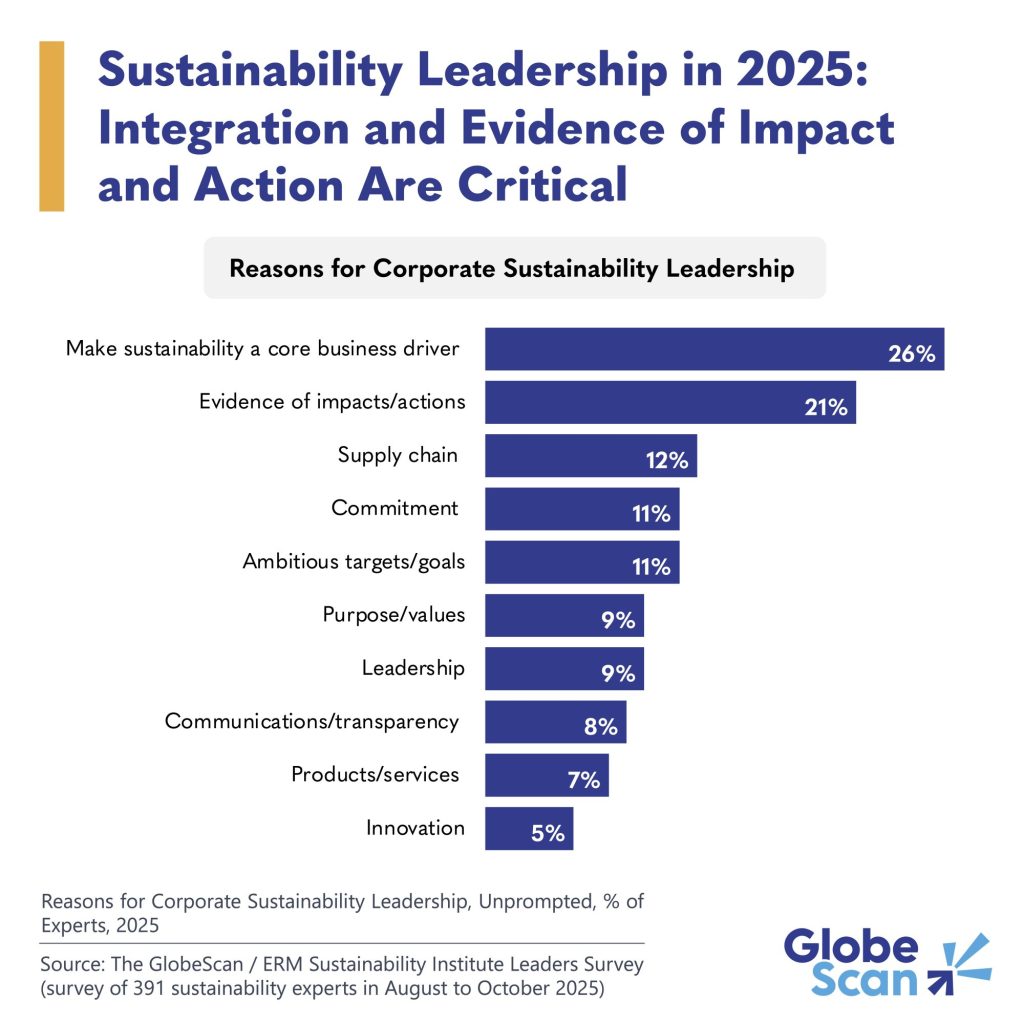
To understand what drives stellar sustainability, Trellis data partner GlobeScan, along ERM, asked sustainability experts to name a company they consider a leader and to explain why. The most influential factor, cited by 26 percent of experts, was making sustainability a core business driver. Close behind, 21 percent emphasized demonstrating evidence of impacts and actions.

Other key elements include:

  • Driving sustainability across the supply chain (12 percent)
  • Showing unwavering commitment (11 percent)
  • Setting ambitious targets (11 percent)
  • Aligning purpose and values (9 percent)

What this means

These results show that companies are expected to double down on integration and evidence, not just as best practices, but as levers to activate and demonstrate the business value of sustainability. In today’s era of backlash, greenhushing and regulatory uncertainty, making sustainability a core business driver signals resilience and relevance, while also providing measurable impacts and actions builds trust and counters skepticism.

The post 2 top drivers of corporate sustainability, according to leaders appeared first on Trellis.

The opinions expressed here by Trellis expert contributors are their own, not those of Trellis.​

With financial accountability for net-zero targets in the spotlight, the time has come for carbon pricing to reach its full catalytic potential. Done well, carbon pricing has the potential to rewrite incentives and motivate governments, corporations and individuals to be more responsible for their greenhouse gas (GHG) emissions.

The elegance of carbon pricing is that it provides a common denominator for GHG liabilities and investments. Carbon pricing enjoys broad, active promotion from decarbonization advocates across the political spectrum — more than some climate policies such as clean-energy or electric vehicle tax credits — and widespread use in the oil and gas sector. With fairly steady support over the years, carbon pricing has grown steadily since 2005, according to the World Bank’s annual roundup. Almost one-third of all global emissions are covered by a carbon price.

Moreover, the Science Based Targets initiative (SBTi) recently released its next discussion draft for the Corporate Net Zero Standard that included its first carbon pricing mechanism. Optional until 2035 and mandatory thereafter, the carbon price would mobilize more climate finance to address “ongoing” carbon emissions. 

Carbon pricing has had durable appeal, but could create a bigger impact in the years ahead. Here are three ways to unlock that potential and mobilize significant climate transition funding.

Tackle the terminology

Most of the World Bank’s report focuses on government policies for carbon pricing. In contrast, a report from the University of Oxford proposes that companies can use internal carbon pricing as a tool “for managing climate risk, incentivizing low-carbon investment, and preparing for emerging regulatory requirements.”

The difference and overlap between these two spheres are complex. One key to scaling outcomes from carbon pricing will be to resolve persistent confusion in the terminology, to disentangle the policy tools from voluntary measures and distinguish strong initiatives from weaker ones.

In practice, the term “carbon pricing” is used as a catch-all, because all carbon pricing initiatives share the goal of internalizing the external costs of GHG emissions. But a regional emissions trading scheme is vastly different from a corporate carbon price. In the simplest applications, carbon pricing is a symbolic and optional guidepost for budgeting decisions. In the strongest cases, it generates measurable financial flows from GHG emitters into decarbonization projects.

Words do matter and carbon pricing needs labels that distinguish one structure from the others. In the case of corporate carbon pricing, the persistent ambiguity lets companies blur the line between promises and progress. It risks letting businesses sound ambitious — claiming they are climate champions because they use carbon pricing — even if they have yet to invest a single dollar in solutions.

Apply it in value chains

Internal carbon pricing makes companies four times more likely to have climate transition plans in place, according to research from non-profit organization CDP. Big name brands and major buyers can use carbon pricing to underpin transition plans for their direct emissions as well as for their value chain climate initiatives, which are key to cracking the Scope 3 puzzle. 

Carbon pricing can create better understanding and alignment of goals up and down the value chain. Large buyers, for example, can establish a pathway for suppliers to slowly phase in carbon pricing, and offer pooled resources and practical implementation guidance. Retailers can use carbon pricing to create both carrots and sticks to accelerate investment in climate projects well up the value chain.

It’s important to make sure that value chain carbon pricing initiatives don’t simply tax and weaken supplier partners. To do this, buyers can use internal carbon pricing as a means to generate funding that, through procurement decisions and direct investment, flows into value chain partners’ decarbonization projects. Many exciting examples of net zero partnership between buyers and suppliers leave suppliers financially stronger and better positioned to serve all of their customers with low-carbon alternatives. 

Solve the interoperability puzzle

To scale up the adoption and success of both policy and corporate carbon pricing schemes, it will be necessary to get clearer on how they overlap. Frameworks such as the GHG Protocol, SBTi, the EU’s Carbon Border Adjustment Mechanism trade policy, the Corporate Sustainability Reporting Directive disclosure law and others will need a common yardstick to measure and value companies’ commitments to internal carbon pricing.

As University of Oxford professor Robert Eccles argued recently in Forbes, the next evolution of carbon pricing depends on prioritizing consistency and collaboration over competition. This applies equally to both policy carbon pricing and corporate carbon pricing schemes. “[The tool] can only function if built on reliable, comprehensive carbon accounting that assigns accountability appropriately while enabling market mechanisms to operate efficiently.”

Companies and governments have long used carbon pricing to create incentives for credible climate action, albeit inconsistently. Today’s renewed attention to net zero accountability offers an opportunity to make good on the full potential of carbon pricing. 

We should expect financial commitments to take center stage in corporate climate initiatives in coming years. To raise the accountability bar, advocates can coalesce around an expectation that companies disclose not just future net-zero intentions, but present day financial follow through.

That will require clearer alignment around the technical uncertainties of carbon pricing. Initiatives to sort out the terminology around carbon pricing, syndicate it across value chains and improve interoperability across corporate and policy schemes will help mobilize hundreds of billions of dollars in additional climate funding. With the right level of attention, carbon pricing may just be the highly practical—not flashy—tool needed to accelerate climate finance in the crucial years ahead.

The post 3 ways to unlock the full potential of carbon pricing  appeared first on Trellis.

A review of recent sustainability reports suggests that real estate owners have entered a more mature phase of decarbonization. Large REITs and institutional landlords are beginning to move beyond portfolio-wide climate targets toward asset-level decarbonization planning, compliance modeling and capital planning.

“Many REITs and large owners have already set high-level goals,” wrote David Maguire, global head of product for sustainability solutions at the commercial real estate services and investments firm CBRE, in an email. “Now they’re moving into implementation, integrating decarbonization targets with capex planning at the asset level.”

New use cases

Investor expectations, occupier goals, disclosure requirements and green financing frameworks are helping push planning down to individual buildings, as metering technologies and building management software (BMS) grow more sophisticated. And owners are finding new ways to manage and analyze these larger and higher-quality data streams to drive action at the building level.

“The business case for each intervention is tied not just to risk management and protecting asset worth, but also to increasing net operating income and exit value,” Maguire said.

GRESB — the sustainability consultancy with a foundation that sets standards for evaluating and benchmarking real-asset performance and a corporation that administers the assessments — has also observed movement toward granularity. 

“Previously, managers drew their targets at the portfolio level and worked on implementing them asset by asset,” said Victor Fonseca, senior associate for real estate at GRESB. “Now we’re seeing demand from investors for this to be done bottom-up.”

The decarbonization plan for each asset should include an emissions-reduction strategy, time-bound milestones and financial grounding, he added. 

In 2020, with investors calling for more granularity, GRESB began collecting data at the asset level, rather than just the portfolio level. And in 2024 it began scoring asset-level data.

Investor demand, then regulation

Although regulation reinforces the push for asset-level data, the demand for deeper detail often starts elsewhere.

“Regulation is typically one step behind industry leaders,” said Fonseca. “Institutional investors drive regulation, and regulation drives the masses.” 

Those industry leaders include REITs looking to differentiate and attract investment — especially from sophisticated global investors with capital tied to long time horizons, who are attentive to long-term carbon risks and the physical threats of climate change.

Hundreds of individual asset plans

Ventas, an S&P 500 REIT with a diversified healthcare portfolio, has drafted individual asset-level decarbonization plans for the more than 900 properties within its operational control, outlining actions across energy efficiency, renewable energy and electrification and refrigerant management. 

Likewise, logistics real estate giant Prologis is developing asset-level decarbonization plans for each property in its operating portfolio. Its net-zero roadmaps coordinate capital upgrades with regulatory timelines, customer needs and projected utility decarbonization.

Vornado Realty Trust, an owner and manager of office and retail properties, finished designing a building decarbonization tool in 2024 for modeling capital energy efficiency projects.  

The company said it has institutionalized annual asset-level sustainability meetings, and its sustainability team is collaborating with each building’s engineering and facilities teams on energy-use reduction.

Asset-level decarbonization remains out of reach for some owners, said Maguire. While some have robust data management systems, many do not — and gaps are common. A portfolio may have superb mechanical asset condition records but little reliable tenant utility data, undermining asset-level modeling aspirations. 

Still, though not every owner is ready for building-by-building planning, the pull toward more fine-grained decarbonization planning and action is evident — and growing.

The post Real estate decarbonization is moving to the building level appeared first on Trellis.

This may have been the year when a somewhat wonky component of sustainability strategy — the environmental attribute certificate (EAC) — went mainstream. The past 12 months have seen certificates for low-emission products minted in multiple sectors, including cement, iron and carbon capture. In parallel, standard setters are close to giving companies greater leeway to use certificates in carbon accounting and target setting. 

“It definitely feels like this year something really clicked across the board — with buyers and suppliers, but also the standard setters seem to be getting it, the environmental NGOs, even governments,” said Kim Carnahan, CEO of the nonprofit Center for Green Market Activation (GMA).

The approach is designed to unlock investment in climate solutions by separating the environmental benefit of a product from the product itself. Take sustainable aviation fuel, an area where EACs are well established. There are companies that are willing to pay a premium to have employees travel on flights that burn fuel derived from used cooking oil and other sustainable sources, but it’s impractical for an airline to respond to that demand by changing the fuel mix on specific flights. 

EACs solve the impasse by allowing airlines to deploy sustainable fuel wherever available and to sell certificates for the associated emissions savings. Companies that purchase the certificates deduct the savings from their greenhouse gas inventories, and retire the certificates so that they cannot be used again. The Sustainable Aviation Buyers Alliance, a project co-managed by GMA, Environmental Defense Fund and RMI that counts Amazon and Visa as members, has used the approach to aggregate $550 million in demand for sustainable aviation fuel certificates since 2021.

Tech giants lead the way 

The approach is now proliferating, with the tech giants — which are trying to balance ambitious emissions goals with data center build out — leading the way. “A major driver behind EACs today is thinking about how we decarbonize data centers,” said Katherine Vaz Gomes, a decarbonization engineer at Carbon Direct, a consultancy. “There was a demand beforehand, but the hyperscalers have really accelerated the need to bring this to market.”

This May, for instance, Microsoft used guidelines Gomes helped write when it purchased EACs covering more than 620,000 tons of emission reductions from Sublime, a startup that has developed low-carbon cement. Microsoft will use Sublime’s product in its construction projects when possible, but most cement is used within a few hundred miles of where it is produced, and Sublime is still building its first commercial facility. Purchasing the certificates allows Microsoft to support the startup — and claim the associated emissions savings — even when it cannot use Sublime’s product.

Other data center projects will also involve EACs. In October, Meta said it would use ones purchased from Electra, a startup that is building a facility to produce low-carbon iron, to cover emissions associated with its infrastructure projects. The same month, Google announced plans to use EACs in a deal to fund technology to capture 90 percent of emissions from a new natural gas plant in Illinois. The electricity from the plant will be added to the grid that serves Google data centers in Illinois and Arkansas.

Renewable energy certificates (RECs), another established form of EAC, have long been used to help pay for clean energy projects. But a new EAC was required in this case: Unlike solar and wind, which produce zero emissions after construction, the certificate needed to account for the fact that not all the emissions will be captured, said Iain Kaplan, a partner at NorthBridge Group, the consultancy that developed the methodology for the certificate.

Broader coalitions

Carnahan and colleagues are working to ensure these individual projects are followed by broader industry-wide efforts. In September, GMA teamed up with fellow nonprofit RMI to launch the Sustainable Concrete Buyers Alliance; founding members include Amazon, Prologis and Meta. The following month, Nevoya, an electric freight company, was announced as the winner of a request for proposals designed to kickstart work on EACs for road transport. The center is also consulting on plans to create a buyers alliance for low-carbon chemicals.

This momentum will likely be accelerated if, as looks likely, two influential standard setters incorporate use of EACs into their guidelines. The Science Based Targets initiative is revising its net-zero framework and the latest draft allows companies to use EACs to hit targets — albeit only for specific types of Scope 3 emissions, a restriction that Carnahan would like to see loosened. Over at the Greenhouse Gas Protocol, a nonprofit that creates carbon accounting guidelines, a working group focused on market instruments is due to publish a white paper later this month that is expected to recommend integrating EACs into future rules.

In addition to the flurry of new activity, 2025 also saw a subtler shift around EACs. The term is broadly used and encompasses two market instruments that are often criticized: RECs, which are faulted for doing little to add new renewables to the grid, and voluntary carbon credits, which, in the worst cases, have been issued to projects with no climate benefit. Other EAC projects have on occasion suffered from guilt by association, but the most recent crop has largely been evaluated on their own merits.

This and other factors point to an increasingly important role for EACs in climate strategies. “We’ll see broader adoption beyond tech and data centers, with chemicals, steel and cement increasingly using EACs to support decarbonization,” said Greg Matlock at EY Americas, who tracks use of EACs in heavy industry. “In many instances, EACs will move from being an add-on to being a core part of how projects are structured.”

The post A wonky accounting device is becoming an essential part of climate strategies appeared first on Trellis.

Officially, Patagonia doesn’t have a chief sustainability officer. Reducing the environmental impact of the apparel company’s products is everyone’s job. 

But materials scientist Matt Dwyer became the company’s effective sustainability champion five years ago after realizing that his team’s job — picking the raw materials for Patagonia’s garments and gear — contributed 85 percent of the company’s greenhouse gas emissions. 

“For me as an engineer, as somebody who’s data-oriented, that’s when it became personal,” he told me in the latest episode of Climate Pioneers, our interview series with innovators and leaders shaping the corporate climate movement.

Now, as Patagonia’s vice president of global product footprint, Dwyer uses his engineering and innovation background to source lower-carbon alternatives across the company’s product portfolio. 

“One of the things you realize, whether it’s in this work or innovation, is that which lives everywhere actually kind of lives nowhere, and you need a group of focused, talented and capable folks to really push the hard work forward,” he told me.

That team spearheaded the publication of Patagonia’s first comprehensive environmental report in mid-November, which details the company’s struggle to deliver on its commitment to reach net zero by 2040. 

Patagonia prepared the analysis, in part, to prepare for potential mandatory reporting requirements. It’s also an educational tool for employees: “I was like, man, if I’m in my position reading through this and learning something new, then hopefully other people in our organization will pick it up and learn something about the company they work for, too.”

Meet Dwyer’s boss

Because materials represent Patagonia’s biggest chance to move the needle on emissions reductions, Dwyer’s team reports into the product development function, led by President Jenna Johnson, who got her start there in product line management.

“By sitting adjacent to or embedded within the product team, you have a far greater chance of selling the idea, getting designers to pick it up,” he said. “I think I’ve experienced in the past, just by virtue of other people’s experience, that when a sustainability team is buried in legal or HR or somewhere deep down in the supply chain, they’re often frustrated.”

Patagonia founder Yvon Chouinard, now 87, remains closely engaged, frequently dropping newspaper clippings on Dwyer’s desk to share ideas: “He always comes back to making sure we’re being really critical of ourselves and our own product, always making it better, always looking out into the world and saying, ‘Who’s doing it best today, and what can we learn from them?’ ”

Beyond its obsession with materials, Dwyer’s team — including environmental scientists, human rights experts and materials science chemists — works with every function to advance other strategies, such as Patagonia’s work on new financing models for funding electrification and other decarbonization initiatives within Patagonia’s supply chain. 

“We’re one unit, but we have our feet in four different buckets at any one time, and that could be business, that could be supply chain, that could be impact work or it could be products,” he said.

AI … not yet

Patagonia’s biggest challenge when pulling together its 130-page report was wrangling data from across the company’s information systems, which was a highly manual process. “I’m always a fan of doing it the hard way, just once, but building it to automate every time after that,” Dwyer said.

Patagonia used artificial intelligence to translate the publication into different languages for employees around the globe, but it hasn’t deeply committed to AI for its work. That innovation is more likely to come from service providers and partners in the form of better traceability and forecasting.    

Be an optimist

In a moment when many sustainability professionals are struggling to keep their work front-of-mind with colleagues and customers, Dwyer looks for the bright spots. His advice: Prioritize the work, even if your company is reluctant to brag about it publicly. 

“It’s always fine to be skeptical, it’s never fine to be cynical,” he said.

The post Why Patagonia picked a materials scientist to lead sustainability appeared first on Trellis.

The lifespan of a stroller is as fleeting as a childhood. Even if used by more than one family, strollers ultimately land in a dump. Recycling infrastructure doesn’t exist.

Bugaboo is an outlier in the industry for emphasizing durability, sustainable materials and circular business models. Such efforts support its net zero goal for 2035, which requires addressing the 91 percent of emissions that stem from materials.

“I’m still surprised about this, but sustainability is not top of mind for consumers when they’re buying a pram or stroller,” said Melanie Wijnands, head of ESG at Bugaboo, based in Amsterdam. “It’s not a message that we, as an industry, are pushing. I hope by talking about it more as a brand, we’re putting it a little bit more top of mind with consumers.”

Only 30 percent of stroller sales were “eco-friendly” models last year, according to one count.

Slimming the product footprint

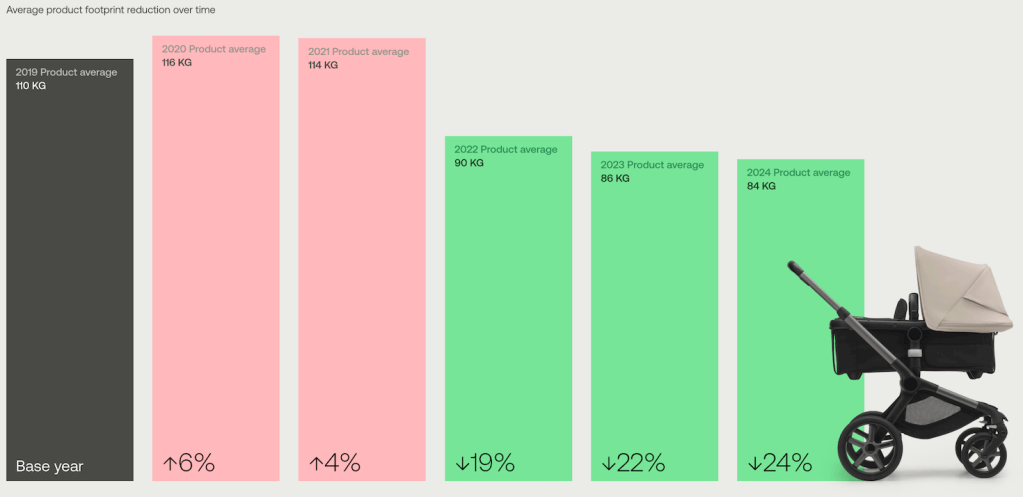
The brand has gradually been slimming down the average carbon footprint of its products since 2019. It’s working toward a 47 percent reduction by 2026.
Bugaboo has been lowering the average carbon footprint of its products since 2019, aiming for a 47 percent reduction by 2026. Credit: Bugaboo 2024 impact report

Much work remains for the industry to zap waste and shrink its climate footprint. About 19 million strollers were sold globally from 2020 to 2023, according to 360 Research Reports, in a $10.5 billion market set to reach $16.6 billion in 2034. That’s a lot of virgin plastic, aluminum and polyester for landfills.

A handful of companies have 40 percent of stroller market share, including Good Baby International Holdings, Chicco and Graco. With roughly 1,000 employees, Bugaboo is among the smaller, premium players.

Circular models and durability

Bugaboo has measured early success in circularity. Its revenues from refurbished and leased products doubled from 2019 to 2024, while the average carbon dioxide footprint of its goods fell by 24 percent. Even as the certified B Corporation made 93 percent more products, its emissions rose by a comparatively low 38 percent.

Even as Bugaboo’s circular sales doubled, they only made up 1.4 percent of revenues in 2024.

Still, that’s something in a space that has left repair and recycling to informal networks of families, friends and charities. Parents also turn to independent stores or Facebook Marketplace. eBay lists 3,100 strollers at the moment. Newer secondhand marketplaces such as Rebel and GoodBuy Gear are growing.

Through a third party, Bugaboo refurbishes, cleans and re-lists 98 percent of products returned under warranty by European customers. Partners TinyMe in the Netherlands and StrollMe in Germany and Nordic countries manage stroller leases.

Bugaboo plans for its products to last the equivalent of 3.5 trips around the planet. That’s between four to 13 years of life for its $1,200 Fox 5 stroller.

Durable, modular and glue-free goods remain Bugaboo’s design focus for circularity. A bassinet basin doubles as a car seat. The $1,449 Kangaroo stroller can expand to fit a sibling. Parts such as brakes are available for older, popular models needing repair.

Bugaboo recently found that 25-year-old models were still being resold. “Our head of design, who’s been with us for 25 years, was geeking out,” Wijnands said.

‘Carbon anatomy’ of two strollers

Textiles, aluminum and plastic account for the greatest share of the CO2 footprint of Bugaboo strollers.
Textiles, aluminum and plastic account for the greatest share of the CO2 footprint of Bugaboo strollers. Credit: Bugaboo 2024 impact report

Materials

Adopting alternatives to carbon-intensive textiles, aluminum and plastics is core to Bugaboo’s near-term target, aproved by the Science-Based Targets initiative. The company plans to slash the average CO2 equivalent footprint of its products by 47 percent by 2026. (It has already met its Scope 1 and 2 goals.)

“To be completely honest, we’re not entirely sure how we can get there,” Wijnands said, noting that biobased plastic and recycled industrial aluminum have already helped. After introducing fabrics recycled from polyethylene terephthalate (PET) bottles last year, the company is looking into textile-to-textile recycled polyester.

Among other material concerns, chemicals safety resonates with Bugaboo customers. “Children sometimes lick the side of their stroller or get anything and everything into their mouth,” Wijnands said.

Bugaboo doesn’t use forever chemicals such as per- and polyfluoroalkyl substances (PFAS) or anti-bacterial coatings, a newer target of watchdog groups. Many of its textiles are OEKO-TEX certified.

Supply chain

Bugaboo has a unique level of control in owning its production facility in Xiamen, China, which is 25 percent powered by renewables. “We work really closely with our first-tier suppliers,” 80 percent of which are gradually getting rid of fossil fuels, she added.

Wijnands joined Bugaboo from consultancy Circle Economy, which publishes a semi-annual global circularity score. The only full-time sustainability staffer, she reports to CEO Adriaan Thierry. Wijnands works closely with Bugaboo’s lead engineer on carbon accounting, head of design and the product team.

“We’ve been really focusing on getting the carbon of our products down, but more and more, we’re also realizing that circularity is a promising route,” Wijnands said.

The post How Bugaboo is pushing low-emissions strollers forward appeared first on Trellis.