The opinions expressed here by Trellis expert contributors are their own, not those of Trellis.​

When a recent study asked, “Are carbon markets fixable?” it did more than assess the performance of carbon markets. It reflected a deeper debate about how the world should decarbonize versus how it actually does.

While there’s certainly an important discussion to be had around the integrity of decarbonization solutions, it’s equally important to understand that what’s really playing out here is often a question of ideology: Should climate action be pure or should it be pragmatic? Meaning, should we wait for perfect systems before acting or make the best use of imperfect ones to drive impact now?

The “purist” theory of change rests on the premise that all government and corporate emission targets will be fully achieved, making offsets an act of displacement rather than contribution. Therefore, if we simply take credits off the table, these actors will take more aggressive, and costly, action to cut their emissions — in many cases voluntarily. 

The premise might rest on solid moral ground, but it’s a comforting fiction. That’s because such a notion implies that credits necessarily displace action that would otherwise happen. In other words, critics of markets often assume that every tonne promised in a net‑zero plan will be achieved internally, but in a world where targets are often aspirational, under-financed or politically constrained, that logic collapses.

A false premise

The fact is that despite three decades of pledges — and some notable areas of progress — global emissions continue to rise. Many companies set ambitious goals only to postpone or quietly abandon them once the real costs become clear. And more still don’t even do that. 

There is nothing to suggest that carbon credits are to blame for this. In fact, evidence suggests that high‑quality credits don’t displace inevitable abatement — they finance additional action that wouldn’t otherwise occur, particularly in regions that receive little climate investment. Research from Forest Trends shows that companies using carbon credits are also decarbonizing internally at nearly twice the rate of those that don’t, underscoring that credits can complement, rather than replace, internal action. 

The real flaw isn’t in the arithmetic, but in the assumption that ambition equals delivery. Recognizing that gap helps explain why carbon credits exist: not to replace internal reductions, but to fill the space between aspiration and reality with verifiable impact.

Economic and climate mitigation models — the kinds used to simulate net-zero pathways and estimate marginal abatement costs — often assume perfect compliance and unlimited investment. These models can underestimate real-world limitations of political will, financing capacity and the pace at which new technologies can scale.

In reality, decarbonization costs vary dramatically. In developed economies, cutting emissions in major industrial sectors can cost up to $500 per tonne of CO₂ and higher. By comparison, high‑integrity nature‑based credits typically cost $25 to $50 per tonne. Even if these credits deliver only half their claimed reductions, the effective cost would still be $50 to $100 per tonne — a fraction of the cost of deep industrial abatement.

The resources available for decarbonization are finite and in many regions, contracting. Of course, buying credits can’t and shouldn’t replace industrial decarbonization. These mechanisms are designed to complement, not substitute for, deep emissions cuts in core operations. The right question isn’t whether one approach is morally superior, but which delivers the greatest total climate impact per dollar spent. 

In that context, high‑quality credits can direct scarce funds toward the most cost‑effective climate impact while providing benefits that internal abatement cannot — biodiversity conservation, watershed protection, and support for Indigenous and local communities who steward vast carbon‑rich ecosystems. At the end of the day, we need to deploy the full suite of solutions available to us. 

Ideology vs. implementation

Much of the decarbonization debate comes down to ideology. Purists believe that rejecting markets will force faster, deeper internal cuts. Pragmatists argue that we need every credible lever available to reduce emissions today while continuing to reform the system.

The purist defines integrity as abstinence — focus only on the most ambitious levels of action and dismiss other solutions as a distraction or delay. The pragmatist defines integrity as continuous improvement — act now with credible tools, strengthen standards and build better mechanisms over time in an effort to deliver progress in a messy, incremental world.

That divide plays out daily in policy and boardroom decisions. Some governments and companies have paused credit purchases entirely, fearing criticism for imperfection. Others are engaging in reformed, transparent markets and reporting openly on how credits complement internal progress. The latter group is helping build the very integrity mechanisms that critics claim don’t exist. This shift raises a practical question for corporate leaders: how can they engage credibly and effectively in these evolving markets?

From integrity to impact

The real question isn’t whether markets are perfect; they’re far from it and face well-founded criticism when it comes to methodologies being too lenient and verification being inconsistent. What matters more is whether abandoning them accelerates or delays global progress. But serious reform is underway and every tonne avoided or removed counts. The atmosphere doesn’t care where the reduction occurs, only that it happens. 

A credible portfolio approach combines internal decarbonization with high‑quality, independently verified credits that channel finance to where it’s needed most. Companies navigating between “purist” and “pragmatist” approaches can bridge the gap by focusing on credibility, transparency and alignment:

  • Integrate credit purchases into transparent, science‑based strategies that disclose both internal and external mitigation.
  • Support jurisdictional or program‑level initiatives that align with national climate goals.
  • Co‑invest in systems that improve market integrity — from monitoring infrastructure to community readiness.
  • Understand the landscape of today’s voluntary carbon market: smaller, more conservative and more transparent, with the Integrity Council for the Voluntary Carbon Market and other reforms setting higher standards and fewer loopholes.
  • Communicate clearly by explaining how credits complement, not replace, internal decarbonization and share methodologies, volumes and impacts openly.

Reform, not rejection

True integrity lies not in purity, but in progress — in building systems that get stronger with use. The climate challenge demands such pragmatism. The responsible path forward is to keep improving standards, transparency and fairness while scaling credible finance for climate and nature. It’s about leveraging every tool in our toolkit. 

Markets aren’t a silver bullet. But without them, we risk cutting off one of the few scalable mechanisms that can mobilize private finance at the speed and volume the science demands. The fact that we haven’t done it yet does not mean that we can’t. In fact, it’s one of the most viable paths forward if we can end this circle firing squad among dedicated climate champions.

Reform is already happening. The choice now is whether we continue that progress or stall it by turning our back on a real solution in favor of a laudable but ultimately unattainable one. 

The post Decarbonization demands pragmatism, not purity appeared first on Trellis.

Heineken plans to install a 100-megawatt heat battery at a brewery in Portugal under a service contract with vendor Rondo Energy and energy company EDP. The technology will significantly reduce or eliminate the European brewer’s need for boilers that run on fossil fuels such as coal or natural gas.

“This project not only helps us reduce our reliance on conventional energy, it shows how practical innovation and strong partnerships can deliver meaningful improvements across our supply chain,” said Magne Setnes, chief supply officer at Heineken, in a statement. 

Industrial emissions related to food production, manufacturing and other heat-intensive processes account for close to one-quarter of U.S. greenhouse gas emissions; if you include emissions related to making steel and cement, the number rises close to 40 percent.

Adoption of options for addressing that footprint has been slow, but thermal batteries are making in-roads alongside other options such as industrial heat pumps and renewable natural gas sourced from biomethane. 

Technology manufacturer Siemens, for example, discovered that installing electrified paint drying and curing ovens at its factories in Texas could reduce almost 80 percent of the emissions related to that process, said Stacy Mahler, vice president of vertical markets at Siemens, during a session at Trellis Impact 25.

“We had to go and look at paint chemistries that would work with the new electric ovens, which were lower temperature,” she said. “So there was a lot of work that went into it. The good news is once you do that work, once the learnings can scale, you can share that with suppliers.” 

PepsiCo’s biomethane investment

Projects for reducing factory emissions have been slow to take shape in part because an approach that works in one location isn’t appropriate everywhere, said another Trellis Impact 25 panelist, Nora Singh, senior director of global sustainability at PepsiCo.

“Some of them are very expensive and the solutions are also not one size fits all, and they’re very local, depending on where in the world you’re looking at,” Singh said.

One way that PepsiCo is reducing emissions is by turning organic waste at its food processing facilities into biomethane gas.

Its facility in Manisa, Turkey, for example, uses cogeneration equipment to convert potatoes, other starches and oils into enough biogas to meet 35 percent of the electricity needs, avoiding 1,370 tons of carbon dioxide in 2024. The rest of the electricity needed for the operation is sourced from solar panel and renewable energy companies. “Obviously it doesn’t work everywhere,” Singh said. 

Nike: Borrow from other industries

The transition related to footwear and apparel maker Nike’s industrial emissions is happening in multiple phases. 

Some factories in its supply chain are moving away from coal but choosing short-term alternatives such as biomass, said Nike’s Courtenay McHugh, director of climate and environment, during the panel discussion.

That creates new obstacles, including the need to ensure that the biomass is sourced from waste and not from deforestation. 

“You have to have really good certification processes for that,” said McHugh. “Biomass is, for us, considered to be a transition option, but it’s not the last stop on the road.” 

Nike uses the levelized cost of heating — the average cost to produce a unit of heat over the lifetime of a piece of equipment — to evaluate alternatives for parts of its manufacturing process that are difficult to electrify, such as fabric dying.

One of the best options it has found are steam heat pumps, used widely by the pulp and paper industry in the drying process. The downside is that this technology hasn’t been used for textile applications and carries a high upfront cost. Nike is collaborating with the Apparel Impact Institute to perform feasibility studies — largely in China, India and Vietnam, where renewable electricity is available — that are also supported by other brands.

“We’re prepared that it’s not necessarily the way that we need to go in all cases,” said McHugh, “but we might get some really great learnings about where it is most optimal, so that we can share that information with our suppliers, give them a little bit more confidence in this technology as a path forward.”

Heineken’s battery project

Those studies will also evaluate what sorts of financing models might be effective at accelerating adoption, including leases rather than outright purchases.

Heineken is exercising that option: Its battery is being procured under a service agreement, so it won’t represent a capital expenditure for the company. It will charge using an on-site solar installation and provide up to 7 megawatts of steam for its brewing processes without requiring a massive equipment retrofit. 

Heineken’s installation, the largest of its kind in the beverage industry, will begin operation in April 2027. 

Rondo is a well-funded supplier, with backers including apparel company H&M. Its technology stores heat in refractory bricks then releases it at temperatures of up to 100 bar, or about 340 degrees Fahrenheit, to power industrial processes. The startup signed another deal Nov. 13 that will support a cement factory in Thailand.

The post 3 ways PepsiCo, Nike and Heineken reduce industrial emissions appeared first on Trellis.

COP30 spotlights the critical role of tropical forests and the Amazon’s unique biodiversity in global climate regulation. And as the first COP held in the Amazon region, research from Trellis data partner GlobeScan highlights a clear global appetite for climate leadership.

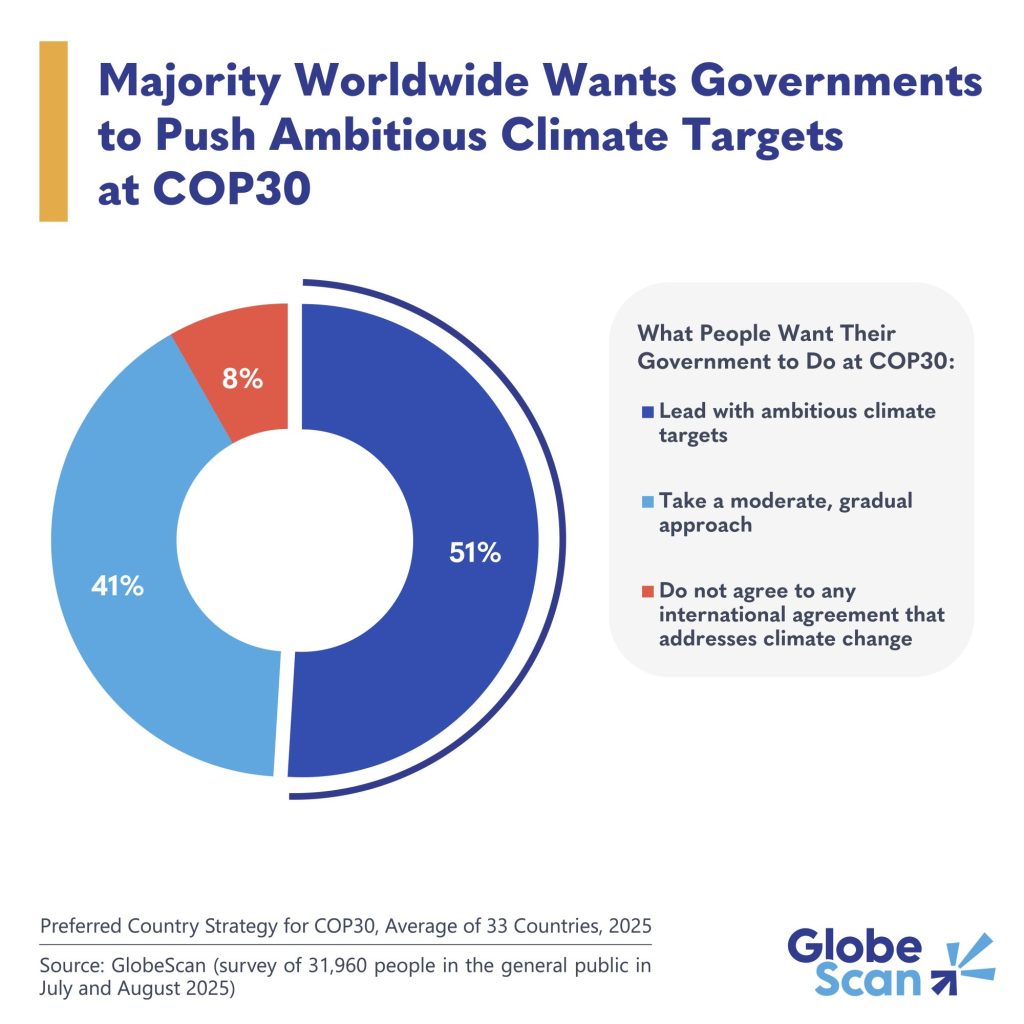
Just over half (51 percent) of more than 30,000 people surveyed want their governments to set ambitious targets, while four in 10 (41 percent) prefer a more moderate approach. Only 8 percent oppose their country agreeing to any international agreements on climate change at COP30.

Latin American markets are among those with the highest support, while more moderate or skeptical views are found in parts of Europe and East Asia. Nearly two-thirds of Brazilians (63 percent) want their country to lead on ambitious climate targets at COP30. These trends across key countries suggest growing public demand for more ambition from their governments on the global climate agenda.

What this means

GlobeScan’s findings reveal a powerful global expectation that people want their governments to lead on climate action. Falling short of these expectations, even with incremental outcomes, wouldn’t only slow this momentum at a critical point, but would also directly contradict public expectations. For a deeper understanding and actionable next steps, leaders can:

  • Respond to pubic expectations for bold action from governments, companies and international bodies
  • Invest in high-impact, large-scale initiatives including regulation, nature protection and agricultural reform
  • Signal ambition at COP30 and other international forums to advocate for national commitments.

Based on a survey of 31,960 people in 33 countries conducted July-August 2025.

The post COP30: Global majority calls for government to push bold climate action appeared first on Trellis.

As COP30 continues in Belém, Brazil, fashion’s climate-friendly rhetoric is bumping up against the reality of rising emissions in the industry. On one side, a United Nations effort reflecting a who’s who of fashion shared an open letter asking world leaders to speed up a clean and just energy transition.

Meanwhile, though, fashion supply chain emissions rose 7.5 percent in 2023, according to the Apparel Impact Institute, and only 7 percent of major brands disclose their renewable energy efforts, according to the latest What Fuels Fashion report. Consulting firm McKinsey has calculated that if nothing changes fashion’s greenhouse gas emissions could increase from roughly 2 billion metric tons in 2018 to 2.7 billion by 2030.

What the U.N. charter wants

The U.N.’s Fashion Industry Charter for Climate Action presented a public communiqué, titled Fashion for Climate, on Nov. 4, to reaffirm the urgency of the Paris Agreement. As the document’s 70 signatories — among them Adidas, Kering, Levi’s, Nike, PVH Corp. and Zalando —pledged to eliminate coal across their operations and Tier 1 and 2 suppliers by 2030, they also called for national policymakers to do their part.

Their ask:

Phase out fossil fuels, by using Energy Attribute Certificate (EAC) frameworks and embedding energy storage and clean grid targets into their Nationally Determined Contributions for COP30. A model to strive for: Vietnam’s recent direct power purchase agreement (DPPA), backed by 29 brands including PVH, Nike and H&M.

Boost transparency, with mandatory climate reporting, including for Scope 3, that aligns with established standards.

Increase climate financing to fund more climate-transition projects for apparel operations in developing and vulnerable nations. Green or sustainability-linked bonds, carbon market insetting and a global price on carbon was suggested as a complement to alongside public-private partnerships.

Further climate adaptation and resilience, by funding research and risk assessments that consider all stakeholders, including workers, particularly in areas like Southeast Asia where extreme weather events have already interrupted supply chains.

What the watchdogs want

The problem, according to a letter sent by industry watchdogs on Nov. 13, is that none of the above requests reflect the fashion industry’s own actions. “Clearly, brands are way off track: to stay within a 1.5 degrees Celsius trajectory, they must reduce emissions at least 45 percent by 2030,” noted the letter writers — Action Speaks Louder, Stand.earth and Fashion Revolution — in a press statement.

So, just as the Charter had demands for global leaders, activists had a set for the signatories and the rest of the fashion industry:

  1. Talk to policymakers in every country that is home to suppliers, and share results of advocacy with fellow brands.
  2. Build on existing commitments, including low-carbon transition plans for workers and electrification and thermal technologies.
  3. Require multibillion dollar brands to fund “their fair share for climate action,” including for available tech like industrial heat pumps, rather than waiting for “perfect policy conditions.”

“The science is clear on what we need to do, and renewable energy has never been more accessible, but there is simply not enough urgency from corporate sustainability professionals to get that work done,” Ruth MacGilp, fashion campaign manager at Action Speaks Louder, told Trellis. “Most importantly, they need to engage with their suppliers — beyond just Tier 1 — to identify clear opportunities for climate mitigation and adaptation that are locally grounded, and rolled out in an equitable way that doesn’t leave workers behind.”

On Nov. 13, another fashion industry group, the Fashion Pact of CEOs, also shared steps to advance climate solutions among suppliers. Its European Accelerator effort starts in Italy, where, the group noted, more than half of suppliers to Prada and other luxury brands struggle to decarbonize.

The post Fashion is at the center of a climate reality check at COP30 appeared first on Trellis.

Nike just inked back-to-back deals for future supplies of circular polyester in its mainstream athletic wear. The Beaverton, Oregon, brand is betting that it can make good use of polyester recycled from castoff fabrics in more than pilot programs and one-off collections.

On Nov. 10, Nike shared plans to become the “anchor” customer for recycled-textile polyester resin from Loop Industries of Quebec. The next day, Swedish recycling startup Syre announced that it will become the “lead strategic supplier” of circular polyester for Nike.

The partnerships reflect a vote of confidence in emerging textile-to-textile recycling technologies, a crowded space that is seeing fierce competition and, recently, a steady series of brand contracts.

Nevertheless, the companies providing the material don’t yet have operational plants. In fact, the site for Syre’s factory in Vietnam has not yet been announced. Loop Industries’ facility in a petrochemicals investment region of India is scheduled to open in 2027.

“Our partnership with Syre represents a shift in our materials strategy and how we source,” said Sitora Muzafarova, vice president of materials supply chain, in a release. “Innovation is at the heart of Nike’s DNA, and textile-to-textile recycled polyester is essential in our ambition to design and produce breakthrough products that both perform to the highest standards that our athletes expect and are more sustainable at the same time.”

Materials and emissions goals

Nike has science-based targets for 2030 to slash Scopes 1 and 2 emissions by 65 percent and Scope 3 by 30 percent, all relative to a 2015 baseline. Lessening the impacts of polyester, Nike’s staple material, is important for reducing its carbon footprint, 34 percent of which came from raw materials in 2024. The company used 183,619 metric tons of polyester by volume last year, two thirds recycled.

The sneaker colossus reached 48 percent “environmentally preferred” materials last year, closing in on a goal of 50 percent for 2025. That would deliver half a million metric tons of Scope 3 emissions reductions. Recycled polyester is among those materials, as is cotton that’s organic, recycled or certified to third-party standards.

The latest deals mark a diversification of suppliers and a gradual shift away from beverage bottles as a polyester source. Nike has kept 3 billion plastic bottles out of the environment by purchasing bottle-to-textile-recycled Repreve material, according to producer UNIFI of North Carolina. 

Nike was an early adopter of recycled polyester when waste-bottle sources were in vogue. At the Sydney Olympics 25 years ago, it featured the Stand-Off singlet, a textured shirt of single-material recycled polyester. Ten years ago, Nike said it was the industry’s top user of recycled polyester, with non-virgin content in 39 percent of its garments.

The tech

Syre and Loop Industries each use chemical recycling to break apart long-chain polyester molecules, which are later rebuilt into pellets that are spun into polyester yarn.

Syre has taken the approach of planning a global network of recycling plants for resin or yarn, and de-risking by signing major offtake agreements with brands. In an analysis undertaken with McKinsey, Syre projected that it can provide 3 percent of the future market for recycled polyester.

The company formed in early 2024 in a joint partnership with H&M Group, which agreed to purchase $600 million of its recycled material over seven years. In June, Syre signed up Gap, Houdini and Target as “launch partners.” 

”This is not a one-off initiative or capsule collection; this is a moment when circular materials move from concept to commercial reality at scale and wider adoption,” Syre CEO Dennis Nobelius said of the Nike deal, expressing the desire for circularity to become “the new normal.” 

Loop Industries creates Twist resin that’s meant to drop into existing manufacturing processes. The company says its Infinite Loop technology turns mixed polyester waste into virgin-quality material. Nike would obtain materials from a facility Loop is planning with Ester Industries. The output would offer an 81 percent reduction in carbon dioxide emissions compared with virgin polyester.

Loop, which has been NASDAQ listed since 2015, also has agreements to provide recycled polyethylene terephthalate (PET) packaging resin for L’Oréal and Danone. Branching further into fashion, it has recently collaborated with yarn experts Hyosung TNC of South Korea and Shinkong Synthetic Fibers of Taiwan.

The next-gen material space is progressing in fits and starts, with polyester recyclers appearing to make more progress than those brokering in natural fibers.

For example, REI of Sumner, Washington, signed an offtake agreement on Oct. 28 to purchase Cycora, the textile-to-textile material created by Los Angeles startup Ambercycle. The Danville, Virginia, company Circ is unique for creating both synthetic and cellulose-based output from recycling mixed polyester-cotton waste. On Oct. 14, it announced a collaboration with H&M and fiber giant Lenzing Group.

The post Nike inks deals for circular polyester to use in its main collections appeared first on Trellis.

Yum! Brands’ lead sustainability executive, Jon Hixson, grew up on a Kansas farm and cultivated a career in agriculture before pivoting to 10 years on Capitol Hill then leaping to a private-sector role in public affairs at Cargill in 2005. There, he interacted with hundreds of small-holder farmers across Asia, working on sourcing policies for coconut oil and palm oil.

Hixson encourages early-career sustainability professionals to seek a similar diversity of perspectives with their career choices, especially roles in which they must manage a budget, even if that’s counter to their instincts. It’s important to “walk in the shoes” of those who will be impacted by your company’s emissions reductions and climate strategies because it encourages more practical approaches, he said. 

“It can be kind of a buzzkill, if you’re coming right out of college and want to storm the beachhead,” Hixson told me in the latest episode of Climate Pioneers. 

“I kind of always remind [mentees] that it’s helpful to try to work in a business unit, try to own a P&L, try to understand what the operational reality is like,” he said. “You will be better able to drive change when you do have that understanding and appreciation.”

Quarterly board meetings

Hixson offers an example from his own experience as chief sustainability officer and vice president of global government affairs for Yum!, a position he has held since May 2017, reporting to the company’s general counsel.  

When Hixson joined Yum!, he met with the board of directors on an annual basis for what amounted to a historical review. That changed three years ago, alongside the rise of environmental, social and governance regulations and related compliance concerns. Now, he’s asked to offer quarterly updates on the company’s science-based emissions reduction targets, validated in April 2021, along with evolving plans to address them.

“I think the board really wanted to know — what’s our ongoing strategy and where are the pain points?” Hixson said.

Harmonized strategy, brand-centric execution

Yum!’s corporate sustainability function is structured as a “center of excellence” that sets and stewards companywide goals, manages reporting and disclosure about progress, and finds ways to scale and share best practices from brand-centric initiatives.

Here’s a rundown of Yum!’s 2030 targets, and current progress as of 2024:

  • Reduce the footprint for its operations (Scope 1) and electricity consumption (Scope 2) by 46 percent by 2030. So far, it has managed a 25 percent cut, which put it on track.
  • Cut franchise energy emissions by 46 percent on a per-restaurant basis. Its current status is 30 percent, well on the way.
  • Slash per-metric ton emissions related to packaging and sourcing beef, poultry and dairy by 46 percent. It’s behind on this goal, with a 1 percent reduction as of the latest environmental report.

The baseline year for all of these commitments is 2019.

It’s the responsibility of brand leads — who report to division heads with a dotted line to the global sustainability officer — to translate those goals into ones that will be most impactful within their own business.

At Pizza Hut, for example, there’s a big focus on new approaches for sourcing cheese and other dairy products. KFC is leaning into investments like optimized exhaust hoods and other kitchen upgrades. Taco Bell is prioritizing beef, through regenerative agriculture initiatives.  

Brands are best able to translate the essence of the larger goals into operational elements that dovetail with their mission — and with consumer preferences, which are different for each fast casual restaurant chain, Hixson said: “I always say we’re trying to do things that work from Virginia to Vietnam.” 

The ‘invisible hand’ of sustainability

One less-public-facing function of Yum!’s global sustainability team is shepherding “invisible hand” programs, such as the company’s long-standing initiative to identify equipment and technology that reduces energy consumption at restaurants. 

The program started when more than 30 percent of Yum!’s locations were company owned. Now, 98 percent of its roughly 61,000 locations are franchised, but Yum! still selects what owners and managers are allowed to buy when it comes to food preparation, or heating and ventilation, which both reduces costs and energy-related emissions. These systems are mandated for new owners or for locations undergoing renovations, one way Yum! ensures that sustainability practices are embedded into operations.

“Sometimes there’s a silent hand of sustainability and a more visible hand of sustainability,” Hixson said. 

What makes the business case

When it comes to pitching the finance team on investments for sustainability initiatives, Hixson focuses on three things:

  • Prioritizing local strategies for sourcing chicken, beef and other proteins served at its restaurants. In 2024, for example, KFC convened an inaugural summit with poultry suppliers to discuss impacts related to soy, a common ingredient in chicken feed. Elsewhere, close to 90 percent of beef is sourced from regions with a lower risk of deforestation. 
  • Choosing initiatives that have longevity. “Most of the places where we do our engagements, especially with partners and suppliers, involve multi-year commitments that allow you to learn, innovate and build that value over time,” Hixson said.
  • Articulating how Yum!’s investments impact the unique environmental challenges specific to each market. The team asks: “What can we do to work within a jurisdiction, in a landscape, to drive broader change.”

Reflecting on his own experience, Hixson said one of the biggest mistakes a sustainability professional can make is failing to thoroughly socialize ideas with others — including co-workers, colleagues and consumers — before moving forward with a new metric or program. 

“I always say that I have kindergarten rules for corporate success,” he said. “Which is, work hard, think before you act and play well with others. Where I’ve seen people get into trouble is where you don’t do one of those elements.”

The post Career advice from the farmer’s son leading sustainability at KFC, Pizza Hut and Taco Bell appeared first on Trellis.

Patagonia needs to cut greenhouse gas emissions by an average of 10 percent each year to reach its commitment to be net zero by 2040. 

Like most other apparel makers, it’s struggling to deliver on that promise in a global economy complicated by trade wars and shifting ESG regulations. 

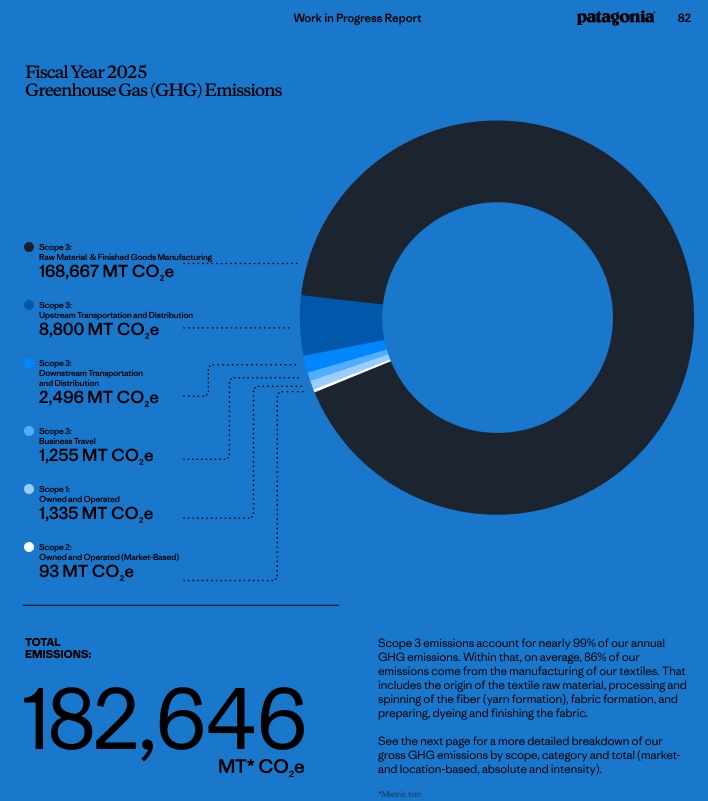
For its 2025 fiscal year ended April 30, the 52-year-old, storied outdoor gear and apparel maker’s footprint rose 1 percent to 182,159 metric tons of carbon dioxide equivalent. 

The big reason for the year-over-year rise: “more carbon-intensive” materials in new duffels and packs, which were a larger part of its product assortment, the company said in its first comprehensive environmental and social progress report published Nov. 12.

Raw materials and finished goods manufacturing accounted for 92 percent of Patagonia’s footprint in fiscal year 2025, according to the 130-page narrative, which pulls together disclosures that the Ventura, California, company makes on its website, through certification audits and to nonprofits. 

Patagonia, which had revenue of $1.5 billion in FY2025, compiled the information so employees, customers and suppliers could learn more about the evolving best practices that it uses to reduce emissions. Since its 2017 baseline year, Patagonia’s emissions are up about 19 percent. 

Unique perspective

As a private company, Patagonia isn’t required to report its climate progress, but the company’s leadership felt it important to counter the rise of greenhushing and to demonstrate that companies should still talk about their work. It hasn’t committed to a publishing cadence. 

“Patagonia is not perfect by any means,” Founder and ex-CEO Yvon Chouinard, now 87, said in a note leading the “Work in Progress” report. “We do not have all the answers, but the fear of getting things wrong in the process cannot stop us from trying to get things right in the end.”

The company’s near-term targets include reducing emissions from its direct operations and purchased electricity by 80 percent by 2030, compared with 2017. Patagonia has pledged to cut absolute emissions from its supply chain by 55 percent in that same timeframe. 

Chouinard, along with current CEO Ryan Gellert, oversees Patagonia’s climate strategy and approves long-term, multimillion-dollar decarbonization investments. Patagonia is organized under a unique ownership structure: the Patagonia Purpose Trust owns the voting stock (2 percent) with the rest held by Holdfast Collective, an environmental nonprofit that has received $180 million in dividends since it was created in 2022. 

A breakdown of Patagonia’s footprint by emissions type. Source: Patagonia
Source: Patagonia

Progress: It’s complicated

Patagonia gives itself passing grades on two of four 2025 environmental goals in the report: eliminating “forever” chemicals from its fabrics and buying 100 percent of materials from “preferred” sources certified as having reduced climate impacts.

It reached 84.4 percent overall for the latter goal, but made particular progress on using recycled polyester (93 percent) and nylon (89 percent), which significantly reduced the company’s dependence on products made from fossil fuels.

Patagonia measures every product using its proprietary Ironclad Quality Index, which evaluates design metrics such as how materials can reduce environmental impact; manufacturing indicators, in an effort to minimize defects that cause returns; and use factors such as durability.

“Responsibly made high-quality products that are multifunctional, durable and repairable can be used for years and years,” the company said in the report. “As a result, they reduce waste and take full advantage of valuable resources already extracted. Quality, for us, is an environmental attribute.”

For example, Patagonia’s Black Hole Duffel has a score of 9.3 (out of 10), compared with a score of 7.2 in 2016. One reason was a decision to replace a thermoplastic polyurethane made from virgin petroleum with a recycled material that had the same qualities but had a matte finish instead of a shiny one. The potential risk to sales was worth it, the company said.

Supply chain: the path forward

The report also outlines several new initiatives intended to encourage more direct action on decarbonization in Patagonia’s supply chain — which contributed 95 percent of its emissions in FY2025. They include:

  • A pilot of a new carbon accounting approach that would allow Patagonia to get credit for investments it funds for suppliers, such as electrification, that reduce emissions.
  • The use of an internal fee — called the Verified Carbon Intervention Unit — that calculates the price of emissions reduction measures and factors this into contracts with Patagonia’s 10 biggest partners. This represented a $37.3 million operational expense in FY2025.
  • A policy that requires suppliers to write a coal-phaseout plan and share the timeline.
  • A “no carbon offset” mandate that applies both to employees and partners.
  • An environmental impact manual that lays out compliance requirements for its supply chain; new suppliers must pass a related screening process during their onboarding.

Untapped potential: Product recycling and reuse

The analysis is rife with contradictions, including high hopes for plans to recirculate and reuse materials even though there is no clear recycling pathway for at least 85 percent of its products.

For example, a typical rain jacket could include at least three different fabrics bonded together with adhesive.

Just 1 percent of the products Patagonia has ever made have been returned for recycling. Just 20 percent of those can be processed; the rest are being stored “indefinitely” until Patagonia can figure out what to do with the items. This requires an industry-level response, the company said.

The post Inside Patagonia’s comprehensive plan to counter rising emissions appeared first on Trellis.

With pressure mounting to prevent waste and hit lagging emissions targets, the first science-based framework for circular business practices has launched. The Global Circularity Protocol (GCP) emerged Nov. 11 during COP30 in Belém, Brazil, supported by scores of large corporations.

The protocol, issued by the World Business Council for Sustainable Development and the One Planet Network, is an attempt at a single, interoperable structure to scale circularity. They position it as akin to the GHG Protocol for the circular economy. 

Reaching net zero climate emissions isn’t possible without designing out waste and reusing, recirculating and recycling far more materials, the backers insist. For example, if widely adopted by business, the framework would save 100–120 billion tons of cumulative materials through 2050, according to President and CEO Peter Bakker of the WBCSD, based in Geneva. In addition, it would avoid the equivalent of more than a year of global carbon dioxide emissions.

“The Global Circularity Protocol for Business sets a new benchmark for corporate performance and accountability,” Bakker said in a press statement. “The GCP packs a serious punch.”

The protocol’s development over the past three years has enlisted 150 experts across 80 organizations. WBCSD member corporations involved include Apple, Cisco, Google, IKEA, Panasonic and Trane. Non-corporate partners include the African Circular Economy Alliance, Cradle to Cradle Products Innovation, the Ellen MacArthur Foundation and the Greenhouse Gas Protocol.

“The GCP represents a significant step forward in aligning businesses around measurable, scalable circularity action,” stated Tove Andersen, president and CEO of TOMRA, a Norwegian technology company that is among those driving the development of the protocol. “By creating a shared framework for progress, the GCP will accelerate the shift from intention to impact – driving systemic change and informing policies that advance a circular economy.”

Mandates coming

The GCP comes as regulatory pressures are rising to hold business accountable for waste at scale. The European Union is implementing its Ecodesign for Sustainable Products Regulation (ESPR), which imposes eco-design requirements for high-emitting industries and bans companies from destroying unsold clothing and shoes.

Extended producer responsibility laws are rising for packaging and fashion in Europe and in the U.S., led by California and with proposals active in several other states.

The EU Circular Economy Act is expected to be proposed next year, addressing structural barriers to circularity. Europe is requiring a central registry for digital product passports by July 2026, which could potentially simplify tracing materials and product flows.

What’s inside the playbook

The 236-page playbook for the protocol walks businesses through the following steps to embed circulartity throughout their operations and supply chains:

Define the scope: Frame the main use case for circularity, such as to steer the company internally, mitigate resource risks or satisfy external reporting. Define whether to focus on products, materials or business units. Identity stakeholders and gauge their readiness. The output: a purpose statement and roadmap for creating data systems to measure circularity.

Map circularity “hotspots”: Identify how the organization will align with GHG or CSRD standards. Trace how materials flow across the value chain, from the raw commodity to a product’s end of use. Conduct a double materiality review over risks, opportunities and major impacts. The output: a map of material flows and a ranked list of “levers” for circularity, such as design, reuse, repair or recycling.

Quantify circular performance: Measure the inflows and outflows of recycled, renewable and recovered materials. Consider factors such as the material intensity per product. Assess how circular materials compare against virgin ones. Align metrics with established standards. The output: baseline metrics for using circular materials and creating value from them.

Manage the findings: Find quick wins or inefficiencies in initial findings. Set targets and progress indicators connecting circular metrics to financial and sustainability goals. Then assign teams governance roles. The output: a circularity strategy and action roadmap that links to business planning, investment and risk management.

Disclose and engage: Use the protocol’s framework to report results. Tailor reports for investors, regulators, customers and suppliers. Then, secure third-party assurance for credibility. The output: standardized circularity reporting, ready-made for ESG filings and supply chain transparency.

Next steps

Finally, just as the GHG Protocol evolved over time, the GCP is a work in progress. Areas of refinement include helping companies expand product-level pilots to circular efforts at scale. Setting a science-based target methodology for circularity across sectors is another goal. 

“The ambition is to both refine organization-level assessments and provide the connective tissue between business action, financing, policy development and system-level transformation,” the report noted.

The post Here’s the missing manual for circular business practices appeared first on Trellis.

A carbon credit buyers coalition designed to channel funds to high-integrity nature-based solutions has announced its first deals. 

Google and McKinsey said late last week that they would purchase a combined 215,000 tons of carbon removal credits from Mombak, a Brazilian company that is reforesting degrading land in the Amazon. The purchase is a second vote of confidence for the project developer, which last year announced a 1.5 million-credit deal with Microsoft.

The recent deal was facilitated by the Symbiosis Coalition, a buyers’ coalition formed last year with the goal of securing commitments for 20 million tons of nature-based removal credits. REI and Bain were announced as new members last week, joining existing participants Meta, Microsoft and Salesforce. 

Due diligence

The Mombak deal is the first to emerge from the coalition’s review of the 185 responses from 40 countries that it received after issuing a request for proposals around a year ago. The project passed muster because of its commitment to create a resilient forest populated by a high proportion of native species, a model designed to keep carbon locked up for at least 100 years.

The project also addresses a consequence that has undermined other reforestation schemes: that protecting land causes activities taking place on it, such as cattle grazing, to move to nearby undeveloped spaces, which only prompts further deforestation. Mombak will tackle that risk, known as “leakage,” through low-interest loans that enable ranchers to intensify existing operations and absorb displaced grazing activity.

Google had already purchased 50,000 credits from Mombak, but the due diligence carried out by Symbiosis helped convince the tech giant to contract for another 200,000, said Randy Spock, the company’s carbon credits and removals lead.

“The ability of Symbiosis to gather as much data as possible about nature restoration projects and then put all those projects up against a common yardstick of what meticulously accurate measurements ought to look like, according to the latest science, is a huge value to the field,” he added.

The price of the credits was not revealed, but for a previous deal, announced in 2023, Mombak stated that credits cost more than $50 per ton.

Google’s portfolio

The purchase further diversifies Google’s credit portfolio. The company signed 16 deals in 2024 for a total of 730,000 removal credits at a cost of more than $100 million. The largest was for close to 220,000 tons from Terradot, a startup that spreads crushed rocks on farmland, which then react with rainwater and release fertilizing minerals and capture carbon dioxide. Earlier this year, Google said it would purchase credits equivalent to 1 million tons of CO2 from projects that prevent the release of methane and hydrofluorocarbons, two highly potent greenhouse gases. 

Google’s most recent environmental report notes that it did not apply any credits to its emissions inventory in 2024 but plans to do so starting in 2030, the year it has targeted for reaching net zero

Hitting that target will likely require Google to retire millions of credits annually. The portion of the company’s footprint covered by its net-zero target reached 11 million tons in 2024, a rise of more than 50 percent since 2019. Like its rival Microsoft, which plans to retire millions of credits annually to hit a 2030 carbon-negative target, Google’s purchases are driven in part by the need to counter increasing emissions from the data centers that power AI services.

The post Google and McKinsey’s credit buy gets ambitious coalition off and running appeared first on Trellis.

The opinions expressed here by Trellis expert contributors are their own, not those of Trellis.​

Tariffs have affected global trade in textiles and apparel in many ways, some obvious, some less so. But one important aspect that’s often overlooked is what tariffs are doing to new machinery. It’s a dire problem that risks derailing the industry’s reshoring goals and the aspirations of the current administration. 

Tariffs on new machinery don’t just add cost — they slow the modernization that U.S. mills and clothing manufacturers desperately need to compete. It’s ironic: companies may want resilient, clean manufacturing at home, but then the government taxes the very capital equipment required to make plants faster, leaner and greener. Bluntly put, you don’t win a race by charging admission to the pit lane.

Over the past year, Washington has layered new import duties on top of existing most-favored nation rates. For many machines, the base harmonized tariff schedule rate was already low or zero; now the add-ons bite anyway at it. If the equipment originates in China, for example, tariffs still apply unless a U.S. company can secure an exclusion. In short, costing made last season for garments delivered this season can blow up, even if the machine itself didn’t change. The invoice did.

This matters because textiles is a throughput business. Productivity isn’t a nice-to-have; it’s the business model. Modern weaving, high-efficiency knitting, automated cutting and other steps to making apparel closes the gap with lower-cost geographies by pushing more good units through with fewer people, fewer kilowatts and fewer mistakes. Simply put, if more products are produced at less cost, efficiency falls to the bottom-line of manufacturers and buyers.

When tariffs lift the sticker price 10 to 25 percent, projects slide. When projects slide, quality, yields and energy intensity stay stuck. That’s the quiet tax companies pay every month on the shop floor: lost efficiency, diminished profitability and higher prices.

Sustainability suffers, and then some

There’s also the hit to sustainability. Newer machines cut power usage per unit, reduce water and curb rework because quality is better and efficiency is higher. The technological benefits of new equipment directly affect sustainability goals. Delay upgrades and some brands and retailers lock in yesterday’s inefficiency while their competitors raise the bar on verified progress. Firms can’t spreadsheet their way to lower emissions with legacy equipment that burns too much energy and generates too much heat. If tariff policy nudges mills to keep older equipment in service longer, because of higher costs for new imported machinery, it nudges them toward higher Scope 1 and 2, no matter the slogans.

Some professionals will argue higher duties on finished apparel help U.S. producers by lifting import prices. That’s only half the math. If the government also taxes the spindles, dye ranges, cutters and sewing lines that drive productivity, it undermines the offsets companies have created. 

Think about it: U.S. wages are higher. Compliance is stricter. Utilities aren’t cheap. The counterweight to all this is world-class machinery. If the government makes it harder to buy, that reduces the very productivity that justifies manufacturing in the U.S. in the first place. Policy talks about reshoring while taxing the tools that reshoring requires it’s just hypocritical — it represents poor policy.

There’s a structural wrinkle, too. The U.S. doesn’t build the most state-of-the-art textile machinery. The leading suppliers are in Europe and Asia. Taxing those tools doesn’t protect a domestic machine base; it just makes our upgrades more expensive than theirs. Plants overseas can adopt the latest technology at list price, while U.S. firms pay a surcharge for the same machine. Guess who moves faster.

There are exemptions, but good luck

None of this means operators are powerless. If a machine originated in China, they can pursue a special exclusion, which would involve making a private petition to the Trump Administration. Examples include exemptions for electronic goods like smartphones, computers, and semiconductors. Sure, it’s paperwork, but a granted request changes profitability overnight. It’s also important to shop around by country for better tariff deals, as some countries may have better tariff rates than others. For instance, the tariff rates on textile machinery varies between, say, Italy, Germany, Japan, Korea and Taiwan. 

If exemptions aren’t in your company’s playbook, you can also stage modernization for energy efficiency. Prioritize steps necessary to maximize the greatest kilowatt and water savings per dollar with dyeing/finishing, dryers, compressors and high-load motors. Companies can also explore domestic secondary markets for interim capacity by using equipment already here to avoid import duties. 

Companies can also leverage the tax code fully with accelerated expensing and bonus depreciation to mitigate upfront capital costs (as provided under the recently passed “Big Beautiful Bill”). Previous depreciation requirements could allow tax benefits for capital depreciation for 5 to 20 years depending on the type of machinery. Now the write-offs are in part front-loaded.

Still, there’s only so much domestic mills can do if policy keeps taxing capital goods. If the objective is a cleaner, more competitive industrial base, companies can try to treat advanced manufacturing equipment as a strategic play and exclude it from the new tariffs. 

It’s a good idea to keep the tariff machinery-exclusion lane open and predictable where no domestic source exists by requesting an exemption from the government. Leverage targeted state and local incentives tied to measurable efficiency gains — energy, water and waste — so the public buys progress, not press releases. This isn’t special pleading for textiles; it’s basic alignment between goals and tools.

Say one thing, affect another

The irony writes itself. The Trump Administration says it wants more domestic factories, more investment and more good jobs, but then it raises the toll on the machines that deliver those outcomes. Meanwhile, competitors abroad buy the same equipment without the surcharge and pull further ahead on cost and sustainability. If we’re serious about rebuilding U.S. manufacturing, the government must stop taxing modernization and start rewarding it.

Here’s the simple test. When a U.S. mill runs the numbers on a new line, do the rules push profitability up or down? If they push it up, through exclusions, sensible tariff design and investment incentives, orders get placed, installers show up and the P&L improves. If they push it down, projects stall. Nothing else matters. Investment either happens or it doesn’t.

Tariffs on garments may or may not affect demand. Tariffs on machines absolutely move investment decisions. Right now, tariffs are nudging things in the wrong direction. If that gets fixed, American operators will do what they’ve always done when given a fair shot: buy the best tools in the world, run them hard and compete on speed, quality and ingenuity. That’s the path to a stronger industry and a smaller footprint. No irony required.

The post How tariffs on new machinery affect reshoring goals appeared first on Trellis.