Democrat Abigail Spanberger’s victory in the Virginia governor’s race puts her at the center of a debate raging across the U.S.: How can the country stay ahead in the artificial intelligence race while shielding people from big energy bills and more pollution?

Spanberger, as part of her broader affordability agenda, promised to make data centers pay their “fair share” of power costs in Virginia — home to the world’s largest concentration of such facilities. To meet their voracious demand for electricity, Spanberger wants to accelerate clean energy projects, including solar, battery storage, offshore wind and small nuclear reactors.

How Spanberger tries to deliver on those promises will be closely watched by policymakers in other states where Big Tech is racing to build new AI data centers, as well as by companies trying to balance their digital footprint with sustainability goals. Microsoft, Amazon, Meta and Google all reported year-over-year increases in greenhouse gas emissions from 2023 to 2024, mainly due to the construction of new data centers and higher energy use for training AI models. 

“A lot of states will be looking at what the Spanberger administration does, because there could be an energy-cost crisis here if this isn’t managed correctly,” Brennan Gilmore, executive director of Clean Virginia, an advocacy group formed to counter the utility Dominion Energy’s influence in the state legislature, said. Clean Virginia donated $500,000 to Spanberger’s campaign.

Rising costs

Virginia has more than 600 data centers, with potentially dozens more on the way. Dominion Energy said this year that it has more than 40 gigawatts of power requested by data centers — double the company’s current peak demand. As a result, Dominion plans to spend about $50 billion between 2025 and 2029 to upgrade the power grid and build new energy resources, with about 80 percent going to carbon-free sources such as offshore wind and solar, and 20 percent on gas. 

Spanberger and consumer advocates argue that it would be unfair to saddle regular customers with the bill, given that data centers are the primary driver of new power demand. 

This year, Virginia regulators have already approved about $400 million in rate increases requested by utilities, according to an analysis by PowerLines, a nonprofit focused on lowering utility bills. The trend is playing out across the country. More than $34 billion in rate increases have been requested or approved so far in 2025 — more than double the same period in 2024 — affecting 124 million customers, the analysis showed. 

Those increases aren’t solely attributable to data centers; utilities are upgrading aging power grid infrastructure, including transmission and distribution lines, said Mark Christie, director of the Center for Energy Law & Policy at William & Mary Law School. 

“We’re really paying for capital assets,” said Christie, who previously served as chair of the Federal Energy Regulatory Commission. “That’s what’s driving the cost of power bills, not just in Virginia, but everywhere. I’m talking about transmission, distribution and generation.”

Consumer and clean energy advocates in Virginia said Spanberger has a good chance of enacting her agenda because Democrats gained full control of the state government on Election Day.

Here are three key issues to watch once Spanberger takes office in January: 

Dominion’s data center case before Virginia regulators

Spanberger said she wants data centers to pay more for their power costs, but hasn’t offered specific policy proposals. (Her campaign did not respond to a request for comment for this article.)

During a debate in October, Spanberger said she’s watching what the Virginia State Corporation Commission, which regulates utilities, does in Dominion’s latest rate case. The utility wants large energy users, such as data centers, to pay a higher share of the costs of power generation, transmission and distribution upgrades. 

“Pending the results of that case, as it moves forward, it may require action within the General Assembly to ensure that large utility users, like data centers, are paying their fair share for the energy that they consume,” Spanberger said.

Expanding solar and battery storage

Democrats will likely propose legislation to encourage clean energy projects at homes, businesses and industrial sites, said Gilmore of Clean Virginia. Spanberger endorsed the idea in her energy platform and said she also supports advanced energy technologies, such as small nuclear reactors, geothermal and hydrogen. 

Her predecessor, Republican Gov. Glenn Youngkin, earlier this year vetoed several clean energy bills that would have encouraged smaller solar projects and directed utilities to triple energy storage over time. He argued that the technology was too expensive and the cost would be passed on to consumers. 

Rejoining the Regional Greenhouse Gas Initiative 

Virginia may also rejoin the Regional Greenhouse Gas Initiative (RGGI), a carbon cap-and-trade market among 10 East Coast states. The initiative — which requires utilities to pay for every ton of carbon dioxide they emit above a limit set by each state — is designed to encourage a shift from fossil fuels toward clean energy. The less utilities pollute, the less they spend. RGGI has raised billions of dollars since 2009, which states are required to invest in energy efficiency and climate resilience programs. 

Opponents, including Youngkin, argue that RGGI is a tax on consumers because utilities pass the costs on through higher bills. He moved to withdraw Virginia from RGGI membership in 2022 via an executive order, but a federal judge ruled that he acted unlawfully. 

Spanberger said she will “negotiate the best ratepayer deal” to rejoin the initiative and ensure the proceeds are used for energy efficiency projects “in line with Virginia statute.”

The post What Spanberger’s win in Virginia means for the data center-energy debate  appeared first on Trellis.
Like other enterprise software companies, Atlassian is spending billions of dollars to beef up the use of artificial intelligence in its core products. And as is the case for its peers and competitors, that strategy is putting pressure on its net-zero agenda.

Atlassian, which counts 80 percent of the Fortune 500 — including Ford and Pfizer — as customers, sells software that facilitates workplace collaboration. 

Its greenhouse gas emissions has increased 85 percent since its 2019 baseline year, reaching 164,346 metric tons of carbon dioxide equivalent in the fiscal year ended June 30, 2024.

During the same time, Atlassian’s revenue more than tripled, to $4.4 billion, which halved the intensity of its carbon footprint on a per-revenue basis. Intensity is a measure that some fast-growing companies, including Salesforce, are using for validated emissions reduction targets related to their supply chain, which falls into the Scope 3 category.

Atlassian hasn’t adjusted its goals yet, but it is reviewing them on the way to setting new five-year commitments, Atlassian Chief Sustainability Officer Jessica Hyman told me last week during our fireside chat at Trellis Impact 25. 

“We have to understand that progress is not linear,” she said, in addressing her company’s slow progress. “We need to take this not as a defeat, but rather to say, ‘Now I know where we need to double down.’ ”

The right relationships

Atlassian fell short of a FY2025 goal to get 69 percent of suppliers to set science-based emissions reduction goals; that number was 12.3 percent as of the FY2024 update. Its path forward will lean on closer partnerships with key suppliers, especially the hyperscalers it uses to host its software, Hyman said. 

Atlassian has a longstanding relationship with Amazon Web Services, and it disclosed a multi-year contract with Google’s cloud services division in August. The company’s climate goals are integrated into procurement negotiations as a standard business practice. 

“When you move way up the chain of your top suppliers, the folks in your company that manage those relationships are going to be sitting close to the executive team,” she said. “We’ve spent years building those relationships and knowing who the influencers are.”

Hyman reports to Atlassian’s legal team, which ladders up to the chief financial officer. The company has six climate working groups that include representatives from sustainability, finance, procurement, risk and compliance, public policy, travel, cloud financial operations, workplace experience and real estate. So it’s vital for business leaders to “speak the language” of every other team. “I have to be able to take our net-zero strategy and translate it for a chief revenue officer just as well as I can for our general counsel just as well as I can for the people team leader,” she said.

Hyman advises sustainability professionals to spend more time understanding how their company’s digital footprint will be affected by corporate AI initiatives. Atlassian experienced an 83 percent increase over the past year in customers asking about its emissions targets, in large part because of its AI strategies. 

“I think we have to own that this is new territory for all of us,” she said. “There’s a lot of humility that you can bring to the table by saying, ‘Hey, I want to understand how AI and this transformation is going to fit into my net-zero goal.’ Get to your engineering teams, get to your heads of AI and get to your hyperscalers, and just ask the questions and start learning.” 

The post Atlassian’s formula for balancing AI and climate ambition appeared first on Trellis.

Send news about sustainability leadership roles, promotions and departures to [email protected].

Rebecca Marmot, who has been part of Unilever’s sustainability strategy for almost 20 years and its chief sustainability officer since May 2019, is leaving the company for an undisclosed new role. 

Her replacement is Michael Smith, a long-time communications strategist, who joined Unilever on Oct. 1 as chief corporate affairs and communications officer after serving in a similar role at accounting and consulting firm PwC.

Though Smith will lead global sustainability, it won’t be reflected in his title.

Marmot’s role expanded to include public affairs in December 2024, a move reminiscent of the early days of corporate sustainability when sustainability and social responsibility were often integrated into marketing and public relations. She kept the title of CSO even though operational management of sustainability initiatives is handled at the business division level. 

That change came one year after former Unilever CEO Hein Schumacher overhauled the company’s approach to the function, giving individual brand managers responsibility for stewarding environmental initiatives.

Unilever’s groundbreaking Sustainable Living Program, introduced in 2010 by then-CEO Paul Polman, was an inspiration for many other companies, but powerful shareholders pushed back on that agenda. 

“We have too many long-term commitments that failed to make sufficient short-term impact, and the latter is what the world really needs right now,” Schumacher said in announcing the shift.

Marmot recalled the “grand goal-setting days” in a July interview with the Two Steps Forward podcast, co-hosted by Trellis Founder Joel Makower.

They “were brilliant at the time, having vision and being able to galvanize and bring enthusiasm behind an agenda,” she said. “But now I think business skills and acumen are absolutely critical. If I don’t understand — and my counterparts don’t understand — what we need to do as a business, we won’t be able to truly embed sustainability.” 

Career trajectory

Marmot left L’Oreal to join Unilever in April 2007 as an external affairs manager, eventually launching the company’s first foundation before being asked to lead a team that combined global sustainability strategy, advocacy and policy and partnerships, such as Unilever’s relationship with the United Nations Global Compact. 

She was the face of the company’s high-profile reviews of its trade association relationships, which examine the potential for the organizations’ policy stances to align with Unilever’s own goals.

“I feel excited about the future but it’s also been a wrench to leave,” she said in a LinkedIn post. “Leading Unilever’s external engagement and sustainability work globally has been absolutely brilliant.”

Marmot’s replacement, Smith, led communications, public policy, sustainability and reputation management at PwC.

Previously, he was part of the executive committee at the world’s biggest public relations firm, Edelman, which Unilever uses. The longest tenure of his career was at consulting firm McKinsey, where he left as global director of communications and marketing. He has worked on projects with the U.N. Global Compact and the Prince of Wales International Business Leaders Forum.

The post Unilever sustainability chief Rebecca Marmot steps down appeared first on Trellis.

Is the carbon market emerging from its years-long slump? 

A series of new findings suggests it is. Buyer confidence, which had been severely dented by exposés of flawed projects, appears to be returning as market quality inches upward.

The most recent data comes from a survey of businesses in 30 countries carried out by SE Advisory Services, the consulting arm of energy technology company Schneider Electric. Asked about purchasing plans between now and 2030, more than half of respondents said they expected to increase engagement with carbon markets — 29 percent moderately and 26 percent significantly.

The shift is driven in part by the spread of new emissions reduction regulations, particularly in Asia, that allow companies to use credits to hit targets. “These early movers are building the inventories, relationships and capabilities they will need when voluntary becomes mandatory,” the report authors noted. 

Buying better

Buyers, particularly those new to the market, are also using new quality signals. The Schneider report found that 55 percent of respondents looked for the Core Carbon Principles, a quality label developed by the Integrity Council for the Voluntary Carbon Market that rubber-stamped its first methodologies in summer 2024. Although the council’s decisions aren’t a guarantee of quality — several of its first approvals were questioned by independent experts — the label is considered a relevant part of a due diligence process nonetheless.

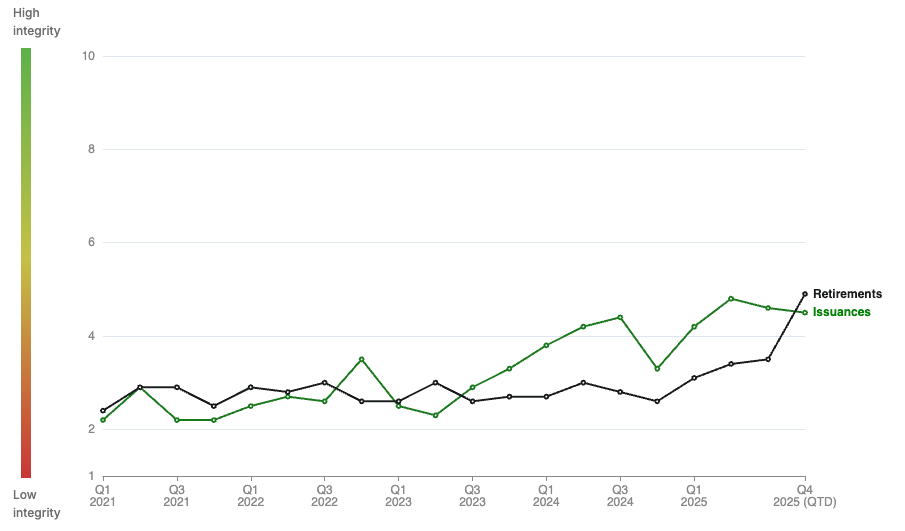
Buyer demand for quality seems to be slowly shaping the market. The integrity of credits issued and retired has been trending steadily upwards since 2021, as measured on a 10-point scale used by Calyx Global, an independent rater of credit projects.

Carbon credit quality trends

A similar uptick was seen by the finance intelligence provider MSCI, which rates carbon projects from AAA to CCC. The company’s second annual report on market integrity, published in September, noted that 35 percent of credits retired in the first half of this year were rated BBB or above, compared with 25 percent in 2022. 

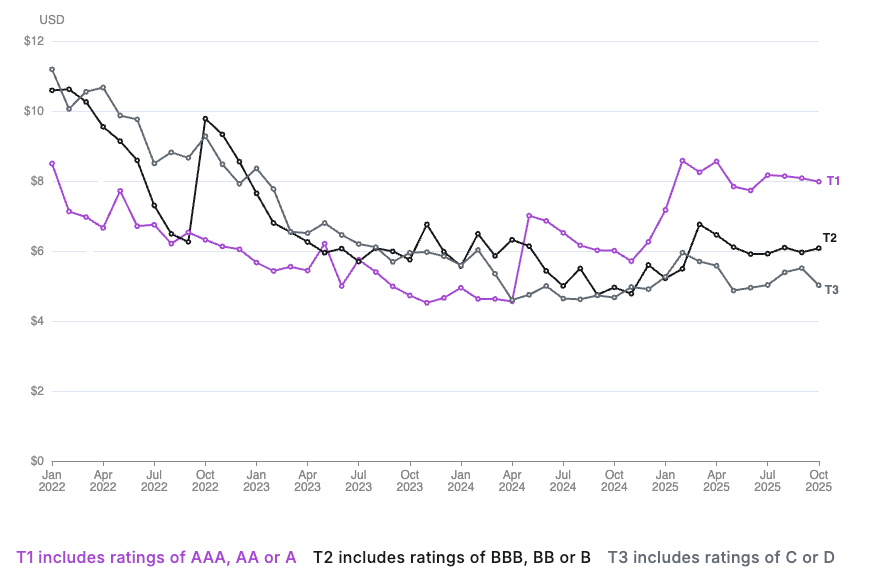
Higher-quality credits are also commanding higher prices, according to an index maintained by Calyx and ClearBlue Markets that offers tools to help companies navigate carbon markets.

Prices for carbon credits in different quality tiers

MSCI data aligns with this: Credits in the company’s high-integrity index traded at more than four times the price of those in its low-integrity index, compared with a two-fold difference in 2024.

‘Intractable’ problems

Still, the most talked-about publication in recent months probably isn’t any of the above. It’s a review of the academic literature on carbon credits, by Joseph Romm at the University of Pennsylvania, which concluded that many popular offset types have “intractable” quality problems. 

Many in the industry said Romm’s paper flagged known problems that are being addressed by the integrity council and other organizations. Others — including the Guardian, one of the fiercest critics of carbon markets — cited it as yet-more evidence that carbon credits cannot be trusted. The carbon market may be evolving, but its ability to divide opinions remains unchanged.

The post Carbon market turnaround continues as buyers eye more purchases appeared first on Trellis.

The Science Based Targets initiative (SBTi) has published a 97-page draft of its next Corporate Net-Zero Standard that recognizes companies for climate finance and carbon removal investments, provides clearer guidance on Scope 2 and 3 commitments and prescribes what should be included in climate transition plans.

These and other revisions to version 2.0 of the guidance are based on feedback from more than 850 stakeholders on the previous mid-March draft. SBTI is seeking another round of comments before Dec. 8. 

“Further input on this draft is crucial to ensuring that the finalized Corporate Net-Zero Standard is practical, credible and robust — helping businesses worldwide accelerate the net-zero transition,” said Alberto Carrillo Pineda, chief technical officer at SBTi, in a prepared statement.

Close to 12,000 companies use SBTi rules to set climate targets; about 2,200 have validated commitments to become net zero by 2050 or sooner and 2,800 are in the process of setting them.

More than three-quarters of companies with net-zero targets said the commitments have improved investor confidence, according to an SBTi report published Nov. 3. But some big-name companies have backed away from the framework in favor of other approaches as the net-zero revisions play out.

New recognition option

Until now, the SBTi has largely focused on guiding companies toward emissions targets. One of the biggest changes in the draft published Nov. 6 is a broadening of its remit to include instructions on how companies should take responsibility for greenhouse gases emitted during the transition to net zero. The guidelines will be voluntary for now, becoming mandatory in 2035.

During the voluntary period, companies can opt into one of two levels of responsibility: “Recognized” and “Leadership.” 

Businesses that address 1 percent or more of ongoing emissions — an intentionally low threshold designed to encourage participation — can earn the first designation. 

To qualify for “Leadership,” large companies must levy a carbon price of at least $80 per metric ton of carbon dioxide equivalent (tCO2e) on 100 percent of ongoing emissions, and use the proceeds to fund mitigation activities equivalent to at least 40 percent of those emissions. 

Eligible activities for both tiers of responsibility include purchases of credits from projects that avoid emissions and remove carbon from the atmosphere.

The initial proposal for the 2035 mandatory rules, which will be consulted on and finalized in the next version of the standard, requires companies to take responsibility for an as-yet undefined percentage of their ongoing emissions, with the fraction ramping up to 100 percent by 2050. Only removal projects are eligible for mitigation and use of more durable solutions, such as geological storage of CO2, will increase toward 2050.

Scope 3 clarity

Many companies have asked SBTi for more flexibility in addressing Scope 3 emissions — and the organization has listened. Ideas floated as options in the previous draft have been expanded into detailed instructions, including rules for addressing Scope 3 categories.

Targets for emissions from purchased commodities, for example, can now be based on an emissions intensity metric, such as tons of CO2e per unit of steel or wheat. Alternatively, companies can commit to buying 95 percent of a commodity from suppliers committed to reaching net zero by 2050.

For companies unable to source enough of a low-carbon product, or that cannot trace such purchases back through a supply chain, SBTi will allow use of environmental attribute certificates, also known in this context as “insets.” 

This will enable companies to invest in mitigation projects within their value chain and deduct the emissions savings from their Scope 3 inventories, even if there is no direct connection between the project and the company’s purchases. The draft references the AIM Platform, an initiative backed by H&M Group, Netflix and others that is developing more detailed rules for such investments.

Moving target: Scope 2 changes

The revision also includes new proposals and modifications related to the Scope 2 emissions category, which covers the impact of energy and electricity purchased by companies for their operations.

One example: It now references “low-carbon” electricity and energy, rather than “zero-emissions” or “zero-carbon” sources, as was the case in the first draft. This will allow companies that use natural gas abated with carbon capture to get credit for doing so.  

The additions acknowledge a forthcoming carbon accounting rule update by the Greenhouse Gas Protocol that will make it more complicated for companies to claim reductions related to this category. The endgame here is to get companies to set targets that increase their usage of low-carbon electricity — either through direct consumption or renewable energy certificates — to 100 percent by 2040.  

Transition plans and progress reports

The updated guidance requires “Category A” companies — large corporations with $450 million-plus in annual revenue or 1,000 employees; or midsize businesses in established economies with more than $25 million on their balance sheet, annual sales of at least $50 million and more than 250 staffers — to publish a climate transition plan. For small and midsize companies from developing nations, which fall into Category B, this is optional.

SBTi expects these plans to outline a phasing out of unabated fossil fuels and to outline specific measures for energy efficiency, switching fuels and replacing high-emitting equipment or inputs with low-carbon alternatives.

Companies also need to publish information about external factors or dependencies that could affect that roadmap. And they’re required to include estimates about what the transition will cost and how the company intends to finance it.

Climate transition plans must be reviewed every five years and updated as necessary. SBTi expects companies to publish annual reports about progress toward validated targets and to request revalidation before the usual five-year mark if warranted — for example, in the case of a merger or acquisition. The organization hints it will conduct “spot checks” on companies that aren’t acting quickly enough to adjust commitments in the face of slow progress.

Updated transition timeline

The revision for the Corporate Net-Zero Standard update is required under SBTi’s governance, but the overhaul was delayed amid controversy in summer 2024 over the organization’s stance on the use of environmental attribute certificates, such as carbon credits, to make emissions reduction claims. 

More than 320 companies have pilot-tested the new net-zero methodology, and a second phase that includes 50 companies will run through early December concurrent with the public consultation period for the updated draft.

The final draft of Corporate Net-Zero Standard version 2.0 is due in 2026, potentially in the spring. Companies will be encouraged to use that framework after it’s published, but doing so won’t become mandatory until Jan. 1, 2028.

Newcomers can set commitments using the current edition through 2027, and SBTi is encouraging them not to wait “as efforts undertaken under version 1.3 will continue to be relevant and provide a strong foundation for future alignment.”

The post SBTi drops latest net-zero draft: What’s new appeared first on Trellis.

The pipeline of U.S. data center construction projects has reached more than 500 sites and counting. With that boom comes a reckoning as communities in states from Wisconsin to Virginia scrutinize — and question — the heavy electricity, water and land requirements of what NVIDIA CEO Jensen Huang has dubbed “AI factories.”

In early October, Microsoft retracted its plan to build on a site in Caledonia, Wisconsin, after local residents protested the potential conversion of agricultural land into an industrial site. The company will pursue development at another location in the state.

“One of the pieces of feedback that we heard was that the parcel was too closely situated amongst other residents,” said Kaitlin Chuzi, director of integrated technology and biomimicry at Microsoft, during a recent Trellis Impact 25 discussion about how to include nature and biodiversity in data center development decisions. 

Engaging communities early is one of the best ways to address land-use questions and co-develop strategies for habitat restoration around new data centers or at other locations, according to the panelists. It starts with landowners and local officials who can connect companies with local conservation organizations to better understand community concerns. 

“Really listening to what they’re hearing is a really helpful way for us to develop an understanding but also ferment some of the ideas about which types of work would be most impactful for the community,” said Emily Backus, sustainability director for North America at Vantage Data Centers, which operates campuses for hyperscalers, cloud service providers and other companies with large data center needs.

Another key stakeholder to include from “Day 0,” Backus said, are utilities. If a site requires new transmission lines, for example, that will dramatically increase the potential impact on nature and biodiversity. 

Part of the plan

Data center companies such as Microsoft and Vantage have integrated habitat and biodiversity impact assessments and water studies into their standard design processes from the onset, especially as communities scrutinize a flood of data center site applications. Microsoft’s Chuzi, for example, reports to the company’s land management team; her role is not part of the sustainability office. Backus, on the other hand, collaborates closely with her company’s development engineers. 

While there’s no typical land use requirement for data centers — and operators are encouraging increasingly higher server densities — hyperscale facilities can still require 200 to 500 acres.

Vantage uses unbuilt acreage to restore native habitats and encourage drought-resistant landscaping, eschewing turf or non-native plantings. By the end of 2024, it used this strategy at half of its site footprint, or about 4,000 acres.

One of Microsoft’s climate goals, set in 2020, was to protect more land than its operational footprint requires by the end of 2025. It has already met that pledge, with more than 15,849 acres permanently protected, as of its latest environmental report. Biodiversity remains a focus amid its furious AI-related expansion phase.

Biodiversity and ‘fireball squirrels’

Both Vantage and Microsoft embrace the philosophy of biodiversity net gain — the idea that development can make land more supportive for new species — to guide new projects. 

Vantage, for example, used rain gardens, vertical greenery and other nature-based features to manage stormwater at its MPX2 campus in Milan, Italy, and restore the local ecosystem. It also planted multiple species of trees and flowering meadows at the campus. Where possible, given construction codes, it adds green roofs to data center buildings. 

That could mean tradeoffs, however, from an emission standpoint, because more steel might be needed to support the weight of plants. Other tradeoffs include higher maintenance needs. 

“The big question that my team and I have been talking about recently is whether it is worth it to put a green roof data center or, for the same cost, do ecological restoration on 100 acres off site,” said Chuzi. Her preference would be to do both.

Vantage will use a metric developed by consulting firm Ramboll to measure the impact of its North American projects, starting with two data centers in the Midwest. This was inspired by projects in the U.K., where demonstrating biodiversity net gain is mandatory for developers. This requires hiring ecologists who can perform initial and ongoing site evaluations.

“You think about all those green spaces around your buildings and your parking lots,” Backus said. “All of those are opportunities to do really significant improvements that can improve the biodiversity of those areas.”

Microsoft likewise looks for ways to add biological buffers and habitats to its campuses, a practice that was initially controversial with engineers, who were worried about squirrels and other rodents chewing through electrical lines. 

“They have so many valid reasons for why you can’t bring nature closer to the technology that we’re bringing to the site,” Chuzi said. “I think my favorite one, and maybe the most memorable excuse was, ‘Kaitlin, you can’t put plants near the data center because we’re going to end up with fireball squirrels.’”   

Much of Chuzi’s role involved balancing these concerns with biodiversity goals. The rodent problem, for example, can be addressed by encouraging habitat friendly to predatory birds that can help manage the population. A buffer can be established between plantings and crucial electric and transmission systems. And electrical systems can include additional insulation.

“It’s a lot of pulling together opposing ideologies and changing how people think about technology, how they think about nature,” Chuzi said. 

Microsoft’s new AI chip mimics a leaf to distribute coolant.
Source: Microsoft

Innovation inspired by nature

Nature is also reshaping design inside data centers. 

Concerns about water, for example, inspired both Microsoft and Vantage to prioritize the installation of “waterless” cooling equipment that relies on outside air to dissipate heat or closed-loop systems that retain and recycle water. 

Both companies are also looking for ways to funnel the heat generated by servers to places where it could be beneficial. Microsoft shares excess data center heat with a municipality in Finland, for example. That takes collaboration with neighboring sites, another reason community engagement is crucial for advancing data center development.

Nature was also the inspiration for a new AI chip design at Microsoft that uses a microfluidics approach to keep cool; the company says it is three times more effective than cold plates. Tiny channels move coolant through the silicon, much the same way that the veins of a leaf deliver water and nutrients.

These ideas all have roots in biomimicry, a discipline that reflects natural worlds in new product and systems design. Two of the most famous examples are Velcro, which was inspired by burrs, and the bullet train, which takes its cues from the anatomy of owls and kingfishers. 

“If you start looking at data centers and how we design them through the lens of ‘How would nature do it in this place or how does nature solve problems like this?’ then you start to come up with really incredibly imaginative new designs that are better for the environment and better for the communities and better for the companies that are designing them,” Chuzi said.

The post No ‘fireball squirrels’: Nature and next-generation data center design appeared first on Trellis.

The opinions expressed here by Trellis expert contributors are their own, not those of Trellis.​

In conversations all year, I keep hearing the argument that we’re in the middle of a “healthy correction” from the alleged ideologically driven excesses of 2018 to 2021. In response, the prevailing advice is to double down on the business case, while avoiding political backlash. 

Although this is a convenient narrative, it’s not a very convincing one. During this peak of enthusiasm, the business case narrative also dominated, but tended to be framed as a broad, unstoppable, win-win trajectory that would benefit everyone. This was always unrealistic. A shift to acknowledging trade-offs would’ve occurred even without the political headwinds in the U.S. today. 

Rather than just doubling down on ROI arguments (which themselves are nothing new), there’s a need for a bigger philosophical shift. I’m not only thinking of the risks from an anti-climate action U.S. administration or commitments, goals and aspirations that have become dangerous. I mean something more fundamental — the underlying assumptions and theory of change no longer hold, so we need a new approach.

5 assumptions that no longer hold

Here’s why the theory of change doesn’t work anymore: 

  • First, sustainability works because it anticipates future regulation. One of the prime risk management arguments for sustainability is that it helps companies get ahead of new regulations. But today, with regulations fragmented, uncertain and globally inconsistent, companies need to anticipate reversals.
  • Second, global pledges aren’t the way to drive change. The latest failure to secure a global plastics treaty is just one sign that flagship voluntary agreements secured at the United Nations are no longer dependable or broadly credible. Corporations that take policy alignment seriously, such as Unilever, are increasingly pivoting their attention to the national level and understand that their government relations and sustainability leads need to work in close alignment.
  • Third, the general public has much more idiosyncratic and mixed views on sustainability than is commonly argued. The underlying assumption of stakeholder capitalism is that everyone broadly wants the same sustainability commitments from corporations. But this view turned out to be too simplistic. Political reversals have made it clear that some members of the general public view these priorities as elitist and irrelevant. Managing the energy transition means acknowledging that some people are very concerned about losing jobs and livelihoods that rely on the fossil fuel economy, and it’s a bad idea to dismiss these fears outright. Pretty much everyone wants clean air and water — and to be able to provide for themselves and their families, so it’s important to prioritize basic fairness first.
  • Next, reputational risk is not a linear accountability mechanism. Because sustainability has traditionally been framed as providing reputational upside, there’s been insufficient consideration of the fact that activists are as likely to target leading companies as laggards. Starbucks was targeted on labor rights, despite having the best pay and benefits in its sector, precisely because it’s a leader, not because it’s a worse performer than other companies in the sector. Target is facing disproportionate scrutiny over DEI reversals, even though its actions are far from exceptional, and its retail employees face considerable physical risk. Campaigns are more unpredictable and social media-driven than they used to be, and the NGO landscape is fragmenting. Flagship agreements with WWF or the Ellen MacArthur Foundation used to be how companies signaled commitment. These days, they’re far more likely to be derailed by social media driven campaigns from tiny, faceless organizations that appear to emerge from nowhere. In summary, reputational risk is a funhouse mirror, not a reliable gauge of the ambition or credibility of your efforts.
  • Finally, transparency doesn’t lead to accountability. Decades of attention on making ESG reporting frameworks more rigorous have led to a lot of progress, but also sucked up disproportionate time and attention and not galvanized meaningful change. We spend far more time on esoteric debates about Scope 3 emissions and measuring impact than on meaningful change. The result: we lose people in the process.

A new focus 

We’re already seeing new approaches emerge and new strategies starting to take shape to move past the assumptions laid out above.

One clear trend is a shift away from overpromising on an enormous range of intractable challenges. What replaces it is a new focus on legitimacy and leverage, with companies dialing down ambition in areas they cannot directly influence and doubling down on areas where they have control. For example, Pepsi has dialed down climate and plastics goals, where it has limited influence, and doubled down on regenerative agriculture, where it has more direct leverage. This seems like great news, so long as it’s accompanied by more thoughtful policy engagement. 

It’s also increasingly accepted that market-based voluntary action is nowhere near enough. Although the mood is darker, there’s more engagement on the actual scale of the challenge, the need to think more carefully about financing models and time horizons, and acceptance that promises and commitments alone are unrealistic.

Of course, corporations are afraid to be opinionated and even in closed-door meetings, I’ve noted pervasive paranoia. This doesn’t look likely to galvanize the kind of collective action and voice we need that was easy enough for everyone up until 2021. I understand the reluctance by companies to make themselves a target, but there’s still strength in numbers and a need for courage and coordination.

There’s also a shift back to convergence between corporate affairs and sustainability. This was once a sign that the company treated sustainability as messaging alone, but now it’s an indicator that ESG reporting has shifted to the finance team and that a range of functions now include sustainability expertise. If sustainability considerations are integrated into procurement, operations and R&D, with the requisite experts, then there needs to be a shift in the role of the standalone sustainability function. Even more important: the narrative challenges facing corporations are so profound that true alignment between talk and action is non-negotiable. 

The most ambitious and thoughtful companies I know are getting clearer, more focused and replacing complex jargon with plain language and a serious focus on implementation. This is just a start, but it’s much better than doing the same thing over and over again and expecting a different result.

The post The case for ditching 5 underlying sustainability assumptions appeared first on Trellis.

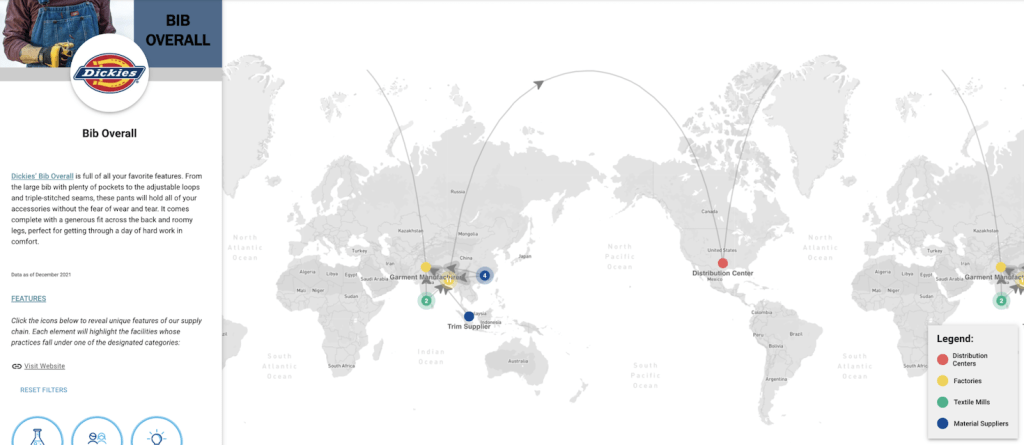
VF Corporation has already mapped the global supply chains of 100 products, including Dickies overalls, Smartwool base layers and The North Face hiking boots. Now, the Denver company reports significant progress toward tracing five key materials down to the commodity level by 2028.

The company disclosed in its Oct. 7 sustainability report that it has achieved 61 percent traceability by volume, the first time it has shared this metric, for certain animal, plant and fossil materials. Wool leads at 78 percent; leather is next at 67 percent. They are followed by natural rubber (56 percent), synthetics and cotton (both 51 percent).

Purchasing more “preferred and regenerative materials” and reducing production volumes helped VF cut Scope 3 emissions by 7 percent in 2024 compared with 2023, though the footprint remains 19 percent above a 2017 baseline.

“We can’t fix what we don’t know, and this work is key to compliance,” said Harsha Chenna, VF’s VP of global product stewardship. Traceability helps meet responsible sourcing policies and regulatory compliance and monitors risks including human rights, water scarcity, deforestation and pollution, he added.

Credit: VF Corporation 2025 sustainability report

Five key materials

The company said 5,003 metric tons of its five key materials were produced with regenerative practices in 2024. Among the progress it marked for each material in 2025:

  • Cotton: VF traced 54 percent across all tiers, aiming to source all of the material from Australia, the U.S. or other regions with sustainable origins by 2026. Regenerative cotton represented 94 percent of the company’s 2024 supply, up from 89 percent the previous year.
  • Synthetics: VF traced 56 percent, from Tier 1 to 5. Recycled material accounted for 64 percent in 2024, up from 48 percent in 2023, surpassing its 2026 goal early. Ninety-five percent of polyester and 80 percent of nylon used by The North Face came from preferable sources.
  • Leather: VF traced 75 percent from Tiers 2 to 5. Timberland used 78 metric tons of regenerative leather in 2025, and 90 percent of footwear tanneries were Leather Working Group-audited.
  • Rubber: VF traced 74 percent of the natural supply chain. The North Face, Timberland and Vans collectively used 319 metric tons of regenerative rubber in 2024.
  • Wool: VF traced 87 percent across all tiers and counted 94 percent ZQ-certified wool in 2024.

Traceability history

VF began dedicated traceability work in 2017, piloting material mapping across 10 products. By 2021, it had expanded to 100 products across 1,200 sites. The company seeks to map materials down to the commodity level, relying on data including supplier traceability, country-level risk maps and environmental and social risk metrics.

“Traceability is still very difficult, requiring significant time, resources and analysis,” Chenna said. VF’s teams in North America and Asia-Pacific report directly to him.

VF conducted 1,070 supply chain audits in 2025. It publicly shares addresses and details for 1,214 suppliers via the Open Supply Hub, updating quarterly. Most suppliers are in the Asia-Pacific region, followed by the Americas and Europe.

A map from several years ago of the supply chain for Dickies bib overalls. Credit: VF Corporation.

VF is also advancing circular design, which represent a tiny slice of sales, as is common for apparel companies with branded resale programs. Its The North Face Renewed secondhand brand sold 96,000 items in the U.S. and U.K. last year. New The North Face products, in contrast, sell in the hundreds of millions annually.

Emissions targets, market challenges

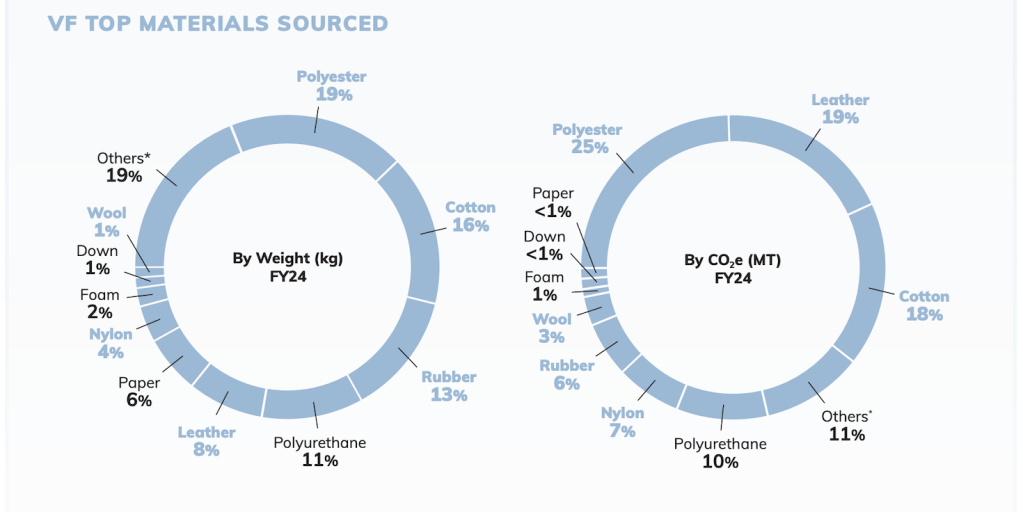
Raw materials drive 79 percent of VF’s climate footprint: polyester makes up 25 percent, leather 19 percent and cotton 18 percent.

Validated by the Science-Based Targets initiative, VF aims for net zero by 2050. Near-term goals include cutting Scopes 1 and 2 emissions by 55 percent and Scope 3 emissions by 33 percent by 2030 from a 2017 base. The recent inclusion in the footprint of refrigerants from HVAC systems in 1,127 stores in 2017 complicates year-over-year comparisons of overall emissions.

VF has faced scrutiny from watchdog group Stand.earth for lagging climate progress. The company does not appear on track to lower supply chain emissions by 33 percent by 2030, according to Stand’s Senior Corporate Climate Campaigner Rachel Kitchin. However, she praised VF’s increased use of regenerative cotton, and tracing some materials to Tier 5.

VF’s annual revenues dropped nearly 4 percent to $9.5 billion in 2025. The company’s 2025 sustainability report followed workforce reductions a month earlier, including the departure of Senior Director of Sustainability David Quass. However, the sustainability work continues apace, according to the company.

The post VF Corporation hits 61% traceability for key materials appeared first on Trellis.

What if exchanging a product carbon footprint were as easy as sending an email?

A cross-industry project designed to make that possible got a boost last week — the latest in a busy year — when a leading source of food-sector emissions data said it would align with the initiative’s guidelines. 

The move added another partner to the growing number of organizations conforming with the product carbon footprint standard developed by the Partnership for Carbon Transparency (PACT). The list includes Procter & Gamble, Toyota, MasterCard and more than 100 other companies using the standard with suppliers; service providers such as SAP and Microsoft that have integrated it into software products; industry collaborations from automotive and other sectors; and several large auditors, including EY and Deloitte.

Current rules for exchanging footprint data vary between industries and companies — to use the email analogy, it’s as if different companies’ incompatible messaging protocols kept them from communicating with each other. The PACT standard is designed to eliminate existing barriers and create a global, industry-agnostic set of interoperable rules. That will allow buyers to more easily search for low-carbon products and sellers to compete on emissions.

The initiative, a project of the World Business Council for Sustainable Development, launched the latest version of its standard in April. The update included new guidelines for calculating, standardizing and exchanging food-sector carbon footprints, paving the way for organizations from the industry to align with the rules. Last week, HowGood, a prominent food-and-beverage sustainability platform that contains more than 90,000 agricultural emissions factors, said its data now aligns with PACT specifications.

Going mainstream

One user will be HowGood customer Ahold Delhaize, a retailer whose U.S. chains include Food Lion and Giant Food. Grant Sprick, the company’s vice president for climate and environment, said that product carbon footprints provide more granular emissions estimates that reflect the decarbonization efforts of suppliers, and that PACT conformance would lower barriers for partners to create and share the data.

It will also help sustainability professionals at both buyers and sellers make the case for low-carbon products, added Nina DePalma, HowGood’s chief product officer. 

“PACT is what is necessary for product footprints to take hold as a standard business metric,” she said. “If this type of sustainability data has any shot at making it into the mainstream of the way a business makes real decisions, it needs to live up to the rigorous demands an IT team would make of any other piece of data in the business.”

Alongside the expansion to food and agriculture, PACT is signing up partners in China, Japan and other parts of Asia, as well as bringing on smaller companies, said Naama Avnia-Kadosh, the project’s director. Companies are already using PACT data to guide research and development, shape procurement portfolios and set broader strategy, she noted. The goal now is to unlock a “flood” of that data. 

“When you get that at scale,” said Avnia-Kadosh, “that is when the impact we’re all trying to achieve will come through.”

The post Global carbon data project boosted by alignment with food sector platform appeared first on Trellis.

The opinions expressed here by Trellis expert contributors are their own, not those of Trellis.​

The embrace of nuclear power is often presented as a climate solution and in isolation, this characterization has merit. Nuclear energy is a clean, reliable power source that can help achieve climate goals while meeting growing energy demands. However, the current deployment of nuclear power is more accurately understood as a private solution to a public problem — one that forces us to confront questions about risk, responsibility and the kind of future we’re willing to create.

The new energy aristocracy

Let’s start with the basics: Microsoft, Amazon, Google and Meta have invested more than $20 billion in nuclear energy and its surrounding technology. In March, these four tech giants formalized their commitment by signing a pledge to triple global nuclear capacity by 2050.

This isn’t corporate virtue signaling; this is the world’s most valuable companies securing competitive advantage through energy infrastructure control. To provide a significant fraction of the terawatt-hours of electricity these tech giants consume each year, nuclear companies will likely need to build dozens of new plants, not just a couple of reactors. 

Yet the nuclear capacity being secured by tech companies represents a tiny fraction of what’s needed to decarbonize the broader economy. According to the International Energy Agency, U.S. data centers alone consumed roughly 4.4 percent of the country’s total electricity consumption. By 2030, this figure is projected to grow by 133 percent to 426 terawatt-hours. The nuclear deals announced by tech companies, while substantial, amount to perhaps six to seven gigawatts of capacity when fully operational — a meaningful addition, but less than 2 percent of projected U.S. electricity demand growth.

This creates a two-tiered energy system where a company’s ability to maintain climate commitments becomes increasingly correlated with market capitalization. When the most powerful corporations purchase their way to carbon-free electricity through long-term nuclear contracts, they simultaneously absorb significant capital and regulatory attention that might otherwise be directed toward more scalable solutions. Nuclear construction requires specialized regulatory oversight, supply chains and expertise that exist in limited supply. Every dollar and engineer devoted to private nuclear projects is, in effect, unavailable for grid-scale decarbonization.

The uncomfortable truth is that we’re witnessing the privatization of climate solutions at precisely the moment when we need coordinated, systemic action. This isn’t a moral failing on the part of tech companies — they’re rational actors responding to market incentives. But their rational behavior creates externalities that undermine broader decarbonization efforts.

The moral labyrinth

Nuclear power presents a profound moral dilemma that cannot be resolved through simple cost-benefit analysis. The arguments on both sides have genuine weight and grappling with this technology requires acknowledging the legitimacy of competing frameworks.

Advocates of nuclear power make a case grounded in consequentialist ethics: nuclear energy’s massive carbon-free output and superior safety record compared to fossil fuels create an obligation to deploy it widely. When you consider that climate change will disproportionately harm the world’s most vulnerable populations — those with the least responsibility for emissions and the fewest resources to adapt — the failure to deploy available low-carbon technologies can look like negligence. 

From this perspective, opposition to nuclear power becomes a form of moral luxury that wealthy environmentalists can afford while the world’s poor will pay the price in heat waves, crop failures and climate-driven conflict.

Data supports this position in important ways. Nuclear power has caused fewer deaths per unit of energy produced than any fossil fuel source, including natural gas. Even accounting for Chernobyl and Fukushima, nuclear energy’s safety record is exceptional when measured against the continuous toll of air pollution from coal and gas, which kills millions annually. If we’re serious about preventing catastrophic climate change while maintaining modern standards of living, can we afford to dismiss a proven technology capable of generating baseload power without carbon emissions?

Critics counter that nuclear power imposes unacceptable risks of catastrophic accidents — events whose probability may be low but whose consequences are nearly unbounded. More fundamentally, it creates radioactive waste requiring secure management for periods that exceed the entire span of recorded human history. This represents a form of intergenerational tyranny where present benefits come at the expense of future burdens we cannot fully imagine, let alone mitigate.

Something is troubling about creating materials that will remain lethally toxic for 10,000 years when we can barely predict social and political conditions a century hence. What right do we have to impose such obligations on future generations who’ll have no say in the matter and receive none of the benefits? This isn’t abstract philosophizing; it’s a fundamental question about acceptable levels of imposed risk and responsibility across time.

Concentration of risk, diffusion of benefit

Nuclear facilities typically concentrate risks in local communities while benefits flow elsewhere. The communities hosting nuclear plants — and especially those designated for waste storage — bear elevated accident risks, property value impacts and the psychological burden of proximity to hazardous facilities. Meanwhile, the electricity generated flows hundreds of miles away to power data centers and urban areas whose residents enjoy the benefits while remaining insulated from the risks.

This pattern mirrors broader environmental justice concerns, where marginalized communities disproportionately host society’s hazardous infrastructure. Nothing is necessarily malicious about this arrangement, but it does represent a form of spatial inequity that we should at minimum acknowledge.

The technology’s complexity also undermines energy democracy by requiring centralized expertise and institutions. Nuclear power cannot be deployed locally or managed by communities. It demands national regulatory frameworks, specialized engineering knowledge and institutional continuity spanning decades. This stands in stark contrast to distributed renewable generation, where homeowners and communities can directly participate in energy production. The choice between these paradigms isn’t merely technical; it’s a choice about the kind of society we want to inhabit and who holds power over critical infrastructure.

Beyond calculation

We’re confronting fundamental questions about acceptable levels of imposed risk, intergenerational responsibility and the wisdom of creating technological systems whose consequences far outlast their creators.

The current moment makes these tensions particularly acute. Tech companies deploying private nuclear capacity are, in effect, making civilizational decisions about risk and responsibility that will reverberate for millennia. These decisions are being driven by market logic and corporate procurement strategies rather than democratic deliberation about the kind of energy future we collectively choose.

This doesn’t mean nuclear power is necessarily wrong, but it does suggest that the question, “Should we deploy nuclear energy?” cannot be separated from questions about who decides, who benefits, who bears the risks and what alternatives exist. What we need is a more sophisticated framework for making collective decisions about risk, responsibility and the distribution of both benefits and burdens. This requires moving beyond individual corporate procurement strategies toward systemic solutions that ensure clean energy deployment serves broad social goals rather than narrow commercial interests.

The nuclear question, ultimately, is about what obligations we owe to those who come after us, what risks we have the right to impose on local communities, and whether our most consequential technological choices should be determined by market forces or democratic deliberation. These aren’t questions that physics or economics alone can answer. They require reasoning about the kind of world we want to create and the legacy we’re willing to leave behind.

The post The catch-22 of nuclear power appeared first on Trellis.