A leading standard for emissions from food and agriculture is being revised to bring it into line with delays in achieving zero-deforestation supply chains.

Companies have until November 6 to weigh in on changes to the Science Based Target initiative’s Forest, Land and Agriculture (FLAG) Guidance. Proposed revisions include pushing back the final deadline for companies to eliminate deforestation to supply chains to 2030. Current guidelines have a December 2025 date, which stakeholders acknowledge companies will not be able to meet.

“To keep the standard relevant and used, we need to revisit the target year and figure out what to do to keep the momentum going,” said Martha Stevenson, a senior director on the forest team at the nonprofit WWF-US and a member of the expert group advising the initiative on the guidelines.

“These deforestation commitments started in 2010; we would have loved to have had action much, much earlier than this,” she added. “No one’s happy about rolling these dates back.”

Stevenson, who led the creation of the first set of FLAG guidelines, said the 2025 deadline has proved unworkable because of international demand for the small group of commodities that drive deforestation — including beef, soy and palm oil — as well as domestic trade in forest countries for those products. Land speculation and ownership rights have also proved difficult to address.

Key commodities

Pushing back the deforestation date will not impact the rest of the FLAG guidelines, which focus on emissions reductions. More than 340 companies have validated FLAG targets, according to the SBTi.

The revisions are also intended to align the guidance with other frameworks and regulations in this area, including the Accountability Framework initiative, a roadmap for achieving ethical supply chains overseen by a coalition of nonprofits, and the European Union’s Regulation on Deforestation-free Products (EUDR), which comes into force in December.

Companies interested in responding to the SBTi’s request for comment should consider how the FLAG guidance dovetails with EUDR, suggested Stevenson. The SBTi is proposing aligning the commodities covered by the deforestation part of the guidance with seven key focuses for EUDR: wood, cattle, soy, coffee, cocoa, palm oil and rubber. But these are not the only material commodities, noted Stevenson. For example, barley and cotton are important to beer makers and clothes manufacturers, respectively, but neither is on the EUDR list. “Both of those commodities can drive land use change in specific regions,” said Stevenson.

The post SBTi moves to delay deadline for deforestation-free supply chains appeared first on Trellis.

When the last-mile delivery team at Walmart began to craft plans to scale service, it faced problems only behemoths have to contend with: which vehicles were right for a network of 4,700 U.S. stores and 1.6 million employees, and if the company decided to go electric, could it actually set up charging infrastructure in all those locations?

“The complexity of Walmart is that we’re everywhere,” said Sai Teja Yerapothina, the company’s senior director for last-mile delivery, strategy and operations. “And we deliver everything from hot chickens to 75-inch TVs to prescriptions.”

Around four years later, Walmart is bringing groceries, electronics and other goods to customers in 2,000 electric vans that are charged at stores.

At last week’s Trellis Impact 25 event, Yerapothina shared details of how the company made the move.

Selecting the ride

Walmart’s leaders impose tough requirements on the returns of every investment, so Yerapothina’s team had to get granular in its assessment of vehicle options. To estimate the total cost of ownership, they factored in everything from vehicle price and energy used to resale value, maintenance and time spent traveling to gas stations. 

“We ran various different cost models about what this would mean for the business, for our customers, for our associates,” said Yerapothina. “EVs turned out to be our cheapest option and also the most sustainable option. So it was an easy decision for us.”

Today, Walmart contracts with Ford and GM for its fleet of last-mile delivery vehicles.

Infrastructure experiments

Level two charging, which provides speeds in the 10-kilowatt range and can recharge a vehicle overnight, was sufficient for the fleet. It is also cheaper, because the cost of electricity is often lower at night.

Beyond that, things got complicated. Permitting requirements differ across regions, as do the utilities involved. In addition, even nearby stores have slightly different designs. Some buildings are owned; others are leased. Parking lots can be for the sole use of Walmart customers or shared with neighboring businesses. “Every single location came with a different challenge,” said Yerapothina.

Rather than overanalyze the situation, his team began by deploying charging stations to a few locations then closely monitoring the results. “The best way we learn is we put something out there in the real world, give it to our associates and ask for feedback,” explained Yerapothina.

Wi-fi signals were one challenge they encountered. Sometimes the best spot for a charger lies beyond a store’s wi-fi range, and that required the team to equip some of them with cell-signal connections. The connectivity allows custom-built Walmart software to monitor the status of the charger and any vehicles connected to it. 

Building the playbook

Over time, the last-mile team worked with colleagues in energy and software to build a playbook that guided the expansion of the charging network to thousands of stores. They also established standards that hardware and software vendors need to comply with.

Though the playbook identifies preferred locations for chargers, it isn’t prescriptive. “Because the best way may not always be the right way for every location,” said Yerapothina. “The final approval of where a charger would go and the other design decisions was left to store managers.”

Guiding design principles also include simplicity and transparency. “We start with: Is this simple enough that I could stand with an early associate in a store and explain to them in 30 seconds?’ said Yerapothina. 

“Always start with the why,” he added. For example, some drivers switched off the one-pedal driving feature, which uses resistance in the motor to simultaneously brake and recharge the battery. The team responded by explaining the benefits of the approach, which include lower charging costs and reduced brake wear. “We’ve seen a huge uptick in adoption,” noted Yerapothina.

Next up: Drones

With the last-mile EV fleet in place, Yerapothina’s to-do list now turns to building out drone delivery. The company has fulfilled around 300,000 orders over the past few years using drones from stores in Dallas, Houston and Arkansas. 

For single-family homes, it’s a relatively straightforward proposition to drop deliveries in the backyard. Yerapothina said the company is still working on a solution for multi-unit buildings.

“There is a future where customers are oblivious to the mode,” he predicted. “They just say, this is the speed I want it in. And then the retailer figures out how to get it there — and drones could be one of those options.”

The post How Walmart built a playbook for deploying thousands of EVs and charging stations appeared first on Trellis.

Calling all bras, panties, boxers and briefs: Calvin Klein is accepting unwanted underthings from any brand for recycling. PVH Corporation’s Re-Calvin takeback program, announced Oct. 23, is a first for a major brand and a test of how circular fashion handles intimates, which companies usually can’t re-sell.

Less than 1 percent of textiles are recycled into new fabrics, according to the Ellen MacArthur Foundation, a rate likely even lower in the roughly $90 billion global market for intimate-wear. It’s not just the ick factor that interferes with reuse, but also the difficulty of recycling blended and often stretchy materials.

Calvin Klein’s program comes as parent PVH faces a 2025 deadline for designing all products for circularity, and as regulations increasingly make brands account for waste after product use.

“It was important that we partner with experts with a proven ability to build and scale programs that handle a wide range of products and categories, making it easier than ever for customers to responsibly extend the life of their items,” said Calvin Klein Global Brand President David Savman.

Re-Calvin partners Trove and Debrand are logistics leaders in the growing efforts to bake circularity into the apparel industry.

“With this launch, Calvin Klein is showing how technology can make responsible choices simple for every customer, accepting items from any brand and across all categories, including intimates, to help keep more textiles in circulation,” said Trove CEO Terry Boyle, in a press statement.

The initiative accepts all sorts of clothing and shoes, even swimwear, but its embrace of intimate apparel fits the 57-year-old brand’s legacy of provocative underwear ads, cultural flashpoints for decades, featuring Brooke Shields, Mark Wahlberg and Bad Bunny.

“I love that Re-Calvin is taking back all brands and is also taking intimates,” said Cynthia Power, an apparel industry veteran whose consulting work includes creating brand takeback strategies. “It makes sense that a brand synonymous with underwear is helping recycle underwear.”

Circularity push

Re-Calvin may ultimately provide useful data for the goal of PVH, the former Phillips-Van Heusen Corporation, to design all products for circularity by 2025.

In 2024, the New York corporation, striving for net zero, has reached 3.8 percent Scope 3 emissions reductions toward its 42 percent target for 2030.

The motivation for circularity programs includes the rise of regulations holding fashion brands to account for the paths their products take after consumers are done with them. In California, the Responsible Textile Recovery Act will impose fines starting in 2030 for businesses that fail to share, through a third party, the fates of their brands’ materials. Similar extended producer responsibility rules are progressing in the European Union.

How Re-Calvin works

Re-Calvin invites customers to mail in previously worn garments using a prepaid shipping label on the program’s website. They can do so via the Calvin Klein website through a plug-in by Trove.

Trove is the digital logistics backbone. Debrand of British Columbia helps to make decisions to donate, recycle or dispose of the materials. The textile waste management leader’s clients include Lululemon, Everlane and Victoria’s Secret.

Items in the best condition will be donated or given to partners for secondhand use. Some materials will be recycled into new textiles. Others will be downcycled into building insulation or padding. At the bottom of the circularity hierarchy, unusable materials are incinerated for “waste-to-energy” purposes.

Consumers get an email explaining how Re-Calvin managed their unmentionables.

It’s a well thought-out program, according to Liz Alessi, a longtime fashion sustainability consultant in New York. “It’s still early days, and the economics are tough when logistics might outweigh resale value, but it’s an important initiative,” she said. “If they can learn what’s coming back and how to process it more efficiently, this could set useful groundwork for scalable circularity.”

The post Why Calvin Klein wants your underwear back appeared first on Trellis.

Which feels easier: taking an empty milk jug to the recycling bin or forking over tax dollars in the name of sustainability?

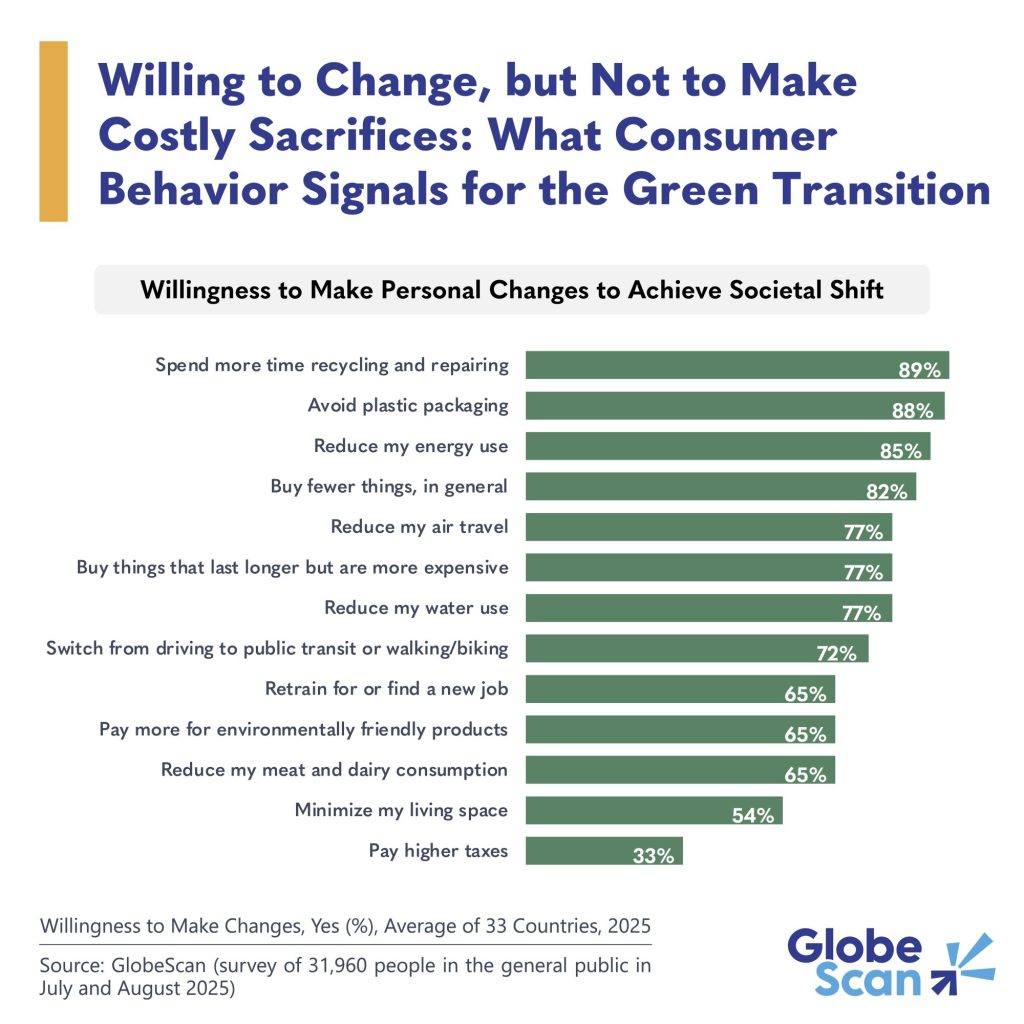
If you chose the former, you’re not alone. According to new insights from Trellis data partner GlobeScan about how societies are responding to the sustainability transition, convenience is king. When asked how willing they are to make specific changes, people are most willing to make changes when they’re low-cost, familiar or relatively easy to do. More transformative changes that require financial sacrifice or lifestyle overhaul face greater resistance. People are most willing to take everyday, tangible actions that feel manageable such as:

  • Recycling (89 percent)
  • Avoiding plastic packaging (88 percent)
  • Reducing energy use (85 percent)

Support drops significantly for more costly or disruptive actions such as minimizing living space (54 percent) or paying higher taxes (33 percent).

What this means

GlobeScan’s research shows that while people broadly support the green transition, their willingness to make hard personal sacrifices, especially financial ones, is limited. Instead, people prefer actions that feel familiar and relatively effortless. This signals a clear imperative: make sustainability frictionless. To accelerate the transition, governments and businesses must embed low-effort, high-impact actions into everyday life and design systems that reward sustainable choices without demanding sacrifice. 

Based on a survey of 31,960 people across more than 30 countries conducted July-August 2025.

The post No costly sacrifices: consumers want ‘easy’ sustainability actions appeared first on Trellis.

The opinions expressed here by Trellis expert contributors are their own, not those of Trellis.​

Resilience has proved to be quite the buzz word this year, whether discussing economic shocks, geopolitical tensions or sustainability, where resilience has become a more neutral and less politicized term.

However, there isn’t much talk of personal resilience. Even though we all know colleagues who’ve quit the profession because the pressures and stress are too much or are on the verge of burnout. 

Yet we barely discuss this, choosing to stay focused on organizational resilience. But without personal resilience, the organizational perseverance won’t happen. With that in mind, let me offer some tactics and strategies for maintaining personal resilience as we wind down the year.

Understand what’s in your control

It’s comforting to think we’re sailing through life on a super-yacht, adeptly changing speed when required, smoothly shifting direction, in full control of the consequences of our actions.

But here’s the rub: the super-yacht analogy only works if the waters it’s sailing in are predictable. This sadly, isn’t the world we live in. Instead, the world around is composed of messy interconnected systems that all have their own energy and their own patterns of working. These systems, from the global energy system to the global food system to national health systems are in rapid transition. Which means trying to control what’s happening around us has its limits.

Sure, we can influence what’s happening, but we can’t guarantee outcomes. So the first step to building personal resilience is being more comfortable with having less control than you might think. Think of the super-yacht more like a kayak. Understand what your kayak can and can’t do, and embrace uncertainty and some inevitable turbulence.

Pay attention to your energy reservoir 

Once you’ve recognized what’s in your control, it’s time to pay attention to your own battery. Can you spot when it’s getting very low? Do you have strategies to recharge it? A really useful metaphor is a bucket of water where there are three levels: relaxed (a third full), normal (half full) and stressed (completely full with water slopping out over the sides).  

At any one point in time, understanding what makes up the clouds dropping rain into your bucket is really helpful. The clouds could be a combination of work pressures, family worries or money worries, but naming them is important. Equally important is understanding what taps are at the bottom of the bucket to let the water out to allow it to drop to a lower level. These taps include taking a break for a walk outside, confiding in a close friend or eating something delicious. 

Filling out the blanks for your own stress bucket is a brilliant way to begin to understand your own energy reservoir. And once you’re clear on what it feels like to not be at your optimal state of well-being, you can find ways to feel better. 

Develop a list of personal hacks

The final part of building and maintaining personal resilience is having a few resilience hacks. Here are three of my favorites:

Live outside the news. I know this is really obvious, but it can be hard to stop doom scrolling and close the news tab. However, we must because living in the news can be overwhelming, depressing and incredibly stressful. That’s because, back to our kayak, there’s very little we can personally do to directly control it. Living outside of the news, and only dipping in when we have to and feel strong enough, can help us stabilize the kayak and critically focus on what’s in front of us and control the next move of the paddle.

Do things daily-ish. We do love a list. Today I must go to the gym, clear my inbox and read the latest self-improvement book purchased out of some desire to be that better person. But do you have to, really have to, do any of that? Right this moment?  

Probably not. Doing things when you feel like doing them, instead of according to a firm schedule, is inexplicably and wonderfully liberating. Sure, you need to ensure there won’t be a small catastrophe as a result of your self-imposed task refusal. Once that’s clear, embrace the moment. It might be incredibly nourishing.

Name it to tame it. Most of us carry anxieties around a majority of the time. Sometimes they don’t get in the way and sometimes they can feel quite paralyzing. In these moments, it can be really helpful to name the anxiety or anxieties. Giving something a name is often a first step to addressing it.  

Even better, try visualizing your anxieties and then create a visual of something you find calming. Some days my anxieties can feel like a nest of sharp-toothed rats, gnawing away at my well-being. On these days I visually turn these horrible looking creatures into fluffy rabbits. The anxieties now feel much more manageable, able to be tamed, and if I can’t deal with them all, it’s easier to ask a bunny to hop along with you rather than be chased by a rat.

Maintain a soft eye

This is a martial arts move, where you maintain broad contextual awareness, but are focused on the immediate action. Too much focus on one or the other can be very stressful. Focusing solely on context and trying to solve root causes of the turbulence around you can lead to burnout. Focusing just on the next action and wave of turbulence means there’s less of a chance of steering the broader system. 

Back to that kayak. What do you need in yours to sail through these choppy waters?  It might be a new map, it might be a new paddle, it could be a tasty snack. But knowing what you need, right now, will help you steer to where you want to go. 

And if all else fails, remember the nested nature of the systems we live in. Maintaining your own personal resilience will help maintain the resilience of the other systems you’re part of — your family, your community, your organization. After all, we must put our own oxygen masks on first.

The post Without personal resilience, organizational resilience won’t happen appeared first on Trellis.

The Trellis Impact climate tech startup of the year is Dexmat, which produces a conductive nanomaterial that can be spun into fibers, films and wires for aerospace applications, EVs and energy storage. The product, Galvorn — which is derived from carbon nanotubes that have the potential to store carbon —is ultra-strong, lightweight and exceptionally flexible. It could potentially replace steel, aluminum and copper.

The Houston company won a live audience vote at Trellis Impact on Oct. 29 in San Jose, California, after five companies made two-and-a-half-minute pitches to investors and corporate leaders.

The early-stage companies among the Trellis 25 Climate Tech Startups to Watch tackle emissions from every angle: energy, carbon, industry, nature and transport. Moreover, they represent a new generation of entrepreneurs that focuses not simply on cutting emissions, but on rebuilding the systems that power the global economy. It is a generation, though, that is currently facing a drop in climate tech funding and challenging policy shifts.

Dexmat is backed by Shell Ventures, the U.S. Department of Energy and other investors in advanced materials for decarbonization. Galvorn emerged from research in the lab of Co-founder and Chief Science Advisor Matteo Pasquali, a professor at Rice University, that was conducted in collaboration with Nobel laureate Richard Smalley. Dexmat Co-founder and CTO Dmitri Tsentalovich, who holds a chemical engineering PhD from Rice, has worked for 15 years on carbon nanotube technology.

“Dexmat was able to show the audience how the problem they are solving affects everyone in the room, and the potential for climate impact at scale,” said Alex Behar, a partner at Buoyant Ventures in Chicago. “Copper is fundamental to upgrading the grid to support the energy transition and increased demand for energy from data centers, but it is resource-intensive to produce. Dexmat avoids these challenges by using alternative materials that can deliver similar or better performance.”

The finalists

Before choosing Dexmat, the finalist in the Industry category, the Trellis Impact audience also heard pitches from four other category finalists:

Energy: Ammobia is reinventing ammonia production, delivering a low-pressure, lower-carbon process that uses renewable hydrogen and air to decarbonize feedstocks for fertilizer and fuel. Founders: Karen Baert and Tristan Gilbert; San Francisco

Carbon: Planet Savers is developing modular, low-cost direct air capture systems to remove gigatons of carbon dioxide from the atmosphere. Founders: Kei Ikegami and Kenta Iyoki; Tokyo

Nature: Airbuild uses microalgae and pyrolysis to transform polluted water and air streams into clean water, biochar and long-term carbon storage. Founders: Richard Mariita, David Gory Jr. and John William Bucur; San Diego

Transport: Photon Marine designs high-power electric outboard motors and fleet management software to electrify commercial vessels and phase out fossil fuels in marine transport. Founder: Marcelino Alvarez; Portland

Choosing the contenders

Trellis winnowed and published pitch videos of 25 finalists from a pool of 109 applicants from 13 nations. The applicants were judged on: solution, business model, customer need and traction, as well as team and pitch presentation.

Collectively, the applicants have attracted more than $750 million in funding. Each was required to have at least one full-time worker and seed or Series A funding.

“It was impressive how much commercial progress each finalist had achieved in a short time, with minimal resources,” Behar said. “They are all engaging partners, which is a smart way to grow faster with less capital.”

The post The Trellis Climate Tech Startup of 2025 appeared first on Trellis.

Send news about sustainability leadership roles, promotions and departures to [email protected].

Pure-play sustainability consulting firm Anthesis tapped Matthew Bell, a long-time EY services executive and former U.K. government climate policy lead, to succeed co-founder Stuart McLachlan as CEO.

The appointment is effective Dec. 1.

Bell, an 18-year EY veteran, most recently led the accounting firm’s climate change and sustainability practice, which includes more than 4,300 specialists. He’s currently chair of the World Green Building Council, a network of 75 regional organizations focused on decarbonizing real estate and construction. He joined Anthesis because of its exclusive focus on accelerating climate action. 

“Anthesis has the DNA of a consultancy, an impact business and a technology company rolled into one,” Bell told Trellis. “Add to that its incredible design creative capability and you’ve got all the ingredients to generate impact at scale.”

The firm, founded in 2013, has more than 4,000 clients in 80 countries, including Cisco, Nestle, Reckitt, Target and Tesco. Under McLachlan, who will remain on the board of directors, it has grown to 1,400 employees worldwide — partly due to the acquisition of 24 businesses over the past 12 years.

“Matthew is the right leader to build on our strong momentum and guide Anthesis through its next stage of growth, bringing his deep industry expertise and a proven ability to build high-performing global teams,” said McLachlan.

Bell’s first priority is to identify places where Anthesis can build on existing best practices. “We’re already working at incredible depth across sectors, so the question now is: How do we connect that expertise globally, amplify our data and digital capabilities and make sustainability transformation easier for every client to execute?” he said.

The post EY veteran named CEO of consulting firm Anthesis appeared first on Trellis.

The opinions expressed here by Trellis expert contributors are their own, not those of Trellis.​

You’ve probably heard of the rebound effect — the phenomenon where savings from increased efficiency (such as lower energy bills) are then spent on other goods that ultimately reduce the expected environmental benefit of the original efficiency efforts.

In your own life, though, you’ve probably seen that it doesn’t have to work this way. Maybe you’ve set aside the money saved from lowering your energy bills by upgrading to smart thermostats or other sustainable home projects, such as installing more efficient appliances. These savings can function as capital for other improvements, and, in turn, snowball into more savings. 

Sustainable packaging is approaching a similar opportunity for savings. Right now, seven states are about to mandate packaging fees through extended producer responsibility (EPR) programs. Under EPR programs, materials — and their fees — aren’t created equal. These programs use a technique called eco-modulation to essentially grade materials on a curve: the lower the environmental impact, the lower the fee for producers. In practice, this means flexible plastic, for example, often has higher fees than more easily recycled materials.  

As these programs launch in these states and potentially advance to others, companies can unlock a new opportunity to save on fees, and then reinvest the savings back into more sustainable packaging options. Call it “improvement capital” for lower-carbon materials, more collection programs and smarter sortation technology.  

Potential savings for lower-impact materials 

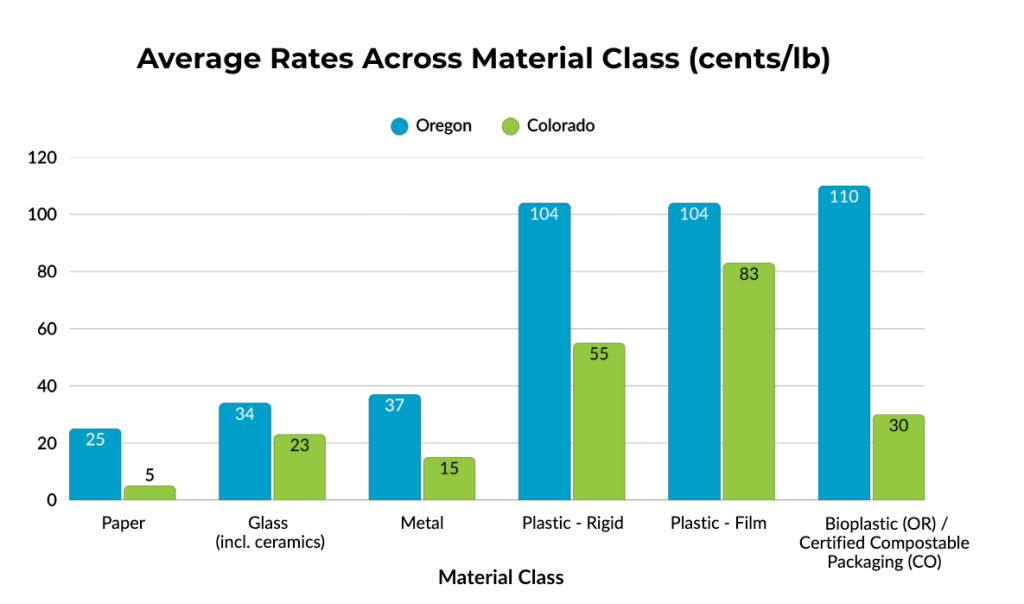
We find the first steps of improvement capital in Oregon and Colorado, the first to publish the fees that packaging producers will be charged for a wide range of packaging materials such as glass, aluminum, rigid plastic, flexible plastic and compostable packaging.  

To look at broad trends, it helps to combine the wide range of materials covered under these laws into a few select categories and to average the fees per category. For example, the fees for rigid plastic vary from 17 cents/lb for PET plastic (used in packaging such as water bottles) in Oregon to 171 cents/lb for “rigid other” in Colorado. 

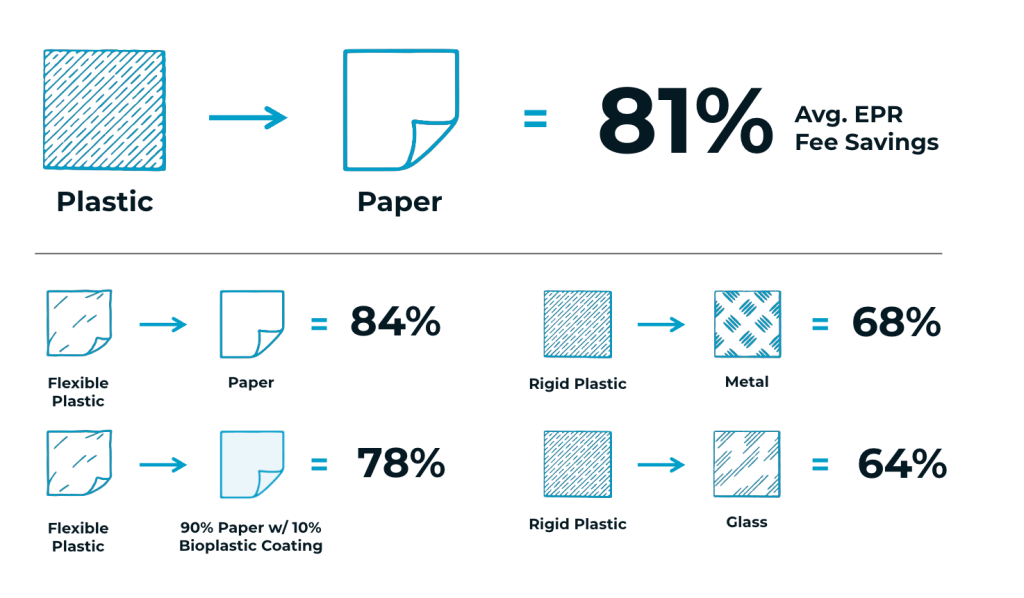
Looking at the average fees in Oregon and Colorado, we see that moving from rigid plastic to paper is a roughly 81 percent fee savings. Moving from rigid plastic to metal or glass gives companies savings in the 60 percent range, and moving from flexible plastic into a paper package with a bioplastic coating yields approximately 78 percent in savings. The takeaway? Companies could see substantial savings from switching to different materials — and these switches are reinforced by consumer perceptions about which materials are more sustainable. 

What might these savings look like for a typical company? To answer that question, imagine this:

  • A consumer packaged goods brand is planning a switch from 34,000 tons of flexible plastic packaging to a paper option
  • The brand does about 19 percent of their U.S. sales in EPR states with fees
  • This new packaging option will require a 16 percent increase in material usage 

In this scenario, the savings are significant: $11 million in fees saved across the seven EPR states. Of course, these savings will depend on a multitude of factors, and the cost of switching to a new material needs to be factored in. But even when an alternative such as paper is more expensive, innovation can lead to savings. More back-of-the-envelope calculations show that in this case, a 34 percent increase in material costs would still lead to over $600,000 in net savings. These are just sample calculations, but the take-home message is clear. Strategically switching to lower-fee materials can add up to meaningful savings. 

Redeploying savings 

Right now, EPR fees are likely going to come out of one part of an organization’s budget and investments in sustainability, new technology, and R&D are coming from another. But what if there could be some feedback mechanisms between the two? 

It will take collaboration and shared goals between finance, product and sustainability teams, but once the connection between fees and innovation has been established, you’ll have even more powerful incentives to build sustainability into your budget. 

This is when the exciting sustainability work begins. The savings from avoided fees could be used as a way to cover additional R&D and fund more testing into how well packages are being reprocessed at material recovery facilities, paper mills and composting facilities. The savings could also be redirected back into consumer education campaigns, especially around topics such as store drop-off where we know consumers are confused and need more information.

Fees can be a driver of innovation

Right now, the packaging industry has the opportunity to see fees as possible new investment capital. Companies can save money by switching to incentivized, lower-fee materials and packaging formats. Then, they can reinvest these savings back into the sustainable materials that once seemed out of reach. 

Your company can get started by: 

  • Cross reference the materials in your packaging portfolio with the base fees and dues posted for Colorado and Oregon, two states that have posted early fee projections   
  • Calculate the largest liabilities in your current portfolio, then run back-of-the-envelope calculations on the potential benefits of switching into lower-fee material categories 
  • Find out how you can make sustainable switches or work with packaging consultancies to support sustainable transformations

Just like the savings from lower energy bills can be directed towards other sustainable home projects, the savings in EPR fees can be funneled towards strategic innovations in materials and recycling infrastructure. 

With EPR laws in seven states, the packaging industry has the opportunity to reverse the rebound effect by turning fees into momentum needed to power sustainable packaging’s innovation flywheel.

The post How extended producer responsibility fees can fuel innovation appeared first on Trellis.

A new analysis from the $80 trillion-backed investor network FAIRR warns that most of the world’s largest protein producers are dangerously unprepared for the escalating threat of water scarcity, placing global food security and investor returns at risk.

The research briefing, “Water Insecurity in the Agri-Food Value Chain,” reveals that nearly two-thirds of the companies assessed in FAIRR’s Coller Protein Producer Index are failing to manage water-related risks effectively. The Index evaluates 60 of the world’s biggest publicly listed meat, dairy and aquaculture companies against sustainability themes linked to the UN Sustainable Development Goals.

The analysis also offers steps that business leaders can take to preserve water supplies — from mapping their full water footprint to setting basin-specific targets and standardizing how progress is measured. These actions, FAIRR says, are critical to safeguarding long-term water supplies as demand and stresses surge in the coming years.

“We are moving towards a future of water insecurity, particularly with the increase in intensity of droughts in different parts of the world,” Simi Thambi, climate and nature economist at FAIRR and co-author of the report, told Trellis in an interview. “It’s becoming a threat to business models, and yet it’s not explored that much.”

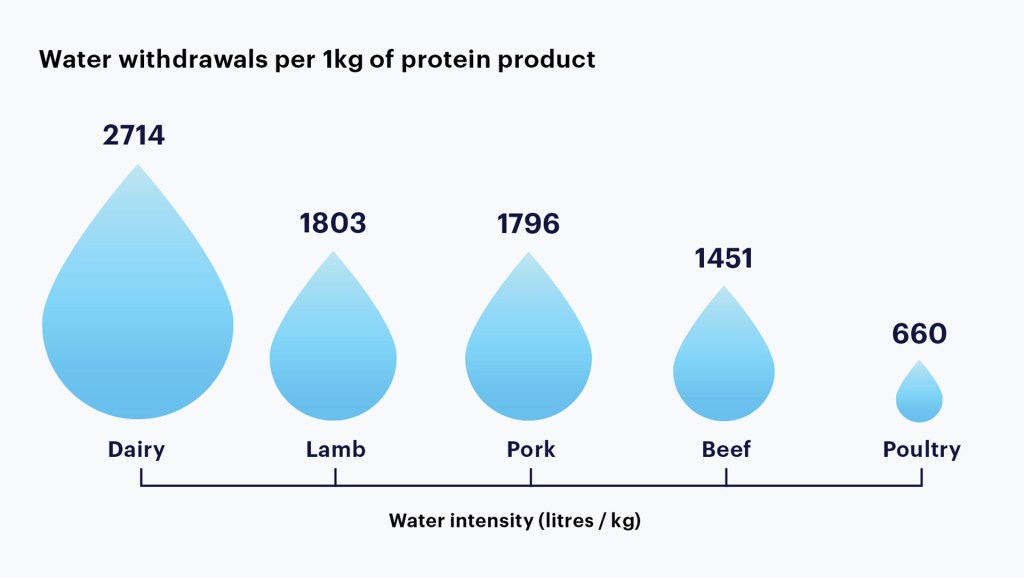
Source: FAIRR

Trace your water footprint beyond the factory gate

For many companies, the biggest water risks lie not in direct operations but in feed and supply chains. Yet FAIRR found that 84 percent of livestock firms fail to disclose where their feed crops come from — even when sourced from drought-prone regions such as northern China, India and the U.S. Midwest.

Only one, Texas-based egg and dairy producer Vital Farms, disclosed all feed sources from water-stressed areas. 

Others are likely under-reporting their exposure. Thailand’s Charoen Pokphand Foods, for instance, estimates its corn supply chain uses nearly 29,000 cubic meters of water per $1 million in sales — roughly 10 times higher than peers that count only direct operations. That difference highlights how much risk can remain hidden upstream.

“Supply chain disclosures of water usage and risk are very important because that’s where a lot of these water-intensive activities are concentrated,” Thambi said. “It’s not sufficient to disclose only direct operations because it doesn’t capture the full picture.”

Set basin-specific targets 

Only 10 companies in FAIRR’s 2024 Protein Producer Index have set targets to cut water withdrawals, and most focus narrowly on efficiency rather than absolute reductions.

By contrast, New Zealand dairy company Fonterra has committed to reducing withdrawals by 30 percent by 2030 at high-stress sites, while Charoen Pokphand has already achieved a 30-percent per-unit reduction domestically and is now expanding targets to overseas operations and suppliers.

The report also recommends tying these absolute reduction targets to executive pay. Such a move could be profitable for investors: BlackRock research cited in the report found that high-efficiency water users achieved better returns than peers.

Standardize metrics

Even when companies disclose water data, comparability remains poor. FAIRR urges firms to report water intensity per unit sales and link it to the source (groundwater, surface or rainfall) and stress level of each basin.

This would allow investors to benchmark risk and direct capital towards companies reducing withdrawals where it matters most. 

The takeaway

Global freshwater demand is projected to outstrip supply by 40 percent within five years. For the trillion-dollar livestock sector, the choice is clear: build water-resilient business models now, or face stranded assets and shrinking supply chains later.

“Just as big tech — and especially artificial intelligence — faces scrutiny over water use, a handful of highly dependent agri-food companies hold outsized influence in building water resilience,” FAIRR research manager and report co-author Henry Throp said in a statement. “It is critical that we understand the financial implications of water insecurity — and the value that can be generated in building resilience.”

The post Big meat producers must mitigate water risks. Here’s how   appeared first on Trellis.

Creating a pair of jeans requires as much water as an average U.S. household consumes in several days, according to Levi Strauss. Multiply that by $6.4 billion in annual sales, and the brand guzzles 66 billion gallons of freshwater a year.

Continuing its work to reduce the environmental impact of the denim industry, Levi’s latest strategy expands water stewardship from its plants to the communities in which they operate. A 35-page report, released Oct. 22, spells out this attempt to make a “positive impact” on water resources across 30 supplier nations.

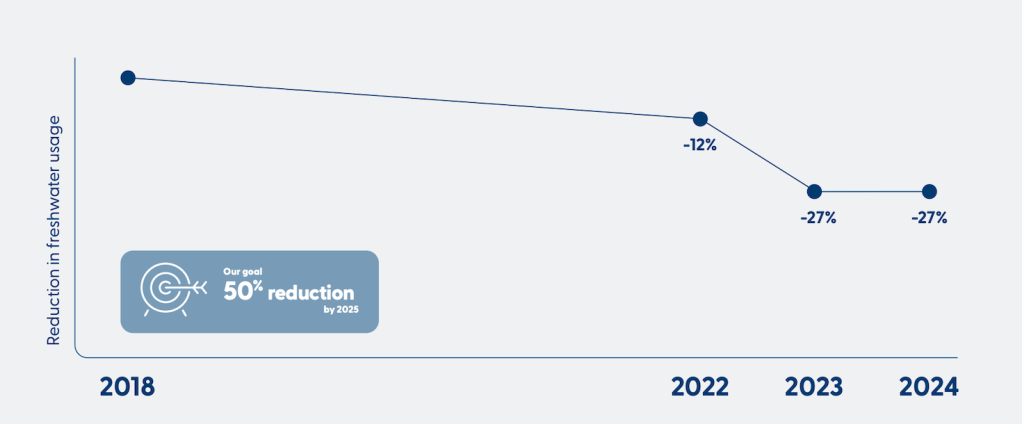
One key target is a 15 percent decrease in freshwater use across the Levi’s supply chain compared with 2022 levels. This comes on the heels of the company admitting to missing its goal to halve consumption in parts of the world with water vulnerabilities by 2025 over 2018 levels.

“Our aim is to build on our long-held commitment to water stewardship to make a positive impact on water quality, quantity and access while protecting and restoring nature,” Jennifer DuBuisson, senior director of global sustainability at Levi Strauss, told Trellis via email.

Cotton is a major driver of water pollution for the brand. Credit: Levi Strauss

Levi’s latest strategy also aims to:

  • Recycle or reuse 40 percent of water across manufacturing and mills, open-sourcing methods. This will account for two-thirds of the planned water reduction, with the final third resulting from efficiency measures.
  • Ensure that dyeing and other operations that create wastewater discharges comply with the Zero Discharge of Hazardous Chemicals Foundation.
  • Better understand “hot spots” for water use and pollution in raw materials and textile spinning plants.

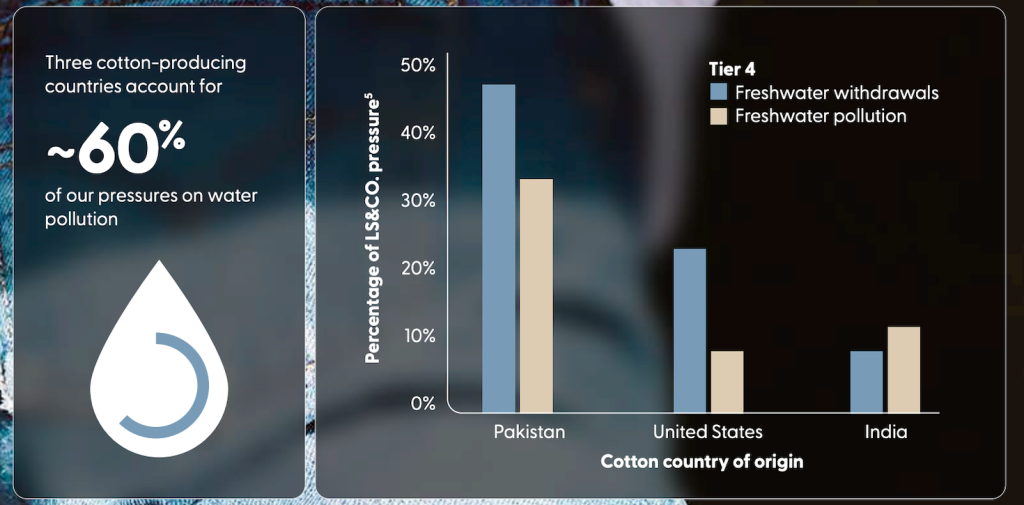
The company took a hard look earlier this year at the opposite ends of its supply chain — cotton field and factory floor — which are responsible for the biggest impacts. Using the Science-Based Targets for Nature framework, Levi’s found that 70 percent of its effects on freshwater systems come from growing cotton in stressed regions. Tier 1 manufacturing, including pollution from laundering, contributes between 16 to 38 percent of its impacts to freshwater.

The company also appointed Chris Callieri, its first supply chain officer to report to the CEO, in August, and launched a program to help suppliers in India adopt renewables a month later.

Its previous year’s progress included wet finishing suppliers in high-risk regions shrinking freshwater usage by 27 percent, a savings of about 1.8 billion gallons over six years. The amount of reused and recycled water among suppliers rose by 85 percent in that same period.

Water resilience

Moving forward, the company’s 2030 strategy includes the following water resilience efforts, which lack public numeric targets:

  • Creating projects to restore watersheds in high-stress areas, including in Pakistan and Bangladesh.
  • Bringing water, sanitation and hygiene projects to more people in developing regions.

Where it stands

The denim pioneer has long been a leader of water responsibility efforts in an industry in which only one-third of brands are currently working on water stewardship targets, and just 17 percent track progress, according to The Global Fashion Agenda Monitor’s report for 2024.

The company admits that it fell short of a goal set in 2019 for this year. Credit: Levi Strauss

Levi’s effort to create “waterless” jeans, which began in 2007, led to a Water>Less strategy that is now the open-source norm for the industry. Its techniques reduce water usage by 96 percent, according to the company.

Similarly, Levi’s is recognized as the first apparel brand to set global wastewater discharge standards, which it did in the 1990s. And 20 years ago, it joined the launch of the Better Cotton Initiative to reduce water usage in the growth of the crop.

Today, some 2.2 billion people globally continue to lack access to clean water, according to WaterAid America, which engages with Levi’s on water sanitation projects in India. In a press statement, WaterAid America’s CEO Kelly Parsons praised the partnership as addressing “one of the most challenging, but solvable, problems of this generation.”

“Their 2030 water strategy embodies the ambition needed for a water-resilient future,” said Jason Morrison, head of the CEO Water Mandate and president of the Pacific Institute.

The post Levi Strauss water strategy expands focus from factories to communities appeared first on Trellis.