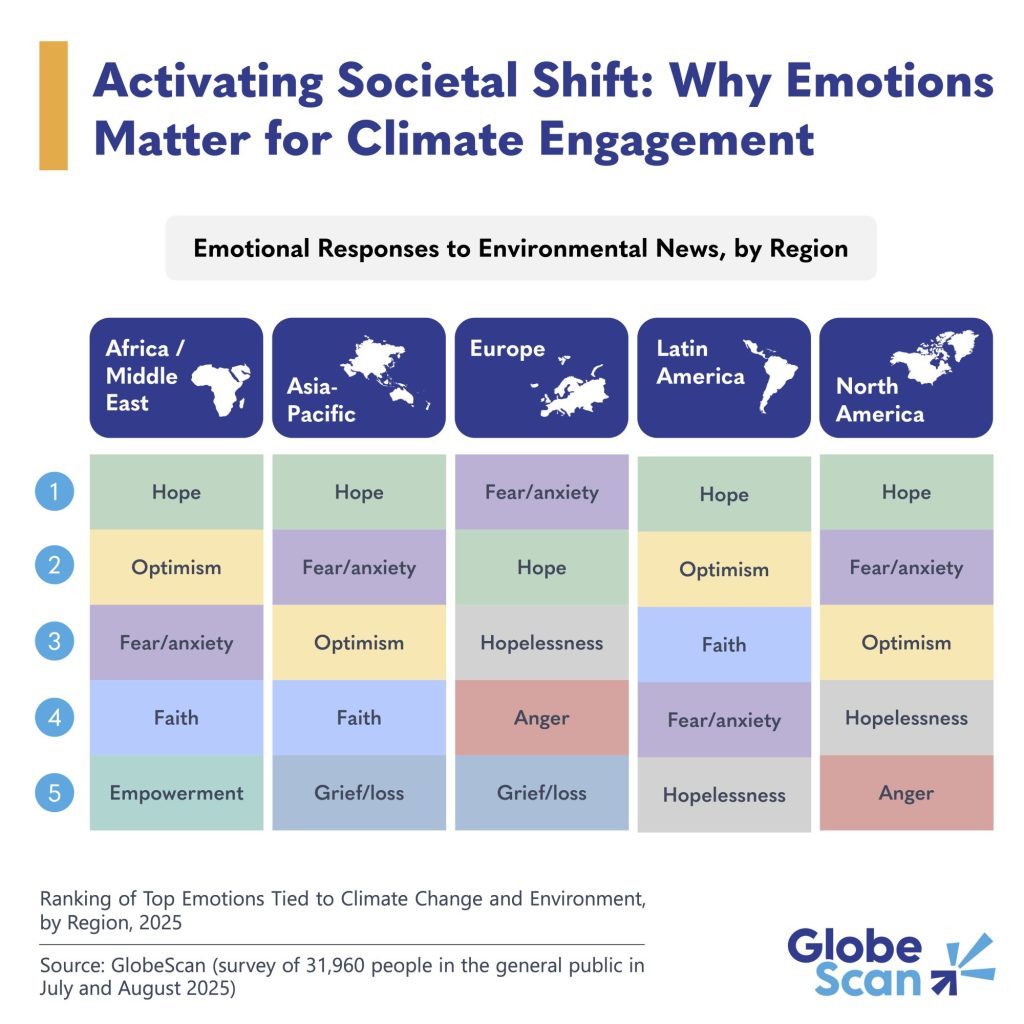
New research about how people engage emotionally with environmental, climate and nature-related issues show a large regional difference.
Trellis data partner GlobeScan’s research around what motivates people to act when it comes to climate change shows in Africa and the Middle East, people tend to feel hopeful and empowered, whereas in Europe and North America, reactions are often marked by fear, anxiety and a sense of helplessness. These contrasting emotional landscapes reveal that climate communication cannot take a one-size-fits-all approach. To truly resonate, messaging must be culturally attuned and reflect local emotional realities and values to inspire meaningful action.
What this means
GlobeScan’s project, called Societal Shift, shows that emotional responses to climate issues are varied, nuanced and full of potential — if harnessed effectively. In the Global South, where feelings of hope and empowerment are more common, there’s an opportunity to build on this optimism and resilience. These emotional foundations can support locally-driven solutions and leadership that reflect community values and aspirations. In the Global North, where fear, anxiety and helplessness are more frequently expressed, communication strategies can evolve to offer a more constructive path forward. This might include amplifying stories of action and not just intent or doom and gloom, to inspire confidence and a sense of agency. This might also include channeling frustration and anger toward calls for greater justice in the climate fight. Emotional engagement is not a distraction from climate action; it plays a central role in enabling people to move from awareness to meaningful participation.
Based on a survey of more than 31,000 people conducted in July and August 2025.
https://sustainable-future.org/wp-content/uploads/2025/03/cropped-trellis_favicon_180x180.png3232sustainablefuturehttps://sustainable-future.org/wp-content/uploads/2024/06/Untitled-design-117-300x94.pngsustainablefuture2025-10-17 22:00:002025-10-18 18:09:29How emotions shape climate action around the world
The global effort to decarbonize maritime shipping and reduce value-chain emissions stalled this week after intense lobbying from the U.S. forced negotiators to delay a decision on a net-zero plan for the industry.
Proponents of the plan had gone into a meeting of the U.N.’s International Maritime Organization (IMO) with cautious optimism. Earlier this year, nations agreed to set steadily increasing emissions-intensity limits on vessels under the IMO’s Net Zero Framework. Owners of large vessels would have been required to cut emissions by as much as 43 percent by 2035, compared to a 2008 baseline. The framework was hailed as the first time an industry would be so regulated at a global level.
The IMO meeting was expected to adopt the plan then move to implementation, but support drained away after the U.S. threatened to impose tariffs, visa restrictions and port levies on countries that backed the plan. On Friday, the nations voted to postpone a decision for a year.
‘Unprecedented effort’
“During the past three days, an unprecedented U.S.-led effort to block a global agreement has culminated in multiple spontaneous proposals, and intense pressure both on and out of the floor,” said Alison Shaw, IMO manager at Transport & Environment, a nonprofit with offices in multiple European countries. “It is a clear effort to enact climate denialism, undo years of constructive negotiation and abandon the very targets the IMO has set for itself.”
The decision will slow efforts by companies to reduce shipping emissions, which form a significant part of Scope 3 inventories, particularly for retailers and consumer packaged goods businesses. Maritime shipping accounted for around 2.5 percent of IKEA’s value-chain emissions in 2024, for instance. The company is aiming to purchase only zero-emissions ocean transport services by 2040.
“This is a loss of momentum for the shipping industry’s efforts to decarbonize,” said a spokesperson for Maersk, which operates more than 700 container vessels on routes between 130 countries.
Currently, companies intent on tackling these emissions rely on a patchwork of initiatives including Katalist, a “book and claim” platform that allows them to support and take credit for purchases of low-carbon maritime fuels, such as ammonia and methanol. Members include Amazon, IKEA, Levi Strauss, Mondelez International and Patagonia.
That project and others continue, but spread of the new technologies will be far slower in the absence of the rules the framework would have imposed.
“We are in a very early part of a transition, and more than 99% of maritime transport is still powered by fossil fuels,” said Jesse Fahnestock, director of decarbonization at the Global Maritime Forum, a non-profit that partners with shipping companies. “So to get alternative fuels and the vessels that can use them out there, the regulatory framework is a hugely important lever.”
Talks continue
Despite the pressure from the U.S. and others, nations agreed to delay rather than scrap the framework altogether. Fahnestock noted that because the proposal is still live, discussions about the details of implementation scheduled over the next 12 months may continue as planned.
“Our impression is that the how of the framework is going to continue,” he said. Talks will focus on which fuels qualify as lower-carbon, rules for life-cycle analysis of the fuels and how proceeds credits, which vessel owners can use to meet missed targets, will be distributed.
Still, standing in the way of an agreement is the world’s largest economy. In a joint statement issued last week, U.S. secretaries for state, energy and transportation said they were considering sanctions against officials from countries that support the IMO framework and blocking vessels registered in those countries from U.S. ports.
https://sustainable-future.org/wp-content/uploads/2025/03/cropped-trellis_favicon_180x180.png3232sustainablefuturehttps://sustainable-future.org/wp-content/uploads/2024/06/Untitled-design-117-300x94.pngsustainablefuture2025-10-17 20:56:252025-10-18 18:09:31U.S. lobbying stalls plan to transition maritime shipping to net zero
What started four years ago as a bold alliance of nearly 150 banks — together managing over $75 trillion in assets and pledging to align their lending with net-zero carbon emissions by 2050 — ended with an almost embarrassing dissolution as final members voted to cease operations after months of high-profile defections, political pressure and a steady erosion of commitments that had been watered down to the point of meaninglessness.
This failure demands our attention because it forces us to confront uncomfortable truths about the nature of voluntary cooperation, the power of political backlash and the gap between stated intentions and measurable outcomes. If we’re serious about addressing climate change through financial systems, we need to understand why the alliance failed — and we need to be honest about what actually works.
The illusion of voluntary commitment
Let’s begin with first principles. The alliance rested on a foundational assumption that major financial institutions, facing the physical and transition risks of climate change, would voluntarily constrain their most profitable activities in service of a collective good.
Consider the incentive structure. A bank’s fiduciary duty runs to its shareholders, not to the atmosphere. Oil and gas financing remains extraordinarily lucrative. Between 2016 and 2024, the world’s largest banks channeled $7.9 trillion to fossil fuel companies — despite the banks touting their own climate commitments. The banking alliance did nothing to change this fundamental calculus. It provided cover, not constraint.
From an impact investing perspective, this represents a category error that should have been obvious from the outset. Real capital allocation decisions — the kind that move markets and reshape industries — are driven by three forces: regulatory requirements, fiduciary obligations and demonstrable financial returns. Voluntary pledges might influence behavior at the margins, but they cannot override core economic incentives. The alliance tried to substitute moral persuasion for structural change and the result was entirely predictable.
The neuroscience of belief offers insight here. When we commit to an abstract principle such as “net zero by 2050,” our brains encode this as a virtuous intention — we receive a small dopaminergic reward for identifying with the moral position. But this reward is disconnected from the behavioral mechanisms that would actually produce the outcome. The banks experienced the psychological benefits of membership while continuing to finance fossil fuels at scale.
This isn’t hypocrisy in the traditional sense; it’s the predictable result of misaligned incentives meeting human cognitive architecture. To take a more cynical view, it may reflect less on human weakness and more on a deliberate calculation by bank decision makers concerned with the optics of commitment and participation.
The collapse: Political reality meets corporate resolve
The exodus began in December 2024 when Goldman Sachs withdrew, followed rapidly by other Wall Street giants including JPMorgan, Citi, Bank of America, Morgan Stanley and Wells Fargo. By summer, major international institutions HSBC, UBS and Barclays had also departed. The alliance’s assets under management plummeted from $75.5 trillion in November 2024 to $42.2 trillion by August.
While many alliance watchers would say the proximate cause was political, I’d argue that political pressure only accelerated failures that were already inevitable. The banks didn’t leave because they were forced to; they left because the costs of staying had begun to outweigh the benefits, and those benefits had always been largely reputational.
This reveals something crucial about the architecture of collective action on climate. When the political winds shift — and they will shift, repeatedly, across the decades required for the energy transition — voluntary commitments evaporate. This isn’t a moral failing; it’s a structural feature of systems governed by quarterly earnings reports and electoral cycles.
What actually works: Moving beyond performance
If voluntary alliances are insufficient, what will drive meaningful capital reallocation toward climate solutions? The evidence points to three mechanisms, none of which the alliance meaningfully advanced:
Regulatory requirements with enforcement mechanisms. The European Union’s sustainable finance regulations, however imperfect, create legal obligations that cannot be abandoned when political winds shift. They embed climate considerations into the operational fabric of financial institutions rather than relying on discretionary commitments. This isn’t ideological preference — it’s recognition that durable change requires changing the rules of the game, not asking players to voluntarily play differently.
Demonstrable financial returns in climate solutions. The renewable energy sector regularly delivers competitive returns with decreasing technological risk. Battery storage, green hydrogen and electric vehicles represent genuine investment opportunities. Capital flows toward these sectors not because of moral commitments but because the risk-adjusted returns increasingly justify the allocation. Impact investors and enterprises should lead with the “magnitude of the opportunity” rather than appeals to altruism, or even measurable impacts. Drop those in the appendix.
Transparency and accountability mechanisms that create reputational and legal consequences for material misrepresentation. This is distinct from voluntary pledges. When banks must disclose financed emissions with the same rigor they disclose credit risk, when greenwashing carries genuine legal liability, behavior changes. Not because hearts change, but because the cost-benefit analysis shifts. (The Eighth Circuit Court of Appeals paused the U.S. Securities and Exchange Commission’s litigation about its climate-risk disclosure rule last month.)
Honest assessment and action steps
The demise of the net zero banking alliance should prompt uncomfortable but necessary questions. How many other climate initiatives in the financial sector rest on similarly fragile foundations? How much of what passes for climate action is actually performance designed to forestall regulation? And most importantly: what would genuinely effective climate finance look like?
For business leaders, those committed to climate action through finance can:
Use the Science Based Targets initiative, which launched its Financial Institutions Net-Zero Standard in July, to help set goals.
Engage banks on specific projects by focusing on concrete, low-carbon transactions (clean power, green steel, renewable fuel) rather than abstract commitments.
Work with values-based banks, which you can find via the Global Alliance for Banking on Values, with more than 70 values-based banks with $265 billion in assets. There’s also Equator Principles Banks composed of 128 financial institutions using environmental/social risk frameworks for project finance and B Corp Certified Banks including Amalgamated Bank, Beneficial State Bank and Sunrise Banks.
The demise of the banking alliance is clarifying rather than demoralizing because it forces attention toward interventions that might actually work. And it reveals which institutions are genuinely committed to transition (largely smaller, mission-driven banks and credit unions) and which are mostly engaged in reputation management.
https://sustainable-future.org/wp-content/uploads/2025/03/cropped-trellis_favicon_180x180.png3232sustainablefuturehttps://sustainable-future.org/wp-content/uploads/2024/06/Untitled-design-117-300x94.pngsustainablefuture2025-10-17 10:00:002025-10-20 18:08:26A reckoning with reality: Lessons from the demise of the Net Zero Banking Alliance
JPMorgan Chase, the largest U.S. bank, has backed away from its pledge to cut the carbon footprint of its corporate offices, bank branches and data centers 40 percent by 2030.
JPMorgan said the transition away from “time- and percent-bound targets,” disclosed Oct. 15 in its 2024 Sustainability Report, will allow it to prioritize measures to reduce, avoid or replace greenhouse gas emissions by analyzing which projects have the largest potential impact relative to cost rather than making decisions based on whether an initiative will deliver specific cuts by a short-term timeframe.
“This evolution in our strategy reflects the insights we have gained over the years and enables us to adapt to a changing landscape, including increased power demand, the pace of technological advancement and the overall economics of sustainable solutions,” the company said in the report.
The original goal was set in 2021, along with pledges related to how JPMorgan makes financing decisions to support the development of low-carbon technologies. Its biggest competitors also have emissions reductions targets focused on their operations (Scope 1) and electricity consumption (Scope 2). For example, Citi aims to become net zero for those categories by 2030, and Wells Fargo is working toward a 70 percent reduction.
As of Dec. 31, 2024, JPMorgan cut emissions related to its operations and overall electricity consumption by 14 percent compared with its 2017 baseline, so it was running behind its original 2030 goal, according to a Trellis analysis of data from its 2023 and 2024 sustainability reports.
JPMorgan declined to comment officially on this year’s sustainability report, nor did it issue a press release about its publication.
Slow progress on renewable energy
The new approach applies to projects JPMorgan is considering across more than 6,500 global sites, such as on-site solar projects, power purchase agreements for renewable energy, lighting and energy efficiency measures and heating and cooling retrofits.
For example, JPMorgan in 2024 installed solar panels at 64 retail branches and three commercial offices; it also paired some of those new installations with energy storage, as part of a pilot project. Its goal in 2023 was to deploy 16 megawatt-hours of energy storage in Arizona and Delaware by the end of 2025. The company’s new headquarters in New York is the city’s largest all-electric tower, powered by a hydroelectric project upstate.
JPMorgan sourced 57,420 megawatt-hours of electricity from its on-site solar panels as of Dec. 31, 2024, up from 47,443 megawatt-hours in 2023. The bank didn’t disclose progress toward its 2030 renewable energy commitment in the latest report; in its 2023 report, the bank said it had reached 23 percent.
JPMorgan will use the cost of renewable energy and the price for high-quality carbon credits when assessing future investments. For example, the company signed a 13-year contract in May that will purchase credits for carbon captured at pulp and paper mills along the U.S. Gulf Coast. The bank paid less than $200 per metric ton of removal, one of the lowest prices reported for a deal of this nature.
$309 billion in green finance
JPMorgan is holding firm on its commitment to invest $1 trillion to support renewable energy, electric vehicles, climate adaptation and other initiatives in pursuit of a clean economy transition by 2030. The bank has so far deployed $309 billion toward that goal, including $68 billion in 2024. Much of that financing came in the form of green bonds or funds deployed for renewables and low-carbon energy projects.
JPMorgan deployed $1 billion in financing to climate adaptation and resilience projects in 2024, its first commitments to that category.
Funding the low-carbon transition
The bank is also sticking to commitments to reduce the emissions intensity of its investments in energy projects and in companies representing eight key economic sectors ranging from aluminum to shipping. Wells Fargo has backed off a similar pledge.
This activity falls into the category of “financed emissions,” and it typically represents the largest portion of any financial institution’s carbon footprint. It’s an area that members of the now-defunct Net Zero Banking Alliance had sought to address collaboratively. JPMorgan pulled out of the group in January.
Despite that defection, the bank still calculates and reports on its energy financing activities. It scrutinizes the amount of money it commits to high-carbon supply compared with its investments toward projects or technologies that support the transition to low-carbon energy. The overall ratio for 2024 was 1.13, meaning that for every $1 committed to high-carbon energy, JPMorgan put $1.13 toward low-carbon projects.
Aside from how it reviews energy financing, JPMorgan also uses 2030 intensity goals to assess investments related to auto manufacturing, aviation, shipping, iron and steel, cement and aluminum. “Our targets are designed to help us track our clients’ decarbonization progress and inform how we can best support our clients’ low-carbon transition objectives,” the bank said in its 2024 report.
For example, the carbon intensity of JPMorgan’s aviation investments has decreased about 20 percent since 2021, primarily because many of its clients in that sector have prioritized fleet modernization initiatives and other projects that have reduced their emissions.
Conversely, the carbon intensity for JPMorgan’s aluminum clients has increased 10.4 percent compared with the 2021 baseline, largely because of its support for companies in emerging markets, where production emissions tend to be higher.
Of the 917 bills that reached California Gov. Gavin Newsom’s desk over the past month, 794 were signed into law.
His decisions related to energy and environmental impacts reflect contrasts. For instance, he continued the state’s cap-and-trade program while green-lighting new oil drilling and rejecting virtual power plant advancement.
As for supply chains, the passage of a requirement for companies to disclose heavy metals in prenatal vitamins contrasts with rejected proposals to ban forever chemicals in cookware and plastic glitter in personal care products.
Here are the key new laws, as well as legislation that perished by Newsom’s pen.
Signed into law
Heavy metals disclosure: In 2027, prenatal vitamin purveyors will have to detail how much lead, cadmium, mercury or arsenic appear in their supplements under Senate Bill 646, which passed without opposition. A similar metals disclosure law for baby food went into effect in January.
“Cap and invest”: Newsom refreshed California’s existing cap-and-trade program through 2045. Funds enabled by Assembly Bill 1207 and Senate Bill 840 are meant to help efforts that include high-speed rail and wildfire prevention.
Drill, baby drill? Many environmentalists decried Senate Bill 237, which eases the approval of up to 2,000 oil wells in Kern County in the south of the state, purportedly to stabilize gasoline supplies.
Carbon capture win: Senate Bill 614 creates a regulatory structure for developing underground storage and pipelines for captured carbon dioxide, ending a moratorium. It’s seen as a boost for the growing carbon capture and storage industry.
Regional power: As the federal government decimates previous support for renewable energy projects, California is expanding its role within a regional power market. Assembly Bill 825 enables the state to trade more clean energy with other Western states.
Small solar boon: Under Assembly Bill 1104, small and midsize solar developers will no longer be considered “public works” organizations, sparing them red tape around labor rules.
Electrification plans: Assembly Bill 39 requires towns above 75,000 people to detail how they will electrify buildings and EV charging systems, especially in underserved communities.
Breakthrough for in-state glass: In a challenged market for recycled glass, Assembly Bill 899 updates California’s Beverage Container Recycling law to let CalRecycle pay higher incentives to in-state manufacturers that use recycled glass.
Vetoed
Forever chemicals stay: Senate Bill 682 sought to restrict harmful perfluoroalkyl and polyfluoroalkyl substances (PFAS) in pots and pans as well as dental floss and food packaging. Newsom said the bill would harm low-income shoppers. Concerns about toxic cookware became a flashpoint last year after a scare over fireproofing chemicals in black plastic spatulas.
No-go on glitter ban: Assembly Bill 823 would have expanded the 2015 Plastic Microbeads Nuisance Law to block the sale of personal care and cleaning products containing glitter, which pollute waterways. Newsom nixed it, stating that “it may incidentally result in a prohibition on biodegradable or natural alternatives.”
RIP to VPPs: Three separate bills would have advanced virtual power plants (VPPs)— which combine distributed sources of energy, such as electric car batteries and solar panels — to shore up the state’s electrical grid. Newsom said no to all of them, citing complications with existing state rules and programs.
Thirsty data centers spared: Assembly Bill 93 would have required California to check water consumption by fast-growing data centers. But Newsom said he was “reluctant to impose rigid reporting requirements about operational details on this sector without understanding the full impact on business and the consumers of their technology.”
https://sustainable-future.org/wp-content/uploads/2025/03/cropped-trellis_favicon_180x180.png3232sustainablefuturehttps://sustainable-future.org/wp-content/uploads/2024/06/Untitled-design-117-300x94.pngsustainablefuture2025-10-17 10:00:002025-10-17 18:08:32California’s new laws include climate and consumer wins — and setbacks
What started four years ago as a bold alliance of nearly 150 banks — together managing over $75 trillion in assets and pledging to align their lending with net-zero carbon emissions by 2050 — ended with an almost embarrassing dissolution as final members voted to cease operations after months of high-profile defections, political pressure and a steady erosion of commitments that had been watered down to the point of meaninglessness.
This failure demands our attention because it forces us to confront uncomfortable truths about the nature of voluntary cooperation, the power of political backlash and the gap between stated intentions and measurable outcomes. If we’re serious about addressing climate change through financial systems, we need to understand why the alliance failed — and we need to be honest about what actually works.
The illusion of voluntary commitment
Let’s begin with first principles. The alliance rested on a foundational assumption that major financial institutions, facing the physical and transition risks of climate change, would voluntarily constrain their most profitable activities in service of a collective good.
Consider the incentive structure. A bank’s fiduciary duty runs to its shareholders, not to the atmosphere. Oil and gas financing remains extraordinarily lucrative. Between 2016 and 2024, the world’s largest banks channeled $7.9 trillion to fossil fuel companies — despite the banks touting their own climate commitments. The banking alliance did nothing to change this fundamental calculus. It provided cover, not constraint.
From an impact investing perspective, this represents a category error that should have been obvious from the outset. Real capital allocation decisions — the kind that move markets and reshape industries — are driven by three forces: regulatory requirements, fiduciary obligations and demonstrable financial returns. Voluntary pledges might influence behavior at the margins, but they cannot override core economic incentives. The alliance tried to substitute moral persuasion for structural change and the result was entirely predictable.
The neuroscience of belief offers insight here. When we commit to an abstract principle such as “net zero by 2050,” our brains encode this as a virtuous intention — we receive a small dopaminergic reward for identifying with the moral position. But this reward is disconnected from the behavioral mechanisms that would actually produce the outcome. The banks experienced the psychological benefits of membership while continuing to finance fossil fuels at scale.
This isn’t hypocrisy in the traditional sense; it’s the predictable result of misaligned incentives meeting human cognitive architecture. To take a more cynical view, it may reflect less on human weakness and more on a deliberate calculation by bank decision makers concerned with the optics of commitment and participation.
The collapse: Political reality meets corporate resolve
The exodus began in December 2024 when Goldman Sachs withdrew, followed rapidly by other Wall Street giants including JPMorgan, Citi, Bank of America, Morgan Stanley and Wells Fargo. By summer, major international institutions HSBC, UBS and Barclays had also departed. The alliance’s assets under management plummeted from $75.5 trillion in November 2024 to $42.2 trillion by August.
While many alliance watchers would say the proximate cause was political, I’d argue that political pressure only accelerated failures that were already inevitable. The banks didn’t leave because they were forced to; they left because the costs of staying had begun to outweigh the benefits, and those benefits had always been largely reputational.
This reveals something crucial about the architecture of collective action on climate. When the political winds shift — and they will shift, repeatedly, across the decades required for the energy transition — voluntary commitments evaporate. This isn’t a moral failing; it’s a structural feature of systems governed by quarterly earnings reports and electoral cycles.
What actually works: Moving beyond performance
If voluntary alliances are insufficient, what will drive meaningful capital reallocation toward climate solutions? The evidence points to three mechanisms, none of which the alliance meaningfully advanced:
Regulatory requirements with enforcement mechanisms. The European Union’s sustainable finance regulations, however imperfect, create legal obligations that cannot be abandoned when political winds shift. They embed climate considerations into the operational fabric of financial institutions rather than relying on discretionary commitments. This isn’t ideological preference — it’s recognition that durable change requires changing the rules of the game, not asking players to voluntarily play differently.
Demonstrable financial returns in climate solutions. The renewable energy sector regularly delivers competitive returns with decreasing technological risk. Battery storage, green hydrogen and electric vehicles represent genuine investment opportunities. Capital flows toward these sectors not because of moral commitments but because the risk-adjusted returns increasingly justify the allocation. Impact investors and enterprises should lead with the “magnitude of the opportunity” rather than appeals to altruism, or even measurable impacts. Drop those in the appendix.
Transparency and accountability mechanisms that create reputational and legal consequences for material misrepresentation. This is distinct from voluntary pledges. When banks must disclose financed emissions with the same rigor they disclose credit risk, when greenwashing carries genuine legal liability, behavior changes. Not because hearts change, but because the cost-benefit analysis shifts. (The Eighth Circuit Court of Appeals paused the U.S. Securities and Exchange Commission’s litigation about its climate-risk disclosure rule last month.)
Honest assessment and action steps
The demise of the net zero banking alliance should prompt uncomfortable but necessary questions. How many other climate initiatives in the financial sector rest on similarly fragile foundations? How much of what passes for climate action is actually performance designed to forestall regulation? And most importantly: what would genuinely effective climate finance look like?
For business leaders, those committed to climate action through finance can:
Use the Science Based Targets initiative, which launched its Financial Institutions Net-Zero Standard in July, to help set goals.
Engage banks on specific projects by focusing on concrete, low-carbon transactions (clean power, green steel, renewable fuel) rather than abstract commitments.
Work with values-based banks, which you can find via the Global Alliance for Banking on Values, with more than 70 values-based banks with $265 billion in assets. There’s also Equator Principles Banks composed of 128 financial institutions using environmental/social risk frameworks for project finance and B Corp Certified Banks including Amalgamated Bank, Beneficial State Bank and Sunrise Banks.
The demise of the banking alliance is clarifying rather than demoralizing because it forces attention toward interventions that might actually work. And it reveals which institutions are genuinely committed to transition (largely smaller, mission-driven banks and credit unions) and which are mostly engaged in reputation management.
https://sustainable-future.org/wp-content/uploads/2025/03/cropped-trellis_favicon_180x180.png3232sustainablefuturehttps://sustainable-future.org/wp-content/uploads/2024/06/Untitled-design-117-300x94.pngsustainablefuture2025-10-17 10:00:002025-10-17 18:08:32A reckoning with reality: Lessons from the demise of the Net Zero Banking Alliance
Vestiaire Collective sells secondhand luxuries far below retail, such as Chanel tweed jackets for $1,500 and Fendi handbags for $650. It just became the first apparel marketplace to offer carbon credits as well.
The Paris-based peer-to-peer reseller is translating the carbon emissions saved by customers’ secondhand purchases into credits to fund its goal of a “100 percent circular business.”
“The ambition is to create a virtuous cycle, where measurable environmental performance generates the financial resources needed to scale it further,” according to Vestiaire’s “Shaping a Circular Future” 2025 report, released Oct. 3 along with its credits program.
Carbon credits are typically associated with high-emitting sectors such as steel or shipping, but Vestiaire argues that fashion belongs in that category too.
“For me, the idea of building revenue through impact work is very critical,” said Vestiaire Collective Impact Director Hortense Pruvost.
That said, critics warn that the carbon credits program is unintentionally encouraging overconsumption and even greenwashing.
Circular fashion
The fashion industry creates between 2 and 8 percent of global carbon dioxide pollution, depending on how one measures such things.
Vestiaire Collective is pricing its credits at almost $40 per metric ton of CO2 equivalent. It plans to offer 25,000 credits per year through Inuk, a Paris firm that verifies carbon credits.
In Pruvost’s view, making Vestiaire’s circular model viable through credits will advance sustainability in the industry. Buying pre-owned instead of new clothing offers 42 percent lower climate and energy impacts, according to a 2023 study in the Journal of Circular Economy.
“We’re definitely very combative about fast fashion and throwaway fashion in general,” Pruvost said of its mission to offer high-end, long-lasting goods. It lists items from more than 13,000 labels including Chanel, Missoni, Versace and Zegna. Vestiaire not only bans ultrafast brands such as Shein, but also more than 60 mass-production mall brands including Abercrombie & Fitch, Gap, H&M and Zara.
Vestiaire inspects fashions in its warehouse in northern France. To fight fakes, it has engaged some luxury brands whose merchandise it resells. Credit: Vestiaire Collective
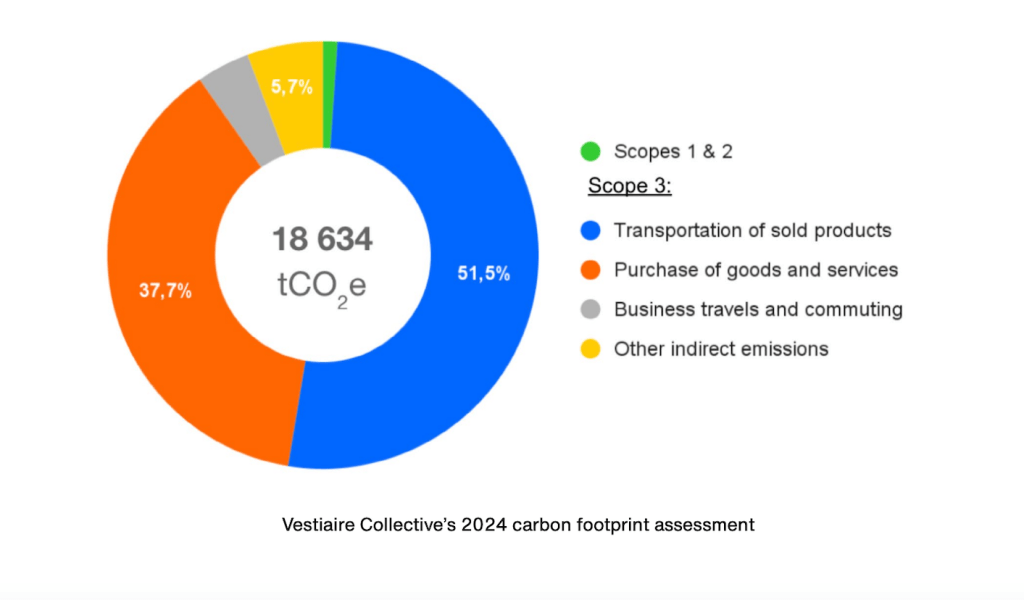
For Vestiaire, which has not reached profitability after 15 years, the carbon credits provide critical support. Most of its emissions come from shipping products, and the company creates no goods. However, for roughly one-third of sales, shoppers request authentication at a Vestiaire warehouse. Fending off knockoffs adds $17.56 per item. Authentication technologies eat up the equivalent of 12 percent of the company’s revenue, according to Vestiaire.
That threatens the company’s efforts to advance circularity, according to Pruvost. Artificial intelligence tools and digital product passports may offer future help, and add costs, against increasingly sophisticated counterfeiters, she added.
How the credits work
The carbon credits, available on Inuk’s website (French), are meant to attract institutional buyers that wish to support a circular economy.
Vestiaire partnered with Inuk to develop a new methodology rather than seek a global third-party certification body such as Verra or Gold Standard, according to Pruvost.
New Jersey firm AmSpec validates Inuk’s methods.
To arrive at a conservative estimate of avoided emissions for circular flows of goods, Inuk’s methodology considered a secondhand “substitution rate” of 85 percent, a measure of the pre-loved purchases that replace the need for new items. Inuk also considered a “rebound effect” that may lead a secondhand shopper to buy more clothes, in addition to the assumption that used items don’t last as long as new ones.
“This is a very novel space,” said Alena Raymond, senior principal life cycle analysis practitioner at AmSpec. “There aren’t rules that fit every program out there, and so the approach here was to pull from existing standards and industry best practices within the space of quantifying avoided emissions.”
The avoided emissions program is specifically tailored to Vestiaire to encourage a circular economy, Raymond added. In addition, it follows multiple standards from the International Standards Organization regarding lifecycle assessments, greenhouse-gas quantification and carbon footprinting.
A close parallel to Vestiaire’s program emerged in September, when London-based Bloom ESG launched credits for emissions avoided by hardware recyclers.
Vestiaire’s credits signal the need for a circular economy to assist broader economic decarbonization, according to Sebastian Foot, founding partner of Bloom ESG. “Creating new incentives for circular models that reduce fast fashion and divert clothing from landfill should be embraced,” he said.
Credit: Vestiaire Collective
Rewards or risks?
Despite apparent good intentions, however, Vestiaire’s program risks greenwashing, according to Benja Baecks, an expert on global carbon markets with the nonprofit Carbon Market Watch in Brussels.
“These credits don’t represent genuine emission reductions; they’re simply monetizing existing consumer behavior,” she said. “It sends the wrong signal by suggesting that buying more clothes, albeit used ones, is helping fight climate change.”
Pruvost, on the other hand, sees a payoff in risking controversy. “I’m very confident in our approach, but I’m also happy to take the risk, because for me it goes beyond the voluntary carbon market,” she said. “It’s really looking at how we fund the circular transition that we all wish to see happen.”
North American firms lag their counterparts around the world in the use of higher-quality Scope 3 data, a survey of more than 1,200 professionals from close to 100 countries shows.
The survey, conducted by the MIT Sustainable Supply Chain Lab, included responses from professionals working in supply chain, procurement, logistics, operations and sustainability.
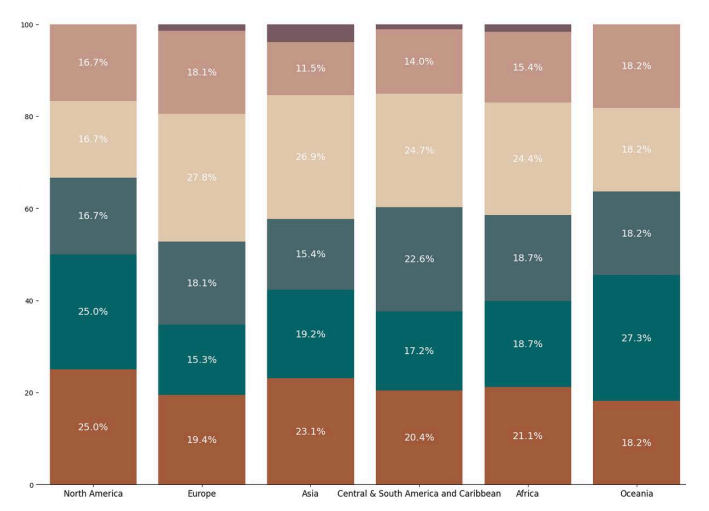
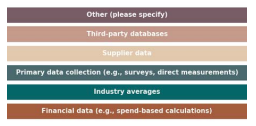
Half of all respondents in North America reported relying on the most basic kind of data on value-chain emissions — industry averages or spend-based estimates — compared to just over a third in Europe.
Use of data sourced direct from suppliers, which is generally more accurate, also showed regional differences: 28 percent of European businesses reported using supplier data, more than 10 percentage points higher than the rate in North America.
Data sources for Scope 3 measurement
The difference stems from the factors driving sustainability in the two regions, said Sreedevi Rajagopalan, an MIT research scientist and an author of the report.
European firms’ sustainability initiatives are more strongly shaped by regulation, particularly the EU’s Corporate Sustainability Reporting Directive, which requires standardized disclosures and greater transparency. These regulatory pressures have pushed European companies to invest in custom tools and supplier-level data collection.
In contrast, North American firms are primarily driven by investors and board priorities, which can be satisfied using spend-based estimates and industry averages.
“These methods are quicker and provide broad comparability—even though they’re less precise,” added Rajagopalan. “The trade-off is that spend-based and industry-average approaches can obscure real supplier-level improvements and sometimes even disincentivize sustainability investments. Companies using more detailed supplier data not only achieve more accurate emissions estimates but also strengthen supplier engagement and uncover new opportunities for emissions reduction.”
https://sustainable-future.org/wp-content/uploads/2025/03/cropped-trellis_favicon_180x180.png3232sustainablefuturehttps://sustainable-future.org/wp-content/uploads/2024/06/Untitled-design-117-300x94.pngsustainablefuture2025-10-15 14:38:032025-10-15 18:08:42Survey says: North America lags the rest of the world on value-chain data
The opinions expressed here by Trellis expert contributors are their own, not those of Trellis.
Companies, especially big ones, rarely tell the whole story. Instead, they focus on what makes them look good. Their half-truths not only conceal their harmful impact on the climate, but also create the false impression that they’re helping solve the climate crisis. This illusion of progress makes them directly complicit with Big Oil, trade associations and other groups actively blocking real climate action.
Positive brand perception is vital for companies, so it’s entirely natural that they seek to burnish their reputations. That’s what marketing is for, after all. When it relates to climate action, however, there’s a larger social context at play and other actors seeking to delay progress. This means their marketing can have massive negative consequences for our ability to make progress on climate.
The corporate world is accelerating these climate half-truths under the current administration. Whether they’re failing to disclose working with fossil fuel companies or misleading the public about the scalability of climate tech, many companies contribute to a narrative that’s slowing climate progress at a time when we need it more than ever.
These claims downplay the scale of the climate crisis and of the rapid systemic changes needed, and create the illusion of progress when any meaningful benefit is years or decades away. By celebrating their contracts for direct air capture or nuclear energy, for example, some companies are promoting hypothetical future benefits without adequately acknowledging the present reality — glossing over the long and uncertain time frame until those technologies scale, not to mention the risks and high costs.
Overhyping future benefits
Just look at AI. A recent paper suggested AI climate solutions could reduce global emissions by 3.2 to 5.4 gigatons of CO2-equivalent by 2035, potentially outweighing the energy demands of AI data centers. These benefits are possible, yet highly uncertain in both timing and scale. What’s more, this estimate ignores the fact that tech companies are selling AI tools to oil and gas companies to expand fossil fuel production, causing direct damage happening now. This is a misleading picture, like a CFO touting revenue while ignoring expenses. It downplays the severity of the climate crisis and the need for immediate, large-scale action and omits any mention of massive current harms.
Microsoft is a prime example. Since its 2020 goal to become “carbon negative” by 2030, its reported emissions have grown 29 percent largely due to new AI data centers. Microsoft is relying on large-scale carbon capture, which is unproven at that scale, to bridge the action gap. Worse, the company actively markets AI technology for use by fossil fuel companies such as Chevron and Exxon, enabling massive emissions today that far outweigh the benefits of its operational actions.
But it’s not just the tech industry. Other sectors also promote their achievements and potential benefits, while downplaying or sidestepping harms. For example, many companies with stated climate goals (including Coca-Cola, Procter & Gamble, and Uber) remain members of trade associations, such as the U.S. Chamber of Commerce, that lobby against climate action. Others, such as law firms and companies operating in consulting, marketing, banking and insurance, tout their work with climate tech companies while also serving fossil fuel clients. By assisting the oil and gas industry with lawsuits, funding and public deception, these companies are complicit in “enabled emissions” generated at everyone’s expense.
Company silence hurts public perception and policy momentum
Many companies are now “greenhushing” — downplaying or staying silent on climate action despite internal progress — in response to environmental rollbacks. A Bloomberg analysis shows climate mentions on S&P 500 earnings calls have dropped 76 percent in three years, and some companies such as Pepsi and Salesforce are weakening their climate goals.
The issue is that corporate silence (or misleading optimism) distorts public perception, dampens support for regulation and slows political momentum. This mirrors past fossil fuel industry tactics, where massive marketing campaigns fueled climate denial and stalled policy change.
When companies do talk about climate change, they often highlight future technologies and voluntary efforts, seeming to suggest that markets alone can solve the crisis. This approach reinforces the misleading idea that strong regulation isn’t necessary, even though it’s both essential and often beneficial for business. For example, companies proudly promote their wind and solar purchases but fail to acknowledge the government policies — R&D funding, renewable mandates and tax credits — that made those investments possible.
Rather than focusing mainly on unproven innovations, we should prioritize deploying existing solutions — wind, solar, energy storage, EVs, heat pumps and grid upgrades — which can scale quickly with the right policies.
Yet most companies remain silent on supporting the very policies that would help them cut emissions, lower costs and ensure long-term viability. Consider the recent “Big Beautiful Bill,” which threatened many clean energy gains from the Inflation Reduction Act. Despite one analysis showing the act’s energy tax credits would create 13.7 million jobs and drive $1.9 trillion in economic growth, very few companies, including Amazon, Apple, Google and Walmart, publicly advocated to save these programs. In fact, some, including Uber, 3M and Cisco, even endorsed the House version of the bill.
These companies may believe they’re protecting their business, but their actions contradict consumer desires. A September 2024 report found that three-fourths of Americans believe companies have a responsibility to limit their climate impact, and nine in 10 retail investors want companies to reduce emissions and prepare for climate impacts.
How to reverse corporate backslide
So, what should companies do differently? They need to be honest about the scale and systemic nature of the climate crisis. When discussing future technologies, they should clarify uncertainties in timeline, scale and cost, and emphasize that technologies don’t negate the need for rapidly scaling existing solutions. They need to be transparent about how their tech is being (or might be) used to harm the climate. They must also be honest and direct about the necessary government policies and regulations, and lobby hard for them.
Business has the power to move the needle and must step up to match the urgency of the crisis. Fortunately, tools already exist for business leaders, sustainability professionals and employees to steer companies toward meaningful action beyond half-truths and climate complicity:
When you see companies telling half truths, help them tell the whole story. If it’s your own company, work with colleagues to paint a fuller picture. If it’s another company, join their conversation on social media to highlight the parts of the story they’re glossing over.
Check out the Anti-Greenwash Guide for Agency Leaders published by Creatives for Climate and actively be on the lookout for ways to combat greenwashing and climate misinformation at work.
Join the growing LEAD community of over 1,000 sustainability professionals who are committed to speaking up for meaningful climate policy advocacy at work. Recognize that advocacy is a long game, but will scale your impact as a CSO.
Read and share ClimateVoice’s Employee Climate Action Checklist, which provides steps anyone can take to urge stronger corporate climate leadership and action at work.
Silence won’t lead to a brighter future. Moral courage, truth-telling, collaborative problem-solving and advocating for meaningful climate leadership will. We must hold companies and their leadership accountable to ensure they rise to the challenge, and quickly.
https://sustainable-future.org/wp-content/uploads/2025/03/cropped-trellis_favicon_180x180.png3232sustainablefuturehttps://sustainable-future.org/wp-content/uploads/2024/06/Untitled-design-117-300x94.pngsustainablefuture2025-10-15 10:00:002025-10-15 18:08:42Half-truths and hidden lies: How large corporations undermine climate action
One of L’Oreal’s most complex environmental goals is a push to replace petrochemicals — widely used in cosmetics for their moisturizing and blending properties — by relying on plants, minerals and recycled materials for 95 percent of its ingredients by 2030.
As of the French conglomerate’s latest progress report, for 2024, the category leader in cosmetics and personal care — with sales of $45 billion — has managed to reach 66 percent. That achievement is linked to its decision to embed “eco-design” principles into its 4,000-person research and innovation team more than eight years ago.
All new products for 2023 and 2024 were evaluated using the company’s proprietary Sustainable Product Optimization Tool, which considers 14 different environmental metrics as part of ingredients sections.
More recently, the ecodesign strategy inspired a new perfume made with fragrance collected from flowers using a water-free extraction system. It also drove the refinement of a vertical farm system that lets L’Oreal cultivate plants for its cosmetics using less land, water and energy. Both innovations address another L’Oreal goal: use recycled water for 100 percent of its industrial processes. So far, the company has achieved 53 percent.
“Our performance as a business cannot be separated from our performance from an environmental and social perspective,” said Marissa McGowan, chief sustainability officer at L’Oreal North America. “I would also say innovation is the mindset of continually striving to do better and continually striving to meet new needs, and sustainability is sort of synonymous with innovation.”
L’Oreal’s 250,000-square-foot scientific research center in Clark, New Jersey, which opened in February and employs 600 scientists and researchers.Source: Trellis Group/Heather ClancySource: L'Oreal
Dedicated space to nurture breakthroughs
Much of the ecodesign work for North American products happens at L’Oreal’s 250,000-square-foot scientific research center in Clark, New Jersey, which opened in February. The facility employs 600 scientists and engineers, who have been challenged to use 12 principles of “green chemistry” on behalf of research intended for the U.S. market. (The lab is responsible for about 20 percent of L’Oreal’s formulations globally.)
McGowan meets with the head of that lab at least monthly to review goals on a brand-by-brand basis. The goal is to prioritize substances that are biodegradable, found in nature and require less energy and water — for both production and consumption.
For example, L’Oreal is leaning into shea butter, which it sources from trees and seeds grown by Burkina Faso communities in West Africa. The substance features prominently in more than 1,700 products, including a new Biolage professional salon line that restores nutrients to damaged or colored hair without using paraben (a known endocrine and hormone disruptor), silicone or mineral oil. L’Oreal scientists developed a way to concentrate the butter, so less of it needs to be used, a process they demonstrated during my September visit to the Clark facility.
Another breakthrough is glycolysine, a patent-pending, bio-based surfactant used in the new CeraVe Air Foaming Cleanser, launched in summer 2025. The substance replaces synthetic substances that can be skin irritants. It’s made from a combination of glycolipids from plants or fungi, and polylysine, an amino acid polymer. The cleanser doesn’t require water to create the foam: a special pump mixes air with the product as it is dispensed, creating bubbles.
Each brand is responsible for its own environmental design priorities, but CeraVe’s growth has exploded over the past five years to more than $2 billion globally, and that’s one reason its work gets special attention. L’Oreal studies the potential ripple effect of an innovation when deciding where to prioritize.
“We do have a brand-by-brand approach, but once that technology comes through in one brand, we look to see how we can scale it across the portfolio and it becomes available for all the brands,” McGowan said.
L’Oreal uses shea butter in more than 1,700 products, including a new salon line that restores nutrients to hair without using paraben (an endocrine and hormone disruptor).Source: Trellis Group/Heather ClancySource: L'Oreal
New cultivation and extraction technologies
L’Oreal’s product-agnostic approach to ecodesign is illustrated by two technologies under development for several years and formally introduced this summer.
Osmobloom, created through a partnership with Cosmo International Fragrances, is an air-capture system for extracting fragrance molecules from flowers while leaving the bloom intact. Traditional approaches use steam, solvents and fats to absorb the fragrance. The equipment uses less energy, water and chemicals. It also enables L’Oreal to harvest flowers that were previously considered “mute,” such as lily of the valley and hyacinth, and those from the iconic orange blossom and tuberose. The first product to result from the innovation: a perfume, Private Talk from Valentino Beauty, made from tuberose plants. L’Oreal has 12 ingredients under development.
At the end of the Osmobloom extraction, the flower is intact and can be used for other applications — such as an ingredient in herbal tea. “We’re adding to the supply chain, not taking away,” said McGowan.
Another technology that will be used across brands is an early-stage, artificial intelligence-powered vertical farm called BioPods developed by Interstellar Lab, a startup that was part of L’Oreal’s innovation accelerator program.
BioPods use 99 percent less water than traditional farming methods, by recycling water, and also capture carbon dioxide. They were initially created for applications in outer space, but L’Oreal sees the technology as important for growing plants in territories impacted by climate change. BioPods will also allow for more cultivation near production facilities.
In recent demonstrations, BioPods were used to grow Centella asiatica, which produces an ingredient called madecassoside, a compound with anti-inflammatory, antioxidant and anti-aging properties.