The opinions expressed here by Trellis expert contributors are their own, not those of Trellis.​

Last year, the BBC’s “Panorama” aired a feature-length exposé on corporate “carbon neutral” claims. One of its most-circulated clips featured a secretly recorded conversation in which a consultant explained that after a company measures its carbon footprint, it can reduce its emissions by “one tonne” and then offset the rest to claim carbon neutrality. 

The consultant’s firm later claimed the clip was taken out of context, arguing it was contrasting a minimal neutrality standard with more rigorous net-zero frameworks. But the damage was done. For many viewers, myself included, it felt like the end of carbon neutral as we knew it.

But that moment didn’t kill the term; it simply signaled its decline. In recent years, the voluntary carbon market has evolved, with reforms aimed at making it bigger and better. The focus has shifted from “reduce a little, offset the rest” to higher standards of ambition, integrity and transparency. 

This is a good thing. But the real challenge now is replacing carbon neutral with a new, equally intuitive and widely accepted claim. Without one, we risk losing something important: the ability for companies to communicate their climate progress in terms that most people can easily understand.

How a useful catalyst became a crutch

Carbon neutral started as a catalyst for climate action. Two decades ago, early adopters such as the flooring company Interface helped popularize its usage, and in 2006 the New Oxford American Dictionary crowned it the Word of the Year. The appeal was obvious: measure, reduce, offset, declare neutrality — simple enough for any consumer to grasp. As Trellis recently reported, that simplicity mainstreamed early action and helped unlock real dollars for climate solutions.

But the very simplicity that made neutrality so communicable also made it brittle. It was never intended to be a hall pass for business-as-usual. At the same time, it was challenging to execute, especially the offset aspect. Investigations and lawsuits further eroded trust in the claim. Courts in Europe, including in a recent case involving Apple’s product marketing, have tightened the screws. New EU consumer rules will effectively prohibit offset-based carbon neutral claims for products starting in 2026 unless lifecycle emissions are actually zero. Brands took note and many are phasing out the term pre-emptively.

None of this should surprise us. What counts as robust climate ambition has grown up. We now expect science-based targets, credible transition plans, supplier engagement and transparent disclosures — alongside any use of high-integrity credits for residual emissions or beyond-value-chain mitigation. 

What we’re losing as the label fades

If you care about integrity of corporate climate claims, you should welcome the end of “reduce a little, offset the rest.” But it’s also true that we’re losing something: a claim that was sticky, marketer-friendly and increasingly recognized in the marketplace. Apple has hinted that ditching the language makes communicating climate action harder. The nonprofit Climate Neutral even rebranded, from a neutrality label to the Climate Label, shifting emphasis from offsets to funding emissions-cutting activities relative to a company’s footprint. That’s progress, but it also underscores the communications challenge we’ve created by retiring a term without offering a mass-market replacement.

Like it or not, simplicity sells. If we don’t give companies a short, truthful, testable and tellable way to explain credible climate action, we shouldn’t be taken aback when we hear that this is a significant barrier to action. 

Can ‘net zero’ fill the gap?

Perhaps, but we should be realistic. Net zero is more accurate and ambition-raising, yet it lacks the instant comprehension carbon neutral once enjoyed. It’s also increasingly guarded by gatekeepers such as the Science-Based Targets initiative and International Organization for Standardization, and it’s unclear where those bodies will land on corporate use of carbon credits. 

Meanwhile, claims such as “climate positive” and “carbon negative” carry much of the same baggage as carbon neutral. Organizations such as the Voluntary Carbon Market Integrity initiative are doing important work to codify credible corporate claims, but it’s not yet apparent if a single, sticky phrase that works for companies (because it resonates with consumers) will emerge. 

The good news is that businesses want to act. According to recent research convened by VCMI, businesses see a real opportunity to use carbon markets — alongside deep value-chain cuts — to meet their climate commitments and make progress toward goals. The takeaway: if we set clear rules and credible guardrails, there’s demand for action.

Three recommendations for where to go from here

1. Acknowledge the permanent critics—and move on. Some people will oppose any corporate claim until the world reaches global net zero. Their critique can be principled, but it’s not a basis for mass action. We should design claims for integrity and impact, not for unanimity.

2. Be rigid on substance, flexible on words. NGOs, standard-setters and regulators should set firm expectations for companies: establish near- and long-term science-based targets; ensure verifiable emissions reductions; develop credible transition plans; engage suppliers; maintain transparent accounting; and ensure that any credits used meet high-integrity standards with appropriate use cases (offsetting a portion of Scope 3 emissions). 

But we should be more pragmatic when it comes to communicating the journey to customers. Since we in the NGO world are not marketing experts, we need to work collaboratively with marketers to ensure the language is compliant, clear and persuasive. The standard should be truthful, testable and tellable.

3. Consider a second life for carbon neutral. In jurisdictions where credit-based neutrality claims for products are going away, we still need something consumers understand. And yes, this may mean being open to giving carbon neutral a second life in limited, rigorously defined contexts.

But if there’s too much baggage and countervailing momentum, we need a replacement that shares its virtues: short, sticky and easily understood. As any marketer would tell you, it’s hard to sell a “contributing to global climate action” watch. I believe the path to victory on climate will be paved, in part at least, by pragmatism and compromise.

Claims such as carbon neutral have an added value that contribution claims often lack: They invite closer scrutiny and this scrutiny fosters accountability, which in turn drives progress. The contribution framing (“our investments contributed to global net zero”) may be accurate, but it often lacks the scrutiny that comes with neutrality claims. Many see it as a softer business incentive that draws less attention. Recent research underscores this gap: contribution claims are stronger on integrity and legal defensibility, but the paper doesn’t identify a compelling business case that would make them attractive to companies. 

In contrast, neutrality claims have prompted greater accountability, attracting media, NGO and regulatory focus. This scrutiny has highlighted flaws, sparked introspection and accelerated higher standards of transparency and clearer rules for using credits appropriately. Ironically, if companies had consistently relied on contribution language, there would’ve been less oversight, less accountability and likely a slower path to the improvements we see today.

The path forward

The evolution of the voluntary carbon market is fixing much of the substance problem that neutrality papered over: higher standards, clearer guardrails, greater transparency and more consistency. Now we must fix the story. Killing the old approach to carbon neutral is the right call. Leaving nothing in its place on the claims front isn’t. We need every tool in the toolkit. And if we want more capital flowing into real decarbonization and high-integrity mitigation — especially for nature and communities that depend on it — we have to give companies a claim that regulators accept and customers grasp and respond to. That’s the assignment.

The post Why it’s time to find a new term for ‘carbon neutral’ appeared first on Trellis.
Federal support for two flagship megaton direct air capture (DAC) hubs designed to generate millions of credits for carbon markets has been terminated, according to a leaked list of cancelled grants.

The Department of Energy, which awarded the grants, denied the awards have been rescinded and said no decision about the projects has been made.

The Louisiana- and Texas-based projects are among the highest-profile carbon removal projects underway in the U.S. and were expected to eventually receive more than $1 billion in government support. The Louisiana facility, known as Project Cypress, is designed to remove 1 million tons of carbon dioxide from the atmosphere annually by 2030. 1PointFive, the developer behind the Texas facility, pegged the project’s annual removal potential at 30 million tons.

Both facilities would dwarf the largest existing direct air capture projects, which remove and store at most tens of thousands of tons of CO2 annually.

“We’ve missed an opportunity here to take a leap forward in terms of scale,” said Erin Burns, executive director of Carbon180, a carbon removal think tank.

Credit consequences

The decision to terminate initial grants of around $50 million each to both projects was first reported by Heatmap and Semafor.

“It is incorrect to suggest those two projects have been terminated,” DOE Chief Spokesperson Ben Dietderich said in response to an inquiry from Trellis. “No determinations have been made other than what has been previously announced,” he added, referring to an announcement made last week about other climate projects that would be canceled.

Heirloom, a startup involved in the Louisiana project, said it had not been told its grant would be canceled and Climeworks, another partner in the Louisiana hub, described the reports as “rumors.”

The move would, however, be consistent with the position of the Trump administration, which has dismantled major chunks of existing federal support for climate action since taking office. Uncertainty around DOE funding had already led to layoffs at Heirloom and the stalling of progress on a federally funded $35 million carbon removal competition.

Withdrawal of support for the DAC hubs would have repercussions for the availability of durable carbon removal credits. Heirloom has signed deals to supply credits to United Airlines Ventures and Microsoft, for example. 1PointFive is also contracted to supply credits to Microsoft and recently inked an agreement with JP Morgan Chase — but in those cases the credits will be supplied by the company’s STRATOS facility, a separate Texas project that is expected to enter service this year.

Ceding leadership

Smaller projects like STRATOS and Mammoth, a facility in Iceland operated by Climeworks, have been financed on the promise of future revenues from credit sales. This funding mechanism will continue to be used by project developers, noted Burns. But the end of federal funding for larger projects would mean “giving up U.S. leadership on direct air capture,” she added.

“The U.S. is really good at developing these technologies,” she said. “What we don’t always see is the benefit of actually building those technologies once they become commercial.”

“The U.S. is home to hundreds of carbon removal companies, but other countries are catching up fast,” said Giana Amador of the Carbon Removal Alliance and Ben Rubin of the Carbon Business Council, in a joint statement. “The U.S. DAC Hubs program, with $3.5 billion appropriated by Congress, was set to support the largest carbon removal facilities in the world and was intended to further establish American leadership in the sector. If funding for the [hubs] is cut, the door will be open for other countries to take up leadership of the industry, and claim the job creation and economic benefits of carbon removal.”

The post DOE: ‘No decision has been made’ on defunding direct air capture projects appeared first on Trellis.

Aldi, Etsy, Netflix, PepsiCo, REI and Weyerhaeuser are among more than a dozen companies testing a new methodology for disclosing the impact of climate initiatives, including replacing diesel vehicles and investing in low-carbon aviation fuel. 

The guidance comes from an independent group of greenhouse gas accounting experts, led by former sustainability pros from Netflix and Amazon and formally known as the Task Force for Corporate Action Transparency. Their tools, published in late September, are meant to complement other reporting frameworks. 

For example, rules from the widely used standards body Greenhouse Gas Protocol outline ways to report on actions to mitigate electricity consumption, which fall under Scope 2. They don’t address methods for discussing the impact of other activities aimed at reducing emissions such as insulating buildings, replacing diesel trucks with electric vehicles, reducing methane emissions from livestock and closing down a business unit as part of a merger. 

Those methods often relate to Scope 3, which covers emissions from a company’s business partners and customers. 

“I would underscore the idea that there has been an explosion of these instruments,” said Chris Davis, a former Amazon executive, interim director for the Task Force for Corporate Action Transparency. “The avenues for progress have outpaced the ability to talk about it.”

“Companies are becoming more sophisticated, and in trying to meet their targets, they are implementing various programs to reduce emissions in their operations and supply chains,” said Noora Singh, senior director of sustainability at PepsiCo. “Unfortunately, the current standards and approaches lack the level of detail and sophistication needed to reflect or record these activities in reporting.”

Common frustration

The lack of disclosure guidance threatens to stall the adoption of approaches emerging to support the adoption of technologies such as sustainable aviation fuel and zero-emissions vehicles. These methods allow corporations to “claim” the environmental benefits related to buying into specific projects or contracts, even if they aren’t directly using the services.

“Under existing standards, it’s unclear how companies can participate,” said Sam Brundrett, environmental impact lead at Etsy. “That ambiguity doesn’t just create hesitation; it threatens to stall action altogether precisely when speed and scale matter most.”

Etsy’s role as a marketplace makes it difficult to directly control emissions reductions, he said.

The Task Force for Corporate Action Transparency was born two years ago through informal discussions. “When I was at Netflix implementing and building our strategy, I wanted to start reporting on all these things we were doing, and I was looking for disclosure guidance,” said Alexia Kelly, now managing director of the carbon policy and markets initiative at High Tide Foundation. “There was no uniform guidance.”

The group’s initial guidance was written to stand up to third-party assurance by organizations that verify ESG disclosures. It includes:

  • Mitigation Action Accounting and Reporting Guidance, which outlines ways to disclose on initiatives not covered under GHG Protocol rules.
  • Target Accounting and Reporting Guidance, a framework for accounting for progress against voluntary climate targets. 

PepsiCo is particularly interested in using the methods for reporting on emissions reduction programs that don’t fall into Scope 2. “We have a number of initiatives, whether it’s upstream in our ag supply chain for fertilizer production, third-party transportation switching to alternative or electric vehicles or various on-farm practices, and it would be helpful to test all of these using that accounting document,” Singh said.  

What’s next

The group enlisted corporate reporting professionals to test its guidance in 2025 and 2026; it may add a few others aside from the dozen-plus companies already committed to the pilot, said Davis.

The task force also plans to solicit feedback through public consultation in early 2026, with a view to publishing updated versions of these documents late next year, Davis said.

The group is aligning its guidance to updates under way at the GHG Protocol, which is revising many of its rules as part of an extensive overhaul, Davis said. It is also in conversation with other standards bodies including the Science Based Targets initiative, the Integrity Council for Voluntary Carbon Markets, the Center for Green Market Activation, the California Air Resources Board and the Voluntary Carbon Markets Initiative.

“The hope is not that this becomes the definitive solution but rather that the established standards, once updated, will adopt some of the approaches proposed by [the task force] and incorporate them into official guidance,” said Singh.

“We want to inform existing systems and move forward,” Kelly said. “We just want this problem solved.”

The post PepsiCo and Etsy are trying a new way to track emissions reductions appeared first on Trellis.

A foundational data source that shapes the work of sustainability professionals across multiple sectors will disappear if the Trump administration goes ahead with plans to scrap the Greenhouse Gas Reporting Program, critics of the move warn.

The program, run since 2009 by the Environmental Protection Agency, requires around 8,000 oil refineries, power plants and other industrial facilities to submit annual emissions reports to the agency. EPA administrator Lee Zeldin proposed scrapping the program last month, describing it as “nothing more than bureaucratic red tape.”

Sustainability professionals see it differently. 

“The Greenhouse Gas Reporting Program matters to everyone, not just the companies that report,” said Sean Hackett, senior manager for energy transition at the Environmental Defense Fund. “It’s the most comprehensive source of emissions data. It underpins investor confidence, regulatory oversight and supply chain accountability across the economy.”

“The corporate world has built sustainability and investment plans around all it does,” added John Milko, senior managing policy advisor at Carbon180, a carbon removal nonprofit.

Cascading impacts

Ending the program would trigger a cascade of negative impacts, they and others warn, because the program provides a standardized data set that feeds into work across the economy. This includes life-cycle assessments and product-carbon footprints, which rely on emissions data from facilities upstream in the value chain.

In construction, for example, companies building data centers and other facilities are increasingly demanding that low-carbon steel and concrete be used. “We want to move to a system that improves the calculations of that embodied carbon,” said Milko. “Shuttering the largest-scale program that is seeking to standardize that data is counterproductive to the sustainability goals of large corporations.”

The move also places billions of dollars of announced investments in carbon removal in jeopardy, including direct air capture projects and plans to capture and store emissions from industrial facilities. The economics of these projects rely on a tax credit known as 45Q, which was made more valuable in 2022. Projects totaling $77 billion in capital expenditures plan on making use of 45Q, but companies need to access data from the Greenhouse Gas Reporting Program to claim the credit. 

“Canceling the greenhouse gas reporting program means you can’t get 45Q,” said Julio Friedmann, chief scientist at Carbon Direct, a carbon management firm. “Whether this is intentional or accidental, it’s very bad. It will chill investment, cost time and money and impair trade.”

Increased costs and complexity

Zeldin framed his proposal as a move that would save businesses billions of dollars by cutting regulatory burdens, but experts warn of increased costs to businesses that report to the program. Companies would still need to collect emissions data to comply with state regulations, demands from investors and requirements from countries they export to. “Without that federal baseline, companies would face a patchwork of state and voluntary programs that would increase costs, uncertainty and complexity,” said Hackett.

Companies wishing to comment on the EPA’s proposal have until Nov. 3 to share feedback. To learn more before commenting, Trellis recommends the following briefings:

The post What you should know about the EPA’s plan to stop collecting emissions data appeared first on Trellis.

The opinions expressed here by Trellis expert contributors are their own, not those of Trellis.​

President Donald Trump’s big tax and spending bill, along with a series of executive actions targeting climate and clean energy programs, are disrupting clean energy manufacturing, supply chains and deployment that had been surging this decade.

Notably, these actions include curtailing tax credits that had driven hundreds of billions of private dollars into clean technologies, making it more difficult to build new energy projects and stopping nearly completed projects in their tracks. These steps actually run directly counter to many of the Trump administration’s own economic and energy goals.

Instead of reducing electricity prices, the bill is projected to increase them by making the quickest-to-build and most affordable new power sources more expensive at a time of rising electricity demand. Instead of restoring America’s manufacturing base and supply chains, the slow deployment will undermine private investment into new clean tech factories planned across the country and their supply chains. And instead of positioning the U.S. to better compete in global industries, the bill effectively cedes key 21st century technologies such as batteries, electric vehicles and energy infrastructure to China.

While these issues have become unfortunate fodder in the culture wars, they were always economic. You can see that in the effort major businesses from across the U.S. economy made throughout 2025, as they pressed Congress to maintain clean energy incentives. And it’s why, amid rising energy prices and economic change, businesses should continue to advocate for clean energy policy that helps to meet energy demand and sustainably grow the economy. In this difficult political environment, climate and clean energy policy must focus on building up U.S. industry and innovation by advancing affordable, reliable, homegrown clean power. 

For sustainability professionals, this is an opportunity to better align key corporate functions with policy priorities and help guide your company’s support through the rest of this Congress. Here are some key policy areas where companies should advocate.

Extend and simplify tax credits

Trump’s big bill takes sharp aim at wind and solar power, rapidly phasing out tax credits for these energy sources if they don’t start construction by next summer or aren’t up and running by the end of 2027. At the same time, the administration has imposed unreasonable restrictions on many wind and solar projects and changed qualification rules, making it harder for projects to get started in time to claim what remains of the tax credits. 

These actions threaten to dramatically slow down deployment of wind and solar power — the most affordable and quickest-to-build energy sources — at a time when the nation needs all the energy it can get as quickly as possible to affordably meet surging demand.

Businesses should call on Congress to provide greater stability and a longer runway for wind and solar power. We need that affordable power to meet the increasing energy demand for data centers, artificial intelligence and new manufacturing facilities. Restoring the incentives will also support new manufacturing jobs as companies work to reshore supply chains to make these technologies in the U.S. 

As the general public and lawmakers from both parties recognize the need for new power sources to prevent skyrocketing utility bills and investments shifting abroad, businesses can play a powerful role in advocating for extended incentives and cutting bureaucratic red tape to accelerate the build-out of solar and wind power.

Make American transportation cutting edge

Congress is due to renew its every-five-year transportation infrastructure funding in 2026 to strengthen the nation’s roads, bridges, railways and more. Not only is this an opportunity to fund critical projects and repairs, but it also presents an opportunity to fully modernize U.S. infrastructure and the transportation systems that companies across the economy depend upon.

Businesses should call for this legislation to support jobs and innovation in industrial materials that are central to our infrastructure such as asphalt, concrete and steel. Incentives for cleaner industrial processes will further support investment and jobs that are already taking root across the country, positioning the U.S. to lead the world in building materials that are in growing global demand.

It is also a timely opportunity for companies that want greater access to electric vehicles to advocate for policies that expand access to them, and for the U.S. auto industry to secure policies that help it compete in a changing global economy. New investment in mining, processing and refining critical minerals would shape domestic supply chains for batteries, while further deployment of charging infrastructure would support wider-spread adoption of the innovative and cost-saving vehicles they are building.

Meet the economic moment with smart permitting

Red tape holds up investment, so meeting the nation’s surging energy demand and supporting domestic manufacturing will require smart policy changes that make it faster and easier to build. Businesses especially need new transmission infrastructure to reliably deliver affordable power, and the U.S. must also find ways to responsibly source our growing need for critical minerals. In each case, it will take reforms that make it more efficient to secure permits and increase certainty for businesses and investors as they take these projects on.

Bipartisan momentum for federal permitting reform has grown in recent years. While negotiations fell short in the last Congress, the need has only increased. Republicans and Democrats have a real opportunity to negotiate responsible reforms that support homegrown clean power and advanced manufacturing to meet the nation’s energy, economic, and national security needs. Businesses are well-suited and well-positioned to help bridge the political divide and make the economic case for action.

The post 3 ways companies can push clean energy forward despite federal rollbacks appeared first on Trellis.

Signet, parent company of jewelry retailers Kay and Zales, streamlined its environmental, social and governance strategy in 2023 to focus on 11 goals rather than 44. 

Some commitments set just two years earlier, including a pledge to hit net zero by 2050 and a series of diversity, equity and inclusion goals, were dropped during the paring. The driving vision for the overhaul: set near-term targets for 2030 that were prudent and achievable, according to Signet’s sustainability team. 

“One of the benefits of this refinement is it helps the entire company be really focused on our roadmap for sustainability and be really clear,” said Anna Bryan, senior director of ESG reporting and communications at the $6.7 billion company’s planetary impact.

The shift is showing up in Signet’s employee retention rates, which are 20 points higher than the industry average for jewelry retailers, said Colleen Rooney, chief corporate affairs and sustainability officer for Signet. “We feel like it adds value to the organization in many forms,” she said. “It definitely attracts talent.”

Recycling and reuse

A dominant theme of Signet’s refined focus is responsible mining and sourcing practices, a longstanding priority for the co-founder of the Responsible Jewelry Council.  

The world’s largest diamond retailer is also prioritizing the use of recycled materials and incorporating more repurposed gems and precious metals into its new designs, a strategy also embraced by rivals Tiffany and Pandora, which has switched entirely to recycled silver and gold

The two-decade-old Responsible Jewelry Council is advocating more circular sources across the jewelry supply chain to reduce the environmental and human rights impacts of mining, including new standards introduced in February that apply to lab-grown diamonds. Signet is well on track with commitments requiring all suppliers to ado pits code of conduct (100 percent) and to be certified by the council (91 percent).

“With jewelry, ‘recycling’ is different than it is with other products since diamonds and gold don’t otherwise get thrown away,” said Paul Zimnisky, principal with research and consulting firm Diamond Analytics. “But as natural gemstones and precious metals get rarer, I think we will see more repurposing in this way. I think it will become more common.”

Signet hasn’t set specific goals for growing the number of jewelry collections that use repurposed materials, but so far it features six — more than 200 separate pieces — under the Zales, Rocksbox, Kay and Ernest Jones retail brands. It also resold 65,000 pieces collected from customers during its most recent fiscal year: Signet’s Zales, Kay, Jared and Diamonds Direct brands offer a store credit to those who trade in jewelry while upgrading to a new piece. 

The company has recovered 22,589 troy ounces of gold, 18,089 troy ounces of silver and 52,031 carats of diamonds, according to its 2025 sustainability report. The value of the recovered metals is at least $35 million.

“We are so very fortunate to work in an industry where the raw materials have value and can be resmelted, repurposed,” said Bryan. “It’s such an advantage when it comes to retailers that have products that don’t have a clear path or avenue for recycling.”

New emissions goals

Signet’s commitments for reducing greenhouse gases are nascent. Its emissions goals for the 2031 fiscal year were only set in March: a pledge to cut emissions from operations (Scope 1) and electricity use (Scope 2) by 11 percent, and a commitment to reduce the carbon footprint from suppliers (Scope 3) by 17.5 percent.

Signet uses an open-source target-setting and reporting methodology published by the Center for Sustainable Organizations, which executives said allow for quicker adjustments as market conditions or resource availability changes. 

“We got really acquainted with the methodology, and we have this ongoing communication with the operations team and with the real estate team about levers we can pull or actions we can take,” Bryan said. If the team wants to adjust its scenarios, it can do so more easily. “We can get quicker results than if we were working with an outside consultant and had to rebase or remodel.”

Scope 1 and 2 account for 78 percent of Signet’s reported emissions inventory for FY25; the data it includes for Scope 3 is narrow and includes waste from operations and fuel/energy-related activities. 

To reduce its electricity consumption, Signet is prioritizing energy efficiency conversions such as the installation of LED lighting in stores. It’s also seeking ways to build clauses related to the adoption of renewable energy into leases. That’s simpler to do for some brands such as Jared and Diamonds Direct, which typically operate in independent buildings. Signet is exploring ways to collaborate with other tenants in shopping malls, where Kay and Zales typically are located.

To cut its Scope 3 impact, Signet expects 85 suppliers doing at least $5 million in business with the retailer to start disclosing emissions and set annual reduction targets, practices required under updates by the Responsible Jewelry Council. The company said more than 40 percent of its supply chain uses at least some renewable energy in the manufacturing process. 

“Footprint details are difficult to ascertain for industries with deep and complex supply chains,” said Zimnisky. “However, the diamond and jewelry industry has made significant progress in the area in recent years. It is encouraging to see such a global supply chain work together in this way.”

The post Why Signet, the world’s biggest diamond retailer, wants your old jewelry appeared first on Trellis.

After four years, the banking industry’s signature joint effort to advance Paris Agreement-aligned climate targets is no more. The roughly 120 members of the Net Zero Banking Alliance (NZBA) said on Oct. 3 they will stop work immediately.

Their decision was no shock to many watching the group contract over the past 11 months. The alliance had been on hold since Aug. 27 pending a collective decision about its fate.

But the permanent end sparked both outrage and resignation from activists, with some calling financial institutions cowards for folding to anti-ESG pressure by President Donald Trump and legal threats by Republican lawmakers. Other experts, however, insisted that the alliance’s closure reflects climate finance moving into a new, action-oriented stage.

Whatever the case, the blush of excitement had long worn off since the banking alliance launched in 2021 under the United Nations-backed Global Financial Alliance for Net Zero (GFANZ). At its peak, the NZBA included more than 140 members in more than 40 countries. In December, JPMorgan Chase triggered an exodus that resulted in departures by the biggest U.S. and Canadian banks, as well as HSBC, Barclays and UBS of Europe.

By January, the GFANZ umbrella group had restructured, weakening itself. Many of its eight sub-organizations lowered their original ambitions. (The Net-Zero Insurance Alliance disbanded completely in 2024.)

‘Doomed to fail’

“We won’t mourn the NZBA,” said Lucie Pinson of Reclaim Finance, a Paris nonprofit that lambasted banks for financing fossil fuels twice as much as it backs cleaner alternatives. “Like other financial alliances of its kind, it brought little — if anything — to the climate, and was doomed to fail. Its purpose was never to take real action, but to create the illusion of measures in order to ward off the risk of regulation.”

The group urged policymakers and regulators to force the issue — that is, to stymie the oil and gas industry while boosting sustainable alternatives. Over the past nine years, the biggest banks in the world have forked out $7.9 trillion to Big Oil, according to the Banking on Climate Chaos report that Reclaim Finance produced with the Sierra Club, Bank Track and other nonprofits.

“Senior bankers need to be far more courageous in this decisive moment for all our futures and must use their influence to push up standards for accountability on climate if we are to stand any chance of making the clean energy transition happen,” stated Jeanne Martin, co-director of corporate engagement at ShareAction, who called the banking alliance’s cessation “bitterly disappointing.”

‘Good news overall’

The NZBA’s contraction reflected an evolution from “collective action to collective learning,” according to Brian O’Hanlon, managing director of climate-aligned finance at the Rocky Mountain Institute in Washington, D.C.

For example, bank financing is beginning to tilt in favor of low-carbon energy, according to Bloomberg New Energy Finance in January. For every dollar in 2023 that fueled high-carbon fuels, 89 cents supported cleaner wind and solar or grid technologies, it noted.

The Environmental Defense Fund supports that view. “There has been a pivot away from aspirational target setting towards a focus on concrete projects and the complex financial mechanics needed to make them happen and scale them,” said Andrew Howell, head of research in sustainable finance at EDF, based in New York. “This is good news overall.

Falling by the wayside, per Howell: the idea that commercial banks might sacrifice returns for net zero.

“Climate finance, like other types of finance, needs to be delivered in a way that produces competitive risk-adjusted financial returns,” he said. “And the good news is that this is in fact happening across the economy.”

What’s left

“At least [the alliance’s] demise brings clarity: the institutions genuinely committed to containing global warming will continue to act,” added Pinson of Reclaim Finance.

Meanwhile, the guidelines and responsibility for banks to support the low-carbon transition remain the same, according to the Global Alliance for Banking on Values. It advocates for divesting from fossil fuels and financing renewable energy.

“It has always been the primary responsibility of banks to chart their own course in terms of impact and transparency,” said a spokesperson at the Amsterdam nonprofit, which represents more than 70 values-led banks. Those include Amalgamated Bank and Climate First Bank, which were two of the three remaining U.S. members of the NZBA. Areti Bank bank was the other.

Beneficial State Bank of Oakland, California, had aspired to join the NZBA. “With the alliance folding, we’ll lose critical opportunities for accountability and shared learning,” said Terra Nielson, the bank’s executive vice president and chief impact officer. With less guidance and coordination, major banks are focusing on the short-term headwinds rather than the long-term risks of propping up high-emissions industries, she added.

The Net Zero Banking Alliance will keep available its latest guidance framework public for financial institutions. The 20-page document advocates for banks to set Paris-aligned, near- and long-term net zero goals; to annually report on emissions related to their investments and other activities over a baseline year; to back up targets with science-based decarbonization scenarios; and to regularly align goals with the latest science.

The post Net Zero Banking Alliance folds, marking a new phase for climate finance appeared first on Trellis.

Ralph Lauren is no longer committing to a 2040 horizon for net zero. Instead, it’s focusing on “rolling” targets every five years that leadership believes it can execute with confidence. The strategy comes as the iconic fashion brand has beat its science-based emissions deadline of 2030 for the past two years.

On the surface, the company is swimming against the corporate tide by getting rid of its long-term target, one that had not been validated by the Science-Based Targets initiative (SBTi). Seventy percent of companies on the Global Forbes 2000, of which Ralph Lauren is one, have a net zero target, according to the New Climate Institute.

At the same time, however, Ralph Lauren shows progress rare in the apparel industry, overshooting its 2030 target of 30 percent emissions cuts, which is SBTi-validated: It made cuts of 34 percent since 2020 across Scopes 1, 2 and 3. In 2024, it was already at a 33 percent emissions reduction.

An ‘exemplar’ (but)

The company said it seeks to maintain progress by focusing on what it can directly control, rather than counting on new technologies, like textile recycling, that haven’t scaled yet. In the next few years, it plans to set new sustainability targets that will come due in 2035.

Ralph Lauren’s annual emissions fell in its latest count to 1,230,541 metric tons of carbon dioxide equivalent, according to its FY 2025 sustainability report, released Oct. 2. That’s about as much as 151,000 U.S. homes emit each year.

“We will continue to follow a science-based methodology aligned with the Paris Agreement to advance our work,” the report said, “further scaling proven approaches across raw materials sourcing; direct supplier engagement to phase out on-site coal; and advancing collective financing mechanisms to fund relevant supplier initiatives.”

“Ralph Lauren’s decarbonization progress is impressive and can serve as an exemplar of what is possible,” said Ken Pucker, an apparel industry veteran who teaches at Dartmouth and Tufts universities. But, he continued, “with the elimination of the company’s net zero goal, and the focus on shorter-term goals, it is surprising to not yet see revised targets.”

Emissions origins

Scope 3 is responsible for 99 percent of Ralph Lauren’s greenhouse gas footprint. The top three sources are raw materials, at 26 percent, followed by processes such as mills and dyeing shops (18 percent) and consumer product use (17 percent).

Three key areas helped the emissions progress reported in 2025, according to the company:

  • A selective strategy of producing fewer units for sale: However, Ralph Lauren does not share production totals — a common blind spot in fashion that activists would like to see revealed.
  • Sourcing lower-impact materials: In 2025, Ralph Lauren reached “sustainable” materials in 98 percent of goods, a 6 percent rise from a year earlier. While many other brands are embracing polyester and other fossil-fuel fabrics, Ralph Lauren uses only 6 percent polyester. Cotton makes up 80 percent of its fabric, almost all of it organic, recycled or grown using regenerative practices.
  • Helping suppliers to eliminate coal: Toward this effort, only one of the 80 plants that Ralph Lauren has worked with internally still uses coal. Ralph Lauren engages 170 supplier facilities through the Apparel Impact Institute’s Carbon Leadership Program. In 2025, it joined the institute’s Future Supplier Initiative, which helps finance suppliers’ energy transitions.

Varied reactions

Ralph Lauren’s 2025 report attracted a mix of admiration and concern. The nonprofit Ceres, for one, advocates for companies to blend both distant and near-term climate deadlines. “A net-zero target sets a clear North Star for a company to align internal teams, engage its suppliers and respond to stakeholder expectations and current and emerging regulations, including those outside of the United States,” said Ceres Company Network Senior Director Mary Ann Ormond.

In June, the activist group Stand.earth rated Ralph Lauren a D+ on its 2025 fossil-free fashion scorecard. The company is one of only six major labels markedly phasing out synthetics, which the nonprofit noted while dinging it on climate commitments and transparency.

The post Ralph Lauren ditches 2040 net zero for ‘rolling’ 5-year targets appeared first on Trellis.

Levi Strauss is teaming up with Schneider Electric to help garment suppliers in India adopt renewable energy. The partnership seeks to engage, educate and assist about 70 suppliers in inking deals over the next three years. 

The hope is that those suppliers will later roll out the learnings to their own suppliers, driving emissions reductions deep into the Levi’s supply chain.

That need gnaws at the fashion industry. Upstream activities — from producing raw materials to producing yarns, fabrics and garments — make up 70 percent of its climate emissions, according to the advocacy group Fashion Revolution.

The Schneider-Levi’s LEAP collaboration, announced on Sept. 23, addresses complaints suppliers have expressed about the difficulties of doing away with the dirty coal and gas that is ubiquitous to apparel factories and mills. LEAP, which stands for LS&Co. Energy Accelerator Program, also draws on Levi’s learnings over the past three years from participating in Walmart’s Project Gigaton power purchasing agreement.

The San Francisco brand projects that shifting to renewable energy can deliver as much as 20 percent of the supply-chain emissions cuts needed to meet its 2030 target: a 42 percent reduction over 2022 levels. The new project in India would make up about 3 percent of the near-term Scope 3 emissions, according to Levi’s Senior Director of Global Sustainability Jennifer DuBuisson.

The proof-of-concept LEAP initiative will help companies either broker power purchase agreements or install solar or other sources onsite. The company plans to “meet suppliers where they are,” she said. “We’re a little bit renewable-energy-mechanism agnostic.”

Levi’s and Schneider want to expand LEAP to the European Union or Asia-Pacific nations as soon as 2026.

The Schneider factor

It’s the first time Schneider has formed such a partnership in fashion. Based outside of Paris, the energy management firm’s other collaborations have touched retail (Walmart’s Project Gigaton), real estate (Blackstone portfolio upgrades), food and beverage (PepsiCo supply chain energy cuts), technology (Microsoft’s 100-percent renewable energy goal) and healthcare (Pfizer efficiency and renewables).

Levi’s has already engaged since 2022 with Schneider in Project Gigaton PPA. Through the project, an Orsted wind farm in Kansas is meant to provide most of the electricity needed through 2036 by the U.S. and Canadian plants Levi’s owns and runs.

“By extending that experience to their own suppliers through LEAP, Levi’s is building confidence in what’s possible and creating a practical, partnership-driven model that others across the fashion sector, and beyond, can replicate to accelerate decarbonization,” said John Powers, vice president of global cleantech and renewables at Schneider Electric.

Sampling Levi’s suppliers

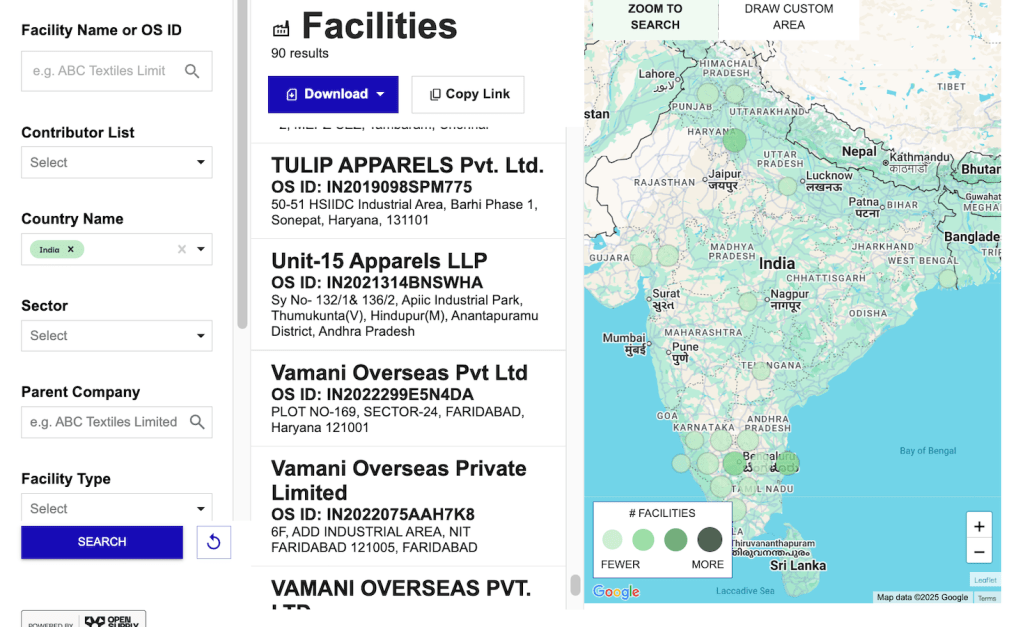
A glimpse of more than 90 Levi’s supplier facilities in India. Credit: Levi’s map, Open Supply Hub

Ceres Company Network Senior Director Mary Ann Ormond praised the denim maker’s transparency in both its climate transition plan and the co-launch of LEAP.

Levi’s was an outlier in its industry for creating a Climate Transition Action Plan in 2024 that details near-term steps toward net zero. That process helped to prioritize emissions-slashing priorities, according to DuBuisson.

“This transition plan highlights that it is not about a silver shiny bullet that does not exist,” DuBuisson said. “These are solutions in the market today that we need to be accelerating, and that’s what we’re trying to do with LEAP.”

Schneider’s experience appealed to Levi’s, she added. “There’s a whole team with years of expertise sitting on the ground ready to answer suppliers’ questions and help them develop the business cases they need.”

In Levi’s other supply chain decarbonization work, it is involved with both the Apparel Impact Institute’s (AII) Carbon Leadership Program and AII’s efforts to advance thermal energy including heat pumps. AII works in India to help textile manufacturers electrify and ditch fossil fuels.

India made an ideal launch pad for LEAP in part because it allows for pooled PPAs, according to DuBuisson. “I was just there and continue to be inspired by the amount of innovation and amazing work that’s happening among these suppliers,” she said. Other favorable conditions include incentives for renewable energy purchasing.

Fashion emissions

With LEAP, Levi’s is taking a stand on the fashion industry’s hidden emissions gorilla within Scope 3. It may have ripple effects across the industry, or at least among the suppliers that serve many other brands, too. 

“As measures of success, we hope to see a measurable increase in suppliers’ renewable electricity procurement in India and eventual expansion of the program throughout Levi’s supply chain to reduce Scope 3 emissions, increase supply chain resilience and inspire peer companies to take similar actions,” said Ormond of Ceres.

However, some critics want multi-billion-dollar brands like Levi’s to back suppliers financially, too.

“Fashion brands helping their suppliers overcome barriers to access high-quality, additional renewable energy through mechanisms like onsite solar and PPAs is a sure sign of progress in turning climate targets into tangible action,” said Ruth MacGilp, fashion campaign manager of Action Speaks Louder. “However, technical support without financial investment and fair purchasing practices to fill the gap of upfront costs is unlikely to reduce risk for suppliers at a sufficient scale for deep decarbonization.”

DuBuisson pointed out that Levi’s is continuing two programs that help to lower climate-transition financing costs for suppliers — the International Finance Corporation’s Global Trade Supplier Finance and HSBC’s Sustainable Supply Chain Finance Program. “But ultimately we really see LEAP as a play in resiliency for suppliers and the ability to make them more competitive for the many brands they are likely sourcing for,” she said. 

“All boats rise. A supplier is producing garments for multiple brands and whether it’s a Levi’s program or another program, this is about decarbonization. That’s what we’re after.”

The post Inside Levi’s and Schneider’s bid to clean up garment supply chains appeared first on Trellis.

For companies seeking to improve the accuracy of Scope 3 inventories, corporate carbon footprints can offer an upgrade to more commonly used methods. But a new study from European researchers suggests that “unpredictable variation” in company-level data severely limits the usefulness of the approach.

To total up Scope 3 numbers — emissions from suppliers, use of products by customers and other indirect sources — companies most often base estimates on activity levels or spending. For a purchase of steel, for instance, a company might multiply the quantity purchased by an estimate of the emissions associated with the production of a typical ton of the material. Use of these emissions factors makes the process relatively easy to implement, but such broad estimates disadvantage suppliers selling lower-carbon versions of a product.

As an alternative, a supplier can estimate its total emissions — its corporate carbon footprint — and allocate a fraction of that total to its customers, depending on how much of its output each purchases. The process, which is used by CDP and other standard-setters, ensures the benefits of any emissions reductions implemented by the supplier will be passed on to customers — but it also means many less relevant factors influence the estimate.

Unstable estimates

Company footprints can fluctuate due to acquisition or divestments, for example. Product lines can be eliminated or expanded, and accounting methodologies change. All would impact a supplier’s footprint — and hence the emissions allocated to customers — but might not change the actual emissions associated with the customer’s purchases.

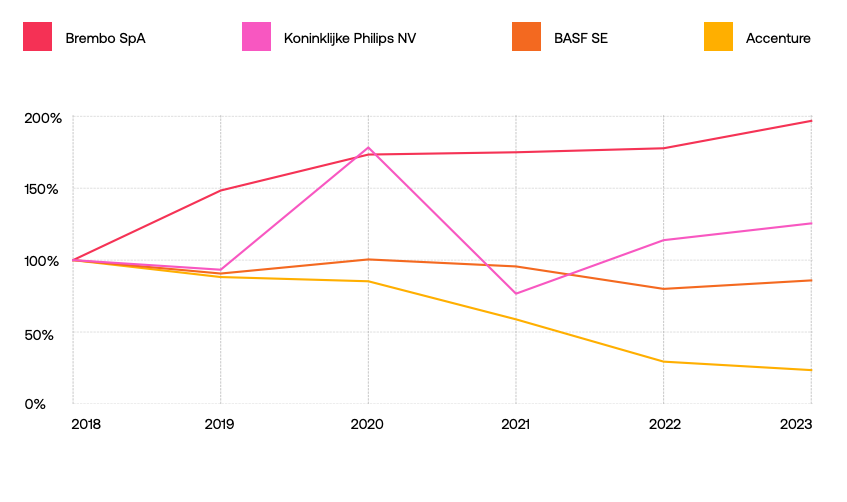
To examine the problem, crtl+s, a Berlin-based sustainability consultancy, teamed up with researchers at the University of St Gallen in Switzerland. They looked at corporate carbon footprint data disclosed to CDP by 62 European companies, all of which had committed to emissions goals with the Science Based Targets initiative.

“All 62 companies exhibited strong volatility in specific emissions over the five-year period,” the team concluded in a white paper released this week. “Even among climate leaders, emissions data proved unstable.”

Using footprints from 2018 as a starting point, the group plotted percentages changes over the following five years. In the case of tech company Philips, total emissions came close to doubling one year before dropping back below baseline 12 months later.

Tracking emissions

The team will next search for the cause of such sudden changes. “But I know for sure it’s not specific emission reduction activities,” said ctrl+s CEO Moritz Nill. Changes from such causes are more likely to be in the 2 percent-per-year range, he added.

Product footprints are coming

The long-term solution, Nill and others say, is to use carbon footprints tied to specific products. Industry groups are collaborating to streamline the creation and sharing of such footprints, including Catena-X in car manufacturing, Mondra in food retail and sector-agnostic systems such as the Partnership for Carbon Transparency, which is being developed by the World Business Council for Sustainable Development.

In the meantime, Nill recommends sticking with emissions factors and refining the estimates using information from suppliers about specific emissions-reductions measures they have implemented.

The post Study: Volatile company carbon footprints skew Scope 3 estimates appeared first on Trellis.