The Two Steps Forward podcast is available onSpotify, Apple Podcasts, Amazon Music and other platforms — and, of course, viaTrellis. Episodes publish every other Tuesday.
Raz Godelnik, an associate professor of strategic design and management at Parsons School of Design Strategies, explores sustainable business models. In his writings on Medium, he weighs in on topics central to the profession of sustainability.
His graduate-level class on sustainable business models has been a mainstay for nearly a decade at Parsons. On the most recent episode of the Two Steps Forward podcast with me and my co-host, Solitaire Townsend, Godelnik offered five lessons garnered from teaching this class.
“You need to operate on different levels,” said Godelnik. “You need to meet people where they are. And meeting people where they are many times means that you don’t lead with sustainability. You actually lead with other priorities that people actually care more about.”
Also in this episode, Soli and I discuss the current state of the sustainability profession, and why it continues to flourish globally, flying in the face of a common misconception that corporate sustainability is dying (the topic of my recent essay on Trellis).
Thinking in systems
Godelnik’s critique of current corporate efforts calls for moving beyond incrementalism and into systems-level transformation that prioritizes values over profits. “We’re living in an era where, for the most part, what we’re doing is tweaking the system rather than transforming the system,” he told us. “I call it sustainability as usual … grounded in the prioritization of profit maximization and growth, mostly short-term growth.”
He urged companies and designers to focus on radical innovation that reimagines systems, rather than making marginal improvements within flawed ones.
“The fundamentals haven’t changed,” Godelnik said. “What has changed is the political environment … It’s also important to zoom out and to look into the regulatory environment, to look into social norms, to look into the market incentives.”
Less auditing, more strategy
Godelnik described how external conditions — regulation, social pressure, policy — can accelerate or impede corporate sustainability, often more than internal ambition. This distinction reflects a concern that compliance is crowding out creativity. True progress will require investment in bold, entrepreneurial approaches, he said.
“There’s a lot of managerial sustainability going on, not much entrepreneurial … They’re spending more money with auditing firms than on innovation and strategic activity and business model work.”
Ultimately, Godelnik’s goal as an educator is to empower future professionals to act decisively, experiment boldly, and retain clarity on the difference between incremental and radical change.
“What is really critical is how to instill in them a sense of agency … Even if these are just small ways of experimenting with change, if they will be doing it, that would be great.”
The Two Steps Forward podcast is available onSpotify, Apple Podcasts, Amazon Music and other platforms — and, of course, viaTrellis. Episodes publish every other Tuesday.
https://sustainable-future.org/wp-content/uploads/2025/03/cropped-trellis_favicon_180x180.png3232sustainablefuturehttps://sustainable-future.org/wp-content/uploads/2024/06/Untitled-design-117-300x94.pngsustainablefuture2025-07-15 06:06:002025-07-15 18:08:57Why future CSOs must aim for transformation, not mere progress
The opinions expressed here by Trellis expert contributors are their own, not those of Trellis.
In a world where business decisions are ultimately based on revenue, sales and profits, circular business models are often siloed in sustainability strategies. To mitigate this reality, many fashion businesses are shifting their success metrics to provide clear, quantifiable evidence of how these models unlock resilience and competitiveness.
The Ellen MacArthur Foundation’s latest project — The Fashion ReModel — is working with leading brands, from high-street to high-end, on what it will take to implement circular business models at scale and begin to make the economics work, while also targeting key intervention points to improve commercial viability.
One year into the project, insights reveal which success metrics are most effective for building a compelling business case that drives internal buy-in and brings stakeholders on board.
Establish a revenue-based ambition for circular business models
Resale, rental, repair and remaking models enable businesses to offer new services, providing multiple revenue streams from one product. At the same time, costs can be reduced due to savings from better resource productivity and risk reduction. What the industry is missing is a meaningful metric to demonstrate the contribution of these models to a business’ overall revenue.
Participants of The Fashion ReModel are working towards their own revenue ambitions to increase the percentage of their total revenue derived from circular business models. By using gross percentage revenue, these brands and retailers have moved the success of circular business models into the core of their businesses, with a clear metric to monitor and align around.
H&M Group, for example, has invested in resale models to create additional growth. In 2024, resell sales represented 0.6 percent of H&M Group’s total turnover, up from 0.3 percent in 2022. Contributing to this growth is Sellpy, Europe’s largest secondhand clothing peer-to-peer platform. Sellpy has significantly increased its revenue contribution to H&M, doubling its share since 2022.
Identify new ways to articulate value — starting with customer benefits
In today’s linear system, the profit margins of circular business models can appear lower when compared like-for-like with linear models. The Fashion ReModel partnered with the NYU Stern Center for Sustainable Business to identify several benefits areas that showcase how circular models can drive business resilience in ways businesses aren’t currently tracking.
One of the critical areas identified is customer benefits. Circular business models offer an opportunity to diversify the relationship with the customer — improving loyalty, engagement and acquisition. Businesses can rethink their customer experiences, designing touchpoints beyond a single product sale.
Arc’teryx, for example, is capitalizing on this opportunity to tap into new customer bases. Its platform for resale and repair services, ReBIRD, has doubled its business year-on-year. Customers can visit ReBIRD Service Centers in stores to assess, wash or repair their product, keeping clothing in the loop and out of landfill.
Quantify the climate mitigation opportunity
With over 500 textiles, apparel, and footwear companies committed to science-based targets or commitments, circular business models offer an opportunity to deliver and demonstrate progress on ambitions by displacing upstream production and keeping products in use for longer, thereby cutting emissions.
Some organizations participating in The Fashion ReModel are using a combination of climate metrics to quantify this impact and further strengthen the business case. Absolute emissions, in particular, is the only metric able to evidence whether businesses are on track to meet decarbonization ambitions.
Take Coach’s Soho denim bag, a product that has been both commercially successful and lowered carbon emissions. It was created by two brands with a long history of reuse and repair. Tapestry (the parent company of Coach) partnered with Bank & Vogue (Canada’s largest secondhand clothing trader) to demonstrate how remaking products out of post-consumer existing denim has a lower environmental impact.
To quantify this, Tapestry commissioned a life-cycle assessment which found that Bank & Vogue’s repurposed denim has up to an 80 percent reduction in GHG emissions compared with conventional first-use denim. With this data, Tapestry can show this product’s ability to help meet its ambitious goal to achieve net-zero GHG emissions by 2050.
A starting point to make the economics work
The journey to scaling circular business models in the fashion industry begins with individual business action. But to make these business models the norm, broader collaborative action is required both within organizations and beyond.
To transform vision into value, increased financing and investment are needed across key areas such as marketing and infrastructure to collect, sort and redistribute merchandise. Businesses can also drive alignment on emissions reporting and measurement frameworks, such as by supporting the GHG Protocol with its revisions to better reflect business activity aligned with the transition to a circular economy. Lastly, businesses must inform an ambitious policy agenda to create industry-wide alignment around critical policies to make the economics work.
https://sustainable-future.org/wp-content/uploads/2025/03/cropped-trellis_favicon_180x180.png3232sustainablefuturehttps://sustainable-future.org/wp-content/uploads/2024/06/Untitled-design-117-300x94.pngsustainablefuture2025-07-14 10:00:002025-07-14 18:09:37How H&M and Coach are shifting success metrics to scale circular business
Less than 10 percent of single-use plastic is recycled, most of it bottles and jugs. That rate is far lower — close to zero, in fact — for smaller bits and pieces of packaging such as bottle caps, straws and coffee pods.
In the cosmetics industry, for example, few of the 120 billion units of lotion pumps, mascara wands and other components made each year are recycled, according to the Pact Collective.
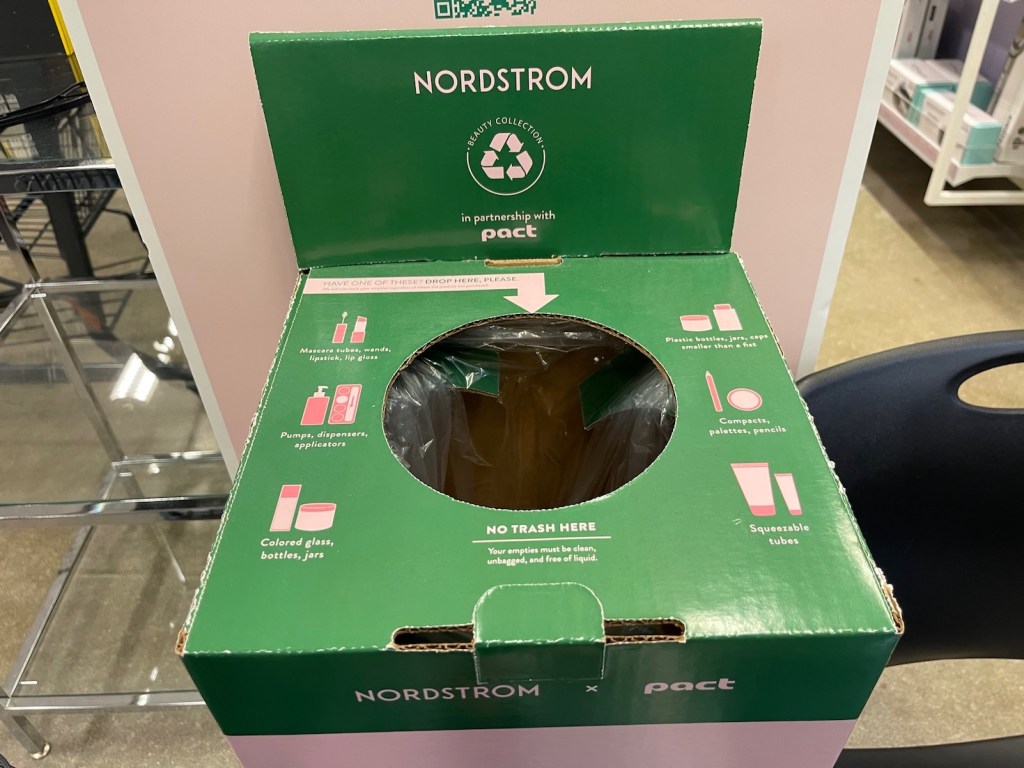
The San Francisco nonprofit has gathered 140 cosmetics makers and retailers — including Sephora, Ulta Beauty and L’Oréal — to attack small-format plastic waste. Pact maintains more than 3,300 bins for spent makeup jars, lids and applicators at North American stores including Nordstrom Rack and Saks Fifth Avenue.
To further its mission, the collective created something new from nearly 232 tons of detritus it has collected since 2022. Last year, as its collection volumes tripled, the organization transformed piles of plastics into a novel resin.
Credo Beauty, a founding member of Pact, then used that resin, called NewMatter, to create recyclable pumps for its moisturizer bottles. Those pumps usually blend several types of plastic with a metal coil, which prevents its recycling. Credo, however, used a single material — polypropylene — to make it easier to recycle later. Now that it has cracked this challenge, Pact seeks to encourage investors and infrastructure builders to support systems to collect, sort and recycle more small-format plastics.
“As the first beauty retailer to co-create a recycled resin from hard-to-recycle empties, we saw an opportunity to show circularity at work,” said Christina Ross, head of science and impact at Credo Beauty, a founding member of the Pact Collective. “This pump became a proof point and we can’t wait to see what brands do with the material next.”
Members of the U.S. Plastics Pact, meanwhile, have focused on sweeping benchmarks for reducing the proliferation of petroleum-based plastics, but their 2025 and 2030 deadlines are slipping out of reach.
“We are taking a different angle,” said Pact Collective Executive Director Carly Snider. “We’re collecting this material and then proving that it has value.” The initial heavy lift shows that certain cosmetics plastics can be integrated into municipal recycling systems, she added. “I’m hopeful that we can have this case study to show that this material has value, and therefore it’s worth the investment to your infrastructure for us to collect this material curbside.”
A Pact collection bin at a Nordstrom Rack store in Skokie, Illinois. Credit: Trellis Group / Elsa Wenzel
Pact’s June 26 impact report described how Credo’s custom pump, announced in September, fit into a busy year of scaling up recycling. Ninety-eight percent of the paper, glass and metal collected by Pact has been recycled. So has 70 percent of sorted, clean plastics.
Retail collection bins are core to Pact’s mission to grow as a household name for consumers, three-quarters of whom care about sustainable packaging, according to the nonprofit. Pact also collected 88,959 pounds of industrial waste of returns and expired or damaged goods last year.
The making of the NewMatter pump
“We used NewMatter resin for the pump because we wanted to show that beauty packaging can be made from beauty waste,” said Ross of Credo. “No one had ever made a high-functioning component from post-consumer beauty packaging before, so we knew the road wouldn’t be easy but also that it mattered.”
The journey to make the recycled pump started as Pact’s consumer-and-industrial packaging streams shipped to a plant in Lake Zurich, Illinois. After being sorted into 14 categories, the would-be trash was sent to mechanical recycling partners.
Next, the plastic recycler shredded and turned the waste into pellets.
The recycler required some 40,000 pounds of incoming material, which Pact’s collections alone did not reach. Therefore, Credo’s fully polypropylene pump blended 84 percent of material from Pact’s collection bins with ocean-bound plastic gathered by hand in Malaysia. The remaining 16 percent is virgin polypropylene. “It took a lot of work with them to figure out ways that we can get this material in there,” Snider said. “This is a really high value source of plastic.”
One pound of plastic waste stays out of landfills or oceans for every 38 pumps that Credo makes, according to Pact.
Next steps
Beyond the pump, Pact also turned recycled high-density polyethylene into soap dishes with Terrazzo-like flecks in them. “It’s really creating a way that customers can hold circularity in their hands,” Snider said. “It’s not this abstract thing.”
Credo is exploring where else it can use NewMatter resin, such as closures and other components that tend to be hard to recycle.
“Now that the infrastructure is set up to use take-backs on a more circular level, we need to continue to create a demand for post-consumer beauty-grade materials,” Ross said. That includes exploring how extended producer responsibility regulations cropping up in multiple states can help brands to advance innovative packaging, she added.
“You’re missing a huge piece of the puzzle here by just sending this to the landfill and not being able to sell it again,” Snider, of Pact, said.
https://sustainable-future.org/wp-content/uploads/2025/03/cropped-trellis_favicon_180x180.png3232sustainablefuturehttps://sustainable-future.org/wp-content/uploads/2024/06/Untitled-design-117-300x94.pngsustainablefuture2025-07-14 07:40:002025-07-14 18:09:54How Credo Beauty created new plastic from tiny bits of packaging
If you think the current sustainability agenda isn’t working, you’re in good company.
A recent survey of more than 800 sustainability experts across 72 countries conducted by Trellis data partner GlobeScan, in conjunction with the ERM Sustainability Institute and Volans, reveals a pivotal inflection point in the evolution of the global sustainability agenda. In 2030 — the year we’re supposed to have achieved the UN’s Sustainable Development Goals — sustainability professionals say a major recalibration will be needed.
When asked how they feel about the current state of the sustainability agenda, 56 percent of sustainability professionals said the current approach must be radically revised. Another 37 percent said the existing strategy needs to be modestly revised and 6 percent said the current approach works well as is.
What this means
Survey results show experts overwhelmingly agree that the current approach is no longer fit for purpose. With more than 90 percent calling for change — and more than half demanding a radical overhaul — we find ourselves at a pivotal moment with significant openness to new approaches to sustainability. This presents an opportunity for new ideas and innovation to take sustainability to the next level.
Based on a survey of 844 sustainability experts in 72 countries in April and May 2025.
https://sustainable-future.org/wp-content/uploads/2025/03/cropped-trellis_favicon_180x180.png3232sustainablefuturehttps://sustainable-future.org/wp-content/uploads/2024/06/Untitled-design-117-300x94.pngsustainablefuture2025-07-11 15:20:092025-07-11 18:09:179 in 10 experts say it’s time to rethink the sustainability agenda
Former Walmart CEO Lee Scott asked Andy Ruben to lead the retailer’s environmental strategy three times before he reluctantly agreed to become its first corporate social responsibility and sustainability chief in October 2004.
Ruben, who supported Scott’s strategic planning work, had been angling for a traditional role with profit and loss responsibility, but his boss was insistent that a strategic thinker was the best person to lead Walmart’s first concerted push to address environmental and social concerns.
Scott’s motivation: addressing a crisis in consumer trust and responding to growing criticisms about Walmart’s environmental and labor practices as the retailer’s revenue edged close to the $285 billion mark. “This was about how Walmart would make use of scale,” recalled Ruben, now the founder of resale startup Trove, during the latest episode of the Climate Pioneers interview series. “It wasn’t about solving for phthalates.”
One year after Ruben stepped in, Walmart announced three simple goals with no end date: to be supplied with 100 percent renewable electricity, to eliminate all operational waste and to sell products that aren’t a drag on planetary resources.
“As we looked at those early years, it was essentially finding innovation anywhere in the business for decision makers and profit and loss owners to do things that would work for customers,” he said. “Society was viewed as the biggest, longest term, broadest way to think about strategy.” This thinking was later foundational in Ruben’s decision to leave Walmart to found one of the first startups focused on “recommerce,” or the resale of secondhand goods.
Lesson: Speak the language of front-line managers
During his three-year tenure as Walmart’s sustainability chief, Ruben learned to be as “bilingual” as possible in conversations with division heads and front-line store operations managers — i.e., asking about their business concerns, hearing about their frustrations.
By doing so, Ruben was able to connect the dots between Walmart’s initiative to shrink the shelf space it used for laundry detergent and early design initiatives to reduce volumes of water into more concentrated product formulas.
“It wasn’t about trying to achieve a climate goal,” he said. “It was understanding environmental and social topics as the broadest form of strategy and leveraging that as innovators.”
Likewise, this thinking can help organizations course-correct quickly if an idea doesn’t work. Ruben cited the example of a program he later tried as head of Walmart’s private label group to shrink the size of cereal boxes — saving on packaging materials. That effort didn’t move the needle in the way Ruben anticipated.
“I was so naive,” he said. “I thought, ‘I’ll just take these great sustainability learnings and we’ll just put them into the products and supply chains.’”
What Ruben didn’t account for was the broader systemic changes required for a new box design to catch on more broadly across the product category. “You couldn’t avoid the model that we were in, and you had to face that,” he said.
His advice for new CSOs who don’t have a background in operations: “Live with operations. I think the understanding of why things are the way they are, and what people need short term and longer term to achieve their businesses and be successful, is so essential to building longer-term thinking … into current business.”
Another tip: When an idea is rejected, ask why. “Every time someone says no, there’s something behind that. Don’t miss the opportunity to understand that.”
Big idea: Help brands resell used products
Ruben’s private-label experience illustrated the limits of corporate sustainability initiatives focused mainly on improved eco-efficiency, so he stepped outside of the system in 2012 to create Yerdle, a marketplace that let consumers trade household items ranging from electronics to clothing.
The venture grew to more than 1 million members — validating consumer interest in secondhand goods — but “self-inflicted” missteps and lackluster interest from brands prompted a reset four years later. That’s when Ruben seized on the idea of offering a way for companies to start their own resale businesses rather than letting others control that narrative. Early supporters: Eileen Fisher, Patagonia and REI. The company is now known as Trove.
“We pivoted to take the capabilities we had and allow the brands to leverage the capabilities to compete in this new way,” he said.
From a sustainability standpoint, extending the life of apparel and other items by allowing them to find a second home is a feel-good story but it’s not the top reason most consumers buy secondhand. Reducing consumption is often the third consideration after brand value and whether the item is available quickly. That’s OK with Ruben.
“I’m good with it being first, second, third, fourth or fifth in order,” he said. “What I really want to see happen is I want to see us change the way we work. When you think about the way we operate from the sky, making hundreds of billions of new items every year and then going through all of the sourcing, production, movement [of goods] only to bury them nine months later back in the ground, it is kind of idiocy.”
Resale accelerant? Trump’s tariff crisis
Uncertainty over the sales impact of President Donald Trump’s tariff strategy — consumer confidence has slipped across many indexes since January — could serve as a nudge for companies to more tightly integrate circular economy strategies with core business initiatives, Ruben said.
“I don’t think they’re the sole driver,” he observed, “but they’re an accelerant.”
Before Trump’s tariff talk sent chills through the retail and consumer products sectors, multiple market forecasts called for growth of 10-12 percent in 2025. Another indicator published in early July predicted sales of $65 billion in the U.S. alone.
The ultimate goal of Trove’s business model is to help companies erase the value judgement between whether something is new or used, which will be crucial for helping circular economy initiatives find a place within corporations that isn’t viewed as a side hustle.
Product take-back and trade-in programs won’t truly make an impact until sales of those used items start eating into sales of new ones.
“The key metric is when you bring back an item, if that item gets sold to someone and displaces some new sales growth dollars, you’re good,” Ruben said.
https://sustainable-future.org/wp-content/uploads/2025/03/cropped-trellis_favicon_180x180.png3232sustainablefuturehttps://sustainable-future.org/wp-content/uploads/2024/06/Untitled-design-117-300x94.pngsustainablefuture2025-07-11 07:00:002025-07-11 18:09:17Why Walmart’s first CSO thinks sustainability leaders should ‘live with operations’
For clues to where the carbon removals market is headed, keep an eye on the annual selection made by Milkywire, a Swedish company that helps businesses meet climate and nature commitments. Because the investments are designed to be catalytic, the focus is on emerging companies and approaches that show the biggest potential.
This year, Milkywire purchased removals from 15 young companies through its Climate Transformation Fund, which is backed by Spotify and others. Together, the startups should receive $4 million this year. Here are some themes from that cohort.
Biochar in developing countries
Biochar, a fertilizer produced from biomass, is one of the breakthrough removals approaches of recent years. Bolivia-based company Exomad Green, for instance, has contracted for 1.7 million tons of biochar removal credits since 2023, according to CDR.fyi, a source of data on the carbon removals market. The feedstock in this case is forestry residues produced by Exomad, its parent company.
By contrast, three of the four biochar companies backed by Milkywire take more decentralized approaches. WasteX, which operates in India and Indonesia, sells a modular small-scale unit that farmers can purchase to create biochar from crop residues. Two other companies focus on smallholders: a collaboration between Planboo and Carboneers that works in Ghana, and Releaf Earth, which helps farmers in Nigeria generate biochar from disused nut shells.
The projects stood out in part because of the co-benefits they provide, said Robert Höglund, head of climate strategy and carbon dioxide removal at Milkywire. “These products often contribute to farmer incomes,” he explained. “Either they get paid for biomass or biochar they produce themselves, or they can increase their incomes through increased crop yields.”
Lower cost direct air capture
Direct air capture (DAC) has significant advantages over some rival removal techniques: It’s relatively easy to measure the CO2 captured and, if geological storage is used, buyers can be confident that the sequestered carbon stays put.
Yet prices of $500 per ton or more mean that DAC remains a small part of the overall removals market. Microsoft’s purchases of “durable” removals, typically defined as methods that store carbon for hundreds or thousands of years, dwarf that of any other company. According to CDR.fyi, the tech giant’s DAC buys make up just 4 percent of its total, as measured by tons contracted for.
Several startups in Milkywire’s new cohort aim to change that. Arbon, a U.S. startup, is one of several companies competing to develop DAC systems in which changes in humidity help drive the uptake and release of CO2. The approach promises big energy savings, which would help bring down costs. Conventional DAC techniques use 4 gigajoules or more of energy to capture a ton of CO2; Arbon said its system currently requires 1.35 GJ per ton and that it’s targeting around 1 GJ.
Two other startups in the cohort are also experimenting with innovative ways to reduce energy use. NeoCarbon, based in Germany, uses low-grade industrial heat to drive the capture process and France-based Norma has developed a system for recovering and reusing the energy required.
Next-gen measurement, reporting and verification
Carbon markets are still recovering from a wave of criticism centered on projects that failed to deliver promised reductions or removals of CO2. And small-scale projects in emerging countries are inherently difficult to monitor, raising the risks associated with some companies backed by Milkywire.
Digital methods for tracking the removal process may help, said Höglund. At Planboo, for example, the team has developed a system for monitoring metrics that include temperature and burn time in kilns used to turn biomass into biochar. Producers are also required to upload photographic evidence of the biomass that is loaded into the kilns and of biochar being used as fertilizer. “I wouldn’t say it’s 100 percent bulletproof, perhaps, but they’re getting there,” said Höglund.
The opinions expressed here by Trellis expert contributors are their own, not those of Trellis.
Developing and implementing a strategic and aligned sustainability program across a large company is difficult enough. But when you’re a holding company — with dozens of wholly or partially owned subsidiaries under one umbrella — creating a successful ESG strategy becomes even more challenging and complex. Complicating things further, these portfolios are often geographically distributed and face differing regulatory or cultural expectations regarding sustainability performance, goals and disclosures.
Companies such as Microsoft, Costco and Switzerland-based Partners Group manage large portfolios of smaller companies that operate in many sectors. Costco, for example, has 31 subsidiaries and operates 905 warehouses worldwide. To streamline its sustainability efforts, Costco has implemented the STAR (Sustainability Technical Assistance Review) program, which helps warehouses manage compliance, energy, water, waste and emissions.
On the other hand, Partners Group, a global private markets firm, has an overarching sustainability strategy but delegates operational control of its sustainability efforts to local “champions” responsible for ensuring sustainability processes and initiatives are tailored to each business unit.
From our work advising holding companies, we’ve identified three issues that, if well thought through and implemented, can lead to more successful sustainability strategies and outcomes.
Understand the pressures businesses face
Just like any business, holding companies face inside and outside pressures on business operations that inevitably influence ESG strategy. If anything, holding companies may face more pressure simply because of how large and diverse they are. Portfolio companies in the software sector have fundamentally different issues to deal with from manufacturing or healthcare companies.
Holding companies must consider the inputs and perspectives of a wide range of stakeholders, who can exert pressure to act in a certain way or address their specific interests. They must decipher what pressures require a corporate-wide response and which are concentrated at the portfolio company level and can simply be addressed there.
For example, one European-based holding company we work with leaves ESG strategies to its portfolio companies and doesn’t attempt to develop a coherent corporate-level approach. Operationally, this means there’s no overall guidance on priorities such as goal setting from the parent company, which only requests for performance (such as GHG emissions) data. In other instances, the parent company will provide specific directions for its portfolio firms to support an overall top-down strategy.
Analyze leadership styles and culture
How a holding company manages its portfolio companies is another major factor to consider. Whether the company uses a hands-off or hands-on approach will affect how sustainability performance is addressed.
Take the example of two multinational holding companies. One has a hands-off approach, where corporate leadership at the holding company prefers to let the portfolio companies have a wide degree of autonomy in day-to-day activities. In this “bottom-up” approach, each portfolio company is responsible for designing and implementing its own approaches to ESG issues to reflect its sector and the internal and external pressures it may be facing.
This may mean that each portfolio company is responsible for determining its own material issues, data collection efforts and producing its own ESG reports. Contrast that with holding companies involved in a “top-down” approach, in which the holding company has clear priorities for overall ESG strategy and expects its portfolio companies to operationalize those priorities. This can mean all its portfolio companies have a common approach to materiality (if not the same list of material topics), data collection, reporting and disclosure.
In either instance, setting and clearly communicating expectations and delineating responsibilities between the corporate level and the portfolio level is important.
Align and collect data
It’s not uncommon for firms in a holding company’s portfolio to have independent data systems that aren’t aligned and don’t communicate with one another. This can make aggregating disparate data sets difficult, as each portfolio company may use different methods of collecting data or measure different kinds of data altogether.
The holding company needs to determine what specific sustainability challenges its portfolio firms are facing and whether data collection at the subsidiary level or the entire holding company is the best strategy.
For example, a tech holding company that uses a bottom-up approach to gather sustainability data for each of its portfolio companies asks each of its approximately 25 portfolio companies to manage their own ESG data collection independently and then report back to holding company top management. This provides more localized operational freedom but can result in disparate datasets that are difficult to compile and compare across the entire portfolio.
Another multinational company with a portfolio focused on manufacturing industrial equipment takes the top-down approach, with an aligned set of material issues and datasets that it requests from its subsidiary firms. The holding company offers training sessions to its portfolio companies to enhance data quality and has an executive in charge of each portfolio company who supports the annual data collection process. This means that data is more easily centralized and cohesive across all companies, thanks to the holding company’s leadership coordinated effort.
When in doubt, focus on the business case
The reasons holding companies develop ESG strategies vary — customers, investors and market pressures all play a role. No matter the reason, the impact of a strong ESG strategy is what remains constant. If a holding company gets its sustainability strategy right, it becomes integral to its overall business strategy. It provides a lens for performance evaluations for portfolio companies and future acquisitions, creating a baseline and measurement for future success.
https://sustainable-future.org/wp-content/uploads/2025/03/cropped-trellis_favicon_180x180.png3232sustainablefuturehttps://sustainable-future.org/wp-content/uploads/2024/06/Untitled-design-117-300x94.pngsustainablefuture2025-07-10 10:00:002025-07-10 18:09:1731 subsidiaries, 905 warehouses: How to manage sustainability at a holding company
Trellis’ Chasing Net Zero series is about a simple question: How are companies faring on their net zero journeys?
A question this important should be easy to answer. Many companies provide emissions data in their sustainability reports and in disclosures made to CDP, an independent clearinghouse for environmental data. In theory, these sources can be used to assess progress toward interim targets, many of which fall between now and 2030.
In reality, it is challenging to answer the question using publicly available data. Companies disclose information in different ways, and they change their goals and accounting methodologies over time. Subsidiaries are acquired and divested. Disclosures may be incomplete, with some scopes included and others omitted (usually Scope 3).
To fill in the gaps, the Chasing Net Zero team — reporters Jim Giles, Heather Clancy and Saul Hansell — is using a selection of sources. Like everything we do at Trellis, we employ these sources to create Chasing Net Zero articles that provide actionable insights sustainability professionals can use to accelerate their work. We believe that by shining as bright a light as possible on company progress, we can tease out the factors propelling some companies to success and holding others back.
Sources we use
Annual sustainability reports. These are generally the first thing we look at. The emissions numbers in these reports are, we assume, accurate as stated. Still, as discussed above, the data can be incomplete and the accounting opaque.
Target validation. Having a target validated by a third party is an important — although, some would argue, inessential — component of goal-setting. The first place we check is the dashboard maintained by the most influential target-setter, the Science Based Targets initiative (SBTi).
Reports on the integrity of company targets. Several teams worldwide regularly interrogate the integrity of company targets. The Corporate Climate Responsibility Monitor, published annually by the non-profit NewClimate Institute, is a great example. We also review a wealth of information on target integrity at theNet Zero Tracker and Climate Action 100+ websites.
Climate-related lobbying. We use LobbyMap to check for information on what companies lobby for and how they do it. Thisdoesn’t directly impact a company’s emissions, but when directed against important climate legislation it can undermine a firm’s claim to be committed to net zero more broadly.
Essential questions
We ask ourselve a list of questions as we make sense of each company’s goals and progress. These are:
Has the company’s target been approved by the SBTi?
Has the company changed the size of its targeted cuts, baseline year or goal year since setting its target? If so, why?
Have new lines of business — hello, data centers and AI! — impacted its emissions’ trajectory?
What level of progress have other companies in the sector made?
Have regulatory changes impacted the company’s emissions?
What role do carbon credits play in the company’s net zero strategy?
If the company is not on track, what are the chances it can get back on?
Expert advice
We’re lucky to have a stellar team of advisors to consult.
Bruno Sarda, former president of CDP now with the consultancy EY
Tensie Whelan, professor at New York University’s Stern School of Business
Laura Draucker, senior director for corporate climate action at the nonprofit Ceres
Steve Smith, executive director of Oxford Net Zero and professor at the University of Oxford
Each article in the Chasing Net Zero series is reviewed by at least one of the above before publication. Their feedback is then used to improve our assessment and inform our actionable takeaways.
We’d love to hear your feedback, too — whether you feel we’re succeeding at or falling short of our objectives. You can connect with our reporting team of Jim Giles, Heather Clancy and Saul Hansell on LinkedIn, or email [email protected].
https://sustainable-future.org/wp-content/uploads/2025/03/cropped-trellis_favicon_180x180.png3232sustainablefuturehttps://sustainable-future.org/wp-content/uploads/2024/06/Untitled-design-117-300x94.pngsustainablefuture2025-07-10 10:00:002025-07-10 18:09:18Methodology: How we assess a company’s progress toward net zero
The 2024 emissions numbers released this past February by Nestlé would have been the envy of many companies. The world’s largest food manufacturer’s first milestone on its journey to net zero — a 20-percent emissions reduction relative to a 2018 baseline — was due to be reached this year. But the Swiss company, which generates more than $90 billion in annual revenue through flagship brands such as Nescafé and KitKat, said it hit its target a year early.
For the first installment in Trellis’ Chasing Net Zero series — a company-by-company look at progress toward 2030 climate goals — we examined Nestlé’s emissions data and spoke with sustainability experts who have studied the company. Several praised Nestlé for its sustainability work, particularly its focus on agricultural emissions. But others raised concerns about its use of carbon removals, a central pillar of its decarbonization strategy. A review of statements made to investors raised additional questions about Nestlé’s future plans.
Compared to its peers, Nestlé has done much to earn its reputation; but the full story of the company’s journey to net zero is more fraught than its emissions data implies.
Track record
Nestlé’s net-zero target was validated relatively early — in 2020 — by the Science Based Targets initiative (SBTi). Five years later, many in the sector are still trying to catch up: Only 44 percent of the largest food, beverage and agriculture companies have net zero targets, and 23 percent have no target of any kind, according to the Net Zero Tracker, a data source maintained by four research organizations.
Other sector comparisons are similarly positive. In a benchmarking exercise released in May by Ceres, a nonprofit focused on the business case for climate action, researchers found that Nestlé was following several best practices that are rare in the sector, including setting climate requirements for suppliers. The company is also one of just three peers — with Campbell Soup and Danone — to have set targets for methane and other non-carbon dioxide agricultural gases in its supply chain.
The work behind this progress is overseen by Chief Sustainability Officer Antonia Wanner, a 24-year company veteran who moved from procurement into an ESG role in 2020 and joined the C-suite in January of this year. Wanner and other leaders have short- and long-term compensation bonuses that are tied to emissions reductions.
Wanner’s boss, CEO Laurent Freixe, took the helm last August; his predecessor was ousted after what The Wall Street Journal described as “slowing sales growth and a slumping share price.” Nestlé stock has fallen slightly since Freixe’s arrival and is now down close to 30 percent from a January 2022 peak.
Nestlé’s biggest challenge: Scope 3
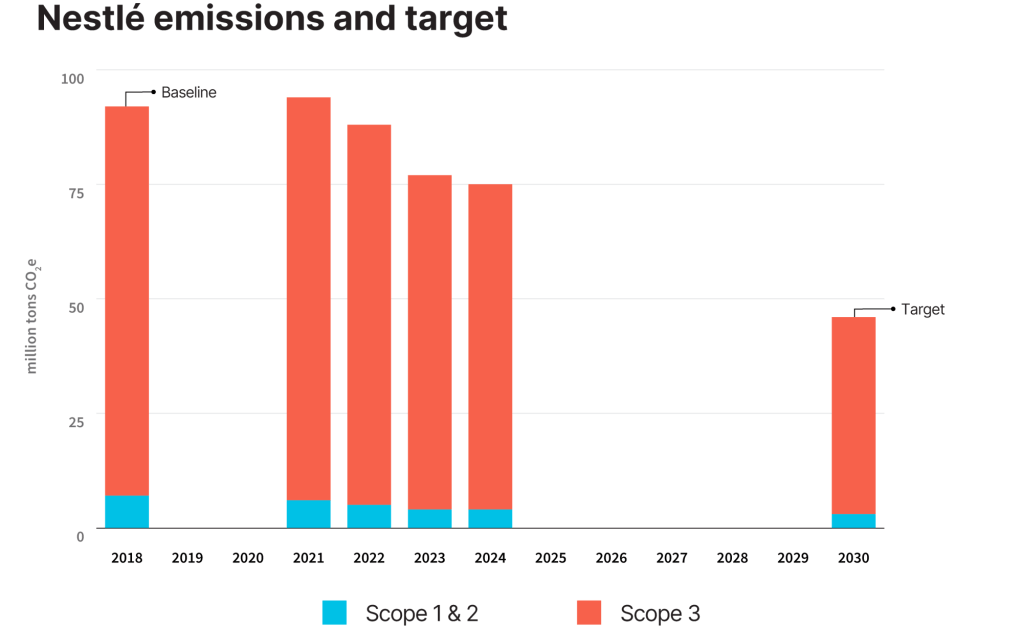
Like many other food and beverage companies, particularly those that source dairy and livestock ingredients, Nestlé faces an emissions challenge that is essentially a Scope 3 challenge: Of the 75 million metric tons of CO2 equivalent emissions (tCO2e) the company generated in 2024, 71 million tCO2e — 95 percent — stem from the company’s value chain. These include 13 million tCO2e of methane emissions from its ingredient sourcing.
Nestlé’s Scope 3 emissions have fallen steadily since 2021, the earliest year for which the company provided data in its most recent sustainability report, as have direct emissions from the company’s facilities and its electricity purchases. If progress continues at the current rate, Nestlé will achieve its goal of halving emissions by 2030.
Source: Nestlé’s Non-Financial Statement 2024
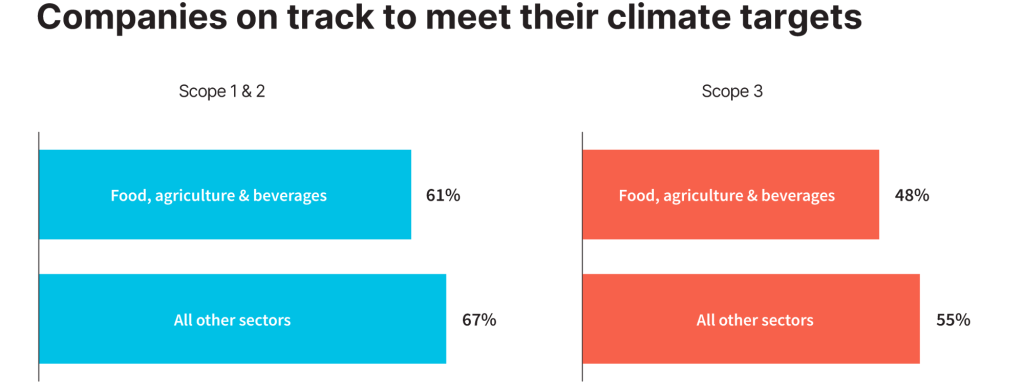
The reductions are notable given that decarbonizing dairy and livestock emissions ranks among the “toughest tasks” for food companies, according to David Linich, a sustainability partner at PwC. Linich declined to comment on Nestlé specifically, but a 2024 PwC survey of emissions disclosures shows that just over half the company’s peers are not on track to hit Scope 3 goals.
Source: PwC’s Second Annual State of Decarbonization Report — Sector Insights
Nestlé has achieved these reductions using tactics that include training producers to improve the productivity of their farms, preventing deforestation in its supply chain and reducing methane emissions from cattle, according to its most recent Net Zero Roadmap, which was published in 2023.
Achieving the remaining cuts that Nestlé needs to stay on track for 2030 — notably lowering emissions from sourcing ingredients by 5 million tCO2e, were the company to reduce all greenhouse gases in proportion — will be challenging. The company is pursuing this on multiple fronts, including the use of food additives for cattle, which the company projects will reduce methane emissions by 3.2 million tCO2e by its target date.
Nestlé is also a member of the Dairy Methane Action Alliance, a collaboration between Ceres and the Environmental Defense Fund, which requires members to create action plans for reducing methane emissions. “We think Nestle is demonstrating that they’re putting plans and steps in place in order to make progress,” said Carolyn Ching, director for food and forests research at Ceres.
More uncertain: The role of removals
A second component of Nestlé’s past and future progress is more controversial. The company hit its 2025 target a year early in part because it removed 1.6 million tCO2e from the atmosphere in 2024 and deducted this figure from its total annual emissions. Nestlé did not break this total down, but removal mechanisms highlighted in its latest sustainability report include planting vegetation around water sources, no-till and other regenerative practices, and integrating trees into cropland.
The approach is particularly pertinent for Nestlé because the company’s use of removals will increase eightfold to hit 13 million tCO2e by 2030, according to its Net Zero Roadmap.
SBTi rules allow removals to be subtracted from total emissions in this way, but the practice has been contested because of uncertainties surrounding the reliability of nature-based removals. The science on the ability of soils to sequester carbon remains unsettled. Carbon stored in vegetation can also be released back to the atmosphere if farmers stop following regenerative practices.
“This is not a permanent emissions removal,” said Sybrig Smit, a policy analyst at the NewClimate Institute in Germany. “It’s going to be released into the atmosphere if the land is mismanaged.”
In an emailed response to questions from Trellis, Nestlé said it collects data directly from farms, including soil sampling and measurements of tree height, and places 20 percent of credits in a buffer pool to insure against losses. The company is also collaborating with Ofi, a major ingredients supplier, to monitor close to 3 million trees planted by 25,000 farmers in Nigeria, Côte d’Ivoire and Brazil. Ofi said that a combination of remote sensing and machine learning enables it to track changes in carbon stocks at the farm level.
What Nestlé tells investors
Smit and colleagues at NewClimate, who studied Nestlé for recent editions of the organization’s Corporate Climate Responsibility Monitor, question another removal line item in Nestlé’s 2030 plans: 6 million tCO2e the company subtracted from its anticipated 2030 total and attributed to “Portfolio transformation.” Tactics under this heading include switching to plant-based ingredients and “evolving our product offering to include more sustainable options.”
A Nestlé spokesperson declined to provide a detailed breakdown of where these cuts will come from, but did highlight recent implementations of this strategy, including with its Nescafé Alta Rica instant coffee brand. The emissions associated with each jar have fallen 11-14 percent since 2018, according to the Carbon Trust, an independent verifier of environmental projects.
Yet Nestlé has deemphasized its commitment to more sustainable products in at least some conversations with investors. A 2022 presentation at a Consumer Analyst Group of New York meeting, for example, included multiple slides on environmental issues and products; in this year’s presentation at the same event, CEO Freixe devoted just two sentences to the topic.
Given the Trump administration’s dismissal of climate issues and attacks on anything considered “woke,” this could be interpreted as prudent green-hushing. But Nestlé’s willingness to invest in sustainability, a metric that can be used as a proxy for a company’s commitment to emissions reductions relative to other priorities, is also unclear.
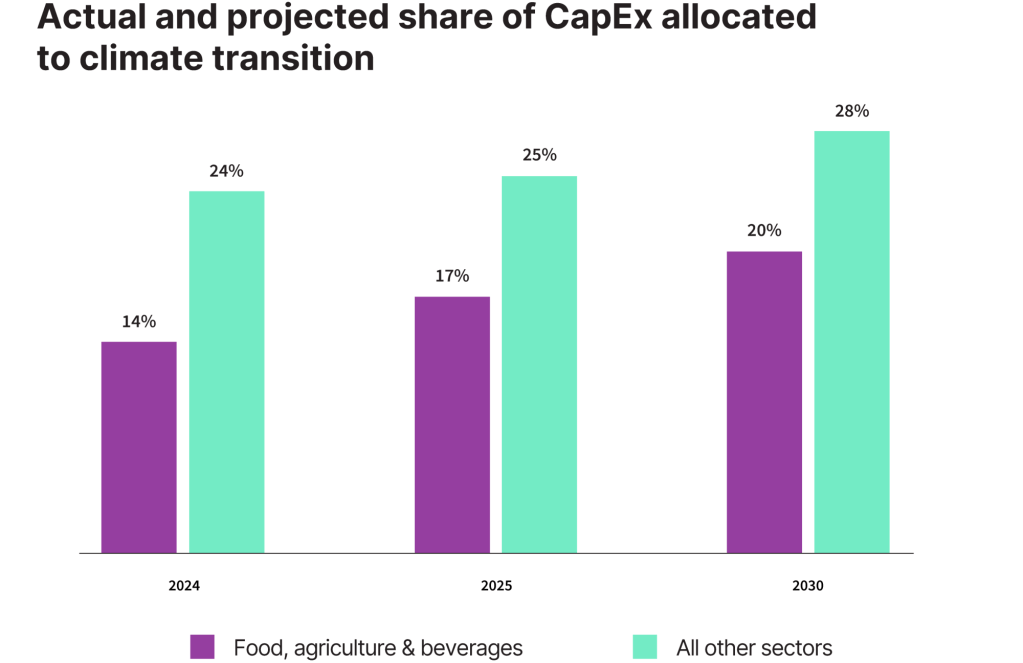
Nestlé does not share the amount it expects to invest in order to hit its 2030 target, but in a 2024 presentation to investors Freixe said that “we have done the heavy lifting” on sustainability and “we will need to continue to invest, probably at a lower pace” relative to the period up to 2025.
This stands in contrast to other food and beverage companies, which expect to increase the portion of their capital spending that goes to climate transition projects to an average of 20 percent by 2030, according to the PwC survey of emissions disclosures.
Source: PwC’s Second Annual State of Decarbonization Report — Sector Insights
The next five years
To understand the complexities of Nestlé’s efforts to halve emissions by 2030, consider the position it now finds itself in.
On one side are investors, who are often more concerned with quarterly returns than long-term sustainability. Freixe’s “heavy lifting” comment, for instance, came in response to an investor analyst asking about the drag of sustainability initiatives on operating margins.
At the same time, the food sector likely cannot reach net zero without fundamental changes that no company can completely control. Decarbonizing would be easier, for example, if consumers swapped dairy milk for soy — but that doesn’t seem likely. Policy support is also an issue: one recent report found that current policies in the EU would decrease emissions by just 1.5 percent between 2020 and 2040.
These pressures leave Nestlé’s leaders with little room to maneuver. They’ve charted a course to net zero that is relatively transparent and ambitious, at least when compared with many sector rivals. At the same time, that roadmap is incomplete and relies on carbon accounting that’s open to question. As the climate crisis intensifies, these shortcomings leave critics of the world’s largest food company frustrated. They are also indicative of where the sector is on its journey to net zero.
(function(t,e,s,n){var o,a,c;t.SMCX=t.SMCX||[],e.getElementById(n)||(o=e.getElementsByTagName(s),a=o[o.length-1],c=e.createElement(s),c.type=”text/javascript”,c.async=!0,c.id=n,c.src=”https://widget.surveymonkey.com/collect/website/js/tRaiETqnLgj758hTBazgd6uvnVafnh2GbAvc8nmuor_2B6YEOCFh1H422jvGkxK5PC.js”,a.parentNode.insertBefore(c,a))})(window,document,”script”,”smcx-sdk”); Create your own user feedback survey
https://sustainable-future.org/wp-content/uploads/2025/03/cropped-trellis_favicon_180x180.png3232sustainablefuturehttps://sustainable-future.org/wp-content/uploads/2024/06/Untitled-design-117-300x94.pngsustainablefuture2025-07-10 10:00:002025-07-10 18:10:35Nestlé is on track to halve emissions by 2030. Here’s how (holes and all)
Climate tech innovation isn’t getting any easier in 2025. Political and economic uncertainty challenge founders and investors. Still, U.S. funding in the first half of 2025 was up 21% compared to the same period a year ago.
The annual Trellis list of 25 Climate Tech Startups to Watch recognizes the most promising of these early stage startups and their climate technologies — and to help keep sustainability leaders at the leading edge of decarbonizing operations. To that end, it features early-stage companies in five sectors: energy, carbon, transport, industry and nature.
2025 Application
Apply below to get showcased — including a video of your “elevator pitch” — on the 2025 list, based on a review by Trellis editors and analysts based on the following criteria: solution uniqueness, traction, team strength and impact potential.
The 25 finalists will also make their pitches to an in-person audience of sustainability and climate executives, investors, and government officials during Trellis Impact 25, our leading event for sustainability professionals developing innovative solutions to the planet’s biggest challenges, Oct. 28-30 in San Jose, Calif.
Five winners from each of five categories will present live to our audience, who will vote on the Climate Tech Startup of the Year. The winner — along with the 25 Climate Tech Startups to Watch in 2025 — will be profiled in an article in the Trellis Briefing newsletter and on Trellis.net. A “people’s choice” winner will also be selected based on online voting.
https://sustainable-future.org/wp-content/uploads/2025/03/cropped-trellis_favicon_180x180.png3232sustainablefuturehttps://sustainable-future.org/wp-content/uploads/2024/06/Untitled-design-117-300x94.pngsustainablefuture2025-07-09 18:51:152025-07-10 18:10:36Apply to 25 Climate Tech Startups to Watch in 2025