If you’re tuned into corporate sustainability, you probably hear companies talk about net-zero targets all the time. You probably also hear companies talk about efforts to prevent plastic pollution and improve packaging recyclability. But how often do you hear companies try to link these efforts together?

It’s a huge missed opportunity. Packaging waste and carbon emissions are two sides of the same coin — the materials used for transport and disposal carry a carbon cost across its life cycle. Understanding this connection is key for making meaningful progress on both fronts. 

While the sustainable packaging community has been busy setting sustainability goals to hit recycling or sustainable sourcing targets, it can feel like the industry has forgotten where these goals are supposed to take us: to a world where we have carbon emissions and waste under control. 

Understanding packaging’s contribution to carbon emissions 

Packaging, as most of us know, heavily contributes to the climate crisis. 

In 2019, plastics contributed more emissions than the aviation and shipping industries combined. According to the OECD, the supply chain of plastics generated 3.4 percent of all global greenhouse gas emissions, and 90 percent of this came from production and conversion from fossil fuels. 

If plastics were a country, they would have the fifth-largest share of global emissions as of 2022, just below China, the U.S., India and Russia. Although many plastics go into products that aren’t packaging, if we look at the rest of the packaging value chain — glass, aluminum, fiber, bioplastics — the total carbon footprint of packaging would be even larger. 

Right now, the consequences of packaging’s waste and carbon emissions are treated in siloes. Waste is framed as a pollution problem, carbon as a climate one — and companies are left to piece together fragmented strategies instead of unified solutions. But we can tackle climate change by using sustainable packaging efforts through the following strategies. 

Fold your packaging goals and wins into your climate strategy

Too often, sustainable packaging does the hard work of decarbonizing without getting credit for it. It’s time to change that. Reducing packaging material avoids emissions, and this should be counted towards emissions targets. Redesigning packaging so that it doesn’t go to landfills is a win for your carbon goals, too. 

Embedding packaging goals and calculations into your climate strategy is the first step. If you don’t know where to start, use Life Cycle Assessment tools and packaging calculators to calculate the avoided emissions of a packaging change.

Make it clear — to colleagues, consumers and investors — how your packaging efforts are part of your climate strategy. Unilever’s Scope 3 GHG reduction plan, for example, shows how packaging is helping them to meet their 2030 target of reducing absolute Scope 3 emissions by 30-40 percent.

Think differently about tradeoffs

Right now, when we design packaging to be recyclable and the change creates more emissions, this is called a tradeoff. Companies feel they have to pick one direction, and based on pressure from consumers, they often choose recyclability. If a package has no good end-of-life option but a lower carbon footprint (like a not yet recyclable plastic bag, for example), this is considered another unfortunate, but necessary tradeoff. 

Instead, what if we thought about tradeoffs like we think about flying with a layover? Layovers aren’t your final destination — they’re just a sometimes necessary stop along the way. Making short-term sustainability tradeoffs is a layover on our path toward a future with reduced waste and carbon emissions in packaging. 

Companies don’t have to wait to address both crises, either. Already, companies such as Prana are adopting practices — such as using seaweed-based compostable packaging — to address both waste and carbon emissions. 

Go for the big swings

What’s the single biggest swing companies can take to address both climate and packaging waste? Reduction. While switching to a “better” single-use material — renewable feedstock or recycled content — may seem like a step forward, it’s ultimately only an incremental change. 

The future of sustainable packaging hinges on whether companies truly understand and embrace the importance of reduction and system redesign. By reducing the amount of packaging used in the first place and redesigning packaging to be reusable or refillable, companies can significantly lower resource use, carbon emissions and environmental impact. And you can take comfort knowing that your company won’t be the first to do this. Companies such as beverage giant Diageo are already finding ways to scale circular, reusable packaging.  

Right now, we’re wasting our time in transit. If we meet these opportunities — by folding our packaging and climate goals together, rethinking tradeoffs and taking big swings — we’ll reach that future with reduced waste and carbon emissions.

For more on reducing and eliminating waste in the global economy, stay tuned for Circularity 2025 starting Tuesday. 

The post 3 strategies for 2 crises: Tackling carbon emissions and packaging waste together appeared first on Trellis.


  • Material made from the “roots” of mushrooms mimic the feel and durability of leather.
  • Startups like MycoWorks, Hydefy and Ecovative have each raised nine figures.
  • Sustainability advocates are pushing mainstream apparel giants to provide even more support for biodegradable options.

Leather remains the go-to material for high-end purses, couches and car interiors. Its petroleum imitation, “pleather,” serves mortals on a budget.

But fungus-focused biotech startups want the world to consider a third option. They are brewing materials that mimic the feel and durability of leather, without the grim costs to nature from exploiting animals or fossil fuels. The key ingredient is mycelium, found in the thread-like “roots” of mushrooms.

More brands are working with these younger companies to test the biomaterials and gauge consumer interest for purses, apparel, shoes and furniture. These partnerships include Mycoworks with Hermès, Hydefy with Stella McCartney and Ecovative with Calvin Klein parent PVH Corp.

The three startups share several things in common. Each has raised nine figures in funding and advertises a leather-like look and feel for plastic-free, biodegradable products on the brink of reaching commercial scale.

The mycelium “leather” market, which reached $12 million in 2024, will soar up to $336 million by 2033, according to research by Market Intelligence.

“There’s a lot of energy in this space right now,” said Katrin Ley, managing director of Fashion for Good, an Amsterdam nonprofit that seeks to accelerate sustainable materials. “We’re seeing continued interest in exploring alternative materials — especially among brands looking to meet ambitious sustainability goals. Some are deepening their R&D efforts; others are partnering directly with innovators to co-develop products.”

Stella McCartney x Hydefy bag made of mycelium composite material.
Source: MycoWorksSource: MycoWorksSource: Hydefy

Mushrooms in action

Mycelium companies insist their creations are maturing past the “gee-whiz” phase and readying to scale. Industry experts cite MycoWorks of Emeryville, California, as the most advanced player. With roughly 250 employees, it has attracted more than $187 million in capital. MycoWorks’ 136,000 square foot plant in Union, South Carolina, uses artificial intelligence and robotics to automate most production. The factory is in a forested region close to sources of sawdust, a main input. The company ships its material for tanning to Igualada, Spain, which has a long heritage of tanning hides.

MycoWorks’ biomaterial, Reishi, recently debuted in a Ligne Roset couch and on the inner door panels of a concept electric General Motors Cadillac. The company’s Fine Mycelium technology was included in an Hermès travel bag in 2022.

Reishi meets or exceeds furniture industry benchmarks for flexibility, abrasion resistance, colorfastness and aging, according to MycoWorks. And for every 11 square feet of material made, only 6 pounds of carbon dioxide or its equivalent are produced — far less than is the case with animal and synthetic leathers.

“MycoWorks has focused on refining the material’s unique properties rather than attempting to imitate leather,” said Fred Martel, the company’s senior vice president of sales and business development. “We are building enduring relationships with partners ready to scale with us—those who recognize that Reishi is not an alternative material, but a new category altogether.”

Chicago startup Hydefy also promotes its biomaterial as being in a class of its own. Its version, called Fy, appears in a purse that Stella McCartney will flaunt in its summer runway show.

Hydefy is also working with several other large apparel and footwear brands.

MycoWorks sends its mycelium material to Spain for "Rei-Tanning" processes.
MycoWorks sends its mycelium material to Spain for “Rei-Tanning” processes.
Source: MycoWorksSource: MycoWorksSource: Hydefy

The company’s work emerged from NASA-supported research that found fungi flourishing around the acidic geothermal hot springs of Yellowstone National Park. The fungi grows in three days in a plant in the former meatpacking district of Chicago, according to Hydefy.

“We set out on this mission because we wanted to give consumers options,” said Rachel Lee, head of business at Hydefy. “Ultimately, we just want consumers to have alternatives to animal and synthetic leathers to reduce reliance on petroleum.”

Hydefy has used liquid air fermentation technology to multiply its fungi. Now, though, it’s moving toward submerged fermentation, a process similar to brewing beer. The company dries and combines the mycelium with crop waste, such as sugarcane husks, to create blocks of material. Next, laminated vinyl flooring machines, customized by the company, churn out sheets of Fy. Hydefy’s use of common polymer industry equipment in an uncommon way offers a scalability advantage, according to Lee.

Hydefy claims to meet brands’ leather-based performance expectations. In any event, some big names are buying what the company is selling. “I am constantly exploring plant and fungi-based, regenerative alternatives that do not harm animals and heal Mother Earth,” Stella McCartney said in a March 31 press statement. “Harmonious to this philosophy, the innovators behind Hydefy are developing materials with fresh thinking and a focus on sustainability.”

This may sound familiar to longtime observers of next-gen materials. Back in 2016, another Stella McCartney bag featured Mylo, a mycelium material cultivated by startup Bolt Threads. However, even after raising more than $300 million, the company paused its fungus-fashion efforts in 2023, citing high costs.

How to scale?

Initial high overhead, infrastructure limitations and supply chain immaturity all contribute to the harsh realities of scaling new materials. That’s why the innovators working with Fashion for Good are taking a long-term, strategic approach, according to Ley. “By working together with brands, suppliers and investors, they’re collectively mitigating financial risks and building the infrastructure necessary to scale sustainably, making sure that the materials are actually market ready and can meet the industry’s quality standards.”

For the moment, though, mycelium materials best suit high-end products rather than mass market goods, according to Tiffany Hua, an analyst at Lux Research in Boston. 

The biotech developers rely heavily on co-development partnerships with brands to overcome the strength, flex resistance and durability shortcomings of the new materials, Hua added. In addition, the fermentation process is resource-intensive and finicky. “Even with efforts to automate and integrate robotics, as MycoWorks is attempting, development timelines remain slow and expensive,” she said.

Another mycelium player, Ecovative, announced March 27 that it was receiving $11 million in funding. The Green Island, New York, venture has raised a total of $120 million. Last year it completed a three-year collaboration with Fashion for Good, exploring how its Forager material could function in products created by Bestseller, PVH Corp. and others.

Ligne Roset's Kobold Sofa uses Reishi material from MycoWorks.
Ligne Roset’s Kobold Sofa uses Reishi material from MycoWorks.
Source: MycoWorksSource: MycoWorksSource: Hydefy

“That pilot helped us better understand the practical challenges of scaling mycelium leather,” Ley said. “It gave the innovators feedback from real brand use cases — how the material performs, how it fits into existing processes and where the friction points are.”

That said, sustainability experts argue that the apparel establishment needs to do more to provide stability and growth to biomaterials innovators.

Cynthia Power, a fashion circularity expert and owner of Molte Volte Consulting in New York, says that brands and retailers should ink long-term investments with startups. “It is rarely helpful to a material innovator to get a brand to use their material for one season and then drop off,” she explained. “If anything, that can be damaging to their smaller and more fragile company ecosystem.”

Power added that fashion businesses should also identify the largest environmental and social “offenders” among their materials, then support the startups formulating less-harmful alternatives. “Most of these startups are waiting for their phone to ring with a big order or big name brand to sign an off-take agreement,” she said.

The post Hèrmes and Stella McCartney embrace a leather alternative: fungus appeared first on Trellis.

Key takeaways

  • The intent is to lessen the financial burdens on domestic businesses in the wake of current tariff chaos.
  • But at least 1,300 Canadian enterprises remain bound to submit reporting to the EU in the next three years.
  • Opponents of the decision believe that the demand for credible sustainability information will continue.

Canada announced that it has paused all mandated corporate climate disclosures, citing the unstable global economy.

“In recent months, the global economic and geopolitical landscape has rapidly and significantly changed, resulting in increased uncertainty and rising competitiveness concerns for Canadian issuers,” said Stan Magidson, chair of the Canadian Securities Administrators and the Alberta Securities Commission. “In response, the CSA is focusing on initiatives to make Canadian markets more competitive, efficient and resilient.”

The announcement is in response to the slew of tariffs levied against Canada by President Trump, including a 25 percent tax on goods related to the fentanyl crisis and on steel and aluminum. Canada also announced $21 billion in retaliatory measures against U.S. goods. But whatever the cause of (potentially) thinner profit margins, the costs of climate disclosure have been deemed unaffordable, at least for now.

Not everyone in Canada, though, is fully aligned with the decision.

“We recognize that regulatory approaches may evolve in response to market conditions, but the demand for credible, comparable sustainability information continues to grow — both globally and at home,” said Wendy Berman, incoming chair of the Canadian Sustainability Standards Board. The Board finalized its sustainability disclosure standards in December 2024.

Canada’s pause is the latest in a global trend. In March, the U.S. Security and Exchange Committee (SEC) halted all court arguments in favor of its own corporate climate disclosures, and a month earlier the EU introduced an omnibus package that scaled back the reach of its own CSRD and Corporate Sustainability Due Diligence Directive.

How Canada’s decision will actually impact businesses is unclear. At least 1,300 Canadian businesses remain bound to submit reporting to the EU in the next three years. And as recently as the EU’s omnibus scale back, experts recommended that companies continue to gather emissions data for shareholders, and mandated corporate climate reporting in effect in California.

“Postponing requirements for businesses to get prepared for climate change and align with positive climate action will only leave businesses less prepared, investors less informed and Canada’s economy less competitive,” said Julie Segal, senior manager of climate finance at Environmental Defence Canada, in a statement.

The post What Canada’s pause on climate-disclosure requirements means appeared first on Trellis.

How much progress is being made on the shift to renewable energy depends on whom you ask. If you’re talking to North Americans, less than half will say it’s going well. But in Africa and the Middle East, a whopping 80 percent will tell you the transition is in the near future.

That’s what Trellis data partner GlobeScan found in its latest public opinion research, which surveyed more than 30,000 consumers across 31 markets and asked them how likely they thought most people would use renewable energy in the next 10 years.

The optimism in Africa and the Middle East is likely a reflection of more centralized policy action in countries such as South Africa, which has made bold renewable energy commitments. Optimism in the energy transition is also strong in Latin America and the Asia-Pacific region, where around two-thirds of people believe the transition will probably or definitely happen.

In contrast, only 46 percent of North Americans feel the same. This skepticism may stem from ongoing political polarization, slower federal-level momentum, and continued cultural and economic reliance on fossil fuels. Europeans are less confident than the global average (59 percent compared to 65 percent globally), likely due to a range of factors, including the recent energy crisis triggered by the war in Ukraine.

What this means

Companies operating across multiple markets can recognize that public expectations around clean energy differ greatly by region. In optimistic markets such as Africa, Asia-Pacific and Latin America, companies have an opportunity to lead boldly and visibly on renewables. In markets with lower confidence, such as North America and Europe, companies may need to focus on building trust, demonstrating feasibility and aligning with local realities, showing how they are part of turning widespread renewable energy use into an achievable reality.

Based on an online survey of more than 30,000 people conducted in July-August 2024.

The post Who’s optimistic about renewable energy? People in Africa and the Middle East appeared first on Trellis.

Key takeaways

  • The company has shifted to large purchases that deliver over many years — many in 2030 or later.
  • Recent buys focus on biomass projects, but the company is targeting a broad portfolio in the longer-term.
  • Many other large companies will need similar amounts of removals to hit net zero, experts told Trellis.

When news broke last week that Microsoft had agreed to a deal for an eye-popping 6.7 million tons of carbon removal credits, the reaction was relatively muted. Why did the largest-ever purchase of durable credits not make a bigger splash? 

The answer might be that record-breaking buys have become the norm for the tech giant. Just a few days earlier, Microsoft announced a 3.7 million ton deal. In less than a week, the company’s two agreements exceeded the durable credits purchased by all companies in 2024. And they build on around 8 million tons of additional durable removals Microsoft bought in smaller deals over the past two years, according to data from Allied Offsets, a carbon markets intelligence firm.

This extraordinary spree raises important questions. Why has Microsoft, far more than any other company, made so many big bets on removals? And what does it mean for the future of the market?

Net zero by 2030

When Microsoft committed in 2020 to becoming carbon negative by the end of the decade, removals were always intended to be used to address emissions it could not eliminate. After making its commitment, the company supported the then-nascent removals market by sharing lessons learned from its discussions with project developers and by buying credits from a number of early-stage companies. “Durable” projects, usually defined as storing carbon for hundreds to thousands of years, were a focus, albeit not an exclusive one.

Microsoft reaffirmed its carbon-negative goal earlier this year, despite its emissions increasing from 12 million tons of carbon dioxide equivalent (tCO2e) in 2020 to 17 million tCO2e in 2023, in part because of the need to build more data centers to power AI products. And by the time 2030 arrives, Microsoft expects to need “single-digit millions” of removal credits annually to meet that commitment, said Brian Marrs, the company’s senior director of energy and carbon removal.

That’s a big requirement for a single company by the standards of today’s carbon markets. But it’s also the kind of volume that many large companies may need to purchase in order to hit net zero. What makes Microsoft stand out, noted Robert Höglund, co-founder of CDR.fyi, a provider of carbon removal data, is that the company is moving faster than others: “This is what a major company would need to meet these kind of early net zero targets.”

Long-term portfolio approach

The roughly 18 million tons of durable removals that Microsoft has purchased over the past two years is concentrated in three project types: direct air capture, and capture of emissions from both bioenergy power plants and the pulp and paper industry. The biomass projects are notable because they involve combining carbon removal equipment with proven technologies, which can speed up development times. 

Marrs cautioned against reading too much into the recent focus on large purchases from biomass-based projects, noting that the company has also invested in earlier-stage removal approaches, including enhanced rock weathering, which was the method used by two of the recent winners of XPRIZE Carbon Removal

“We’re very clear-eyed that there are limits to the amount of sustainable biomass and limits to the amount of traditional industry that we can augment in that way,” he said. “So we’re going to need to take more bets.”

The company bases its due diligence for removals on four quality criteria: whether a project genuinely requires credit revenue to proceed, the ability to accurately measure the quantity of carbon removed, the permanence of the removals and community benefits. In parallel, the tech giant also weighs commercial considerations, including cost and time to delivery. Over time, those criteria will push Microsoft to create a portfolio of large investments, said Marrs.

Many of Microsoft’s recent agreements are also long-term and due for delivery years from now. The deal with the pulp and paper mill project, for example, spans 12 years. “Nearly 100 percent of the carbon removal purchases announced in our current fiscal year will be delivered between 2030 and 2050 via long-term offtake agreements,” said Marrs. “We’re not looking at this sustainability report to sustainability report.” 

Will others follow?

Microsoft has long dominated the carbon removal market when measured by volumes purchased. With its most recent deals, the company has now bought five times more durable credits than the next nine largest buyers combined, according to CDR.fyi.

It’s also likely to be far ahead in terms of dollars spent. The next largest buyer on the CDR.fyi leaderboard is Frontier, a coalition of companies that has committed to spending at least $1 billion on durable carbon removal by 2030. Microsoft does not disclose what it pays for removals, but publicly available pricing data for similar projects puts the cost of its two largest projects alone at more than $2 billion.

“If they decide that they want to stop making these purchases,” said Peter Minor, CEO of Absolute Climate, a removals standard-setter, “then it’s unclear what happens to the industry after that.”

That said, other companies are stepping in. Recent first-time removal buyers include Lego, TikTok and two large Japanese companies, which may be followed by others in the country due to government incentives. But Höglund described the pace of new arrivals as a “trickle.” He and others have pointed out that a recent proposed revision to the Science Based Targets Initiative’s net-zero standard will do little to push companies to invest more in removals in the near term. And the fate of U.S. government funding for removals, which surged under President Biden’s administration, is in doubt under President Trump.

These developments leave removals advocates with mixed feelings about the future, praising Microsoft for its leadership while wondering when others will step up. “What Microsoft is doing is what every company should be doing,” said Noah Deich, a former deputy assistant secretary for carbon management at the Department of Energy who is now a climate fellow at Stripe, the payments company. “It shouldn’t be seen as extraordinary.”

The post Unpacking Microsoft’s mega-purchases in durable carbon removal appeared first on Trellis.

Key takeaways

  • Amazon is kickstarting low-carbon concrete and steel startups with investments from its $2 billion Climate Pledge Fund.
  • The company uses five principles to drive building management decisions but tailors them to region and facility type.
  • One potential blocker: Technicians trained to fine-tune new equipment and artificial intelligence tools.

Amazon manages thousands of facilities across 20 building types — from data centers to commercial offices to grocery stores to distribution centers.

The company is countering their greenhouse gas emissions by switching to mass timber, lower-carbon concrete and steel for construction; replacing refrigerants with high global warming potential; and using artificial intelligence to fine-tune energy and water consumption, to name a few best practices.

Amazon doesn’t disclose exactly how real estate contributes to its carbon footprint, but in general buildings account for close to 40 percent of the world’s carbon footprint.

“In an average building, we like to think of it as half the emissions are in the materials themselves — in the embodied carbon as part of construction — and the other half are in the operational emissions from operating with utilities and refrigerants,” said Chris Roe, director of worldwide environment, carbon, at Amazon. 

Purchases that cut construction emissions

Amazon is investing to reduce emissions across both phases of a building’s life. Its $2 billion Climate Pledge Fund has backed Brimstone Energy and Paebbl, two early-stage startups focused on reducing emissions from supplementary cementitious materials; CarbonCure, which injects carbon dioxide in fresh concrete to sequester it; and green steel maker Electra, to name a few.  

Amazon is also changing its purchasing habits to favor these disruptive technologies. Amazon’s East Coast headquarters, for example, features 70-foot-long mass timber beams, a layered alternative to steel beams, and low-carbon concrete. The headquarters uses 24 percent less energy than similar complexes; the concrete portions of the campus have a carbon footprint that is 20 percent lower than traditional approaches.

Looking ahead, Amazon has decreed all new data centers be constructed with 35 percent less embodied carbon than construction as usual. In 2023, 29 Amazon building projects sourced lower-carbon materials, cutting 79,500 metric tons of CO2 equivalent, or the annual emissions of 17,200 cars. As of January, these materials were used in 40 buildings.

“We’re looking at ways that we can send demand signals to bend cost curves for everyone,” Roe said. “These are hard problems that no one company wants to solve alone.”

Amazon sets goals for embodied carbon for each construction project, and at the close it collaborates with contractors to calculate the footprint for all materials, using resources such as the free EC3 accounting tool from nonprofit Building Transparency. 

“They ask the harder questions about the impact they are trying to have rather than just using proxy labels and oversimplified metrics,” said Lindsay Baker, CEO of the International Living Future Institute, a nonprofit that advocates for carbon-free building design. “Their standards of how they build are more carefully written to focus on measurable carbon impacts.”

Amazon’s same-day delivery center in Sacramento, California, was the first North American fulfillment facility to earn a zero-carbon designation from the International Living Futures Institute.
Source: AmazonSource: Amazon

Several Amazon buildings are certified under the institute’s zero-carbon methodology, including Amazon’s same-day delivery center in Sacramento, California — the first North American fulfillment facility to earn this designation. 

Features that helped earn that recognition include the parking lot, made of locally sourced and repurposed materials; low-carbon concrete for the floors that cut embodied emissions by 33 percent; and material handlers with high-efficiency motors and low-friction belts and rollers that reduce energy consumption 38 percent compared with similar equipment. 

Achieving these sorts of outcomes requires close partnership with construction firms, real estate investors and building management companies. “We’ve been using these kinds of mechanisms and really key partners across real estate to work together on this,” Roe said. “I would absolutely underscore that point.”

AI for better management and maintenance

To address operational emissions, Amazon developed a suite of software applications to reduce energy and water consumption. They include:

  • FlowMS, which detects water leaks that aren’t visible to the human eye. At one location, it prevented the loss of more than 9 million gallons annually. 
  • Base Building Advanced Monitoring, which picks up malfunctions in heating, ventilation and air-conditioning systems that are a drag on energy efficiency. It will be deployed at more than 300 buildings by the end of 2025.
  • Advanced Refrigeration Monitoring, which analyzes equipment that keeps perishable goods at optimal temperatures across Amazon’s grocery network in North America and Europe. In one location, the software flagged a faulty defrost cycle, preventing food loss and saving 1,000 hours in equipment downtime.
Vegetables shown in a refrigeration case at a grocery store
At new Amazon Fresh and Whole Foods grocery stores, Amazon is installing refrigerants made of ammonia, carbon dioxide, propane and other naturally occurring gases.
Source: AmazonSource: Amazon

Key team priorities, regardless of building type

Amazon’s real estate team uses five core principles to guide emissions reductions and other sustainability decisions for building selection, construction and operations.

  • Prioritize sites with access to carbon-free energy: Amazon hosts more than 300 on-site solar installations in the U.S., Europe and Asia. Some can handle 80 percent of a site’s energy needs. Amazon matches electricity with power purchase agreements to claim reductions: it’s the largest corporate renewables buyer at more than 600 projects. 
  • Source lower-carbon building materials when and where possible: These replacements can be simple. Amazon’s delivery center in Sacramento, for example, opted for plywood decking on its roof, which reduced the embodied emissions of that feature by 49 percent compared with steel.
  • Increase energy efficiency: More than 200 “boots on the ground” audits were conducted in 2024; the findings will inform future retrofits or fixes that are straightforward, such as installing air curtains on a distribution center’s loading dock doors to keep conditioned air inside.
  • Reduce on-site water consumption: Conservation and stormwater management are table stakes for all sites. Some managers are experimenting with newer approaches, such as atmospheric water harvesting, which Amazon uses at commercial offices in India to collect evaporation. 
  • Opt for natural refrigerants: This is a requirement for new Amazon Fresh and Whole Foods sites that’s likely to find its way into other types of facilities.

“The implementation of how we’re going to be able to roll out the sustainability-focused practices is going to depend on several factors: local regulation, where we are in terms of geography across the portfolio is going to drive how we have to tailor to each of the facilities,” said London Kemp Boykin, director of worldwide real estate development at Amazon. “But we do have standards that are embedded across all of the design and engineering work streams within the operations verticals. Most buildings are going to incorporate some portion of those standards.” 

Spotlight on refrigeration

At new Amazon Fresh and Whole Foods grocery stores, for example, Amazon is installing refrigerants made of ammonia, CO2, propane and other naturally occurring gases rather than synthetic ones carrying a higher global warming potential.  

“So much of our modern lives revolve around refrigeration,” said Danielle Wright, executive director of the North American Sustainable Refrigeration Council, an industry group that advocates for these technologies. “This is a big opportunity that could have a big impact today. You can think of this as buying time.” 

The 35,000-square-foot Amazon Fresh in Seattle saved at least 100 metric tons of CO2 equipment compared with similar stores by opting for these refrigerants, along with all-electric kitchen equipment and hot water. 

Refrigerants accounted for a small fraction of Amazon’s Scope 1 emissions in its 2023 environmental report. That impact has grown since Amazon’s 2019 baseline year, but it shrank 25 percent between 2022 and 2023 thanks, in part, to the grocery switchover. 

Amazon is applying lessons learned from this transition to other facilities, including data centers. One thing holding the company back is the low availability of local technicians trained to maintain these systems, so Amazon is investing in training to scale that workforce amid a shortage of HVAC specialists. 

“If we don’t have people, technicians to install and maintain, then no one will realize this transition,” Wright said. 

The post Inside Amazon’s blueprint for cutting building emissions appeared first on Trellis.

Key takeaways

  • Novel approach will capture millions of tons of CO2.
  • Startups pursuing geological storage of organic waste and biochar were also named winners.
  • The XPRIZE Carbon Removal was established in 2021 with $100 million from Elon Musk’s foundation.

A plan to pay millions of smallholder farmers in developing countries to draw down carbon dioxide has scooped the XPRIZE Carbon Removal competition, the organizers announced today. 

Mati Carbon, the startup behind the idea, took the $50 million grand prize. Most of the rest of the $100 million prize fund, provided by Elon Musk’s charitable foundation, was distributed to three runners-up.

Mati earned first place by developing an alternative take on enhanced rock weathering (ERW), an idea that has risen to prominence over the past couple of years. Like many ERW companies, Mati captures CO2 from the atmosphere by crushing basalt, a widely available rock, and spreading it on farmland. The rock powder reacts with CO2 dissolved in rainwater, storing the greenhouse gas in a relatively inert molecule known as bicarbonate. In the process, the basalt releases minerals that fertilize the soil.

Mati’s twist is that rather than focus on large agriculture operators, the company is targeting millions of smallholder farmers, initially those working rice fields in India. The location is a promising target because wet and hot conditions accelerate the capture of dissolved CO2. “The two biggest knobs that you can twist on trying to speed up the dissolution are heat and water flux,” said Jake Jordan, Mati’s chief science officer.

Narrow the numbers

The potential of rock weathering has been questioned due to significant differences in estimates of its potential to capture carbon. Narrowing those numbers is challenging on open farmland, where temperature and other variables that impact the performance of the crushed basalt cannot be controlled. This has put pressure on early-stage ERW companies to invest in extensive sampling and modeling to win the confidence of investors. 

In Mati’s case, the company followed methodologies developed by Puro.earth and Isometric, two well-regarded standard setters. To validate its model, the startup collected 30,000 samples over a four-year period in which it studied prospective rice fields in India and elsewhere. “It is now proven on a repeated basis that this is a good signal,” said CEO Shantanu Agarwal. “We can trust it.”

$100 target

Early buyers of the carbon credits that Mati has generated include Stripe, Shopify, Siemens and Figma, said Agarwal. The credits currently cost around $300 per ton of CO2 removed — much higher than credits generated by reforestation and other nature-based mechanisms, but significantly lower than some “durable” removal options, such as direct air capture. 

The company is targeting a price point in the region of $100 per ton as the process scales. Agarwal said that the company is on track to deliver 25,000-30,000 tons next year in India before ramping up to “megaton scale” in the next three to five years.

Mati is a non-profit, but intends to scale by allowing local for-profit partners to run operations on the ground. Agarwal estimated that a typical smallholder in India might currently earn $1,000 to $1,500 per year. Their share of the credit sales would likely be around $100 and yield improvements from the fertilizing impact of the basalt powder would contribute $300 more. “For a $1,500 income farmer, we are essentially giving him $400 additional income,” said Agarwal. “That’s meaningful. That’s really changing their life.” 

Best of the rest

Mati’s closest three rivals from the group of 20 XPRIZE finalists also received cash infusions:

  • Runner-up NetZero received $15 million for its biochar work in Brazil. Nikki Batchelor, the prize’s executive director, praised the company’s “sophisticated operation” and its circular strategy, which involves creating biochar from crop residues and returning the substance to farmers for use as fertilizer.
  • Third prize and $8 million went to Vaulted Deep, a waste management spin-off that collects organic waste, including animal manure, and injects it into geologic storage sites.
  • Rival ERW startup UNDO, which operates in Scotland and Canada, received $5 million.

Much has changed since the prize was established in 2021. The number of startups in the space was dramatically lower and the major buyers that have accelerated growth of the field, including Microsoft and the Frontier coalition, had not begun to make significant purchases. The influence and public positions taken by prize funder Musk were also very different. 

“We have had a really hard time watching everything unfold as it has with his actions and all of the inconsistencies and contradictions of what his positions are,” said Batchelor. She added that it is XPRIZE policy to implement clear firewalls between sponsors and prize operations, and that sponsors have no say in who the winners are.

The post Scheme to help smallholder farmers remove carbon wins $50 million XPRIZE appeared first on Trellis.

Key takeaways

  • Conventional carbon accounting measures impact over 100 years, lessening the focus on short-lived drivers of global warming.
  • The Global Heat Reduction Initiative is offering an alternative accounting methodology that emphasizes near-term impacts.
  • The science behind the methodology is broadly accepted, but adopting it requires trade-offs in what companies and countries value.

When companies complete their carbon accounts, a single metric is generally at the heart of the numbers: tons of carbon dioxide equivalent (tCO2e), a handy means of allowing multiple greenhouse gases to be included on the same balance sheet.

But is the focus on tCO2e causing policymakers and corporates to undervalue important methods for slowing global warming? That’s the claim being made by the Global Heat Reduction Initiative (GHR), which is backed by notable scientists and is offering what it says is a more holistic form of carbon accounting. The initiative is a spin-off from SCS Global Services, a standards-setter and certifier of environmental projects.

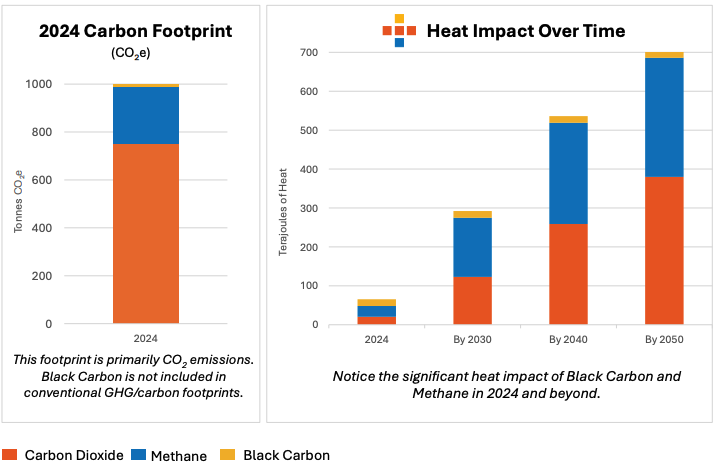
GHR’s solution involves expanding traditional emissions accounting to include different timescales. Carbon dioxide equivalence data usually rests on estimates of the global warming potential of greenhouse gases over 100 years, relative to that of CO2. Around two-thirds of any release of methane, for example, will have left the atmosphere after around 12 years. During that time, however, the impact on warming is up to 150 times greater than CO2. And considered over the 100-year time frame used in conventional accounting, methane’s impact is diluted to 28 times greater than CO2.

Existing methods exclude some pollutants altogether, including black carbon, also known as soot. Black carbon particles survive in the atmosphere for just a week or so, but by absorbing sunlight and remitting the energy as heat, the short-term warming impact of the substance can be up to 1,500 times that of CO2. Almost 6 million tons of black carbon are emitted annually, according to the Climate and Clean Air Coalition, a project of the United Nations Environment Programme.

Holistic accounting

In the GHR version of carbon accounting, emissions are inventoried and CO2e numbers presented as normal. Alongside that data, the company also shows customers how their emissions, including black carbon, will contribute to global warming over the next 5 to 25 years.

A conventional carbon footprint (left) and GHR’s analysis of how the same emissions will contribute to near-term warming (right).

That can affect how different mitigation options stack up against each other. GHR’s first customer is Napa Recycling and Waste Services in California. “I wasn’t really sure what we were getting into,” said resource manager William Kelley. The company’s GHR report, which it received earlier this month, highlighted the warming impact of the black carbon generated by the diesel fuel used by some of its machinery. The report also shone a light on the short-term impact of methane released from composting operations. Kelley said the analysis made him realize that it may be better to tackle those emissions before other projects, such as electrifying vehicles that run on natural gas.

There are other interventions that are revealed as more important when viewed through the GHR lens, added Kiff Gallagher, the company’s executive director. Reducing food waste from company cafeterias, which helps cut methane emissions, is one example. So is making warehouse roofs more reflective to bounce sunlight back into space. “Maybe by taking an investment there with a reflective surface you would actually bend the heat curve more rapidly and more effectively than if you partnered with a plant-a-tree nonprofit,” he said.

Judgment call

The science behind GHR’s methods is broadly accepted and may be gaining in importance. The company’s advisory board includes Drew Shindell, a climate scientist at Duke University who has advocated for a greater focus on short-lived climate pollutants. The issue is also being taken up by the IPCC. Last month, scientists met in Bilbao, Spain, to begin work on an IPCC methodology for measuring short-lived pollutants, which is due to be published in 2027.

Scientific agreement on the principles does not mean the accounting system will be adopted, however. Zeke Hausfather, climate research lead at the payment company Stripe, noted that there has been a push among climate scientists for countries and companies to set specific targets for different greenhouse gases rather. But, he added, there are fundamental differences in opinion about how to treat the issue of different timescales.

The dominant view is that we should focus on stabilizing the climate by restricting long-term warming to less than 1.5 or 2 degrees Celsius. A more economics-based approach would be to apply a discount to longer-term impacts and focus instead on maximizing near-term reductions. Determining which view is correct is difficult, noted Hausfather, because the answer rests on a value judgment about present and future generations: “How are you valuing an immediate big effect versus a smaller long-term effect?” 

The post New carbon accounting method could change thinking about short-lived pollutants appeared first on Trellis.

Key takeaways

  • Operations are among the biggest sources of emissions for fast-food restaurants.
  • The Greener Stores framework outlines 25 practices store managers can use to reduce energy and water consumption, and minimize packaging and food waste.
  • Starbucks focused first on new locations, but existing cafes are encouraged to embrace Greener Stores habits.

Starbucks has verified 9,400 cafes for meeting strict requirements related to energy efficiency, waste diversion and water stewardship. 

That’s more than double what it reported in 2024 and just shy of the 10,000 locations it aims to certify by the end of 2025, the coffee chain said in an April 22 update.

Starbucks manages close to 40,200 retail locations globally, so roughly one-quarter of its locations are now certified. It introduced the Greener Stores initiative in 2018, and saves an average of $60 million annually in operating costs as a result. That’s due to the 30 percent average reductions in energy and water consumption that these stores report.

Starbucks is one of several high-profile fast-food restaurant chains encouraging waste, energy and water efficiency to help curb emissions. KFC, for example, builds certain requirements into franchise agreements. Scope 3 emissions tied to these locations are among the biggest contributors to these companies’ carbon footprint.

Starbucks’ Greener Stores framework, which it developed in collaboration with World Wildlife Fund, covers 25 practices that define the construction and operation of new cafes and retrofits of existing locations.

Examples of measures that count toward certification include sourcing electricity from solar, wind or other clean power sources; using energy-efficient equipment such as refrigerators with low global warming-potential coolants; and embracing initiatives for diverting packaging and food waste. 

Starbucks stores can also get credit for adding renewable energy installations, such as solar panels, or for investments that support electrification, including electric vehicle charging stations.

In the U.S., Starbucks is pushing for the installation of more than 100 direct current systems that speed charging, starting with a corridor between northern California and Washington state that it described as a charging desert. It has so far installed 34 units in collaboration with Mercedes-Benz, according to the April 22 update.

The post Starbucks nears 2025 goal for 10,000 “greener stores” appeared first on Trellis.

Key takeaways

  • New regulations and global pressure are accelerating the shift toward more sustainable medical garments.
  • Most medical textiles are not recycled, contributing to health care’s large climate and plastic waste footprint.
  • Startups FIGS and AmorSui are serving sector professionals seeking to reduce those impacts, with “circular” scrubs and lab coats.

The lives of medical textiles are brutish and short. Nurses and doctors often wear scrubs and lab coats to death within a year. Some masks and exam gowns only last for minutes before landing in the trash.

Small wonder that health care, which creates 4.7 billion tons of annual waste, contributes more than 4 percent of the planet’s climate emissions, according to the United Nations. More than two-thirds of that comes from indirect Scope 3 sources, including textiles and other medical supplies.

But a growing number of small makers of “circular” scrubs, lab coats and gowns are finding a niche among health care institutions that strive to reduce waste and emissions — and satisfy emerging regulations.

Meanwhile, researchers are testing ways to keep medical textiles in circulation. For example, scrubs maker FIGS and lab coat brand AmorSui are expanding recycling options.

Regulations and waste piles

Starting in 2026, part of a new California law takes effect that will force health care customers and distributors to manage worn-out lab coats, gowns and drapes in environmentally friendlier ways. The state’s Responsible Textile Recovery Act, which took effect Jan. 1, is among the early extended producer responsibility (EPR) laws in the U.S., and the first to govern garments rather than packaging.

Efforts to expand textile recycling and reuse also come as multinational negotiations continue over a Global Plastics Treaty.

“We want to encourage more circular approaches, where waste is avoided, the materials are reused,” said Will Clark, executive director of Health Care without Harm in Europe. “It’s this hierarchy of preventing waste, reusing products or avoiding single use.”

Textiles make up between 14 and 31 percent of waste in the industry, according to nonprofit Health Care Without Harm, based in Reston, Virginia. Single-use items, such as polypropylene masks, examination gowns, surgical drapes and shoe covers, account for nearly 10 percent of plastic waste in hospitals.

Gowns and scrubs, at least, are already “circular” in some sense because health care professionals re-wear them. Yet these garments often blend synthetic polyester and spandex with cotton, making them hard to recycle. Fluid- or microbe-resistant finishes add further complexity.

Pilot projects

The nonprofit is in the middle of a two-year partnership with the Norwegian Retailers Environment Fund to encourage health care providers to adopt reusable gowns, aprons, masks, wraps and drapes. Health Care Without Harm is working with hospitals in the U.K., Colombia, Brazil and the Philippines to identify the potential for using and scaling similar materials in local markets.

The projects seek to prove the existence of demand for less wasteful practices and products. That’s challenging in a heavily regulated industry in which infection prevention specialists often gate-keep against change, added Clark, a former health service sustainability director.

“A big concern about medical waste, and recycling it back into medical products, is the biohazard risk,” said Marcian Lee, an analyst specializing in plastics at Lux Research in Singapore. “Even if we were to design medical products to be reusable, it takes energy to sterilize them for reuse. So sometimes its just that so much easier, probably cheaper and maybe safer to just use disposable.”

A scrubs solution

FIGS specializes in what it pitches as less “itchy” scrubs. “We want to make it seamless for health care professionals to easily swap out their old scrubs that suck and replace them with FIGS, and to do so without creating waste,” a spokesperson for the Santa Monica, California, company told Trellis.

On April 3, the 12-year-old business launched a recycling program that allowed customers to either mail back their unwanted scrubs or bring them to centers in Los Angeles and Philadelphia. It follows a one-month pilot last year that downcycled more than 45,000 pounds of scrubs into sporting gear filler, carpet underlayment and car insulation.

FIGS’ reverse logistics partner is SuperCircle, based in New York. The 7-year-old infrastructure startup collects, identifies and sorts garments, then provides textiles to 20 specialized recyclers. In working with brands such as Reformation, J.Crew and Guess, SuperCircle says it has prevented the waste of more than 2 million garments. These recycling efforts are profitable and drive customer loyalty, according to SuperCircle.

“Roughly 40 percent of what we process is fiber-to-fiber recycled and turned into new textiles, while about 60 percent go to open-loop recycling, becoming long-life products like insulation or industrial materials,” a SuperCircle spokesperson said. “We only work with open-loop recycling partners who extend the fiber’s life by at least five years. So nothing becomes short-term waste.”

Because scrubs lack complex fasteners and trims, they’re relatively easily shredded for recycling without a lot of prep work. However, FIGS main fabric, FIONx, blends a majority of polyester with roughly one-fifth rayon and a lesser portion of spandex. Conventional recyclers groan about such blends, a technical challenge that microbial and chemical recyclers are competing to solve.

Although it’s not a perfectly circular, textile-to-textile solution, the company is working toward other materials milestones. By 2030, it aims for 75 percent of its scrubs fabric to come from “recycled and upcycled” materials. Another goal is for 30 percent of materials for fabrics, buttons and zippers to contain 30 percent recycled ingredients or traceable fibers.

Nylon lab gowns

AmorSui, by contrast, is focusing on single-material lab jackets and other garments to simplify recycling. It also makes “zero waste” gowns, as well as fire-resistant scrub sets and hijabs.

The company’s garments are used in 15 hospitals across the U.S. In recent months, more health care systems have been asking about end-of-life solutions for textiles, according to AmorSui Founder and CEO Beau Wangtrakuldee.

Since it launched in 2018, the Philadelphia company has seen 100 percent year-over-year growth, she said. Larger hospital systems with established sustainability programs are increasingly interested as they focus their decarbonization efforts toward the carbon footprint of their supply chains.

Scope 3 emissions, including from supplies, contribute to 71 percent of the sector’s greenhouse gases, according to a 2019 study.

AmorSui is transitioning away from polyester, as well as trims such as metal snaps that complicate recycling. “We are moving towards developing a mono-material garment, meaning that all the trims and everything are made from just circular nylon,” Wangtrakuldee said. “It allows us to not have to do a lot of labor in terms of sourcing, which saves costs in a long run and also allows the garment to be 100 percent reclaimed, 100 percent recyclable and 100 percent recycled.”

Compared with polyester or cotton, nylon is light, repels fluids and dries more easily, she added. AmorSui sources the nylon in the U.S. Another partner performs chemical recycling to turn worn garments back into raw material that can be spun into a new yarn. But that involves pyrolysis, which is controversial. This nylon does not generate “forever chemical” PFAS (per- and polyfluoroalkyl substances), according to Wangtrakuldee.

Established players

In contrast to the startups, a thriving ecosystem of companies that rent reusable textiles to hospitals and clinics emerged from the informal rag trade more than a century ago. The Textile Rental Services Association (TRSA) of Alexandria, Virginia, represents hundreds of members, including uniform provider Cintas and numerous regional laundering services.

The TRSA’s North American members process 40 billion pounds of healthcare textiles, including scrubs, lab coats and bed sheets, each year. Recycling is the missing link in this near-circular industry, due partly to the complexity of blended textiles. “It’s just going to take time, and logistics is just as much of a problem as anything else,” said TRSA President and CEO Joseph Ricci.

[Join over 1,500 professionals transforming how we make, sell, and circulate products at Circularity, April 29-May 1, Denver.]

The post Lessons from the emerging effort to advance ‘circular’ textiles in health care appeared first on Trellis.