
Key takeaways

  • Despite popular belief, conversations happening on Capitol Hill regarding clean energy tax credits and incentives are cordial, respectful and productive.
  • Government affairs and sustainability teams can work closely to ensure advocacy opportunities are as high impact and low risk as possible.
  • Even if lawmakers don’t care about climate change, framing environmental issues in terms of things they do care about — U.S. competitiveness, job creation and more — can transcend politics.

U.S. sustainability professionals have faced daunting challenges in the opening months of 2025. The Trump administration appears resistant to climate action and a series of executive orders and new tariffs have added to the uncertainty. All of this makes it hard to push for strong climate policies. But from where I sit, sustainability leaders have the opportunity to transcend the politics of the moment with compelling stories about the business case for long-term investments in the clean energy economy. Last month, I helped convene dozens of large companies on Capitol Hill to do just that — and I learned a lot from the experience.

In this volatile moment, here are a few ways sustainability leaders can better align their specific climate goals with their company’s policy engagement strategy:

Find strength in numbers

In March, at the outset of the ongoing budget negotiations in Washington, 80 large companies and investors took to Capitol Hill for meetings with about 100 Congressional offices, the vast majority of which were Republican, to call on lawmakers to keep federal clean energy tax credits and incentives in place. The message was direct, but the conversations were incredibly cordial, respectful and productive. Importantly, we have not heard of a single company receiving any kind of political blowback as a result. 

In fact, the feedback has been quite the opposite: just days after we left D.C., 21 Republican members of Congress released a letter emphasizing their support for maintaining the incentives amid ongoing tax debates. And this month, four Senate Republicans followed up with a supportive letter of their own.

There are many ways to attribute this success, but undoubtedly one of the most important is that the large-scale, cross-sector and collective business voice created a virtuous cycle. Not only did it provide validation to lawmakers that leading companies want and need clean energy tax credits, but the multi-sector “big tent” approach creates a comfortable and safe space for businesses to direct their advocacy, further amplifying the impact. Businesses committed to climate and sustainability leadership can join cross-sectoral opportunities such as these and consider putting their name on strategic sign-on letters and other opportunities to collectively weigh in.

Link policy priorities to business goals

Climate change will affect the entire economy, so at some level all climate policies are business concerns. But that concept is too broad and abstract to drive meaningful policy action. Effective business advocates lead with the issues that are central to their business’s operations. Ford Motor Co., for example, has publicly advocated for maintaining federal clean vehicle and battery tax credits, which have guided the company’s long-term investment decisions and are key to growing the manufacturing and adoption of electric vehicles.

While that example gets directly at Ford’s business operations, companies should have no trouble advocating for more tangential policies that have a clear business impact. With energy prices too high and the grid constrained, it makes sense for nearly every company to advocate for policies that support the rapid deployment of clean energy resources such as solar and battery storage, as they’re the most affordable and quickest-to-build forms of new power.

Prioritize government affairs

Sustainability and government affairs teams need to work closely together during this turbulent time. Government affairs staff are understandably buried by the barrage of complex and unpredictable policy changes coming their way. Sustainability professionals should flag discreet policy priorities early and often, and make a compelling case that links timely advocacy to core business priorities.

They can also ensure that advocacy opportunities are as high impact and low risk as possible. Think about ways to frame issues in a way that will appeal to lawmakers who simply may not care about climate change or pollution — but could be receptive to arguments about clean energy affordability, job creation, global U.S. competitiveness and innovation. Time and time again, we’ve seen that the economic case can transcend politics. And there are ample opportunities to work as part of a group with peer companies or with businesses across sectors.

Consider corporate credibility

While it’s understandable that a changing political environment could affect companies’ approach to publicly supporting climate policy, it’s conspicuous when a business that once described something as a core principle no longer prioritizes it. No one is expecting companies to weigh in on or respond to every individual policy move. But investors — who continue to prioritize corporate climate advocacy — will take note if businesses aren’t engaging. Lawmakers will notice as well. Silence, after all, is a message of its own.  

The post Corporate climate policy still works: 4 lessons from 100 meetings on Capitol Hill in March appeared first on Trellis.
Key takeaways

  • Two prominent Republicans have reintroduced a bill to hold foreign importers accountable for carbon emissions.
  • But the Foreign Pollution Fee Act (FPFA) could increase domestic emissions as manufacturers ramp up production to compensate for fewer imports.

Republican Sens. Lindsey Graham (S.C.) and Bill Cassidy (La.) reintroduced a 2023 bill that would impose a 15 percent tax on imported goods containing aluminum, cement, iron and steel, fertilizer, glass and hydrogen. If passed, the Foreign Pollution Fee Act (FPFA) would mean that some countries, including China, Russia, Vietnam, India and Taiwan, could face fees of as much as 200 percent after previously levied tariffs are factored in.

To avoid tariffs, companies can either purchase carbon credits or capture carbon emissions released in their business operations.

In a time of hyper-partisanship and continuous attacks on climate-mitigation funding from the Trump administration, the FPFA serves as blueprint for other bills addressing climate change.

Thibault Denamiel, a fellow at Center for Strategic and International Studies, noted the specificity of the bill’s language, explaining that transparently labeling the bill in any way would likely slow momentum towards passage. “FPFA doesn’t mention the words ‘carbon’ or ‘climate,’” he said.

FPFA impact: the good, the bad, the less innovative

If passed, FPFA’s impact on U.S. manufacturing would be significant, as it will doubtless spur production to accommodate suddenly unmet demand. But that could mean an increase in carbon emissions as manufacturers anxious to seize economic opportunities turn to suppliers that rely on energy derived from coal and natural gas.

“As you put these tariffs on foreign goods,” Denamiel said, “replacing them with domestic products will likely involve sources that are less clean.”

Denamiel also worries that pressure to fill in supply chain holes quickly will lead to a slowdown in innovation, “especially in green technologies,” as scrambling manufacturers have fewer resources to devote to R&D.

The post How to propose climate legislation in today’s political climate appeared first on Trellis.

The 2022 Inflation Reduction Act (IRA) created dozens of clean energy tax credits that allowed businesses across the country to decarbonize their operations. Now, the Biden-era law is under threat, with many GOP lawmakers expressing desires to cut many of the same clean energy credits that created hundred of jobs in their states.

However, there are still ways for businesses to lobby for the preservation of certain IRA credits. At least 26 Republican senators and congressmen have publicly expressed a desire to maintain specific credits, arguing that their districts and states will lose jobs and revenue should the credits be cut.

Specifically, 21 House Republicans and four senators wrote separate letters to the Chair of the House Ways & Means Committee Jason Smith and Senate Majority Leader John Thune, respectively, while Sen. Todd Young (R-Ind.) stated in an interview that he was examining different IRA credits within his state. These 26 representatives are more likely to continue to strongly push for the permanent preservation of energy credits if businesses within their states contact them directly. Below are all 26 representatives, their contact information, and a link to the public statement they made.

House members

Mark Amodei (Nevada, 2nd District):

Don Bacon (Nebraska, 2nd District):

Rob Bresnahan Jr. (Pennsylvania, 8th District)

Earl L. Carter (Georgia, 1st District)

Juan Ciscomani (Arizona, 6th District)

Gabe Evans (Colorado, 8th District)

Vince Fong (California, 20th District):

Andrew Garbarino (New York, 2nd District):

Erin Houchin (Indiana, 9th District):

Jeff Hurd (Colorado, 3rd District)

Thomas Kean, Jr (New Jersey, 7th District)

Jennifer Kiggans (Virginia, 2nd District)

Young Kim (California, 40th District)

John James (Michigan, 10th District)

Dave Joyce (Ohio, 14th District)

Nick LaLota (New York, 1st District)

Michael Lawler (New York, 17th District)

Ryan Mackenzie (Pennsylvania, 7th District)

Mariannette Miller-Meeks (Iowa, 1st District)

Dan Newhouse (Washington, 4th District)

David Valadao (California, 22nd District)

  • Contact information:
    • All office locations can be found on Valadao’s website. Office locations include Washington, D.C., Bakersfield, and Hanford.
  • Public support to preserve certain IRA credits found here.

Senators

John Curtis (Utah)

Jerry Moran (New York)

Lisa Murkowski (Alaska)

Thom Tillis (North Carolina)

Todd Young (Indiana)

The post These 26 Republicans support preserving IRA energy credits appeared first on Trellis.

The Global South – home to most of the world’s population – is where most of the planet’s economic growth and greenhouse gas emission growth is taking place. In the runup to COP30 in Brazil later this year, we explore how a sample of these economies are shaping climate financing. 

Key takeaways

  • Jamaica has been at the forefront of climate financing since becoming the first country to issue a climate catastrophe bond in 2021.
  • By pioneering financial mechanisms to mitigate climate change, sustainability leaders have been able to make important strides in areas such as sustainable agriculture and renewable energy.
  • Investors have opportunities to diversify their portfolio through Jamaica’s stock exchange and via bank and credit unions that have climate-friendly loans for solar panels and electric vehicles.

Here’s a little-known fact about Jamaica: it was the first country to issue a climate catastrophe bond in 2021. And last year, its development bank invested equity into a sustainability-oriented venture capital fund. 

Such moves have helped the island in the Caribbean earn a reputation for pioneering financial mechanisms to mitigate climate change, making important strides in areas such as sustainable agriculture and renewable energy. As UnaMay Gordon, former head of the Climate Change Division in Jamaica’s Ministry of Economic Growth and Job Creation, puts it, “Investment advances in Jamaica can provide a model for the Global South.”

Because much of the climate action that will move the needle takes place in low- and middle-income countries, sustainability leaders need to be especially attuned to how the global majority approaches climate solutions. The opportunities for trade, investment and cooperation are boundless. Whether it’s to reach a science-based target or reduce a corporate carbon footprint, investing in emerging and frontier market climate opportunities is vital to a company’s contribution to a thriving global economy.

From bonds to plant-based cuisine

Since the issuance of the first climate disaster bond, the Development Bank of Jamaica (DBJ) has provided grants, loans and equity for small and medium-sized enterprises geared towards climate. Last year, DBJ invested almost $5 million into a $50 million venture capital fund that invests in climate-focused companies. Around the same time, the Jamaican government approved a 50 megawatt solar farm for SunTerra Energy to build, own and operate. 

On the heels of these investments, the Jamaican government has set a target of producing at least half of its electricity from renewable energy by 2030. To incentivize consumers, the government has set up ways for users to send electricity back to the grid and receive compensation and provided an income tax credit of 30 percent of the purchase cost of rooftop solar, up to roughly $25,000. For businesses, Jamaica gave a 25-30 percent income tax reduction for large scale renewable projects valued at $1 billion or higher, and the suspension of an import tax on many climate solutions, including wind turbines, inverters and solar panels. 

On the transportation end, government incentives for EV growth include a reduced 10 percent import duty (as opposed to a 30 percent duty for internal combustion engine vehicles) and no license fees. Businesses also benefit from the suspension of the Common External Tariff on lithium-ion batteries. 

On the food, agriculture and land use side of climate, the Jamaican market for both plant-based cuisine and natural carbon sink restoration is attractive. Jamaica is home to an authentically local vegan cuisine known as ital (pronounced eye-tal) and has the potential to expand its role as a food exporter and proponent of sustainable, plant-based diets. Jamaica is also illustrating climate leadership by embarking on an ambitious project to restore mangroves. Rachael Barrett, trustee of the Alligator Head Foundation, said the project is “a model that can be replicated in other regions facing similar challenges due to climate change and coastal development.”

Investment opportunities

For investors, emerging market stocks are an important element of portfolio diversification and alpha creation, and Jamaica is no exception. The Jamaica Stock Exchange (JSE) provided the highest returns in the world in 2019 and continues to recover after the COVID-era downturn. Apart from buying shares in JSE-listed climate companies, such as those highlighted by Carbon Collective, retail investors can open savings accounts in Jamaican banks and credit unions that include climate-friendly loans for solar panels and electric vehicles.  

And with approximately the same number of Jamaicans living outside of the island as on it, the Jamaican diaspora is a powerful economic contributor, providing roughly $3 billion annually to the country. As a result, a cottage industry of investment firms, such as Blue Mahoe Capital, have cropped up to cater to the diaspora via retail bond and equity offerings that include climate solutions. 

Looking ahead

As with all economies, a number of changes could help support a more climate-friendly society. For example, the average consumer cannot afford the $31,000 price tag on current EVs in the Jamaican market. There’s an opportunity for more affordable models to enter the island, such as those proposed by BYD Auto and Wuling Motors. And while Jamaica’s 25 credit unions and eight commercial banks provide services to about 80 percent of the population, only a handful provide a full suite of climate-friendly products. Encouraging credit unions and banks to extend affordable loans to households and businesses would go a long way in enabling climate action.

Of course, one would be remiss to not mention one of Jamaica’s most globally known attributes — its annual $4.3 billion hospitality industry. Tourism is a way for solar developers and other green manufacturers to showcase the power of clean energy: this year, Soleco Energy will install solar panels on the iconic Montego Bay resort of Half Moon Bay. Angella Rainford, CEO of Soleco Energy, foresees a bright future: “With ongoing cost reductions for battery energy storage solutions, we believe the rate of solar adoption will only accelerate.”

The post The Global South: What Jamaica can teach us about climate financing appeared first on Trellis.

Key takeaways

  • Technology giants are “mining” rare earth elements and precious metals from old computer hardware and recovered electronics to meet waste reduction goals.
  • Apple and Google are also recovering precious metals and rare earth elements.
  • The company recycled or reused almost 91 percent of its decommissioned servers and other data center hardware in 2024.

Microsoft is expanding electronic waste collection from its data centers with a new initiative to recover rare earth elements and precious metals from hard drives without using acids.

The program announced April 17 is a collaboration between drive maker Western Digital along with Critical Materials Recycling and PedalPoint Recycling. It aims to scale U.S. production of rare earth elements at a time when the world’s biggest supplier, China, has threatened to cut off exports amid an escalating global trade war.  

So far, the pilot has processed 50,000 pounds of obsolete drives collected at Microsoft data centers, extracting rare earth elements including neodymium, praseodymium and dysprosium — crucial components for magnets used in electric vehicles and wind turbines. The initiative has also recovered gold, copper, aluminum and steel.

A Microsoft executive declined to disclose how much of these materials has been recovered, what percentage of end-of-life hard drives was included under the program or whether the company received a financial benefit by participating. 

“This is the right thing to do,” said Rani Borkar, corporate vice president of Azure hardware and systems at Microsoft, pointing to the company’s 2030 zero waste goal. 

Rising demand

Microsoft, like its primary rivals in cloud computing Google and Amazon, is expanding its data center footprint at a furious pace. Hard drives will account for about 80 percent of the data storage capacity at hyperscale and cloud services facilities through 2028, according to forecasts by researcher IDC. This technology depends heavily on rare earth elements and precious metals, as do many systems enabling the clean energy transition.

The materials already recovered from several Microsoft data centers are being fed back into the U.S. supply chain, which accounts for just 15 percent of rare earth production. Other large technology companies, including Apple and Google, are also mining rare earths and other precious metals from old electronics and computer hardware.

No one is doing this at scale. The current U.S. recycling rate for rare earths is less than 10 percent, according to Western Digital. 

The project highlighted by Microsoft uses a multi-step process pioneered by Critical Materials Recycling:

  • Obsolete or old drives are shredded using traditional processes.
  • That material is sorted and processed by PedalPoint, and the magnets and steel are sent to Critical Materials for sorting.
  • Rare earth oxides are extracted using a chemical recycling process that doesn’t contain acids.

“This project isn’t just a milestone, it’s a blueprint for large-scale, domestic recycling of essential metals and materials that will drive sustainable progress for years to come,” said Jackie Jung, vice president of global operations strategy and corporate sustainability at Western Digital. 

Demand for rare earth metals is growing at 9 percent annually, and the market is projected to reach $16.3 billion by 2030.

Microsoft’s zero-waste agenda

The rare earths recovery effort is just one component of Microsoft’s strategy to keep computer hardware out of landfills. It recycled or reused close to 91 percent of the computer servers and other technologies that run its Azure cloud services in 2024, meeting its 2025 target and keeping 3.2 million components in circulation throughout its data centers.

Much of that work is being delivered by Circular Centers, regional sites that handle technology that’s become obsolete for Microsoft’s data center applications. The average lifespan of computer servers is between four and six years, depending on the application. 

Through this program, high-value components such as memory or central processing units are removed and redeployed. Some systems are donated to local organizations such as schools or community groups. 

So far, Microsoft manages six Circular Centers in the U.S., Ireland, the Netherlands and Singapore. It’s planning three more: in Australia, the U.S. and Wales. 

The post Microsoft is mining hard drives for rare earths. Why it matters appeared first on Trellis.

Key takeaways

  • Granholm’s experience revitalizing Michigan’s automotive industry after the Great Recession offers valuable corporate perspective.
  • Her oversight of $200 billion in clean energy projects will inform companies seeking investment opportunities.
  • Her diplomatic skills will shape future public-private partnerships.

Send news about sustainability leadership roles, promotions and departures to [email protected]. Read more Executive Moves.

Jennifer Granholm, the two-term Michigan governor who served as U.S. Secretary of Energy under President Joe Biden, was named senior counselor at “commercial diplomacy” firm DGA Group.

Her job is to advise multinational corporations on energy and infrastructure issues, including the nuclear power renaissance and electric grid modernization, and to help them identify organizational vulnerabilities and opportunities for investment.

“From energy security to industrial transformation, the choices leaders make today will shape their resilience and relevance for years to come,” Granholm said in a statement.

Granholm’s accomplishments include orchestrating Michigan’s economic recovery after the Great Recession, encouraging the auto industry’s wave of investment.

At the Department of Energy, Granholm managed a $200 billion portfolio of investments aimed at accelerating the U.S. transition to clean energy. During the last year of her tenure, in 2024, the U.S. more than doubled its solar power deployments — adding the equivalent of 30 Hoover Dams-worth of zero-carbon electricity. Plans to launch or expand more than 1,000 factories for building clean technologies — e.g., batteries, solar panels, small nuclear reactors — were announced as a result of policies she shaped.

Based on her LinkedIn post about the appointment, you can expect Granholm to focus on furthering “the great work DOE did to reshore and grow manufacturing in the U.S.,” — this time from the private sector perspective. 

“Thanks to everyone out there working to preserve the tax credits — the tool that makes the U.S. energy dominant, energy abundant, and irresistible for investment,” Granholm said.

The post Former Energy Secretary Granholm becomes energy strategist appeared first on Trellis.

Key takeaways

  • Multiple automotive companies have piloted the Catena-X data-sharing ecosystem
  • The system is designed to accelerate information flow through value chains
  • Catena-X could serve as the blueprint for similar solutions in other industries

A tool that allows for “radical collaboration” around sustainability data will expand from Europe to the U.S. in the next few months.

Catena-X is a data-sharing ecosystem that automotive industry companies use to exchange product carbon footprints and other sustainability information. The system, developed by BMW and other European companies, was piloted last year. Now, the Automotive Industry Action Group, a non-profit that promotes collaboration between industry partners in the U.S., is gearing up to offer Catena-X to its almost 5,000 member companies.

The system is designed to smooth the countless points of friction that automotive companies encounter when sharing sustainability data — for example, the use of different software systems. Similarly, smaller companies that typically sit deeper in supply chain find it harder to efficiently measure and share data with larger manufacturers.

Common language

Catena-X creates a common language for value-chain partners to use. Oliver Ganser, the BMW vice president who chairs the Catena-X board, likened the system to email protocols that allow users of any relevant software — Gmail or Outlook, for example — to exchange messages seamlessly. “Now SAP can talk to IBM,” he said, referring to two of the tech companies that provide sustainability software to the automotive industry.

In addition to BMW, the Catena-X board includes representatives from Renault, Siemens, Mercedes and others.

The system also includes “kits” that suppliers can use to calculate information they want to share, such as the carbon footprint associated with specific products, as well as rules that allow companies to control which partners have access to commercially sensitive data. 

Catena-X was piloted last year after around three years of development. In one test, a team at BMW’s plant in Landshut, Germany used it to receive data from Covestra, a partner that supplies the kidney-shaped grilles that adorn the front of the company’s cars. The information included all emissions involved in production of the grille, from the extraction of raw materials through the manufacturing process. After being transferred to BMW, the data was integrated with the Siemens software the company uses to track its own emissions numbers.

In another pilot, Witte Automotive, a supplier of door handles and locks to BMW and others, used Catena-X to more efficiently calculate the carbon footprint of one of its products. A third test involved data exchange between three companies — Ford, semiconductor manufacturer Micron and Flex, which designs and produces electronics. Unlike BMW, the trio was not involved in the development of Catena-X.

Expanding stateside

More than 140 companies began to use the system after those pilots were completed and registration opened last October, said Ganser. U.S. companies will soon be invited to join them. Kevin Piotrowski, chief transformation officer at the Automotive Industry Action Group, said that in the next month or two he will announce a formal collaboration with Catena-X and invite his members to use it. “They want to collaborate and share data, but they don’t want to do it five different ways or 10 different ways,” he said. “We’ve got to come up with a standard way.”

Although designed for automotive companies, the emergence of Catena-X raises the possibility that multiple industries might one day plug into a common architecture for sharing sustainability data. For example, Catena-X incorporates core principles developed by the Partnership for Carbon Transparency, an industry-agnostic initiative from the World Business Council for Sustainable Development that has created a standard for sharing Scope 3 data.

“Catena-X is intentionally designed for the automotive sector, addressing its specific complexity, multi-tier supply chains and regulatory demands,” said Ganser. “However, from the beginning it was developed as a blueprint for other industries facing similar challenges.”

The post System for “radical collaboration” on emissions data expands to the U. S. appeared first on Trellis.

Key takeaways

  • A transition to recycled sources also pays off in emissions reductions.
  • Recycled content represented 24 percent of the materials (by mass) in products shipped to customers in 2024. 
  • Barriers to recycled content include trade treaties, limited origin data and scarce supply chain capacity.

Apple’s push to source 15 priority materials entirely from recycled or renewable sources — including aluminum, rare earths and lithium — is paying off in appreciable emissions reductions for its manufacturing processes.

Apple has reduced its greenhouse gas emissions by 60 percent since 2015, on its way to a 75 percent cut by 2030, according to the 2025 Apple Environmental Progress Report published April 16. (Emissions were 15.1 million metric tons, down from 22.6 million in the baseline year.) During the period in question, Apple’s revenue grew 65 percent, to $391 billion.

Much of Apple’s reported reduction came from renewable electricity investments, but sourcing recycled and other lower-carbon materials helped the company avoid 6.2 million metric tons of emissions in 2024. Avoided emissions, sometimes called Scope 4, are calculated by estimating the amount of greenhouse gases that weren’t emitted because of production changes or other measures and subtracting them from historical emissions trends. 

Apple claimed 41 million metric tons in avoided emissions for 2024. Moving to recycled materials accounted for 15 percent of that claimed reduction. For context, product manufacturing activities represent 54 percent of Apple’s overall carbon footprint.

Recycled content from sources certified to ISO 14021 specifications accounted for 24 percent of the materials in Apple products in 2024. The product containing the most recycled materials was the MacBook Air, at 55 percent. A close second is the latest Mac mini: 50 percent of its components come from recycled sources and it is manufactured using renewable energy, making its footprint 80 percent smaller than a mini created using a business-as-usual scenario, Apple said.

The company is prioritizing 15 materials in its recycled content transition, representing 87 percent of its production by mass: aluminum, cobalt, copper, glass, gold, lithium, paper, plastics, rare earth elements, steel, tantalum, tin, titanium, tungsten and zinc.

“Our strategy is to transition to materials that are manufactured using low-carbon energy and recycled content,” the company said in its environmental report. “We’ve prioritized the materials and components that make up a large part of our product carbon footprint to move us closer to our goal of carbon neutrality.”

Spotlight on aluminum

Case in point: Apple used recycled sources for 71 percent of the aluminum it bought in 2024 — a strategy that could prove prescient as manufacturers reckon with Trump-era aluminum tariffs

Recycled aluminum is used for the enclosures of pretty much every Apple product: the latest Apple Watch series and Mac mini models, MacBook Air and MacBook Pro, iPads and iPhones. Apple reclaims a portion of that aluminum from old Apple products that it takes back through trade-in programs and procures the rest from other post-consumer and post-industrial sources. 

That initiative has reduced aluminum-related emissions 76 percent since 2015. The material represented 7 percent of Apple’s product manufacturing footprint for 2024, compared with 27 percent in the baseline year.

Apple is also investing in a Canadian venture, called Elysis, commercializing a process to smelt aluminum without emitting direct greenhouse gases. The material isn’t yet available at industrial scale, but it’s been used in some iPhone SE models, circa 2022.

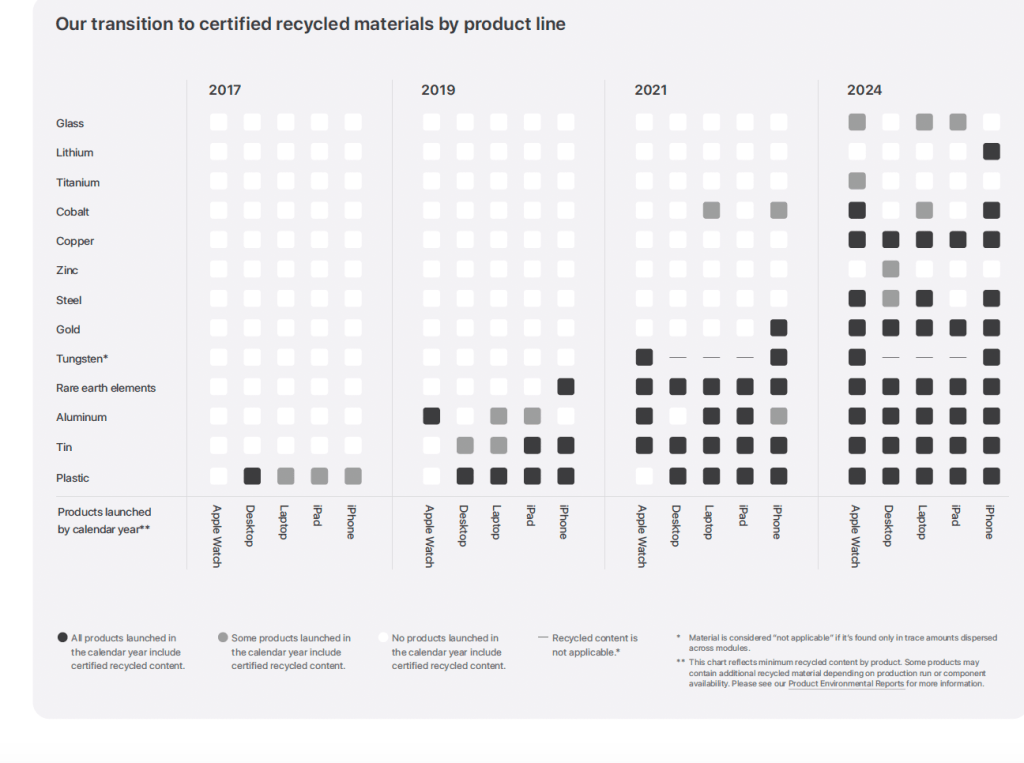
Graphic showing Apple's use of recycled materials, but product line.
Apple’s recycled content usage increased notably between 2021 and 2024 across all product lines.
Source: Apple

Work in progress

Apple has several other near-term goals for recycled metals and rare earth elements that it’s close to meeting. They include:

  • Recycled cobalt for all Apple-designed batteries: It’s at 99 percent for the batteries; 78 percent of the cobalt sourced for all products in 2024 was recycled, compared with 52 percent in 2023.
  • Recycled sources for all tin soldering and gold plating in certain circuit boards: They represented 99 percent in 2024.
  • Recycled rare earth elements for all magnets: They represent 99 percent of what’s used in Apple batteries and 80 percent for all of Apple’s rare earth needs.

In addition, Apple’s progress on sourcing recycled gold — used in circuit boards, connectors and chips — accelerated from 2021 to 2024. In 2024, recycled gold was used for 40 percent of material in all products, up from 1 percent in 2021. The company doubled the number of suppliers certified to manufacture these materials over the past 12 months.

Challenges to future increases in recycled materials usage include overcoming technical concerns such as durability and potential contamination; constrained supply availability; limited data that traces origins; and international regulations that may inhibit cross-border shipments. “Addressing these takes a collective response,” Apple said.

[Join over 1,500 professionals transforming how we make, sell, and circulate products at Circularity, April 29-May 1, Denver.]

The post Progress report: Apple’s push to use recycled aluminum, rare earths and 13 other materials appeared first on Trellis.

Key takeaways

  • Science Based Targets initiative’s net-zero revision introduces a new corporate classification for companies with less than $450 million in sales.
  • Some requirements, such as third-party assurance of carbon accounting, are optional.
  • It holds special appeal for businesses in lower- and middle-income countries.  

Most companies with validated net-zero goals are big multinational organizations, but the Science Based Targets initiative’s proposed revisions include changes intended to boost adoption by small and midsize enterprises (SMEs) — especially those in emerging economies.

The 132-page proposal circulated for feedback through June 1 suggests a revised categorization model based on company size and geography. Category A refers to large multinationals. The new Category B includes small and micro enterprises with less than $50 million in annual revenue and fewer than 250 employees; and medium businesses from low- and middle-income countries with up to $450 million in sales and 250 to 1,000 workers. 

Category B companies will get more time to have net-zero targets validated after they commit: two years instead of the one-year deadline set for larger companies. In addition, some requirements — such as the need to get carbon accounting verified by a third party or to trace supply chain emissions within a specific period — are optional.

The proposed revisions are more welcoming to small companies, allowing them to stay focused on directly making “good quality reductions” to emissions from their facilities and electricity purchases that are more within their control, said Cooper Wechkin, founder and CEO at consulting firm RyeStrategy.  

“It was hard to blame a company for balking,” he said. “This can be tricky and expensive.”

Large-company mindset 

The new model replaces criteria SBTi previously set for smaller companies and are more “realistic” for SMEs and enterprises in developing nations than the previous framework, said Chris Hocknell, director of consulting firm Eight Versa. 

“This is a shift from the previously nearly uniform approach, which could offer some businesses more attainable paths toward net zero,” he said.

Many small companies that Eight Versa has advised have been frustrated with the rigidity of SBTi’s requirements, and some have chosen not to act because of that. “It’s this all-or-nothing mentality,” Hocknell said. “That is part of the problem. There’s not a perceived alternate route of even second best that is considered credible enough.”

While SBTi’s new net-zero standard is more flexible, it still requires absolute reductions for Scope 1 and 2, which can be a particular challenge for fast-growing startups — including those developing climate technologies that can help reduce emissions.

“It betrays a naivete about business that hasn’t been addressed,” Hocknell said. 

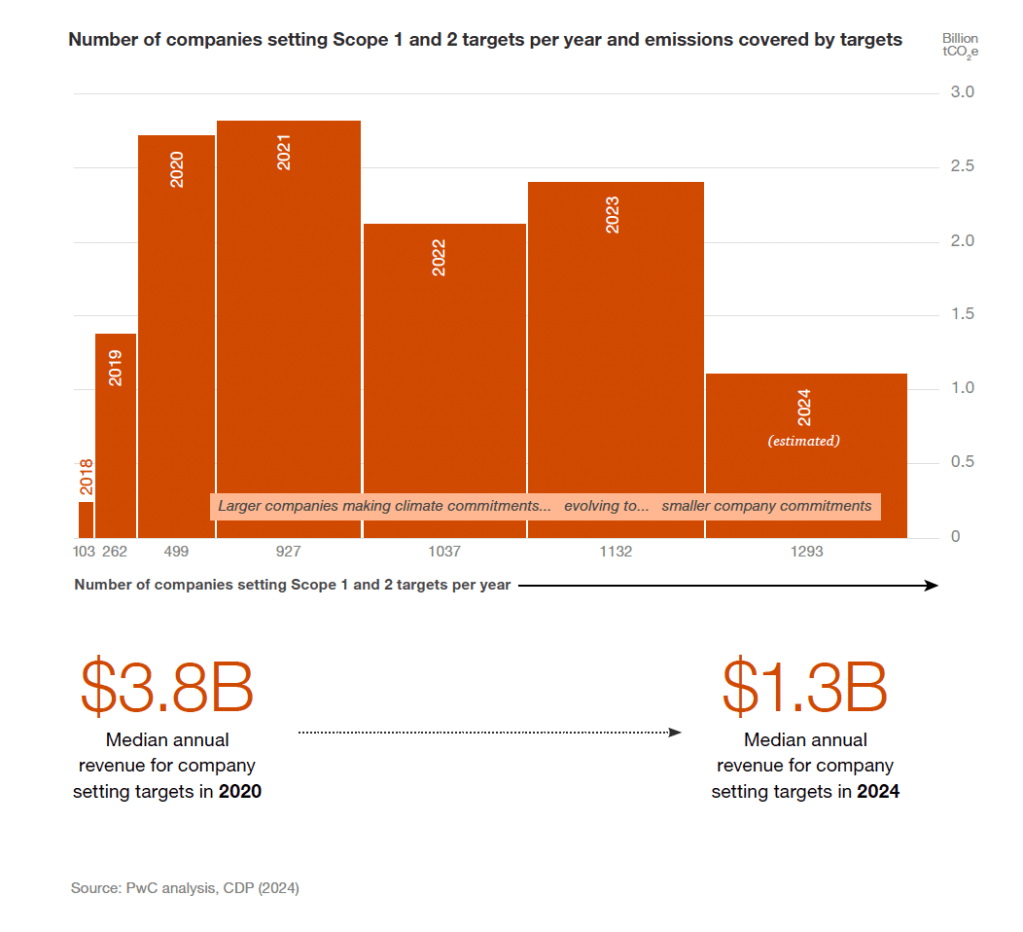
chart showing net zero commitments, and the amount of emissions they cover.
The number of companies setting new targets surged from 2020 to 2023, but only cover 1.1 billion metric tons of carbon emissions.
Source: PwC

Ripple effect across supply chains

One-third of the roughly 1,500 companies that already have validated net-zero strategies are small and midsize businesses — the U.S. classifies SMEs as those with fewer than 500 employees and $1 billion in annual revenue. Small companies represent a growing percentage of those booked for validation in the second quarter, according to SBTi.

That aligns with PwC’s recent analysis of disclosures to CDP. Between 2020 and 2023, the number of companies setting greenhouse gas emissions reductions goals surged but their median annual revenue shrank to $1.3 billion in 2024 compared with $3.6 billion in 2020. 

Many smaller companies are moving to set targets because they’ve been encouraged to do so by large multinationals. “We call this a ripple effect,” said PwC Partner David Linich. “Over time, they will turn to their own suppliers and ask them to do the same thing.”

Primary motivators for SMEs

Small companies considering whether to set emissions reduction goals often weigh three questions, said Mahesh Ramanujam, CEO of Global Network for Zero, which helps companies with net-zero certification. They are:

  • Can I cut my costs?
  • Can I get more business by doing this?
  • Will I lose a customer if I don’t take this action?

“This shouldn’t be one size fits all,” he said, talking about the difficulty most companies have in calculating emissions inventories and reporting progress. “At the same time, it should not require a consultant. It should be a simple plug-in.” 

Approximately 60 percent of SMEs are setting targets in response to client expectations, up from 40 percent in 2024, according to a recent survey by We Mean Business Coalition.

“Our investors want to see real, measurable progress, while our guests choose us for our commitment to sustainability,” said Ananda Putra, sustainability manager for OXO, an Indonesian property developer. “Since publicly disclosing our emissions, we’ve noticed stronger investor confidence, increased guest loyalty and reduced unnecessary energy and water, directly cutting costs.”

[Connect with more than 3,500 professionals decarbonizing and future-proofing their organizations and supply chains through climate technologies at VERGE, Oct. 28-30, San Jose.]

The post SBTi wants more small companies to set net-zero goals. Here’s how it’s wooing them appeared first on Trellis.

Key takeaways

  • The fashion veteran brings decades of apparel and fiber expertise to Avalo’s AI-driven mission to breed better cotton.
  • Industry peers have credited her with efforts to advance circulose, textile-to-textile recycled material from doomed startup Renewcell.
  • Carey spent 24 years at fiber giant Lenzing Group, where she led denim strategy and expanded the use of Tencel.

Send news about sustainability leadership roles, promotions and departures to [email protected]. Read more Executive Moves.

Tricia Carey, a veteran of sustainability innovation in apparel, is joining a six-year-old startup that seeks to accelerate the evolution of climate-friendly cotton. As the new chief commercial officer for AI-focused Avalo, she will help develop irrigation-free cotton plants that use 30 percent less fertilizer than with conventional methods.

Based in New York City, Carey will help the Durham, North Carolina, company expand a two-year effort in Texas to discover “low-input” cotton strains that require fewer chemical applications than when conventionally grown. 

Carey brings deep experience in fiber and textile development, honed over more than two decades at Lenzing Group. In the late 1990s, she helped usher the company’s new semisynthetic fiber, Tencel, into supply chains for brands including Gap, Levi’s and Under Armour. She worked her way up to become director of business development for denim and the Americas.

More recently, Carey attracted a mix of sympathy and criticism in her nearly two years as the chief commercial officer of Renewcell, which she left last July. The promising Stockholm circularity startup recycled old cotton jeans and T-shirts into material to be blended and spun into new clothes. H&M, Zara and Levi’s featured the product in capsule collections. Due to a mix of bad timing, failure of purchasers to honor agreements and the pressures of a newly public company, Renewcell filed for bankruptcy. However, its product, circulose, lives on with the name Circulose and in mainstream clothes by Reformation and others.

Carey has held numerous leadership roles at fashion sustainability groups, including Textile Exchange and the Fashion Impact Fund. She sits on the boards of Accelerating Circularity and the Transformers Foundation, of which she is also a founding member.

“What excites me most about Avalo is its ability to reimagine agriculture at the intersection of science, AI, and sustainability,” she told Trellis. “My vision for this role is to help scale Avalo’s cotton from pilot to full commercialization — connecting the dots from farm to retail. On a weekly basis, that means working closely with farmers, industry partners, spinners, and mills to optimize fiber performance, as well as collaborating with brands and retailers to align on sustainability goals and product development.”

Avalo’s vision of “low-input,” low-carbon cotton

“We’re so excited to have Tricia on board who has brought industry changing innovation to the textile world,”  Avalo CEO Brendan Collins said in a press statement. “That said, her experience as a strategist, supply-chain connector and coalition builder will help us bring similar innovation to other industries that desperately need it.”

The machine learning startup hopes to rapidly produce and popularize crops that weather droughts and other conditions amplified by the climate crisis. The company’s “discovery engine” pinpoints the genetic basis for specific crop traits, then uses its findings to make quick, accurate simulations and predictions. Avalo doesn’t make genetic modified organisms; it finds ways to breed more plants that use fewer resources and chemicals.

Fashion loves cotton, its second most utilized fabric. But so do aphids and bollworms. Worldwide, cotton is responsible for roughly 10 percent of pesticide use and 2.5 percent of global use of farm-worthy land, according to the Pesticide Action Network. The crop also guzzles 3 percent of all water used in agriculture, according to the World Wildlife Foundation.

Only 2 percent of global cotton is grown with organic, traceability standards, such as the Better Cotton Initiative.

Avalo is also working on other low-carbon commodities, including rice and rubber. Its sugarcane efforts nabbed a partnership in March with CocaCola Europacific Partners (CCEP).

The company just raised most of its $14.9 million in funding in March, with a Series A round of $11 million led by Alexandria Venture Investments and Germin8 Ventures.

Threads of AI and fibers

Carey recently advised FibreTrace, another AI technology bid involving apparel materials. It enables end products to be traced to their origins by embedding a nontoxic, pigment-based identification marker in raw fibers. She recently described the growth in tech-focused companies boosting materials traceability and transparency as part of a generational shift in the industry. “You need someone to make sure it’s being applied properly, so you need your IT person but you also need a textile technologist,” she told California Apparel News last week.

It sounds like Avalo was listening.

[Join Trellis Network to gain the powerful peer network you need to drive more impact across your organization.]

The post Tricia Carey joins “low-carbon” crop startup Avalo appeared first on Trellis.