Key takeaways

  • To reach a wider audience, companies need to avoid jargon-heavy water stewardship terms.
  • Credible descriptions for water stewardship targets succeed when water is linked to climate, nature and people.
  • Compelling stories can help stakeholders understand why water issues and programs matter to them.

If the terms “water positive” and “nature positive” leave you confused, you’re not alone. To improve water stewardship and communications around the topic, companies need to avoid technical or jargon-heavy terms that aren’t engaging for most audiences.

In a recent survey of more than 350 water and sustainability experts, Trellis data partner GlobeScan, in conjunction with the World Wildlife Foundation, found the most meaningful and credible descriptions for water stewardship targets are:

  • “restoration of nature and ecosystems” (49%)
  • “science-based” (42%)
  • “protection of rivers, lakes, and wetlands” (40%)

In contrast, experts consider “water positive,” “nature positive,” and “replenish” to be the least meaningful and credible of the options presented.​ Similarly, GlobeScan’s public opinion research shows people rank “protect rivers, lakes, and other water-based habitat/nature” much higher than “use less water in operations and supply chains” in terms of the most important water-related goals for an environmentally-responsible company.

The research points to three reasons for low levels of awareness and engagement related to companies’ water stewardship activities:

  • Most companies don’t talk about water very often or via channels that reach many stakeholders
  • Water-related communications usually put a heavy emphasis on data and methodologies like “water positive” and “replenish” that are not very relatable or compelling for most stakeholders
  • Corporate communications on water focus too much on the quantity/efficiency of water whereas pollution or ecosystem restoration is more likely to gain traction with the public

What this means

Going forward, companies can improve transparency and disclosure by communicating in ways that are more relevant, tangible and engaging by linking water to climate, nature and people. Organizations can highlight the important ways that water links, shapes and contributes to powerful, nature-based solutions for climate resilience, adaptation and mitigation. The public strongly associates water with nature and conservation, and linking it to nature offers opportunities for restoration, progress and positive stories. More compelling corporate communications on water stewardship can help stakeholders understand why issues and programs matter to them and how both the company and consumers stand to benefit from corporate actions and investments. ​

Based on a survey of 352 water and sustainability experts across 63 countries and territories conducted in Nov.-Dec. 2024.

The post To enhance water stewardship, tout the ‘restoration of nature and ecosystems’ appeared first on Trellis.

Key takeaways:

  • The success of Unilever’s climate transition action plan depends on stricter regulations for high-emitting sectors.
  • The company will quit trade groups that remain misaligned 12 months after being put on notice.
  • Unilever’s annual assessment of industry association is rare.

Unilever has distanced itself from two trade associations because their lobbying activities are misaligned with the consumer products company’s climate policy agenda.

In one instance, the company requested that the German Chemical Industry Association stop using Unilever’s name and logo in marketing materials because the organization is out of step with Unilever’s advocacy positions on renewable energy and carbon pricing. 

Unilever is also distancing itself from the Tennessee Chamber of Commerce & Industry, which represents the interests of an ice-cream manufacturing plant in Covington. That relationship will be reviewed in late 2025, along with several others, after Unilever divests its ice cream business.

The actions were outlined in Unilever’s annual assessment of the lobbying and political advocacy positions of more than two dozen key industry organizations in which it has a membership interest. 

The company belongs to more than 600 trade groups. Those assessed — including the Consumer Goods Forum and the Personal Care Products Council — represent sectors where more stringent regulations and policies are needed to drive climate progress.

“Unilever is already making progress toward our climate goals, but enabling government policies will help us go further, faster,” said Rebecca Marmot, chief sustainability and corporate affairs officer at Unilever. “We’ve increased our direct advocacy on climate issues to reflect that. We need trade associations to do the same, bringing their considerable influence to the table, and growing climate engagement amongst their members.”

As a matter of course, Unilever would rather stay engaged with trade organizations, to create constructive change. If a misalignment lingers for longer than a year, the issue is taken up by the Unilever division that owns the relationship. “At this point, we will determine whether to withdraw our membership and make our withdrawal public,” Unilever said in its assessment. “In some instances, there may be a disagreement regarding positions taken, but Unilever may decide that its interests are best served by retaining membership.”

Fewer trade groups misaligned with decarbonization goals 

Unilever’s most recent analysis, released April 7, uses publicly available information from research firm InfluenceMap. It found that 18 of the 26 evaluated organizations have no “misalignment” with Unilever’s climate policy positions. That’s up from 13 of the 27 organizations considered in the 2024 edition

But only five organizations are actively engaged in supporting climate policies, while 50 percent are “passive” — meaning they don’t speak out either way. Unilever wants those organizations to do more.

With one exception, the same organizations were evaluated in the two assessments.

“After last year’s [report], Unilever outlined additional actions for trade associations to take,” the company said in its analysis. “Many were responsive to requests, but more work is needed to make sure these actions lead to policy changes, especially since the last review was recent.”

5 cross-cutting political priorities

Unilever’s climate transition action plan calls for the company to actively engage on the following policies:

  • Convince countries to adopt national emissions reduction plans that will hold global temperature increases to 1.5 degrees Celsius
  • Advocate appropriate carbon pricing levels
  • Scale up renewable energy capacity, while phasing out fossil fuels
  • Support forest protection and nature restoration
  • Encourage the Greenhouse Gas Protocol to evolve carbon accounting standards to reward emissions reductions across corporate value chains

Unilever ranks as a leader among the limited group of corporations that actively engage on climate policy, and it was highlighted in 2024 by InfluenceMap for its influence on trade groups. 

“The review continues to raise the bar in driving best practices around how companies should be asking for stronger climate change policies while strategically engaging with their trade associations,” said Deborah McNamara, executive director of advocacy nonprofit ClimateVoice. 

Unilever is a bright spot at a time when many companies in the U.S. have “stagnated or gone silent,” she said. “I think companies need to be asking over and over again if enough is being done, and the answer is definitively no. This review however sets the path and shows what is possible.”

The post Unilever pushes trade associations to speak up on climate policy appeared first on Trellis.

Key takeaways

  • Supply chain shifts from tariffs could affect a company’s ability to collect data on the impact of value chains and shift carbon disclosure goal timeframes.
  • Compliance on human-rights initiatives and ethical business practices could vary if supply chains move location.
  • Companies committed to ESG performance likely will let political issues shake out before determining next steps.

The U.S. administration’s introduction (and delay) of sweeping tariffs already is showing signs of disrupting global trade. Of course, addressing the fundamental economic challenges the tariffs represent will be top of mind for all companies, but it’s important to note that the redrawn trade patterns and alliances will also likely change how companies approach their efforts to ensure supply chains meet their standards for environmental, social, and governance-related performance. 

In addition to the standard business imperatives of cost, quality, and timeliness, most global corporations have already invested significant resources into mapping their value chains. Forward-looking companies have also engaged with suppliers on a wide range of issues including climate reporting and performance, human rights-related issues and ethical business practices.

But as customers and suppliers come to grips with a new economic landscape, it may require them to change suppliers to ensure they can remain economically competitive. 

A supply chain reshuffle 

According to our conversations with several global companies in the pharmaceuticals, software and manufacturing sectors, it’s still too early to predict the exact impacts of tariffs. However, all see the following three scenarios as possible, if not likely, if tariffs remain in place for any significant period.

  • Supply chain shifts could affect data collection: Global corporations have invested substantially in building relationships with suppliers who share or at least agree to support efforts to obtain relevant data regarding the impacts of their value chains. The new economic calculus that the tariffs represent will almost certainly result in substantial portions of global supply chains being restructured and new relationships being put in place. This will affect mutual agreements on what information is provided by suppliers to customers – such as carbon metrics, health and safety information, human rights-related data and other sustainability measurements. Many of these ESG data collection processes will need to be rebuilt to some extent and may result in a disruption of data availability for some time. 
  • Changing carbon disclosures and goal timeframes: Various goal-setting regimes, including those administered by the Science Based Targets Initiative (SBTi), often have a requirement for companies to set goals related to the emissions that originate in their supply chain. To meet these goals, companies often will encourage their suppliers to set their own goals. However, if companies have to identify new suppliers to mitigate the impact of tariffs, most of these agreements will need to be renegotiated, putting those companies who have set such goals at risk of not being able to accomplish them in the time frame expected. This may result in reputational damage to those not able to meet their original commitments. 
  • Compliance unknowns for suppliers and manufacturers alike: The onshoring of supply chains in response to tariffs may result in easier compliance with various human rights and anti-corruption requirements. That’s because many companies have built sophisticated operations to protect working conditions and uphold ethical business practices. If supply chains are moved geographically closer — presumably to where the regulatory environment is similar to the purchaser — then there’s the chance we could see a net benefit from such tariffs. On the flip side, if a company requires certain raw materials that only originate from specific countries as an essential component to their manufacturing process, it’s also possible there could be a “race to the bottom” — where companies are tempted to source materials from anywhere, regardless of the supplier’s commitment to human rights and ethical business practices. 

Doubling down on values

It’s clear we’re in a highly disruptive period for businesses, particularly for those committed to sustainable business practices. If you couple tariffs with an administration that’s clearly inclined to deregulate sustainability-relevant issues, then progress towards a more sustainable future may be more difficult for the next few years. 

That’s why companies should prioritize their most important “non-negotiables” — be it human rights, basic carbon data and/or anti-corruption efforts — and stick to their values on these. Then let the political issues shake out before determining the next best steps. 

Regardless, the business case for sustainable practices remains clear. Forward-looking companies that have already committed to visibility and traceability in their supply chain will be better positioned to navigate these disruptions and quickly adapt to the new global supply chain landscape. 

[Connect with more than 3,500 professionals decarbonizing and future-proofing their organizations and supply chains through climate technologies at VERGE, Oct. 28-30, San Jose.]

The post 3 ways tariffs will affect sustainable supply chains appeared first on Trellis.

Key takeaways

  • The view that nature strategies are beyond companies’ capacity and budgets is outdated.
  • It’s now the job of the CSO to make the case that funding biodiversity conservation and restoration should be part of the company’s overarching environmental strategy.
  • AI is now making previously impossible projects viable.

Entrepreneurs, investors and companies gathered in London for a Nature Tech Summit on March 27th. The event, part of the world’s first “nature tech week,” revealed key insights to guide CSOs in their nature tech decision-making, including trends around AI, politics and data sources. 

Nature tech is booming, as startups in the field attracted about $2 billion in funding in 2024, according to Nature4Climate, up from $1.6 billion in 2023 and double the investments of 2018. 

However, as this young sector matures, CSOs face a potentially confusing smorgasbord of tech. Satellite forest data, drones, eDNA, bioacoustics ground sensing — the list continues to grow. Trellis attended the Summit to hear how companies can surf the trends and make the most of nature tech this year.

What is nature tech?

“From detecting deforestation to efficiently mapping species ranges, a new class of companies and technologies are making it possible for CSOs to account for their companies’ nature impacts,” said Kevin Webb of Superoorganism, a venture capital company focused on biodiversity, in an email.

“What a lot of the purists would say is that it’s any form of technology, anything from AI to drones to genomic sequencing, that is implemented to benefit nature,” said Ollie Potter, founder of The NatureTech Memos, a newsletter focused on the nature tech market.

Energy, pharmaceuticals and mining are the three sectors currently showing the most interest in nature tech, said Potter, but they are not necessarily the most at risk. “I think there is a different conversation to be had about which industries face the most material risk because of nature degradation.” 

Industries at high risk include agriculture, cosmetics and fashion.

Five insights 

1. Companies need climate and nature strategies

“We work with some financial institutions, and a few of them say: ‘Can we just do climate? We can’t really do nature as well,’” said Jo Paisley, president of GARP Risk Institute, during a panel at the summit.

Although some CSOs might consider nature strategies beyond their capacity or budget, this view is outdated. To be sustainable going forward, companies must adopt both climate and nature strategies — irrespective of changing governments and political will in their countries. 

There was a subtle, if unmissable, political undercurrent at the Summit. Many speakers alluded to “shifting landscapes” or “uncertain times” in reference to Trump’s anti-climate policies and rightward trends in European countries. 

Gareth Thomas, Head of Research Innovation at London’s Natural History Museum, shared the clearest message: “Political shifts don’t change ecological facts.

“Nature doesn’t care about politics. Biodiversity is declining. Risk is increasing and instability is growing. The consequences of that remain as inevitable as they did back in December,” he said.

It’s now the job of the CSO to convince the CFO and other executive leaders that funding biodiversity conservation and restoration should be part of the company’s overarching environmental strategy, alongside cutting emissions.

“Often CSOs are bewildered about how to make the case for nature preservation in their organisation,” said Gilad Goren, executive director of the Nature Tech Collective, a nature tech accelerator. “But nature tech can actually help them make the case because these entrepreneurs can back the case up with actual data.”

2. Nature tech isn’t just for reporting

The NatureTech Memos has mapped the sector, capturing more than 1,000 startups in one big table. Some of them provide nature and biodiversity data, while others organize this data so that companies can use it. For example, companies might use nature tech to inform insetting or to make decisions about financing nature restoration projects.

“A common perception is that nature tech is about helping corporates report about their nature risks and dependencies, either through [the EU’s Corporate Sustainability Reporting Directive] or [the Taskforce on Nature-related Financial Disclosures],” said Potter. 

But that doesn’t go far enough. These innovations also give sustainability leaders the quantitative data they need to demonstrate their companies’ supply-chain dependence on biodiversity and strengthen the case for funding nature strategies.

“I think more and more are going to look at the resilience of their business in terms of: Will I have commodity X coming my way or not?” said Goren. “And will I have issues with my supply chain unless I do something about it? Do I need to assess? Or do I need the actual intervention?”

3. Look for data validated by ecologists on the ground

A lot of forest data is gathered using satellite imagery. “The benefit of that is that you can get the data from anywhere in the globe, even where it’s hard to access,” said Sabine Nix, a spatial data scientist at Cecil, a nature data aggregator. “But you also need to be able to train models and validate your data using insights gathered on the ground.”

Cameron Nicol, head of marketing at Space Intelligence, a company using satellite data to map global forest cover, echoed that: “​​One of the challenges of using remote sensing to map landscapes can be getting the granularity to differentiate between what is actually a forest and what is a crop plantation of, say, coffee or cocoa. 

“We’ve been incorporating ecologist expertise into our mapping processes to ensure these forests and tree crops are accurately categorized,” he said.

4. Companies using multiple data sources should stay focused

As well as seeking data validated on the ground, Nix has noticed more companies using a combination of different datasets to inform decisions. “We’re already seeing customers using 10, 20 or 30 different data sources,” she said.

That being said, numerous experts advised CSOs to focus on the question they need to solve, rather than exploring and adopting multiple nature tech innovations as they reach the market.

“There are a lot of different offerings emerging in this space, from data providers to data organizers. CSOs should focus on improving their metrics and think about whether they want general data or specific data about their supply chains,” said Marco Albani, CEO of Chloris Geospatial, a nature data provider.

5. Accelerate data collection using AI

Of course, artificial intelligence is also transforming nature tech. From the micro (a start-up recording earthworm sounds to indicate soil health) to the macro (a company mapping forests in the tropics), large language models are increasingly prevalent. 

Such innovations can equip CSOs with new, previously inaccessible, data and enable them to return to projects previously deemed impossible.

For example, AI has sped up Space Intelligence’s satellite forest data collection, said Nicol: “We’ve now mapped 50 countries across the world and that’s taken us six or seven months, whereas, without AI machine learning, that same work would have taken six or seven years.”

[Join a vibrant community of leaders and innovators driving cutting-edge tools, business strategies, and partnerships to protect and regenerate nature at Bloom, Oct. 28-30, San Jose.]

The post 5 insights for CSOs from London’s Nature Tech Summit appeared first on Trellis.

Key takeaways:

  • SBTi’s new CEO stresses the need for flexibility in target-setting methodologies.
  • Corporations shouldn’t wait for the new Corporate Net Zero Standard methodology to set emissions reduction goals.
  • Climate transition plans will become a critical component of the target-setting process.

The Science Based Targets initiative’s new CEO, former EY sustainability consultant David Kennedy, said the nonprofit must evolve to recognize “pragmatic” approaches for corporate emissions reductions as it finalizes extensive revisions to the Corporate Net Zero Standard.

Kennedy officially joined SBTi in early April, after being named as the new CEO in early January. He boasts three decades of experience in developing net-zero strategies within government and the private sector, especially those related to food systems.

While Kennedy is in “listening and learning” mode during his initial days as CEO, he offered initial impressions and hints about his priorities during an April 9 webinar convened to field questions about the proposed new standard published March 18. SBTi is accepting feedback on the revisions until June 1, as part of public consultations and an online survey. 

“We have to be science based, but we can be more pragmatic and more action focused,” Kennedy said. “We need to be a listening organization; we need to be building relationships.”

New political and economic reality

The Corporate Net Zero Standard revision comes at a fragile moment. While most corporations remain “committed and determined” to reduce emissions, the mood has shifted because of the U.S. political situation and some will find it “very difficult” to meet their original reduction targets set for 2030, Kennedy said. 

SBTi must find ways to reward action even when companies fall short of the goal, he said, noting: “It’s more clear as we move to implementation just what the challenges are.” 

Kennedy highlighted several proposed evolutions in the methodology that he said should benefit corporate practitioners, including:

  • A defined process to assess progress and gaps at the end of a target cycle
  • The decision to let corporations set separate targets for Scope 1 (their own operations) and Scope 2 (purchased electricity and energy)
  • A proposal to require corporations to submit a climate-transition action plan after having targets validated

Companies should not wait for the new standard, which won’t be finalized until late 2026. SBTi will offer a transition path and there “will be mechanisms to align with the next cycle,” Kennedy said. “Get on with acting and driving down your carbon footprint.” 

[Connect with more than 3,500 professionals decarbonizing and future-proofing their organizations and supply chains through climate technologies at VERGE, Oct. 28-30, San Jose.]

The post New SBTi CEO urges companies to step up action on net zero appeared first on Trellis.

Key takeaways

  • Climate United sued the EPA and Citibank for freezing nearly $7 billion in funding towards decarbonization projects.
  • The first suit of its kind during the second Trump administration, its ruling will set a precedent for any future litigation accusing the federal government of illegally withholding funding.

Climate United, often referred to as America’s green bank, sued the EPA and Citibank over its congressionally appropriated funds being frozen. It now awaits the court’s ruling, which is expected to come out on April 15 — a decision likely to set a crucial precedent.

The timeline (so far)

April 2024: Climate United is one of three coalitions selected by President Joe Biden’s EPA to disburse $20 billion to decarbonization projects across the country under the Greenhouse Gas Reduction Fund (GGRF), established in the Inflation Reduction Act.

February 12, 2025: EPA administrator Lee Zeldin releases a social media post accusing Climate United of financially mismanaging the funds designated by the GGRF.

February 18: The nearly $7 billion in funding — held in accounts at Citibank — is frozen after Zeldin’s accusations.

March 5: Citibank releases its first statement, to Trellis, saying, “Our role as a financial agent does not involve any discretion over which organizations receive grant funds.”

March 8: Climate United sues both the EPA and Citibank for a temporary restraining order that would force EPA and Citibank to unfreeze the funds.

March 11: After the EPA requests a one-day delay in the hearing, Zeldin announces the termination of the GGRF.

March 12: Climate United, the EPA and Citibank appear before the U.S. District Court for the District of Columbia in response to the lawsuit. Judge Tanya Chutkan questions whether “the request for an additional day was made in good faith.” Chutkan also appears to question the legitimacy behind the EPA’s reasons for freezing the funding, asking its lawyer, “Can you proffer any evidence that [the grant] was illegal, or evidence of abuse or fraud or bribery — that any of that was improperly or unlawfully done, other than the fact that Mr. Zeldin doesn’t like it?”

What the case could mean for the future

Citibank and the EPA’s actions towards congressionally allocated funding already in the hands of the grant recipient is a first; the outcome will create a precedent for any future lawsuits filed against the agency in connection to previously established federal funding programs. Already, the Coalition for Green Capital (CGC) — one of the other two coalitions awarded money from the GGRF — has also filed a lawsuit against the EPA and Citibank over the termination of its $5 billion grant.

The post Climate United Fund v. Citibank (and EPA): What you should know appeared first on Trellis.

Key takeaways:

  • A German court found Adidas guilty of vague climate claims without defined pathways or offset disclosures.
  • Experts warn of “greenhushing” but encourage clearer communication.
  • New legal challenges and scrutiny around sustainability marketing and reporting are emerging.

Adidas maintains standard best practices to reduce its contributions to the climate crisis, including grounding net zero targets in science. However, that didn’t stop the company from losing a greenwashing lawsuit. On March 25, the Nuremberg-Fürth Regional Court in Germany found Adidas guilty for failing to detail how it would achieve “climate neutrality” by 2050.

Despite the lack of a fine, the bad press for Adidas brings repercussions for other companies advertising climate goals. The suit uniquely targeted a broad, long-term ambition that underpins an overarching corporate sustainability strategy, rather than a specific product claim.

“It is a warning shot for other textile companies to make sure they can substantiate their claims and to move away from vague terminology,” said Richard Wielechowski, senior analyst at Planet Tracker in London. “There is a challenge here in that brands that are trying to do something and talking about it are the ones risking being hit with litigation, whilst those doing nothing get ignored. This might encourage greenhushing.”

Such rulings bring cons and pros for corporate sustainability work, according to Suzanne Shelton, senior partner at ERM Shelton, in Knoxville, Tennessee. “I worry companies will get demotivated from doing the arduous, trailblazing work of decarbonizing, and maybe we’re not giving enough grace for companies to find their footing and communicate as they go,” she said.

“On the other hand, we do need to communicate with consumers in a crystal clear way – our data has shown for years that nobody likes to find out that environmental claims that played a role in their decision to purchase were misleading (it’s damaging to brands).”

These details about difficult decarbonization efforts, including in Scope 3 emissions, come from the annual 2024 report by Adidas.

Deception or imprecision?

Environmental Action Germany, or Deutsche Umwelthilfe (DUH) filed the suit last fall, accusing Adidas of deception. “Companies may not simply communicate sustainability goals (or climate neutrality targets) without explaining how they intend to achieve them,” said Agnes Sauter, DUH head of ecological market surveillance. “The ruling shows that transparency and comprehensible plans for how sustainability goals are to be achieved are essential to create trust and to ensure legal compliance.”

Adidas shared a statement with Trellis: “The decision relates exclusively to a specific wording on our website, which we already adjusted in August 2024.”

The Herzogenaurach, Germany-based brand has not altered its plans to reduce emissions. “Progress is already clearly visible: since 2022, absolute emissions including the supply chain have fallen by 20 percent,” the Adidas spokesman added.

Adidas is among 500 apparel companies with third-party approval by the Science-based Targets initiative for a net zero target. The company aligned that 2050 deadline with an ambitious, Paris Agreement level of a 1.5 degrees Celsius rise in global temperatures.

The specific legal complaint was that Adidas failed to define “climate neutrality” or admit to using offsets.

A year-old Adidas web page about its 2023 environmental impacts now addresses both issues by defining “climate neutrality” as a concept that may balance “residual emissions with emission removals as well as accounting for regional or local bio-geophysical effects of human activities.”

In recent communications, Adidas appears to be dropping language about “climate neutrality,” which it qualified here in its 2023 annual report.

Adidas discloses emissions steps

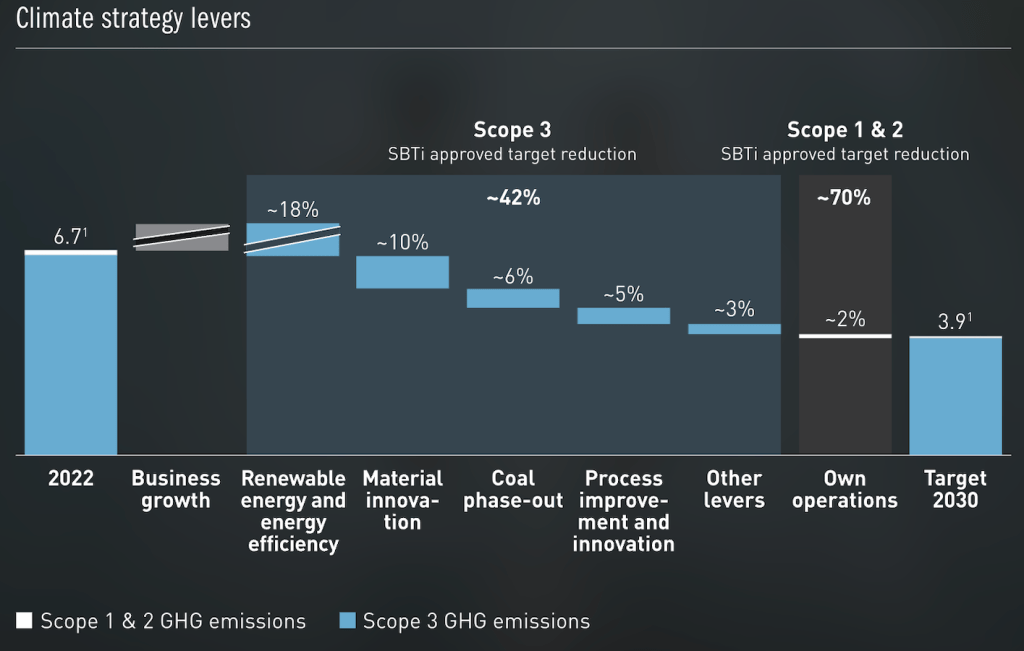
Adidas’s 2024 annual report, issued March 5, does not prominently mention “climate neutrality.” It does, however, detail activities to meet net zero across Scopes 1, 2 and 3 by 2050. That goal includes a 42 percent reduction in indirect Scope 3 pollution by 2030 over 2022 levels, and a 70 percent drop for both Scope 1 direct emissions and Scope 2 energy emissions.

Scope 3 is a special focus for Adidas, whose energy-intensive upstream activities create 87 percent of overall climate emissions. Progress there hinges upon encouraging suppliers to adopt renewable energy and abandon coal-fired boilers. To that end, more than half of the brand’s direct suppliers or subcontracting suppliers had made energy upgrades by the end of 2024.

As for efforts to use lower carbon materials, Adidas sources 99 percent of its main material, fossil fuel-based polyester, from recycled sources. By 2030, it plans to derive 10 percent of its recycled polyester from used textiles. Upcycled marine plastic waste, including fishing nets, is a major source today.

Beware making ‘aspirational’ sustainability claims

Experts note that more legal challenges to insubstantiated expressions of ambitious climate goals may increasingly emerge, especially if the European Union’s Green Claims Directive becomes regulation as expected later this year. Already in January, the E.U. Corporate Sustainability Reporting Directive (CSRD) began requiring companies to share their climate transition plans or provide reasons for why they have not. 

“The same types of cases as the Adidas case are happening in the United States,” said Katie Bond, partner at the Keller and Heckman law firm in Washington, D.C. “There are, for instance, several prominent cases on so-called “aspirational” claims and there are lots of cases on carbon-related claims.”

A leading example of aspirational claims comes from a 2023 challenge, by an arm of the nonprofit BBB National Programs, to meat giant JBS Holdings of Greeley, Colorado. In response, the company modified language about a “Global Commitment to Achieve Net-Zero Greenhouse Gas Emissions by 2040.” The new language replaced “commitment” with fuzzier terms, such as “ambition” and “goal.”

JBS had also made claims such as, “We’re setting time-bound, science-based targets and backing them up with $1 billion in capital over the next decade.” The New York Attorney General filed suit against the revisions. In January, however, the court dismissed, “finding that without the “commitment language,” the issue seemed to be resolved,” Bond said.

Meanwhile, cases over “carbon neutral” claims have attacked Delta, Evian, Apple and Clif Bar. It remains to be seen how these will fare, but companies can reduce risk by explaining exactly what they mean by “carbon neutral” or “carbon negative,” according to Bond.

In fashion, fits and starts for greenwashing challenges

Fashion brands have withstood high-profile greenwashing challenges in recent years. A judge last summer dismissed a class action lawsuit against Nike for its “Move to Zero” initiative and claims about sustainable materials.

Two separate 2022 class action lawsuits, in New York and Missouri, challenged the language in H&M’s “conscious choice” collection. The cases ultimately fizzled out, but companies should learn from them what wording and substantiation helped H&M’s defense, according to attorney Bond.

“In H&M in particular it seemed to make a difference that the company labeled its clothing “more sustainable” and explained why, versus claiming that its clothing is across-the-board ‘sustainable,’” she said. “I think compliance lawyers like me have been saying for a long time to be wary of ‘big’ claims like ‘sustainable’ and ‘eco friendly.’”

Meanwhile, the U.S. Federal Trade Commission has been working behind the scenes to make the first updates since 2012 to its Green Guides. Corporate legal teams, and activists, follow the guides to gauge the potential liability of businesses’ environmental claims. The guides are expected to refresh in the next few years, if not sooner.

“I’m afraid the sustainability communications sector has been the Wild Wild West for a long time, and most generalist ad agencies simply don’t realize they’re overstating claims when they do,” Shelton said. “So it is important for regulators to get guard rails in place, as is happening in both the E.U. and U.K., and for companies and their comms agencies to get the message that sustainability is no place for hyperbole.”

The post Adidas greenwashing judgment offers warnings about climate claims appeared first on Trellis.

Key takeaways:

  • Norfolk Southern is allowing freight customers to buy Environmental Attribute Certificates, which they can use to reduce Scope 3 emissions.
  • Similar schemes already exist in aviation and maritime shipping.
  • The company has a goal of having lower-carbon fuels account for 7 percent of its fuel mix by 2027 and 20 percent by 2034.

A major U.S. railroad is joining the aviation and maritime shipping industries in launching a book-and-claim scheme to help customers reduce freight emissions.

Norfolk Southern, which operates more than 3,000 locomotives and moves around 7 million shipments annually, unveiled its RailGreen system last week.

Like other book-and-claims schemes, RailGreen is designed to allow any customer to pay for and claim Scope 3 benefits. When biodiesel is used in a Norfolk Southern locomotive, the company generates an Environmental Attribute Certificate (EAC) for every ton of emissions avoided. Customers then purchase EACs and count them against Scope 3 emissions. The certificates cannot be used twice or passed to another company. 

The scheme was inspired in part by an equivalent maritime project known as Ship Green that was developed by maritime shipper Hapag-Lloyd, said Josh Raglin, Norfolk Southern’s chief sustainability officer. The Sustainable Aviation Buyers Alliance operates a similar scheme for air travel.

Displacing diesel

Norfolk Southern’s biodiesel will be produced from vegetable oils, animal fats and used cooking oil, said Raglin. The company’s locomotives do not have to be modified to work with the fuel — provided that the lower-carbon alternative does not make up more than 20 percent of the mix. Norfolk Southern is working on introducing another alternative fuel, known as renewable diesel, that can completely replace fossil diesel. Raglin said the company has a goal of having these lower-carbon fuels account for 7 percent of its fuel mix by 2027 and 20 percent by 2034. 

Norfolk Southern is aiming to use 9 million gallons of biodiesel this year, which, if certified through the RailGreen system, would generate EACs corresponding to 70,000 tons of CO2. Raglin declined to disclose the exact cost of an EAC, but said that it would be less than $100.

The scheme builds upon Norfolk Southern’s emissions tracking technology, which checks fuel burn in locomotives every 15 minutes. The data is used to report emission shares to individual customers, adjusted for the weight of freight they are moving, distance travelled and other factors.

Intermodal impacts

Fuel switching initiatives are worth pursuing because no new technology is required to implement the schemes, noted Scott Bernstein, founder of the Center for Neighborhood Technology and an expert on railroads and other aspects of regional and urban planning. The downside, he added, is that they can distract from investing in more consequential changes: “Sometimes fuel switching ends up being an excuse for not making capital investments in a more efficient sort of system overall.”

One example that Bernstein advocates for is intermodal freight, in which transport networks are redesigned to shift the burden from road to rail. The idea was the subject of a 2023 report by the Environmental Defense Fund, to which Bernstein contributed. Because emissions from rail are around 75 percent lower than the equivalent from trucking, shifting freight from one modality to another can produce big benefits, regardless of the fuel used. 

“Going from truck to train is probably a much greater impact on decarbonization than staying with train and just changing the fuel ingredient,” said Bill Loftis, a supply chain expert, author of the EDF report and owner of Supply Chain Ecology, a consultancy. “It’s bound to be because rail is tremendously more efficient than truck.”

The post U.S. railroad launches book-and-claim scheme to reduce Scope 3 emissions appeared first on Trellis.

Key takeaways

  • The new targets cover the seafood sector only.
  • They offer companies a structured way to address ocean sustainability and align their operations with scientific thresholds.
  • Expanding engagement beyond seafood, into shipping, logistics and manufacturing, will further strengthen business resilience and ocean health.

The Science Based Targets Network (SBTN) has launched the first-ever ocean science-based targets, focusing initially on the seafood sector. This milestone completes SBTN’s initial suite of nature-related targets, alongside those for land and freshwater, and provides a structured, scientific framework for companies to address their ocean impacts.

For sustainability teams facing growing regulatory and investor scrutiny, adopting these targets will signal a commitment to improve biodiversity while addressing risks to global supply chains.  

Why this matters 

Continued overfishing, habitat destruction and biodiversity loss threaten both marine ecosystems and business resilience. Seafood providers, pharmaceutical companies and many other industries source directly from the ocean, and marine transportation is essential for worldwide trade. More than 80% of global trade by volume is transported via maritime shipping.

Despite these material risks, there is a dearth of corporate ocean commitments — especially those that go beyond blue carbon (i.e., carbon stored in marine ecosystems) to include biodiversity. SBTN’s new targets provide a pathway to bridge that gap, offering companies a structured way to address ocean sustainability and align their operations with scientific thresholds, ensuring long-term viability while mitigating reputational and regulatory risks.

“With the first ocean science-based targets for seafood, companies now have a globally recognized framework to scale action across land, freshwater and ocean,” said Erin Billman, executive director of SBTN. “These targets help companies move beyond incremental change, strengthening marine ecosystems, supply chain resilience and long-term viability.” 

What’s included 

Developed under the leadership of World Wildlife Fund and Conservation International — with input from key industry stakeholders like Sustainable Fisheries Partnership and the Aquaculture Stewardship Council — the targets were piloted in 2024 by four companies with materiality in the ocean and seafood systems, including Danish aquaculture company Musholm A/S and Orkla Foods in Sweden.

Following a public consultation, SBTN refined its approach to cover three key goals for companies in the seafood and aquaculture sector:

  • Avoid and reduce overexploitation: Ensure sustainable sourcing of wild-catch fisheries and reduce reliance on overexploited stocks.
  • Protect structural habitats: Address the impact of seafood operations on critical marine ecosystems, such as coral reefs and seagrasses.
  • Reduce risks to marine wildlife: Mitigating risks from fishing and aquaculture practices on vulnerable marine species.

Each target includes multiple pathways for action, ranging from direct operational changes to engagement in jurisdictional and ecosystem-based initiatives. For example, a company sourcing wild-catch seafood may set a target such as: “By 2030, we will reduce sourcing of Atlantic blue marlin by 13 percent compared to a 2025 baseline.” 

This ensures that overexploited stocks have time to recover while promoting sustainable practices.

An advance, but more is needed

The new targets represent a major step forward for corporate ocean action but only scratch the surface. Starting with fisheries makes sense. At the same time, many other industries also depend on healthy marine ecosystems. For example, pharmaceuticals and agriculture rely on marine resources, and marine-derived compounds are used in medicines and skincare. Fishmeal, meanwhile, is a key ingredient in animal feed. 

Ensuring that these sectors recognize their role in ocean stewardship will be key to long-term success.

The ocean is also an emerging source of sustainable materials, such as seaweed-based plastic alternatives that could transform packaging and reduce dependence on fossil fuels. If marine ecosystems continue to decline, new opportunities will be be lost, fueling materials shortages and increasing costs.

We’ve already seen how fragile supply chains are when ocean access is restricted. The Ever Given blockage in 2021 delayed $9.6 billion in goods per day when a container ship ran aground and blocked the Suez Canal, and Red Sea attacks by Houthi forces have forced costly rerouting since 2023. While these disruptions resulted from physical blockages, marine ecosystem collapse could create similar risks at a systemic level.

SBTN’s targets lay a strong foundation, and expanding engagement beyond seafood, into shipping, logistics and manufacturing will further strengthen business resilience and ocean health.

What’s next

Companies in the seafood and aquaculture sector can now begin setting their own ocean-related science-based targets. Early adopters will not only position themselves as sustainability leaders but also gain a head start in regulatory alignment and supply chain resilience.

But for ocean sustainability to be truly effective, other industries beyond seafood producers must be held accountable as well. There’s growing recognition that investors and industry leaders can play a critical role in expanding targets beyond fisheries and creating a clear business case for broader ocean stewardship. The economic risks of ignoring ocean sustainability — disrupted supply chains, increased insurance costs for marine transport, loss of biodiversity affecting raw material availability — are too significant to overlook.

For more information, or to express interest in setting seafood science-based targets, visit SBTN’s Ocean Hub page.

The post The first science-based targets for oceans are out. Here’s what you should know appeared first on Trellis.

Key takeaways

  • The EU’s cap-and-trade scheme — the Emissions Trading System (ETS) — released data showing that participating sectors have reduced emission to 50 percent of 2005 levels.
  • The reductions keep the EU on track to meet its 62 percent emissions decrease by 2030 goal — thanks, in large part, to a 12 percent reduction in the power sector.
  • The ETS’s progress proves climate mitigation economics can be a success, just as the EU has been slowly shifting right after its 2024 elections.

The European Union’s oft-criticized Emissions Trading System (EU ETS) has reduced emissions from participating sectors by 50 percent, according to new data, in the process helping the EU stay on track to achieve its 2030 target of lowering emissions by 62 percent.

The scheme assigns a cap to the CO2 produced by companies, while creating incentives to reduce those emissions. EU ETS is similar to cap-and-trade laws established in U.S. states, including Washington and California. European companies purchase a set amount of emission allowances that covers their expected emissions for one year. If a company emits more than its allotted allowances, it must either purchase allowances from other companies that came in under their cap, or pay a fine.

The price of carbon is set by the market, as companies buy and sell allowances.

As of Mar. 31, 2025, sectors covered by the system demonstrated a 5 percent reduction in total emissions in 2024, compared to 2023, cutting ETS emissions to around half of 2005 levels.

The sectors covered include:

  • Electricity generation: The leading sector in decreasing emissions, power producers reduced emissions by 12 percent below 2023 levels, driven mostly by increased renewable energy.
  • Industry: The most wide-reaching of the categories, this includes the energy-intensive production of fertilizer and cement. Industry emissions remained stable from 2023 to 2024.
  • Aviation: The only category to see a rise in emissions, which increased by 15 percent compared to 2023, likely due to the re-inclusion of non-domestic flights recently added under ETS rules.
  • Maritime: The newest sector to enter the system lacks previous data on emissions for comparison.

Notable timing

This success happens during a time of change within the EU. The European Parliament recently voted to delay its compliance timeline for the seminal Corporate Sustainability Reporting Directive (CSRD) and Corporate Sustainability Due Diligence Directive (CSDDD), pushing back the 2026 and 2027 dates to 2028 and 2029.

Meanwhile, elections in the summer of 2024 saw the makeup of EU representatives shift to the right. Far-right groups from Germany, France and Italy among others gained 189 seats in the EU, more than a quarter of the total.

The post EU’s carbon pricing scheme lowers emissions to 50% of 2005 levels appeared first on Trellis.