What is a New York City handbag giant doing in central Illinois, where it lacks boutiques, offices and factories? Tapestry, which runs the Coach, Kate Spade and Stuart Weitzman brands, together with Pivot Energy, completed three community solar projects on Jan. 8. They total 13.5 megawatts, enough to power about 2,500 homes.

Two more installations will follow those just established in Peoria, Ottawa and tiny Dover, Illinois, in a 15-year partnership, announced in 2023.

The five community solar projects will add up to a modest 33 megawatts. However, those clean electrons are instrumental to Tapestry’s goal for 2025, which it reached, to count 100 percent renewables across its own operations, according to Logan Duran, global head of ESG and sustainability at Tapestry.

“Getting our own house in order from a renewables perspective was the first step,” Duran said, “simultaneously continuing to engage with our long-term and strategic partners in the supply chain, on the facility and factory level.”

In pursuit of its science-based net zero deadline of 2050, Tapestry is stretching toward a new target, announced Dec. 22. By 2030, it seeks to power 40 percent of its supply chain with renewables. Today that’s at 12 percent.

Ninety-nine percent of the corporation’s climate emissions are in Scope 3. By 2030, Tapestry aims for 42 percent cuts over 2022 levels.

In 2025, the business noted a 14 percent rise in Scope 3 emissions since 2021, which it is seeking to reset to 2022 to account for the impacts of the COVID-19 pandemic. Emissions intensity dropped by 10 percent in the same period.

Land of Lincoln

The corporation took a portfolio approach toward its achieved goal of 100 percent renewables for its own offices, stores and fulfillment centers.

“What we found was, we have a lot of stores but they all have small roofs,” Duran said. The company, which has more than a dozen stores in the Chicago area, liked Denver-based Pivot Energy’s proposition for a long-term Renewable Energy Credit (REC) offtake agreement in Illinois.

The project-based REC allows Tapestry to take credit for the clean electricity and its associated emissions reductions. 

“We can’t necessarily track direct electrons to our individual stores but if we’re able to stay within the same grid or within the same region, we felt like it was meaningful from a commitment perspective,” Duran said.

The bulk of Tapestry’s 2025 emissions

Tapestry’s Scope 3 emissions make up most of its climate footprint. Credit: Tapestry 2025 sustainability report

“Illinois has become a favorable market for renewable energy development, with the enactment of the Clean and Equitable Jobs Act,” noted Pivot Energy Senior Director of Project Development Buzz Becker. The law, enacted in 2021, offers incentives for RECs and requires social equity support for new energy installations.

Supporting the local community also appealed to Duran. Illinois consumers who opt for the solar power can enjoy discounted utility bills. Meanwhile, Illinois Central College and HIRE360 receive $65,000 contributions from Pivot Energy, a certified B Corporation based in Denver.

“This project announcement makes state policy tangible,” said Matthew Popkin, U.S. program manager at RMI. “Illinois encouraged the market to use community solar to not only meet today’s energy needs but also increase consumer access to fixed-cost energy and support longer-term workforce development goals.”

The energy portfolio

In other markets, Tapestry uses a mix of unbundled and bundled RECs as well as Energy Attribute Certificates (EACs).

In Europe, Tapestry is among 12 brands joining the Fashion Pact in a Collective Virtual Power Purchase agreement, announced in 2023. The solar project they’re supporting in Spain would generate an estimated 100 MW under peak sunlight.

Tapestry is also directly helping suppliers to adopt renewable energy and ditch coal by 2026, part of risk mitigation within its sustainability work. 

“If there are random brownouts or blackouts or disruptions, it obviously impacts our ability to manufacture and move product,” Duran said.

The company’s decarbonization program last year engaged with 40 suppliers across Tiers 1 and 2, addressing about 70 percent of its suppliers’ emissions. For instance, Tapestry paid for onsite assessments and feasibility studies for Tier 1 contract supplier Pungkook Ben Tre to install solar panels in Vietnam.

In addition, Tapestry engages with the Apparel Impact Institute to help tanneries slash emissions.

Materials and nature

Circularity and biodiversity protection are other core focuses for the accessory brands’ sustainability work.

Almost all of Tapestry’s leather tanneries are rated Gold or Silver by the Leather Working Group. Environmentally preferred materials include “wet blue” leather scrap from startup Gen Phoenix. That only appears in the experimental Coachtopia brand, but products are being developed for the main line, too, Duran said.

“When we look at the longevity, the durability and the intrinsic quality of the material, it ultimately really lends itself well to things like the circular economy,” he said of leather, its main material.

The post Why the parent company of Coach and Kate Spade is investing in community solar in Illinois appeared first on Trellis.

Meta’s three new deals for up to 6.6 gigawatts in nuclear energy aren’t just record-breaking; they underscore growing corporate interest in clean power that’s available at night.

Contracts orchestrated by companies with emissions reduction commitments added (or will add when the projects are complete) close to 128 gigawatts of renewable or clean energy to the U.S. electric grid from 2014 through November 2025, according to data collected by the Clean Energy Buyers Alliance (CEBA).

Wind farms and solar installations represent the vast majority of that new power, but deals from generation resources that can run around the clock, such as fusion, geothermal, hydro and nuclear, are growing. They accounted for 17 percent, or 3.4 gigawatts, of new capacity in the first three quarters of 2025. 

There are 21 related contracts since 2021 in 10 states: Illinois, Nevada, New Mexico, Ohio, Pennsylvania, Tennessee, Texas, Virginia, Washington and West Virginia. 

“No matter how you slice the data, it is a fast-emerging trend. This is taking off fast,” said CEBA CEO Rich Powell. “I have every reason to expect you will see significant deals through 2026.”

Nuclear energy has been undervalued for some time, but corporations interested in sourcing low-carbon electricity are reevaluating this resource because it can provide power when solar panels cannot, said Gavin McCormick, co-founder and executive director of nonprofit WattTime, which tracks grid emission data. 

“Why it’s valuable is because it works at night,” he said.

Several announced deals — and the corporate funding behind them — have had the effect of adding nuclear power plants back to the grid or keeping them operating. “Preventing a nuclear plant from closing is excellent additionality, even if it’s not new,” McCormick said.

Big Tech loves nuclear power

Amazon, Google, Meta and Microsoft are behind the biggest corporate nuclear deals, but big industrial manufacturers, including steel maker Nucor and chemical company Dow are also signing contracts. 

The publicly announced nuclear deals for Big Tech alone will support close to 13 gigawatts. Nuclear plants account for close to 20 percent of the power on the U.S. electric grid, and almost half of the resources that are considered “zero emissions” (which includes solar, wind, hydro and geothermal).

With its latest deals, Meta has now committed to buying more nuclear power to address its emissions goals than any other U.S. company, with approximately 7.7 gigawatts of contracted electricity.

The company signed a power purchase agreement in June 2025 with Constellation that covers 1.1 gigawatts from an Illinois power plant over the next 20 years. 

Meta’s three new contracts support a mix of legacy and advanced nuclear. They include 20-year deals with Vistra to extend the life of two plants in Ohio and one in Pennsylvania, as well as to expand their capacity. Meta is also funding advanced reactors to come online early next decade from startup TerraPower, well funded by investors including Microsoft founder Bill Gates; and Oklo, heavily backed by OpenAI CEO Sam Altman.

The post What Meta’s big nuclear deals say about corporate clean energy strategy appeared first on Trellis.

Throughout their lifecycle, buildings are among the largest contributors to greenhouse gas emissions and waste. Erecting and operating structures accounts for one-third of global greenhouse gas emissions, while construction and demolition waste amounted to 30-40 percent of the total global solid waste stream in 2022.

And that is unlikely to change until governments and owners demand it.

“What’s built depends on what jurisdictions mandate and clients specify,” said Eamonn Connolly, director of engineering at Chicago-based McHugh Construction. Low carbon is currently not an emphasis — and even if it were, diffusion of best practices across the industry is sluggish. 

The construction industry has historically been a slow adopter of almost everything, including sustainability. But there is progress. “As companies, individuals, entities, and suppliers gain experience, they become more capable and open to advocating for low-carbon strategies,” Connolly added.

Architecture, engineering and construction (AEC) firms must embrace approaches that support fundamental change, because incremental improvements are no longer enough. Here are four trends to watch for in 2026 — none completely new, but all coming into their own.

Adapt, don’t build

Architects know that the most sustainable building is the one never built. Not building cuts the embodied carbon energy required to extract natural resources, manufacture and transport materials, and build structures. And that means reusing existing structures.

Detroit’s redevelopment offers a lauded example. Many projects feature buildings on local, state or national historic registers. Often, the materials and craftsmanship aren’t cheap — or can’t be had today at any price. Retrofitting with energy-saving components delivers significant efficiencies, and renovations that preserve the building envelope typically take far less time and money.

Adaptive reuse goes a step further by finding new uses for old structures. Detroit-based architecture firm McIntosh Poris has led in stopping the wrecking ball and giving structures new life. The firm transformed a 1925 bank building into a techno nightclub called Panacea, the former Detroit Fire Department Headquarters into the boutique Detroit Foundation Hotel and Fischer Body Plant 21 (below) — opened in 1919 and abandoned in 1993 — into multi-use apartments with retail and co-working space. 

Adaptive reuse produced approximately 25,000 new apartments across the country in 2024, a 50-percent increase year-over-year. Nationwide, projects are on the upswing, with a record-breaking 181,000 apartments in development, mostly from office spaces never reclaimed after the pandemic. A driving factor is the boost in affordable housing from reusing structures, which cuts construction expenses and timelines for units in desirable locations. For example, at least 20 percent of the units at the Fisher 21 Lofts will be designated for residents earning at or below 80 percent of the area median income. Tax credits and government incentives can make these developments more economical with mixed-income properties and help revitalize older neighborhoods.

Design around climate

Instead of one-size-fits-all architecture, climate-responsive design focuses on energy efficiency that arises from the site and environment. Designers orient structures to block or capture sun and wind, and select materials that naturally reduce energy use and embodied carbon. The result: reducing the use of mechanical systems for heating, cooling, ventilation and lighting. 

For instance, natural airflow decreases the need for electric cooling. So, architecture firm Foster + Partners designed the Bloomberg European HQ in London to feature a unique “breathable” façade. Automated bronze louvers open and close to provide natural ventilation and, combined with a central atrium, reduce energy use by about 35 percent compared to a typical office.

Climate-responsive design has evolved into holistic architecture driven by data and technology. Google’s Bay View campus in Silicon Valley, opened in 2022, features a massive geothermal system, solar roofs, 100 percent outside air ventilation, natural light, native landscapes and net-zero water use.

Still, the vast majority of the world’s building stock needs to be transformed for true climate responsiveness.

Reenvision glass

The appeal of sleek glass curtain walls, combined with light and open interiors, explains why glass is the material used for more than half the exterior surface of modern skyscrapers. That typically leads to poor energy efficiency given glass’s low insulating value. But several innovations can dramatically reduce energy loss from glass facades: 

  • Low-emissivity coatings to control heat flow 
  • Insulated glass units that seal two or three panes inside, cutting heat loss
  • Using denser argon and krypton to replace air between panes, slowing heat transfer even more 

The logical progression is windows that can generate energy by capturing light and converting it into electricity — as NEXT Energy Technologies’ windows do at Patagonia’s corporate headquarters in Ventura, Calif.

Also crucial is increasing the sustainability of manufacturing, which requires mining of sand, soda ash and limestone, and running furnaces fed by fossil fuels at 1500 degrees Celsius. To address these issues, manufacturers are increasing recycled glass content, using cleaner oxy-fuel technology, improving furnace efficiency and capturing carbon. Given glass’s infinite recyclability, it has the potential to become a true circular material.

Optimize with AI

The consensus from a survey of 235 contractors by Dodge Construction Network is that AI will transform the industry once construction adopts technologies that use it. But that may take time; in Yooz’s 2023 Technology in the Workplace survey, workers in construction viewed their own industry as the least technologically advanced. 

Still, construction is seeing the value of AI. Autodesk’s 2025 State of Design & Make: Spotlight on Construction report highlights some of the top use cases for AI in sustainability, including supporting data-driven decision-making, analyzing and improving supply chains, enhancing reporting, optimizing energy use and efficiency, and reducing material waste. 

Questions about data privacy and security remain. Still, architects and engineers are using generative AI to explore alternatives for structural design that use the least material while maintaining integrity. AI programs can be trained to predict the exact material quantities a project requires, eliminating over-ordering and cutting cost and waste. By quantifying embodied carbon in materials, AI can also help reduce a project’s carbon footprint.

Digital twins — virtual replicas of real-world entities such as buildings — also use AI to predict behavior from design to end of life. Continually updating digital twins with data from sources like embedded sensors enables managers to test new ideas and make changes. For instance, a digital twin of Heathrow Terminal 5 simulates energy use, airflow and thermal comfort for greater efficiency and post-occupancy performance.

Double down

By 2050, the global building stock is expected to double. The practices and tools to lower future buildings’ carbon footprints are out there, awaiting demand and adoption. “We’re just an industry waiting for the signal to do more,” said Connolly.  

The post 4 sustainable construction trends to watch for in 2026 appeared first on Trellis.
eBay, the world’s biggest resale company, has joined the growing cohort of companies that have published a climate transition plan outlining specific steps needed to meet corporate emissions reduction targets. 

Delivering the goods sold by the 134 million sellers on its marketplace to their customers is eBay’s biggest greenhouse gas liability: it accounts for almost 84 percent of total emissions. 

The 30-year-old company vows to cut that footprint by 27.5 percent by 2030 — it has already achieved a 21 percent reduction — and to reach a 90 percent cut across all emissions categories by 2045. The baseline year for reduction goals is 2019.

Those commitments were validated in 2025 by the Science Based Targets initiative (SBTi), and the 37-page roadmap published Jan. 14 is a “natural follow-on” to the many cross-function conversations and data-modeling exercises required to come up with the goals, said eBay Chief Sustainability Officer Renee Morin. 

“This is not a report that came out of the blue,” she said.

Approximately one-quarter of companies that report greenhouse gas emissions to research firm CDP have published a climate transition plan, but that number is growing rapidly because of anticipated regulatory changes in Europe and potential requirements as part of the forthcoming overhaul of SBTi’s Corporate Net Zero Standard.

eBay’s climate transition plan provides an inside-out view of the company’s impact on climate change and an outside-in perspective on physical and financial risks that could impact eBay’s business as weather patterns change and the world warms. It is meant to motivate eBay partners, sellers and employees by linking climate goals more explicitly to the company’s long-term business and financial growth strategy, Morin said. 

Certain sections of the plan are likely to be updated on an annual basis, but eBay hasn’t finalized a schedule.  

“At the end of the day, when you can show the value of sustainability, the value of decarbonizing, the value of derisking systems, then businesses are going to lean into those outputs,” she said.

For example, eBay acknowledges in the report that shipping partners may be adversely affected by flooding, extreme heat or natural disasters exacerbated by climate change. It’s in their interest to collaborate with eBay on potential solutions, the report suggests. 

Prioritizing carriers

eBay doesn’t own fleets or warehouses. But it is prioritizing relationships with carriers including DHL, UPS and FedEx that have explicit goals to decarbonize their operations through investments in electric delivery vehicles and procurement of sustainable aviation fuel (SAF). FedEx, for example, has committed to shifting all of its new vehicle purchases to electric models by 2030. UPS and DHL have similar EV buying plans, and both aim to use SAF for 30 percent of their air operations before 2035.

Other strategies eBay is expanding: local delivery options and the use of ground shipping versus air freight, which generates higher emissions. 

eBay published a “carrier engagement guide” in 2024 that outlines its minimum expectations of shipping and logistics partners. It requires all to set short- and long-term emissions reductions goals that are certified by an independent organization and to report annually on strategies for renewable energy, sustainable packaging and operational efficiencies.

In order to reach net zero by 2045, eBay estimates it will need to work with carriers to cut emissions from those activities by 46 percent.

The post Why DHL, FedEx and UPS are central to eBay’s climate transition plan appeared first on Trellis.

There’s truth to the adage, “Out of sight, out of mind.”

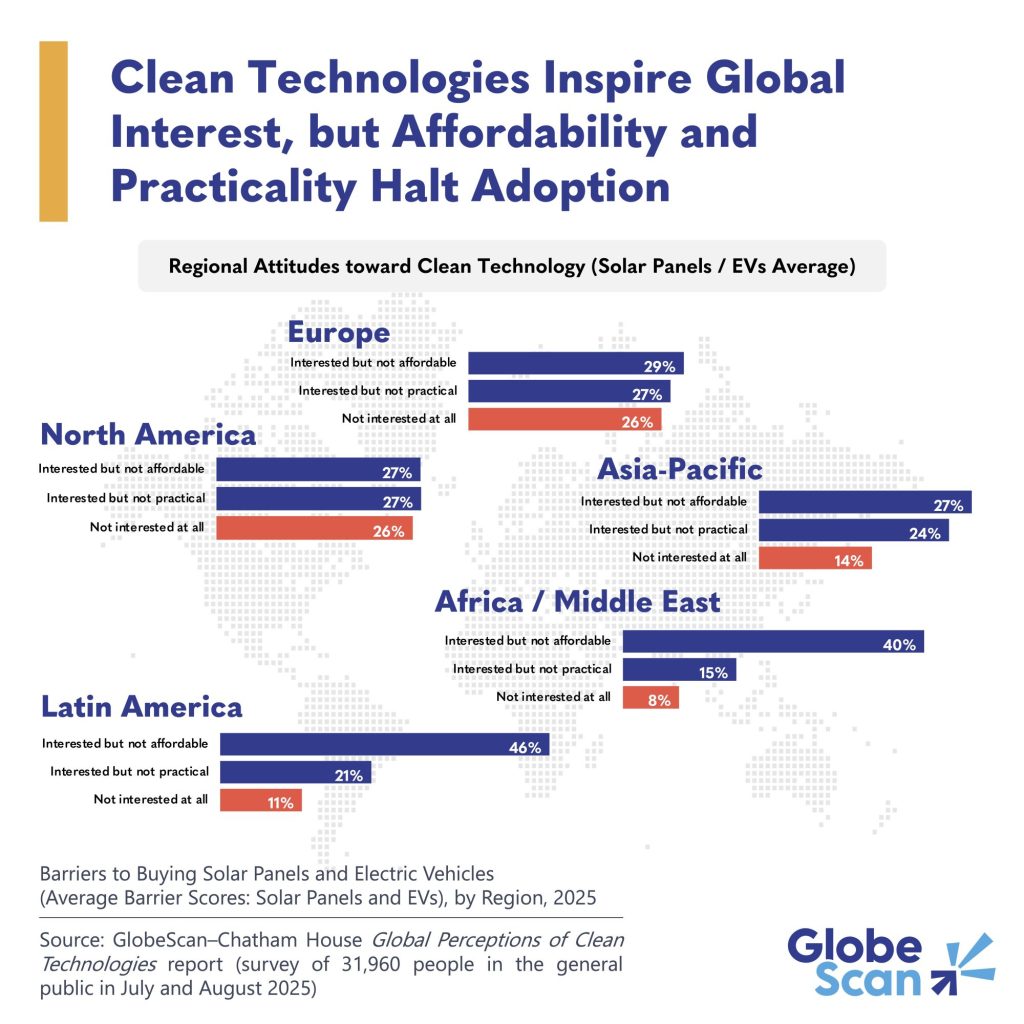
At least, that’s what research from Trellis data partner GlobeScan shows when it comes to the sharp decline in the public visibility of sustainability messaging by brands. Across more than 30 global markets surveyed, the reach and credibility of sustainability communications diminished in the last year. In 2025, only 36 percent of consumers reported seeing at least “some” sustainability messaging from brands, down from 49 percent in 2023.

Trust in these messages has also fallen: 65 percent of people reached by sustainability communications say they have at least “some” trust in them, compared to 79 percent in 2022. These trends were consistent across eight major product categories:

  • Cars
  • Cleaning products
  • Clothing
  • Electronics
  • Financial services
  • Home furnishings
  • Packaged food
  • Personal care products

What this means

For brands, pulling back on sustainability communications risks losing consumer trust and relevance. As fewer people see and believe these messages, brands have less influence on purchase decisions and sustainable behaviors — even if the same work is continuing under the radar. To stay impactful, organizations must rethink how they engage consumers and make sustainability messaging more visible, credible and personally meaningful.

Based on a survey of more than 30,000 consumers across 31 countries conducted July — August 2025

The post Greenhushing is eroding consumer trust, survey shows appeared first on Trellis.

The opinions expressed here by Trellis expert contributors are their own, not those of Trellis.​

Holiday returns look clean from the customer side: Click a button, scan a code, drop off a box. The refund lands like magic, usually within a week or so.

But behind that drop-off counter is a second supply chain that’s uglier, faster and far less forgiving than the simple consumer return process. Apparel isn’t a toaster; it doesn’t sit on a shelf politely while you decide what to do with it. The minute the calendar turns, the value starts leaking out.

The National Retail Federation projects U.S. consumers returned about $850 billion in merchandise in 2025, about 15.8 percent of total retail sales. Online shopping is worse, with returns estimated at 19.3 percent of all online sales. And then the holidays hit the gas: retailers expect roughly 17 percent of all holiday sales to come back.

So where do all those returns go? Not straight to the landfill, but not straight back to the rack, either. It goes through a triage system designed around one brutal reality: Every extra touch costs money and every extra day kills resale value. Here’s a breakdown of how those returns play out. 

Backroom triage

Store returns start with one question: Can we sell it again today? The key here isn’t “should we,” but can we?

If it’s clean, tagged, the current season and still moving, it gets scanned and put right back out. That’s the golden path of returns: no shipping, no processing center, no extra handling, no delay. One touch, and it’s back to revenues.

Most apparel doesn’t get that easy outcome. A little deodorant smell, makeup on the neckline, a missing hangtag or a stretched waistband can make a return take another route. A “looks worn” vibe you can’t prove but you can’t ignore. Once it fails that quick test, it drops out of the full-price stream.

Then it’s a routing decision. Companies can ship it to a returns center, transfer it to another store or mark it down. None of these choices are made with feelings. They’re made with a spreadsheet and a clock.

The returns center

Online returns usually skip the store and go straight to a processing site. Many brands and retailers try to reduce chaos by consolidating shipments, reducing packages and minimizing touches. Happy Returns, for example, sells the “box-free” drop-off model that aggregates returns and sends them together to regional hubs.

Once the garment hits a processing table, it gets graded: sellable as new, sellable with light cleanup, sellable only through discount channels or not sellable.

“Cleanup” sounds minor until you watch the labor stack up: rebagging, relabeling, steaming, lint removal and tag replacement. Rebuilding sets that came back incomplete or repacking accessories. It’s a lot of hands-on work for a low-margin item.

This is why “free returns” quietly rewires product strategy. An $18 top can become a loser for apparel companies after two shipping legs and a few minutes of paid handling. At that point, the retailer isn’t asking whether it’s a nice top. They’re asking whether it’s worth touching one more time.

Fraud and return abuse

Returns now also come with a policing job for companies. NRF’s research estimates 9 percent of all returns are fraudulent, which are defined as anything from customers claiming items didn’t arrive to returning a defective item you already owned. What’s more, nearly half of shoppers say it’s acceptable to bend the rules when returning items.

Apparel has its own brand of abuse. “Wardrobing” is the most rampant: wear it once, return it and leave just enough ambiguity as to whether you did or didn’t use the product that nobody wants to fight. The result is predictable: The garment becomes markdown merchandise (or outlet) or a write-off. 

While companies are trying new ways to combat wardrobing, the reality is that the system is spending more money just to decide whether it’s being cheated. During the 2025 holiday season, for example, Happy Returns tested tools aimed at spotting fakes and suspicious patterns by using sophisticated barcode and database recognition software. 

Where the clothes actually go

Once things are sorted, returned apparel usually ends up in one of five places: 

  • Back on the shelf: Either in the same store, another store or back into the “new” online flow. That’s a clean loop and what retailers ideally want.
  • Markdown: Still sold, but discounted to reflect the clock, handling efforts and weaker demand.
  • Off-price and liquidation: Bulk movement where the brand recovers pennies on the dollar. Sure, it’s better than zero, but not a win.
  • Re-commerce or donation: Heavily dependent on condition, category and what the brand is willing to operationalize.
  • Disposal: The dead end.

To be fair, disposal doesn’t always mean “tossed immediately,” but it’s far more common than customers assume, especially for low-value goods, intimate categories and damaged items where the labor cost of sorting exceeds the resale value. Reverse logistics company Optoro estimates returned inventory generates 5.8 billion pounds of waste annually and some goods end up in the landfill just because reprocessing costs exceed resale value. That’s the ugly truth: sometimes the cheapest move is to stop moving it.

Even when a returned garment isn’t tossed in the trash, recycling isn’t a reliable safety net. The National Institute of Standards and Technology notes that only about 15 percent of used clothing and textiles in the U.S. are reused or recycled, with the rest going to landfills or incineration. That’s because many parts of clothing, such as trims or blended materials (a shirt made of cotton and spandex), make it difficult and costly to separate materials for actual recycling. 

So the post-holiday return surge doesn’t just stress customer service and warehouse labor. It exposes how thin the whole “after” system really is.

What can change the outcome

While all this can seem overwhelming, consumers and companies do have options to make the system better. First, speed matters. The faster a return is inspected, graded and routed, the better the resale odds. That’s why retailers extend return windows for shoppers, then sprint internally to process the wave with seasonal labor, third-party logistics providers and overflow capacity. 

But reducing returns matters even more. Better sizing, better specs, clearer product information, fewer mystery fits — especially online and during gifting season — cuts the problem off at the source. Returns prevention is still the highest-ROI “sustainability” program in most closets.

Consolidation matters, too, because it reduces wasteful motion. If you can reduce redundant shipping and handling, more garments stay economically sellable instead of sliding into the loss pile.

Holiday returns aren’t a character flaw. They’re baked into modern retail. But once a garment crosses the return desk, it stops being a product and becomes a routing problem. If the system finds a second buyer fast, it lives. If it doesn’t, that refund gets attached to a quiet pile of waste.

The post How apparel companies handle the post-holiday return surge appeared first on Trellis.

U.S. companies that rely on a widely used but crude method for calculating Scope 3 inventories should prepare to see double-digit increases in supply-chain emissions estimates when switching to a more sophisticated version of the process, according to a recent study.

Difficulties in obtaining primary data from suppliers often prompt companies to employ spend-based models, which use emissions factors to convert the amount spent on a product into an audit-friendly estimate of the emissions associated with that purchase. 

The factors vary widely depending on the model, however. Many models contain emission factors based on a single country. A single-region model based on U.S. data, for example, effectively assumes that everything in a company’s supply chain was manufactured in the U.S. And because goods manufactured outside North America often result in higher emissions, Scope 3 estimates can leap when regional differences are taken in account.

“We’re putting a false ‘made in the U.S. sticker’ on every product and hiding the real story,” said Yohanna Maldonado, an author on the study and head of climate data at Watershed, a carbon accounting firm.

Global data

To increase accuracy, companies can switch to multiregional models that account for local emission intensities. Working with researchers at Stanford University, the WWF and CDP, Maldonado and her Watershed colleagues found that the total upstream emissions of around 5,400 companies that reported revenues to CDP in 2023 jumped by 2 billion tons of carbon dioxide when a multi-region was used. Their study was published last month in Nature Communications.

How this headline figure applies to individual companies is challenging to determine, in part because few companies disclose details of the models they use. But the problem appears to be widespread: Three-quarters of companies that did disclose details said they used a single-region approach. 

Companies that import significant quantities of steel, fertilizer and other emission-intensive products are likely to see the biggest jump when moving to a multi-regional model. Maldonado said increases of 20 to 40 percent are typical among the Watershed clients that have made the switch.

In addition to the misleading Scope 3 numbers, single-region models also hamper companies’ ability to identify potential emission reductions, noted Maldonado. She cited the example of aluminum sourced either from Brazil, where widespread hydropower lowers emissions intensities; or China, where coal-powered electricity is more common.

Free multi-regional model

Ease of access explains the continued widespread use of single-region models, said Maldonado. Until last year, the Environmental Protection Agency maintained a free-to-use model based on U.S. data, and the U.K.’s Department for Energy Security and Net Zero continues to offers an equivalent. 

That will change later this year when Cornerstone, a collaboration between Stanford, environmental consultancy ERG and Watershed, makes its multi-regional model available for free. The model will incorporate the former EPA data and a multi-region model that Watershed acquired in 2023 when it purchased VitalMetrics, a sustainability software provider and consultancy.

Companies considering switching models should ideally do so before they set targets, advised Maldonado. Those with targets will probably need to restate historical Scope 3 data using the new method, she noted. 

The post Why switching to a better supply-chain model can cause emissions estimates to spike appeared first on Trellis.

Microsoft has responded to the growing backlash over U.S. data center expansion with a set of five commitments meant to win over communities worried about electricity prices, water scarcity and job losses.

More than $64 billion in data center projects were killed over the past two years by villages, towns and cities concerned about surging utility bills, shrinking water supplies and land development deals conducted in secrecy.

The Community-First AI Infrastructure initiative encapsulates the policies that Microsoft will use when approaching new development starting this year, including a promise to bear the cost of electric grid transmission updates and new generation resources.

“We need to stand up and step up as an industry and ensure that we pay the tab for things like the cost of electricity data centers will need,” said Microsoft Vice Chair and President Brad Smith, speaking at a launch event in Washington, D.C.

Microsoft is also pledging to replenish water in communities that host new facilities, to train and hire local residents for jobs at its facilities, and to refrain from requesting special tax breaks. 

Community-First AI Infrastructure doesn’t include specific policies related to land-use conversion, which is another concern for some rural agricultural communities. But Microsoft’s data center development team screens sites for potential impacts on nature and biodiversity.

The Trump administration has adopted sweeping federal-level policies to encourage AI infrastructure development via executive order, but the real decision making comes at the community level, Smith said: “As important as the President of the United States is on almost everything, when it comes to a data center, sometimes it is the president of the village council that is more important still.”

Already in practice

Many approaches or policies promised under the initiative are already used in communities where Microsoft has a presence or seeks to establish one. Likewise, Amazon and Google have orchestrated creative relationships to support their need for new data center capacity, especially those running on clean energy. 

But Microsoft is the first to make broad promises about picking up the tab for electricity and water upgrades needed to support the industry’s billions of dollars in planned AI expansion. Amazon and Google did not respond to a request for comment.

“Not all companies are speaking like them, certainly not all companies are acting like them,” said Mike Monroe, chief of staff for North America’s Building Trade Unions, a labor organization that supports Microsoft’s plan. 

For example, the company is spending $7 billion to build what it bills as the most powerful AI data center in the world near Racine in Mount Pleasant, with the first phase to be complete early this year. The company was the largest single taxpayer in the county in 2025. It’s also supporting a special electricity tariff in Wisconsin for customers with large loads, including data centers, so that the costs aren’t passed on to individuals or smaller businesses.

“If we think about the impact that businesses like Microsoft can have, that leveraging the AI revolution can have, they are real and substantive,” said U.S. Rep. Brian Steil, a Republican who represents the district. “They are real and substantive, I think, in two ways. One, reducing the tax burden, which is always a good thing but also investing in a lot of the resources that communities need.”  

In Wyoming, Microsoft created a first-of-its-kind tariff about 10 years ago, with utility Black Hills Energy, to segregate its needs from traditional rate payers. The arrangement lets Microsoft source wind energy for its data centers and also enables Black Hills to draw from Microsoft’s on-site backup power supplies during times of peak demand.

“In order to make this successful for the community, I think that Microsoft saw early on they wanted to make sure they were a long-term, viable partner,” said Wes Ashton, vice president of South Dakota and Wyoming utilities for Black Hills. The company has been candid about its growth needs and vision, which was essential for success.

Microsoft’s new strategy for water also has roots in past experiences. In Quincy, Washington, an 8,200-person agricultural town in the center of the state that has hosted Microsoft data centers for two decades, the company funded a water reuse facility, rather than relying on groundwater, and it pays for ongoing upgrades. 

The tech company is likewise paying for water and sewer improvements near its data center in Leesburg, Virginia. Identifying the needed upgrades and developing an investment plan took many meetings and candid communication, said Brian Stone, deputy director for the Leesburg department of utilities, who manages these relationships for the community. 

Once the difference between Leesburg capacity and Microsoft’s needs was quantified, a plan to address it was captured in a formal agreement that was executed in late 2025. Microsoft is paying 100 percent, or about $2 million, for a capacity upgrade that serves its facility along with a large portion of other upgrades and maintenance projects.  

The post Microsoft’s plan to counter community backlash over AI data centers appeared first on Trellis.

Levi Strauss and Discovery Education are picking up where home economics classes left off. Which is to say, they are teaching high schoolers basic sewing skills.

The “Levi’s Wear Longer Project,” launched Jan. 14, starts in San Francisco with workshops at Levi’s Eureka R&D center. A global campaign will follow to share virtual and in-person lessons for tasks like adding buttons, patching jeans and altering hems.

Thirty-five percent of members of Gen Z polled by Levis’s said they would keep their clothes for longer if they knew how to address tears and other flaws — but 41 percent reported having no way to do so. (Levi’s noted similar things about Millennials when it launched repair tutorials in 2014.)

“By building up repair skills within the next generation and emphasizing the idea of durability, we’re helping spark a culture of creativity, sustainability and pride in taking care of the things we value,” Levi Strauss President and CEO Michelle Gass said in a statement.

Levi’s also appears to be vying for youth brand loyalty to carry forward an identity of durability, which originated with its outfitting 1850s gold miners.

“Some brands claim that offering repair creates continued engagement after the point of sale and drives traffic into their stores, which is then converted into new sales on top of the repair,” said New York-based sustainability consultant Liz Alessi.

Indeed, Levi’s is among a small yet growing number of brands advancing repair. That often-neglected pillar of the circular economy movement counters the industry treatment of clothes as perishables. Signs of growth include the rise of apparel-repair startups including Revive and Alternew, which recently signed a deal with Primark.

Globally, the market for mending services will expand by 9.4 percent each year to 2035, growing to $1.18 billion from $.53 billion in 2026, according to Business Research Insights.

Tersus Solutions, which provides resale logistics, cleaning and repair services to apparel brands including The North Face and Eileen Fisher, is seeing significant growth in brands’ warranty and repair programs, according to CEO Peter Whitcomb. “Many brands are shifting from replacement-first models to repair-first approaches as a way to better serve customers, extend product life and reduce environmental impact,” he said.

Levi’s other repair plays

In addition to its longtime focus on design for longevity, Levi Strauss has been advancing other circular economy programs within its sustainability strategy. The 173-year-old company offers tailoring services at certain stores, including free hemming for its Red Tab loyalty program members.

Part of Levi’s push for net zero by 2050 includes the 2030 goal of cutting down Scope 3 purchased goods and services emissions by 42 percent over 2022 levels. The use of Levi’s products, including laundering, makes up 31 percent of the company’s overall emissions, according to its 2024 Climate Transition Plan. 

Efforts to address that include Levi’s Secondhand branded resale program, which is entering its sixth year. It also enables customers to exchange used Levi’s for a coupon of up to $30 at certain retail stores. Buying used items requires 53 percent of the carbon that would be emitted from buying something new, according to the company.

Patagonia, Uniqlo, Primark and Neiman Marcus are among the other companies expanding a mix of repair services, alterations guides or in-house workshops in the United States. Comparable efforts are relatively more normalized in Europe, which has a longtime culture of product aftercare and restoration, particularly among luxury houses such as Hermès, Dior and Burberry.

A Uniqlo repair event in Asia in 2025. Credit: Uniqlo

Other fashion brands repair plays

Here’s a sampling of approaches by other brands to make repairs mainstream:

Patagonia

The fleece jacket giant’s network of free, lifetime repairs is part of its Worn Wear program, launched in 2017 with the idea that “repair is radical” and generating $13 million in revenues in 2025. Patagonia offers simple patching or seam-closings in stores and from repair vans at special events, as well as more complex mail-in fixes. Its Reno, Nevada, repair center counts tens of thousands of repairs each year. A partnership with iFixit produces virtual repair guides, which Patagonia has kept 583,000 items out of the trash.

Uniqlo

Repair counters are spreading at fast-growing Uniqlo stores, owned by Fast Retailing of Yamaguchi, Japan. An upcycling workshop at one of its shops in Germany has grown into Re:Uniqlo Studio repair and “remaking” services at 70 stories in 23 international markets. The brand introduced Re:Uniqlo to certain U.S. stores several years ago, charging $5 to close fabric holes or replace buttons.

Primark

In May, Dublin retailer Primark began expanding repair workshops to the U.S. in Staten Island and Tysons, Virginia. The company has held more than 730 such events across Europe since its “Love it for longer” program began in 2021. The company also shares online tutorials for mending and hemming.

Neiman Marcus

Former Dallas-based department store Neiman Marcus, now based in New York under Saks Global, belongs to an old world or high-end, in house repairs. All of its three-dozen locations offer tailoring, alterations, repair and restoration, including for clothes, shoes and handbags bought elsewhere. Simple adjustments for full-price goods are free. The brand began marketing decades-old services as a circularity play around 2021. It met a 2025 goal to extend the lives of 1 million products two years early.

However, repair is harder to monetize than resale, according to “Untangling Circularity” podcast host Cynthia Power. “These are the companies with loyal customers who will shop at the brand for decades. These companies have much to gain from offering repair services and repair education programs because they are strengthening the foundation of their existing value proposition to their customer.”

The post Why Levi’s is teaching high schoolers how to mend jeans appeared first on Trellis.

The opinions expressed here by Trellis expert contributors are their own, not those of Trellis.​

Offset integrity problems have led to a crisis of confidence in the voluntary carbon market and legal woes for companies in recent years. In the U.S., for example, Apple and Delta Airlines have faced lawsuits under state consumer-protection laws related to the integrity of offsets used to support their emissions-offsetting claims. Other large companies have lost similar cases in other countries. Some U.S. federal agencies may also have authority to bring enforcement actions to address certain types of misleading claims by corporate buyers, as discussed in a recent Institute for Policy Integrity report

Overall, there seem to be unbridgeable gaps between skeptics of offsets and those who see them as an effective climate mitigation tool. To move the debate forward, stakeholders need to address a critical but often overlooked aspect of the problem: The emissions removals or reductions that underlie carbon credits are inherently uncertain and their risks cannot be completely eliminated. Acknowledging and incorporating these risks and uncertainties would enhance transparency and clarify the role of imperfect removals or reductions in carbon markets and climate mitigation. 

A misalignment in definitions

Let’s start with the fundamental concern of permanence: Removed or reduced emissions can be re-emitted (for instance, if a wildfire incinerates a forest grown for an afforestation project). For certain projects, crediting programs maintain buffer pools to compensate for such reversals, and market participants can also purchase insurance to address this risk. 

Crediting programs typically only require project developers to make “permanence commitments” of a few decades to a century. Seeking to provide guidance to market participants, the Integrity Council for the Voluntary Carbon Market calls for permanence commitments of 40 years for projects with a “material risk” of reversal. At least in practice, the voluntary carbon market has thus defined permanence to mean “lasting a few decades or a century.”

Yet the market’s definition of permanence doesn’t align with the science. Carbon dioxide can remain in the atmosphere for hundreds if not thousands of years, contributing to climate change throughout that timeframe. From a scientific standpoint, the duration of an emissions removal or reduction should roughly match the lifespan of the emission it’s meant to offset. An emissions removal or reduction that lasts for 40 or 100 years cannot cancel out an emission that lasts for hundreds or thousands of years. Yet it would be unreasonable and unrealistic to expect project developers or crediting programs to guarantee emissions removals or reductions on so long a timescale. 

So here’s the problem: The market must either: 

  • Use an unscientific definition of permanence and permit offsetting claims with math that doesn’t add up in the long run (and with inaccuracy that might expose participants to greater legal and reputational risk).
  • Admit that it can’t guarantee permanence on a timescale that would justify using carbon credits to offset emissions. 

Moving past the current impasse

Honesty about these risks and uncertainties may be the best way to move past the current impasse between proponents and skeptics of this market. 

One option that some market participants seem interested in is adopting an “equivalence framework” to compare and value emissions removals or reductions of different durations by calculating how many “imperfect” (risky or temporary) credits equal a “perfect” one. Unlike the market’s current approach, an equivalence framework can embrace imperfect yet beneficial credits that don’t meet the market’s current standards without overvaluing or misrepresenting the imperfect credits that do. 

How best to measure equivalence requires careful consideration. At least one crediting program uses ton-year accounting for certain project types, comparing emissions removals or reductions of varying durations in terms of physical climate impacts (such as global warming potential) over a selected timeframe. But ton-year accounting creates a similar bind to the market’s current approach: It can distinguish between short-lived removals or reductions only if one picks a timescale that cannot truly support offsetting claims. 

As discussed further in another recent Institute for Policy Integrity report, a more recently developed approach is the “social-welfare equivalence” framework. Under this framework, a perfect offset is valued at the social cost of carbon, an estimate of the damage (in present value) caused by emitting one ton of carbon dioxide. This equivalence compares imperfect removals or reductions in terms of the monetary present value of avoided damages — a measure of social welfare rather than physical climate impacts. 

As future impacts are discounted and therefore worth less than present impacts, even temporary removals with no long-term physical climate impact have social value, and removals or reductions of different durations will be valued differently even if their long-term physical impacts are the same. Unlike current market approaches, social-welfare equivalence can incorporate reversal (and other) risks across the scientifically correct timescale of hundreds or thousands of years.

Adopting social-welfare equivalence would necessitate changes to claims that buyers of carbon credits commonly make. Instead of claiming to have offset their emissions, they may tout that they’ve counteracted the social damages of their emissions. Although admittedly less catchy, these modified claims could be more accurate, and potentially less legally (and reputationally) risky, than the claims of today’s voluntary carbon market. 

Equivalence and legal risk

In the United States, the Federal Trade Commission (FTC) Act prohibits “deceptive acts or practices in or affecting commerce.” Relying on low-integrity offsets to make net-zero, carbon-neutral or other claims could potentially expose corporate buyers to this liability. The act empowers the FTC to bring enforcement actions against companies it views as having potentially violated this law. Meanwhile, many states have “Little FTC Acts” that also allow private parties to file lawsuits, as in the Apple and Delta cases. 

In light of these legal risks, corporate offset buyers need to be careful about the claims they make. A company that adequately qualifies its claims or that has a reasonable basis for them doesn’t violate the FTC Act. But to the extent that the government or a private party could still argue that offset integrity problems make a corporate buyer’s claims deceptive, a framework that more fully and honestly accounts for the risks and uncertainties affecting the underlying removals or reductions could provide an extra line of defense.

To be sure, equivalence may not be the best or only way forward. Even if the market adopted an equivalence framework, participants may still have incentives to misrepresent projects’ risks and uncertainties. Nonetheless, reimagining how the voluntary carbon market deals with risks and uncertainties could move the conversation forward and clarify the role of private efforts in advancing much-needed global climate change mitigation goals. Just like we shouldn’t let the perfect be the enemy of the good, we also shouldn’t pretend the imperfect is perfect.

The post How companies can lessen legal risk in carbon markets appeared first on Trellis.