When Kate Williams graduated from business school in the mid-1990s, she didn’t seek a job with a traditional company. Instead, she dedicated her early career to leading a trail preservation nonprofit and as a partner in a yak farm in Vermont.
“I knew that I wanted to have a purpose-led career, and it did not occur to me that I could do anything other than be in a nonprofit,” Williams told me in the latest episode of our Climate Pioneers interview series. “Fast forward to now, I have a strong belief in the power of the nonprofit sector for creating solutions outside of the marketplace.”
The nonprofit Williams has led for the past 11 years, 1% for the Planet, is dedicated to boosting corporate funding of environmental causes in a way that doesn’t trigger greenwashing accusations. It was started in 2002 by Patagonia founder Yvon Chouinard and Blue Ribbon Flies owner Craig Mathews to encourage businesses to put 1 percent of their annual revenue toward causes that protect or restore nature. 1% for the Planet’s role is to verify those donations.
The organization is modeled on Patagonia’s own pledge to do the same, adopted in 1985. The company has given away $140 million in cash and in-kind donations to date.
Closing in on $1 billion
1% for the Planet now represents 5,000 companies; it validated $144 million of philanthropy in 2025. That’s an annual record: Donations were roughly $20 million per year when Williams joined. 1% for the Planet is now poised to certify $1 billion in total donations by the end of 2026 — with brands such as Patagonia, New Belgium Brewing, Klean Kanteen and Tumi among the high-profile contributors that market their brands with the 1% for the Planet label.
“Every single member is only a member because they’re done exactly what they said they were going to do, and we have verified that they have done that,” Williams said. “That’s our certification process. They don’t get beyond a year if they haven’t done that. Full stop.”
Small, private companies
Most 1% for the Planet members are small and privately held, although some, such as Oxo and Tumi, are subsidiaries of large publicly held companies. Many are Certified B Corporations or meet Fair Trade practices; fees to the organizations that confer those certifications, such as B Lab Global, count toward a company’s donation totals.
The member retention rate was remarkably high in 2025, given the decisive moves that President Donald Trump took to abandon U.S. leadership on climate issues, Williams said.
As the organization thinks about its next milestone — $2 billion in verified donations — it wants to convince companies of all sizes that funding planetary protection is as natural as paying rent, meeting payroll or supporting core research.
“We shouldn’t need to think twice about the fact that we need to invest in the planet that is really this underlying foundation for any future economy,” she said.
Bring your own nonprofit
1% for the Planet curates a directory of 7,000 nonprofits organized by four primary impact areas: rights to nature, conservation and restoration, resilient communities and just economies.
The list is actively culled. Nonprofits are added on behalf of specific businesses, although being listed isn’t a guarantee that corporations will donate. Only 4,500 organizations from 1% for the Planet’s directory received gifts via the site in 2025.
“It’s tricky for us, because we can’t guarantee any of them funding, nor do we exist to,” Williams said. “Our raison d’etre isn’t to ensure the future viability of the nonprofit sector. The reason we exist is to drive impact through the nonprofit sector, through these impact areas, through a corporate philanthropy model. And we do that very, very well.”
https://sustainable-future.org/wp-content/uploads/2025/03/cropped-trellis_favicon_180x180.png3232sustainablefuturehttps://sustainable-future.org/wp-content/uploads/2024/06/Untitled-design-117-300x94.pngsustainablefuture2026-02-05 10:00:002026-02-05 18:08:37The nonprofit exec who makes corporate philanthropy credible
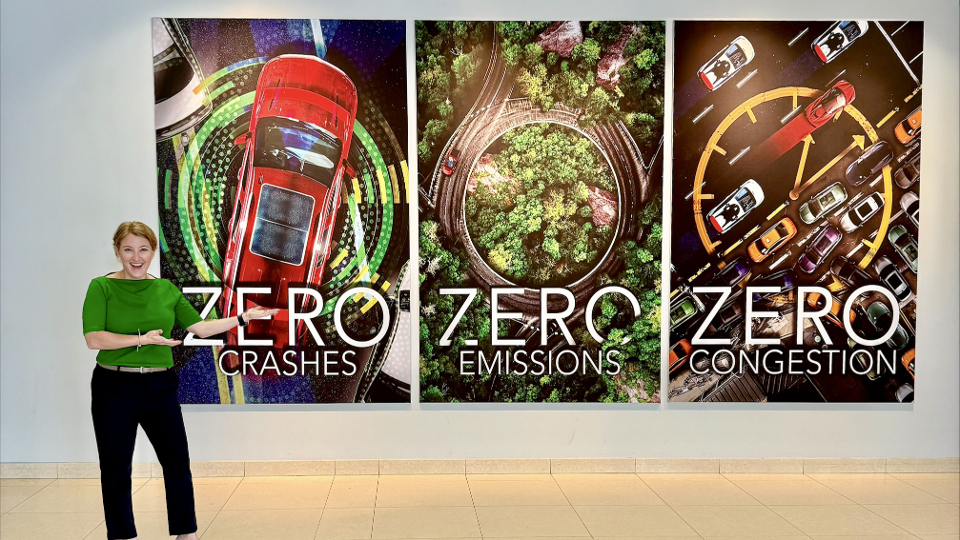
One of the first things Cassandra Garber saw when she arrived for her first day at General Motors last spring was a 10-foot-tall lobby-wall sign proclaiming the company’s commitment to zero emissions.
Garber had been asking herself if she had made the right move in swapping the chief sustainability officer role at Dell for the same position at GM. “And then you walk in and you see the very thing that you want to do with your entire career on a big panel on the wall,” she recalled. “You’re like, that’s mine.”
Cassandra Garber, GM’s new CSO, on her first day at work. Source: GM.
That commitment is, however, a complicated thing to inherit.
Concerns about high prices and low ranges deterred consumers from adopting EVs as quickly as the company expected when it set targets in 2021. Tailpipe emissions from new light-duty GM vehicles in the U.S. have fallen just 7 percent, likely rendering unobtainable the company’s goal of eliminating tailpipe emissions by 2035. And the Trump administration has dismantled critical regulatory support for EVs, which will further slow the transition.
All of which leaves Garber with some tough decisions. Should she push back the target date? Dial back the scale of commitment? Or declare the goal itself — which depends on factors such as charging infrastructure, which GM does not control — a distraction from more impactful work?
In this latest installment of Chasing Net Zero, our series of deep-dive profiles on sustainability strategies at Salesforce, Nestlé, GSK and other large companies, we draw on interviews with Garber and outside experts to assess GM’s options.
The conversations reveal the depth of the challenge facing the new CSO, and others in similar roles. Garber has to reorient the company’s sustainability strategy amid a time of regulatory and economic upheaval, while simultaneously deciding whether to downgrade or drop what remains one of the highest-profile climate commitments from a legacy automaker.
“It’s incredibly hard for these companies to meet their climate goals, which were ambitious to say the least, in a political context that presents not just headwinds, but hurricane-level headwinds,” said Jeff Senne, a Trellis contributor and CEO of Sandbar Solutions, a corporate sustainability consultancy.
What GM committed to
Four years before Garber arrived at GM, CEO Mary Barra had unveiled a stunning aspiration: America’s largest automaker by sales, the maker of iconic brands such as Chevrolet and Cadillac, would eliminate tailpipe emissions from new vehicles by 2035. Half a decade after that, it would be carbon-neutral. The Environmental Defense Fund, which worked with the Detroit company on its vision for an all-electric future, described the move as an “extraordinary step forward.”
Those targets were extended a few months later when the Science Based Targets initiative validated GM’s goal of cutting Scope 1 and 2 emissions 72 percent by 2035. The initiative also rubber-stamped the company’s Scope 3 target: a 51 percent reduction in per-kilometer emissions from new light-duty vehicles by the same date.
Hitting those goals required a rapid transition to an all-electric future — one that then seemed more realistic. Around the time GM got SBTi approval, for example, new President Joe Biden committed to spending $170 billion on installing 500,000 EV chargers, strengthening rebates for EV purchases and other efforts to speed the transition.
Adding to the excitement around EVs was Tesla’s extraordinary rise — its stock price rose sevenfold in the 12 months preceding Barra’s January 2021 reveal, putting Elon Musk on track to become the world’s richest man — and its impact on investor expectations. Tesla’s sales growth made it the “bright shiny object,” recalls Stephanie Brinley, an auto-sector analyst at S&P Global. “If you weren’t investing in EVs and making these kind of really bold predictions, Wall Street was getting frustrated.”
What happened next
GM has since made significant achievements; its most recent sustainability disclosures, published in October 2025, note a 46 percent reduction in Scope 1 and 2 emissions since 2018, putting the company on track to hit its 2035 goal for those sources. That’s been achieved through on-site electricity generation, power purchase agreements and other mechanisms — but not by buying unbundled renewable energy certificates, a strategy that’s often criticized as having limited impact on the growth of clean power.
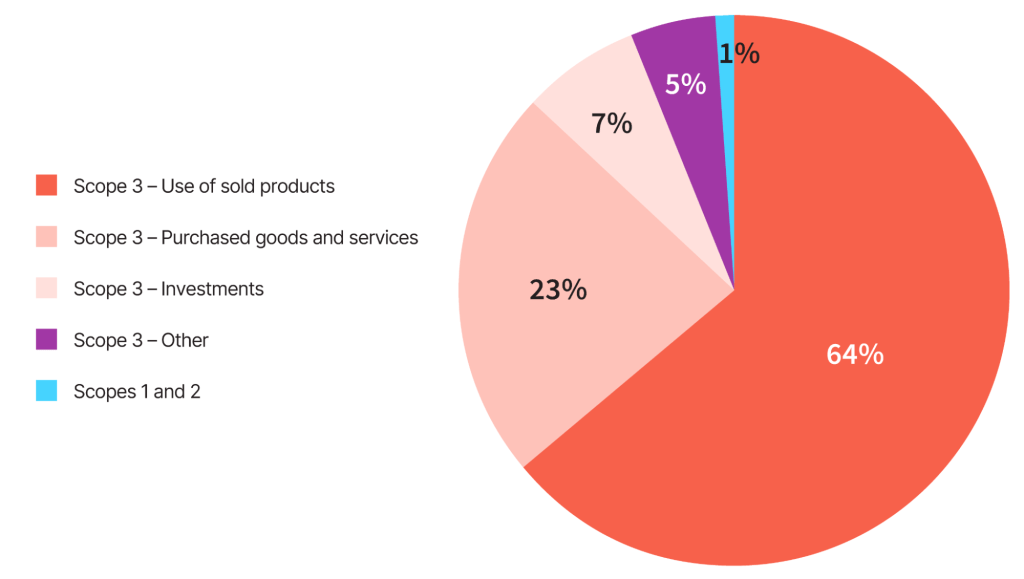
Yet for large automakers, the path to net zero is all about sunsetting internal-combustion cars and selling EVs. Close to two-thirds of GM’s 2024 footprint of roughly 390 million metric tons of carbon dioxide equivalent emissions come from the engines that power the large majority of the vehicles it sells. To hit its 2035 goals, Barra and her sustainability team needed to turbocharge uptake of the Chevrolet Bolt, all-electric Hummer and other zero-emission offerings.
Companies that aim high on sustainability are sometimes accused of prioritizing splashy commitments over detailed implementation plans. But GM’s early commitment was genuine, said a former employee involved in the target-setting process who asked not to be named because the person is not authorized to speak about their time at the company. “At GM, if you set a target, our legal staff, our controllership, everyone’s there. You can’t just set a target without a clear path of how you’re going to get there.”
Over the following five years, the company spent billions expanding its EV line-up — it now offers 12 all-electric models, more than any other major U.S. automaker — and investing heavily in new EV production facilities and battery technology.
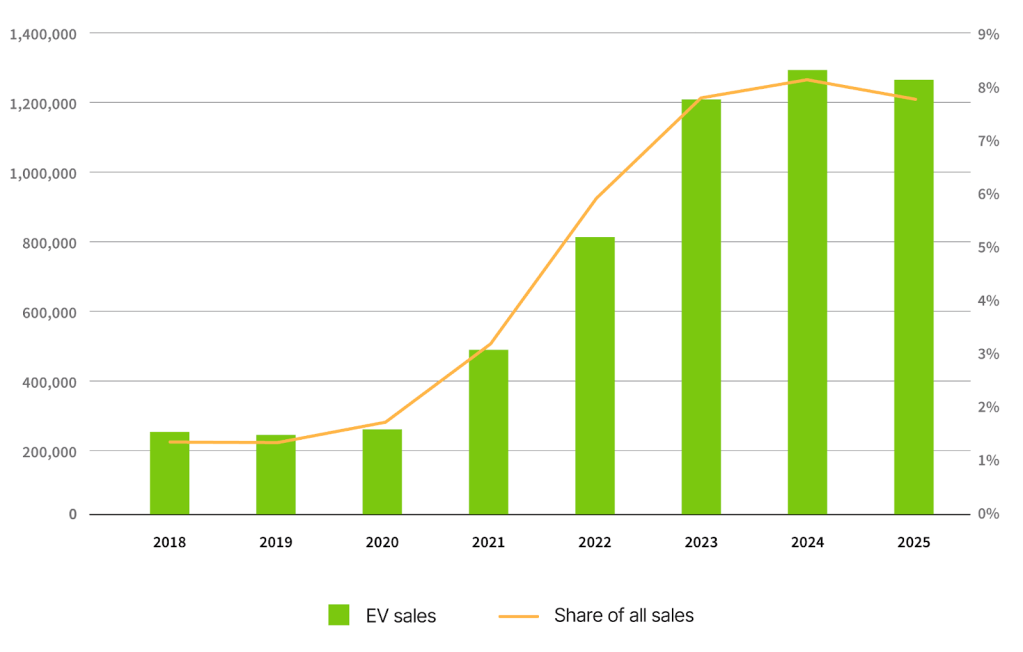
This money was still being spent when the transition spluttered. After booming in 2022 and 2023, EV sales plateaued in 2024. Cost was a major issue, said Nathan Niese, Boston Consulting Group’s global lead for electric vehicles. Sticker prices in the $30,000 to $35,000 range were mentioned, but when EVs arrived dealers asked $10,000 to $20,000 more. That ruled out mass-market buyers. Concerns about unreliable public chargers and slow charge times further hampered sales. “EV-curious people are continuing to be curious, versus actually being ready to buy,” said Niese.
Then, in 2025, Donald Trump’s administration cut the federal $7,500 tax rebate on EV purchases, a key pillar of the all-electric transition, helping send the market into reverse. Niese said that BCG’s latest forecasts put EV adoption in the 30-40 percent range by 2035, far short of the 100 percent GM is targeting for that date. (It’s worth noting that critics say GM’s lobbying helped kill other regulation critical to the EV transition, such as federal limits on vehicle emissions. GM says the regulations were impossible to comply with.)
All of that sapped GM leaders’ confidence in their EV roadmap. By last fall, with the rebate gone, the company was in retreat. One EV plant was retooled to produce conventional vehicles, and more than 1,700 jobs cut at EV and battery facilities. Unwinding its EV investments and contractual commitments will cost GM more than $7 billion, the company has said.
In 2025, GM sold 170,000 EVs in the U.S., just 6 percent of its total. Meanwhile, U.S. drivers have continued their love affair with gas-hungry pickups and other large vehicles. As a result, GM’s Scope 3 target is actually further away than it was in 2021: per-kilometer 2024 emissions were up 3 percent since the baseline year of 2018. The company’s 2035 deadline is still a way off, but, right now, the target Garber is tasked with hitting looks out of reach.
What should the CSO do?
Garber’s desk at GM’s offices in Warren, Michigan, is in the product department — a change for the company and one reason she took the role. “I get to sit where the emissions are,” she said during one of two phone interviews with Trellis in December and January.
In the roughly nine months since she joined, Garber has begun implementing what she calls an “enterprise approach” to sustainability. Every relevant function in the company is asked to take on a sustainability-related key performance indicator (KPI), which is developed with two key partners: a senior executive and a leader from the function who is responsible for operationalizing the KPI.
“Having KPIs and holding executives accountable across the company is game-changing when you’re trying to move the needle on sustainability,” she said.
For 2026, the product function’s KPI focuses on integrating sustainability considerations into designs for new vehicles. That could mean introducing AI features that make charging more convenient, increasing engine efficiency or reducing the number of vehicle parts to cut logistics emissions.
Elsewhere in the organization, Garber is collaborating with manufacturing on further cuts to energy use and working to add more sustainable materials to GM’s supply chain. GM is also part of the Transform: Auto program, a project with Ford, Toyota and others that helps suppliers access renewable energy.
On our calls, Garber was keen to discuss these cross-company efforts, but more guarded when the conversation turned to the status of the company’s commitments. At one point she expressed frustrations with target-setting more generally, which she described as secondary to the more meaningful work of creating lower-emission products. When pushed, she noted that the emissions goals are being reevaluated, but said there were no immediate plans to change them. What, then, are her options? Here are answers from sustainability experts who spoke with Trellis.
Option 1: Adjust the target
Several told Trellis that GM could work with SBTi to restate GM’s Scope 3 goals in a way that makes the targets easier to hit, perhaps by pushing back the target year or lowering the emissions reduction required to meet it.
Companies known for setting ambitious sustainability targets, including PepsiCo and Salesforce, have recently diluted their commitments in response to changing commercial realities. Such moves should be seen as a normal part of business, say sustainability leaders. In both cases, the restated targets retained SBTi validation and remain in line with the goal of limiting global temperature increases to 1.5 degrees Celsius of warming.
“Companies get some negative headlines, some ‘tsks’ and a little bit of scolding,” said Steve Rochlin, a Trellis contributor and CEO of Impact ROI, a corporate sustainability consultancy. “However, companies can manage it by saying we’re not moving away from our long-term goals.” One critical factor, he added, would be whether the company’s long-term goal remains intact. In GM’s case, Barra has said that while the company’s path will change, the destination is still zero emissions.
The cost of downgrading goals is also lower now due to the weak job market, added one leader with decades of sustainability experience, who requested anonymity because the consultancy they work for has a relationship with GM. The biggest audience for annual sustainability reports is often prospective employees, the consultant noted. With bigger pools of applicants to choose from, the pressure for a company to advertise its climate bona fides has lessened.
Option 2: Stay quiet
The argument for restating would likely be conventional wisdom in a normal business environment — but we’re not in one. Companies are operating in a world where one Republican state attorney general has accused the SBTi and CDP of being part of a “climate cartel,” and others have banded together to attack the use of renewable energy certificates by Google and other tech giants. One consequence of these attacks — in fact, perhaps one goal of them — is to deter companies from making any kind of announcement about sustainability.
With that in mind, Garber could conceivably decide to say nothing about GM’s targets, at least until the political climate shifts. “Some companies know they’re not going to meet their target, but they’re like, “Yeah, we’re not even going to go change it, because we don’t even want to generate a conversation about it, we’re just going to keep doing what we’re doing,” said the consultant.
Option 3: Break ties with SBTi
A third option would be to set a new target outside of the SBTi process. Garber did not suggest doing so, and parting ways with one of the most influential standard-setters would risk undermining ambition across the autosector. But there’s no doubt it would provide GM with flexibility on several issues, including one that concerns Garber: the sync between targets and business planning.
“You should create your goals against the same timelines as your business,” she said. “Because that’s how sustainability gets integrated.” The deadline for GM’s SBTi goal was 14 years in the future when it was set; automotive planning, noted Garber, tends to look five years ahead.
Garber did not appear to be in a rush to decide between these options, but she will have to say something soon. SBTi rules require companies to review their targets every five years. After the end of April, GM will have six months to submit its review to the organization. If an update is required, the company will have an additional six months to finalize changes.
SBTi rules are not the only reason why GM might clarify its intentions. GM’s record on climate is viewed as mixed by some environmental groups, in part because the company has lobbied against pro-climate legislation. But even though the 2035 deadline for CEO Barra’s pioneering commitment will likely be missed, she is praised for introducing a goal that served as a north star for the company’s sustainability efforts. “In some respects that was more important than the year,” said S&P’s Brinley.
Looked at from that perspective, Garber’s best course may be to choose the least bad of the options available — and to do so quickly. Then she can get to what sustainability professionals would say is the real and more daunting challenge: uniting the company — which employs 155,000 people around the world — in an effort to hit those new targets.
Cassandra Garber will speak on the mainstage at GreenBiz 26 later this month. GM is also a sponsor of the event.
https://sustainable-future.org/wp-content/uploads/2025/03/cropped-trellis_favicon_180x180.png3232sustainablefuturehttps://sustainable-future.org/wp-content/uploads/2024/06/Untitled-design-117-300x94.pngsustainablefuture2026-02-05 08:02:002026-02-05 18:09:35GM’s pioneering emissions goal looks out of reach. What can it do?
One of the biggest holes in the carbon rulebook was plugged last week when the Greenhouse Gas Protocol finalized its standard for land-sector emissions and removals.
The 133-page document, which was five years in the making, has implications for companies in food, agriculture, apparel and other industries. The new rules are being widely hailed as a welcome step forward, but they are also generating questions about how they will work in practice.
The protocol’s Land Sector and Removals Standard details accounting rules for the many scenarios by which land-sector activities generate and remove greenhouse gases — from emissions in bovine burps and tractor tailpipes to carbon-capture by soil microbes, crops and trees. Overseen by the protocol’s backers, the World Resources Institute and the World Business Council for Sustainable Development, it received input from more than 300 external reviewers.
Uncertainty about how to account for these processes in emissions disclosures has been blamed for limiting investment in projects that reduce land-sector emissions. “This is not just a standard, this is a catalyst for transformation the sector urgently needs,” said Christopher Schwarz, associate director for implementation at South Pole, a consultancy.
More flexible accounting — to a point
Identifying precisely where the wheat in your breakfast cereal was harvested is often all but impossible; like many other ingredients, it is aggregated from multiple farms during processing. This makes it difficult for buyers to claim the benefits of supporting suppliers that cut fertilizer use or take other emissions-reduction measures.
The new standard helps by giving the green light to an approach known as “mass balance.” This allows conventional and low-carbon crops to be mixed in supply chains, provided the emissions savings are claimed by an appropriate proportion of the resulting products. The approach, which was not included in the previous draft of the standard, provides welcome flexibility, particularly because it allows for mixing across sites in a supply chain, said Alice Chang, senior manager for sustainability standards at Indigo, a sustainable agriculture company.
Yet the protocol stopped short of including an even more flexible accounting mechanism, known as “book and claim,” in which the environmental benefits associated with an ingredient can be traded independently of the ingredient itself. Advocates for such market-based mechanisms emphasize that integration with existing standards, including the protocol, is essential to the success of the approach. Another important standard-setter, the Science Based Targets initiative, opened the door to these mechanisms in a recent update.
The decision will likely not be the final word from the protocol on the debate, however. A separate workstream within the organization, tasked with tackling what the protocol calls “Actions and Markets Instruments,” released a white paper in December outlining how book-and-claim and related mechanisms might be used. The land-sector document notes at several points that the standard may be amended when the workstream publishes its recommendations.
The good news for companies with such plans is that the new standard provides detailed instructions on how to include removals in emissions inventories. The more problematic issue is what happens next. Because carbon absorbed by soil and vegetation can be released back to the atmosphere, someone needs to take responsibility for monitoring such “reversals.” The standard requires that the company that claims the benefit does that monitoring — and it does not specify when that liability expires.
“They were very staunchly rooted in this idea that the permanence period needs to be infinite, and if at any point you aren’t able to continue monitoring, you need to assume a full reversal,” said Chang.
Being asked to assume a perpetual liability might seem like a deal-breaker, but these rules are also likely to evolve. Satellite imagery is increasingly being used to lower the cost of monitoring removals projects, for example. And stakeholders can collaborate on monitoring. “It does not need to be done by the reporting company; it can be performed by the farmer, a third party, a national monitoring program or other mechanisms,” said Pankaj Bhatia, GHG Protocol global director at the World Resources Institute. More details will be provided in a guidance document due to be published next quarter, he added.
The protocol punts on forests
“Both science and feasibility are core design principles of GHG Protocol standards, and more time is required to ensure that both are appropriately met,” the protocol wrote in an FAQ accompanying the new standard. Organizers will now ask stakeholders for further input in the hopes of including forest rules in a future version of the standard.
Advisors working on the standard have for years been split on the carbon accounting rules for forests. Points of contention include challenges with separating anthropogenic from natural changes, establishing baseline emission scenarios and allocating responsibility to different parts of forest value chains. An independent advisory board within the protocol tasked with resolving these issues failed to do so.
In any case, some advisors to the protocol may be done waiting for an official ruling.
“My hopes aren’t high that the existing governance structure or forces behind the scenes can produce a workable result,” Vaughan Andrews, a senior sustainability manager at forests company Weyerhaeuser who is one such advisor, wrote on LinkedIn. “Instead, I believe it is time for a fresh approach.”
“It’s a shame GHGP couldn’t manage to accept what its stakeholders were telling it, but that doesn’t mean we have to stop,” added another advisor, Nathan Truitt, executive vice president at the nonprofit American Forest Foundation. “We now know how to do this right, I don’t think we need permission from the GHGP!”
https://sustainable-future.org/wp-content/uploads/2025/03/cropped-trellis_favicon_180x180.png3232sustainablefuturehttps://sustainable-future.org/wp-content/uploads/2024/06/Untitled-design-117-300x94.pngsustainablefuture2026-02-04 14:58:522026-02-04 18:08:31How the new land-sector carbon accounting rules will impact your company
The opinions expressed here by Trellis expert contributors are their own, not those of Trellis.
When I sit down with a candidate, I’m not necessarily looking for an environmentalist. I’m looking for leaders who’re comfortable handling data, communicating complexity across business functions, and helping embed sustainability as the foundation of long-term growth.
To understand if candidates have those skills, I use the following questions, which are meant to reveal which candidates are the most determined to go beyond “checking the box” and instead use our mission to minimize risk and maximize competitive edge.
What do you think sustainability should mean to an organization?
This may sound simple, but I’m looking for a very specific response. Sustainability work extends across the public, private and nonprofit sectors, so it’s common for job candidates in this space to have varied experiences.
With this question I’m looking to see if candidates proactively connect sustainability to business value. Depending on a business, that might involve energy costs, insurability, bond ratings or supply chain resilience. What’s important is that the candidate is prepared to discuss sustainability not just with like-minded advocates, but with finance-driven CFOs and deadline-driven product managers. I applaud all types of sustainability professionals, but naturally I’m looking for those primed to thrive in a private, growth-minded technology company.
What technology are you most excited about and why?
It should go without saying that at a technology company the sustainability team isn’t just focused on the rules or regulations of today—we’re on the frontlines of what’s next.
I want to see candidates show that they’re reading and thinking about the future, whether that concerns AI, quantum or innovative applications of technology. Electric grids have been around for more than a century, but modern electrification of vehicles (even industrial ones), HVAC and more is poised to change our world — and the business of sustainability. Similarly, the proliferation of sensors and high-fidelity data are allowing industry efficiencies at an unprecedented level.
How do you think about the intersection of AI and sustainability?
This may be among the most important questions for today’s sustainability professionals. Anyone applying to IBM should have a point of view, and I’m confident that’s true in most other sectors.
A good response should consider both the “top” and “bottom” lines — what can be done to minimize AI’s energy needs, but also how can AI help improve sustainability outcomes? The IEA has estimated that by 2035 AI will be enabling energy reductions almost 3 times as much as its own energy consumption, so a well-rounded candidate should have some ideas for applying AI, as well as limiting its environmental footprint. Increasingly, smart use of AI is also simply a day-to-day part of the job, so I love to hear candidates’ personal experiences, too.
What aspects of the job are you most excited or challenged by?
I ask this to get a genuine sense of whether the candidate’s passions and perspectives align with our needs, but I also want to hear about creative and surprising opportunities or new ideas for supposedly intractable challenges.
In terms of opportunities, I’m quite excited by advances in geospatial AI, which isn’t discussed nearly as often as large language models. There’s a huge amount of geospatial data available, and AI provides a new opportunity to unlock insights at scale, helping scientists and others better understand our earth. Materials science is another exciting area, and I’ve written here previously about emerging capabilities to detect and develop substitutes for concerning materials.
There are also plenty of challenges to pick from, but I like to hear which one a candidate gravitates to and why. If a candidate is focused on external factors like policy, they’re likely missing opportunities to make change in places where we have more control. One excellent response I received was about getting buy-in from the business; that can indeed be a challenge, but it’s great to approach it with enthusiasm and fresh ideas.
Be creative and walk me through how a sustainability initiative could open up a new revenue stream.
I admit this is a hard one, but it gets to the very core of what I’m looking for. Effective corporate sustainability teams today aren’t just focused on reducing waste; they’re part of the same mission to drive business value as their colleagues. Their jobs can even be harder, requiring that they push the boundaries of how we measure, understand and communicate that value.
Most candidates can respond to this question by connecting sustainability to reduced risk and lower costs, but it takes an additional level of thinking to get to revenue and growth. One in-house example we’ve had is with an AI assistant that doesn’t just help my team, but enables our sales colleagues to do their job better as well. I expect many candidates have their own examples, or hope that with this nudge they can begin envisioning the possibility.
For me, these five questions give candidates the chance to show they understand both the issues and — crucially — how to get things done. The sustainability field is an ever-changing one, but there is no question that its future involves more data, technology, and clearly crafted business cases.
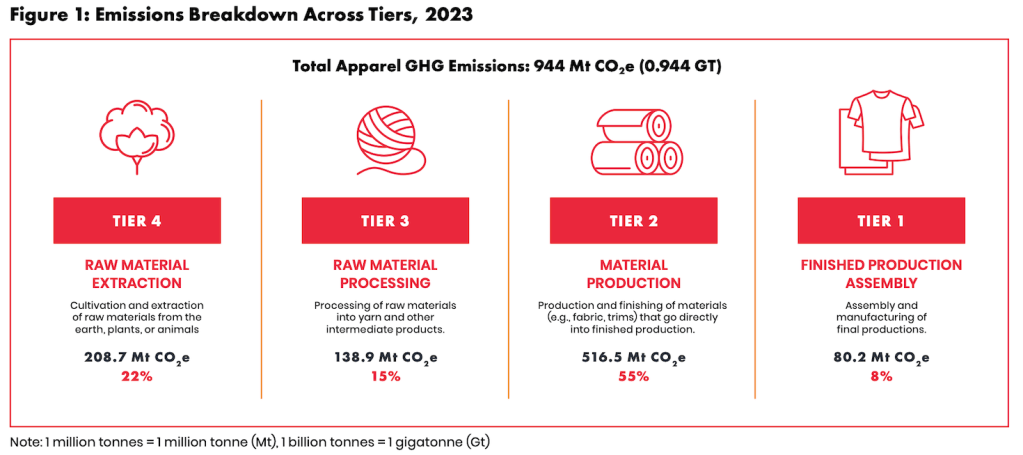
The sewing room may be the most visible symbol of manufacturing in fashion. The work of assembling finished products, known as Tier 1 in the supply chain, is also increasingly accounted for in sustainability reporting.
But it’s the Tier 2 facilities — the ones that produce, dye and finish fabrics and trims — that actually create more emissions.
Renewable energy only makes up 2 percent of energy use across both Tier 1 and Tier 2. But while Tier 1 makes up about 9 percent of supply chain emissions, Tier 2 produces more than 50 percent.
Finding climate emissions hotspots across those energy-intensive facilities can go a long way toward helping the fashion industry decarbonize, according to Joel Mertens, director of Higg Product Tools at Cascale, formerly known as the Sustainable Apparel Coalition.
“A company’s sphere of influence starts to enlarge,” he said.
Data emerges
Cascale analyzed patterns from data from thousands of Tier 1 and 2 facilities, reported in 2023 and 2024 by brands and retailers through its Higg Index. The results appeared in Cascale’s State of the Industry Report on Jan. 28.
Tier 2 processes make up between 45 percent to 70 percent of brands’ Scope 3 emissions, according to a McKinsey analysis in March 2025 of data from more than 9,000 suppliers. McKinsey suggested two decarbonization “levers” for Tier 2, including brands favoring low-emissions suppliers. The consulting giant also suggested that suppliers make technical adjustments, such as adopting renewable energy.
However, the special challenges of Tier 2 include a heavy reliance on boilers for dyeing, finishing and drying material. Coal makes up 31 percent of the industry’s energy sources overall, and 40 percent within Tier 2, according to Cascale.
“Thermal energy is harder to decarbonize than electricity,” said Mertens. “If you have a boiler, it doesn’t really change until you change that boiler.”
Another challenge for Tier 2 reduction hopes: Its geographically scattered facilities are often larger than Tier 1 cut-and-sew shops. Emissions tend to be concentrated in a small number of large suppliers, Cascale found.
“The larger facilities tend to have more equipment and processes, higher energy needs and show a higher carbon intensity in general,” Mertens said. “Because emissions are concentrated in a small number of suppliers, it’s actually an opportunity. We can target our conversations to a smaller subset of manufacturers, where the interventions are really going to make a difference.”
The counterpoint to that, however, is that change requires collective action, he added.
To that end, the Outdoor Industry Association runs a Clean Heat Impact CoLab. Under that effort, Patagonia, L.L. Bean, Cotopaxi and other outdoor labels created an open-source Textile Heating Electrification Tool one year ago for mills to adopt.
Where the action is
Meanwhile, the nonprofit Apparel Impact Institute (AII) is addressing funding bottlenecks that Cascale identified as inhibiting progress. On Jan. 27, the AII realigned its Climate Solutions Portfolio, which provides grants of up to $250,000 for decarbonization solutions, to emphasize supplier-focused electrification efforts, especially in Tier 2 plants. It belongs to the organization’s Fashion Climate Fund, built to mobilize $250 million toward $2 billion in blended capital for low-carbon supply-chain adjustments.
“We see brands starting to plan their longer-term electrification strategies by country and supporting suppliers with technical and financial assistance to do so,” said Pauline Op de Beeck, the AII’s climate portfolio director. Brands are also increasingly sharing what they’ve learned from pilot projects, she added.
And support for Tier 2 climate-transition work by suppliers has continued under the Future Supplier Initiative, a collective financing model engaging the Fashion Pact and the AII with Guidehouse and DBS Bank. Marks & Spencer, Ralph Lauren and Tchibo joined in 2025 alongside the original member brands Bestseller, Gap Inc., H&M Group and Mango.
In November, 55 CEOs, including from luxury houses Chanel and Prada Group, committed to the Paris-based Fashion Pact’s European Accelerator. Joined by Kering, Moncler Group and others, the collaboration seeks to drive decarbonization deeper into their upstream supply chains.
Other work to advance low-emissions technologies among fashion suppliers include Cascale’s Manufacturer Carbon Program. It helps brands measure emissions at plants and encourages them to assist suppliers with decarbonization projects.
Meanwhile, Schneider Electric has recently teamed up with Levi’s and Marks & Spencer in separate efforts to help the companies’ mills and dye houses access renewable energy through power purchasing agreements.
“There isn’t one model that’s risen to the forefront and said, ‘This is the solution,’” Mertens said. “The only way we get there is by having some uncomfortable conversations across the value chain.”
https://sustainable-future.org/wp-content/uploads/2025/03/cropped-trellis_favicon_180x180.png3232sustainablefuturehttps://sustainable-future.org/wp-content/uploads/2024/06/Untitled-design-117-300x94.pngsustainablefuture2026-02-03 14:51:462026-02-03 18:08:48The real carbon hotspots in fashion aren’t where brands look first
An estimated three-quarters of Starbucks’ sales are for cold beverages, almost all of which are served in plastic cups containing food-grade polypropylene.
The national coffeehouse wants more customers to recycle those containers when they’re finished sipping their drink, but polypropylene recycling rates have historically been low compared with other plastics — less than 8 percent compared with around 30 percent for plastic bottles made of polyethylene terephthalate (PET), according to industry research.
Starbucks is pushing to change that narrative with several like-minded collaborators: WM, the biggest U.S. waste and recycling services company; certification organization How2Recycle; and two industry-led coalitions, The Recycling Partnership and NextGen Consortium, managed by investor Closed Loop Partners’ Center for the Circular Economy.
Since last August, representatives from these organizations have met with cities and communities across the U.S. to build awareness, with Starbucks often leading the outreach and conversations.
As a result of those efforts, polypropylene cups can now carry the “widely recyclable” label from How2Recycle. That means they can be recycled through curbside pickup or drop-off programs used by more than 60 percent of U.S. households. That’s an increase of 14 percentage points in the past four years alone.
“The missing piece was that municipalities, cities and towns across the U.S. had not realized that, in fact, for this particular format, there is access and so that wasn’t formally being communicated as part of their programs to households or at the community level,” said Marika McCauley Sine, who leads sustainability at Starbucks.
Historically, food-grade polypropylene hasn’t been considered as valuable to recyclers as other plastics. It has also been tough to process, because it’s often contaminated with food and drink, said Thalia Bofiliou, senior investment analyst for plastics with research firm Planet Tracker.
“Many of the original systems were designed around PET and a few other core polymers like high-density polyethylene, so polypropylene has come into mature recycling markets quite late,” she said.
More companies, however, are looking to source recycled polypropylene that can be downcycled and turned into plastic paint containers or garden planters, among other applications, said WM Chief Sustainability Officer Tara Hemmer.
“We, of course, are having conversations with other brands to educate them about the How2Recycle designation and that this material will be widely recyclable,” she said.
More than 90 percent of WM’s facilities can handle polypropylene, and that number will reach 100 percent by mid-2026, she said. The company has invested $1.4 billion since 2022 in sorting-automation technologies at close to 40 facilities across North America. Its polypropylene recycling rates have already increased by 1.5 times.
“What we know is that people will recycle more if recycling is easy, and if they believe more materials can go in the bin and actually get recycled,” Hemmer said.
Another motivator is extended producer responsibility (EPR) laws — coming into effect in Oregon, Maine, Colorado and California and being considered in at least a dozen more states — that make businesses responsible for footing the bill for better recycling infrastructure.
High-quality recycled polypropylene needs more development before it can be used by Starbucks for food-grade applications, McCauley Sine said, but the company is investing in improvements.
“Part of the effort is increasing access, and increasing the sorting and processing of cups, which serves to bolster and enhance,” she said. “That’s when the likelihood of having that kind of high-quality, food-grade recycled content starts coming through, and everyone from Starbucks to all the other users of this type of plastic can then capitalize on it.”
Starbucks is researching many ways to decrease dependence on virgin plastic, including encouraging customers to embrace reusable cups.
The coffeehouse chain has already reduced the overall amount of plastic used in cold cups by 10 percent to 20 percent, depending on the format.
Starbucks’ goal is to make 100 percent of its customer-facing packaging reusable, recyclable or compostable by 2030. As of its 2024 environmental update, it had achieved 27 percent.
https://sustainable-future.org/wp-content/uploads/2025/03/cropped-trellis_favicon_180x180.png3232sustainablefuturehttps://sustainable-future.org/wp-content/uploads/2024/06/Untitled-design-117-300x94.pngsustainablefuture2026-02-02 16:07:142026-02-02 18:08:36How Starbucks and WM made it easier to recycle plastic to-go cups
The opinions expressed here by Trellis expert contributors are their own, not those of Trellis.
Last year, a slew of extreme weather events disrupted agricultural operations, some costing hundreds of billions in damages and financial hardship to farmers and ranchers. Uncertainty loomed amid evolving global regulations and trade policy, and consumer scrutiny of food companies intensified over everything from their ingredients to pricing and product availability.
But as we start off 2026, there is one key resolution food companies can set this year to help navigate supply chain shocks and economic hurdles — and seize new opportunities: Invest in the resilience of their agricultural suppliers.
Resilient and sustainable agricultural projects are needed for the industry and its farmers to stay in business. Our research found that companies face around $253 billion in losses each year because ecosystems are declining, leaving them unable to perform environmental services that farms depend on to be productive The impacts of climate change, pollution, and other forces driving nature loss are harming their ability to maintain the quality and health of soil and water sources.
The upfront costs and risks of trying out new practices have been big barriers to farmers implementing next generation agriculture methods, such as crop monitoring technology and nutrient management systems. But companies across the industry are seeing these roadblocks as strategic entry points to help farmers in their supply chains make the shift to sustainable agricultural approaches. And, in the process, they’re unlocking real business benefits by ensuring their suppliers will be around in the long run.
By funding initiatives aimed at conserving water and restoring soil quality, for example, companies can mitigate escalating climate and nature risk while contributing to greater stability across the food industry. That’s because these efforts offer valuable pathways to discover new innovations and test emerging practices in the field.
All of which are necessary to protect corporate bottom lines and the industry’s future by transforming how food is grown and livestock is raised. With government-backed programs in flux, the role that companies can play in financing resilient agriculture on farms has become even more essential.
For food companies ready to commit to agricultural resiliency in 2026, here’s a look at three existing initiatives that are reaping positive returns for farmers, their investees, and the industry
Soil and Water Outcomes Fund
In a comprehensive program that pools investments and resources from multiple companies including Cargill, McCormick, Ingredion and Coca-Cola, the Soil and Water Outcomes Fund goes beyond simply cost sharing investments with suppliers. Instead, it provides financial incentives to farmers interested in row crop conservation practices, such as cover cropping and no-tillage, that can improve soil health and reduce erosion.
Notably, the independent fund also equips participants with extensive technical support and tools, including carbon accounting and advising services, to help foster successful outcomes. Since 2020, 1.7 million acres of farmland across 21 states have been enrolled in the program, and over $55 million in payments have gone to farmers, with an average payout of $33 per acre. In terms of climate impact, 1.4 million metric tons of greenhouse gas equivalents have been cut by participating farmers, equating to removing 304,000 cars from the road for a year, according to the fund.
Practical Farmers of Iowa
Another approach companies are taking is to focus on specific levers for cutting risks. Funded by PepsiCo and a USDA Advancing Markets for Producers grant, Practical Farmers of Iowa offers a free-for-participation program to farmers that pays for deploying known methods for driving down nitrogen in soil.
These range from crop rotation, manure application and incorporating livestock grazing into farming systems. Farmers are guaranteed $5 for every acre where nitrogen is reduced and if production yields decrease alongside nitrogen rates, farmers can receive an additional $30 per acre. Practical Farmers of Iowa’s most recent analysis of its network members found the majority of farmers saved money by lowering their nitrogen usage, even if their output dropped.
Sustainable Dairy PA
Sustainable Dairy PA is a pilot project backed by The Hershey Co. and Land O’Lakes, its highest volume dairy supplier, that concentrates on going deep locally. The two companies are partnering with the Alliance for the Chesapeake Bay on a three-year project to help the e surrounding region’s dairy farmers slash greenhouse gas emissions and improve water quality. Hershey has committed $300,000 to its local suppliers to fund a range of sustainable farming solutions, from planting riparian buffers that prevent soil erosion and improve wildlife habitats to installing animal waste storage systems. So far, more than 3,000 trees have been planted alongside streams, saving 850 pounds of phosphorus and almost 4,000 pounds of nitrogen from entering Chesapeake Bay waterways.
These examples demonstrate that corporate investments can pay dividends in successfully encouraging more sustainable practices in their supply chain. But for that to happen, more companies on a larger scale need to participate to effectively safeguard farmers, ranchers and the industry that depends on their resilience — the very food companies that buy from them.
If health is the new wealth, data show that could be the best way for brands to engage more with consumers.
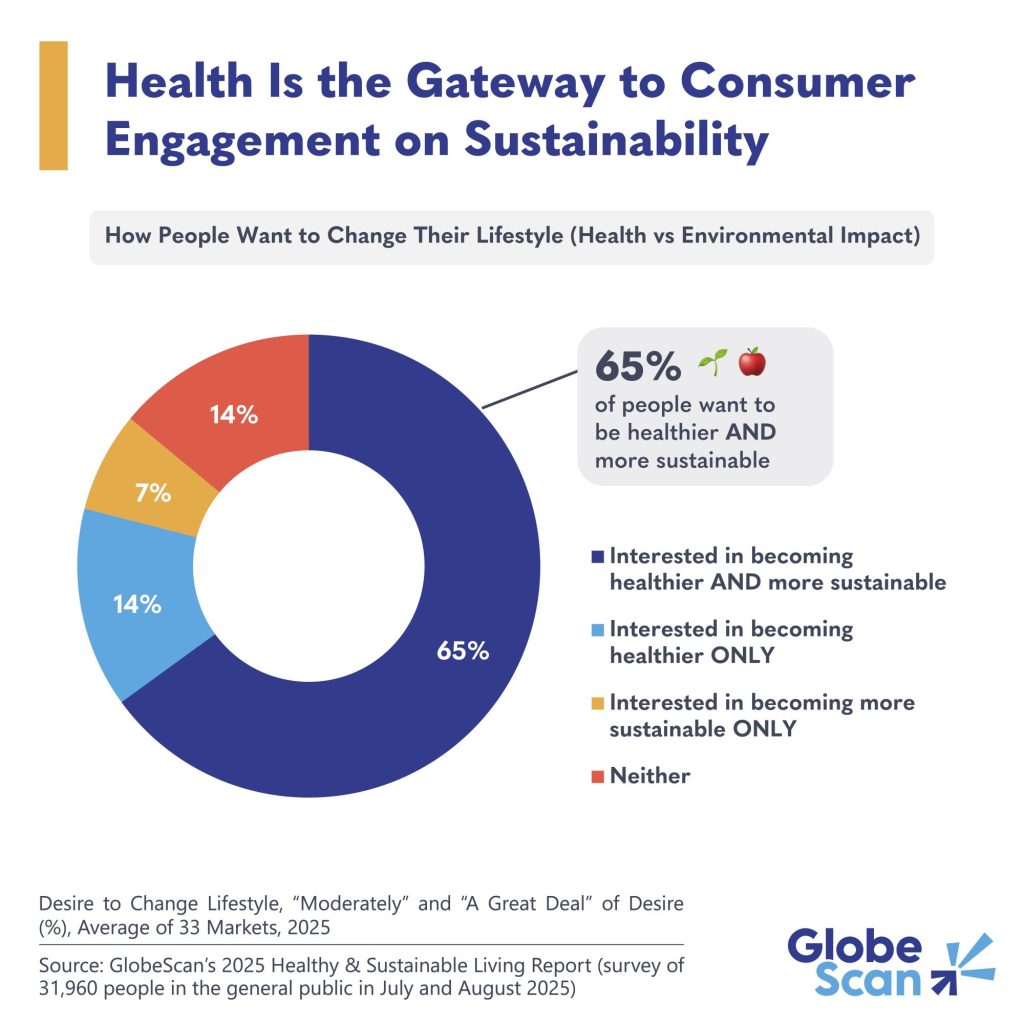
According to Trellis data partner GlobeScan’s recent research on healthy and sustainable living, health is now the strongest driver of sustainable behavior change. The desire to be healthier isn’t just compatible with sustainability; it’s the main reason people are open to making more environmentally-friendly choices. When sustainability is positioned as a way to achieve better health, it becomes relevant, actionable and personally meaningful.
Results show that a majority of consumers are motivated by the promise of improved well-being. Only a small fraction (7 percent) are interested in sustainability alone, meaning almost everyone who says they’d like to live a more sustainable lifestyle also claims that they’d like to live in a healthier way. Additional insights from the research support the notion that the most effective engagement strategies for sustainability are those that lead with health and well-being, making the benefits of sustainable choices immediate and relatable.
What this means
For brands, NGOs and governments, the data reveal a strategic opportunity: health isn’t just an added benefit for sustainability but instead may be the primary motivator for sustainable lifestyle changes. With 65 percent of consumers expressing a desire to be both healthier and more sustainable, organizations can anchor their sustainability messages in tangible direct benefits to physical and mental health. By leading with health, organizations can cut through skepticism, apathy and sustainability-related fatigue to reach disengaged audiences and achieve behavior change at scale.
Based on a survey of nearly 32,000 people in the general public conducted July — August 2025.
https://sustainable-future.org/wp-content/uploads/2025/03/cropped-trellis_favicon_180x180.png3232sustainablefuturehttps://sustainable-future.org/wp-content/uploads/2024/06/Untitled-design-117-300x94.pngsustainablefuture2026-01-30 10:00:002026-01-30 18:09:43To get consumers to engage on sustainability, focus on health
The opinions expressed here by Trellis expert contributors are their own, not those of Trellis.
There are two days left for CSOs everywhere to provide their from-the-market perspectives on the Greenhouse Gas Protocol (GHGP) Scope 2 proposed changes.
While all the changes are important to understand, the biggest debate centers on whether the market-based method (MBM) of accounting should require companies to match their clean energy procurements to their energy use on an hourly basis (instead of annually) and within much smaller market boundaries (instead of national boundaries).
I’ve been working on voluntary clean energy procurement for 25 years, and it’s always been clear to me that large energy buyers need to focus their efforts on energy procurement that decarbonizes the whole grid, not just their own buildings.
The vast majority of market experts and energy users oppose the GHGP’s proposed change that would make hourly and location matching mandatory because it could raise household energy prices by 26 percent, will raise clean energy prices for companies so much that it could kill voluntary clean energy procurement, and could drive greenhouse gas emissions up, not down, and quite substantially. In fact, one study found that removing market boundaries for corporate clean energy procurement could save 1.7 billion tonnes of CO2 over 15 years and drive $85 billion of investment into developing economies.
Step 1: Advocate for not changing definitions
Your first step is to oppose GHGP’s proposed changes to the definition and purpose of Market Based Method accounting (starts on page 6). If you’re short on time, questions 18 through 22 can be your only area for comment.
Today’s definitions of the location-based method (LBM) and MBM are clear and have underpinned clean energy markets for over a decade. The GHGP was thoughtful, intentional and elegant more than a decade ago when it distinguished between the GHG emissions associated with a company’s electricity use (in the LBM) and the emissions associated with a company’s energy procurement (in MBM).
GHGP was right in creating those two lenses then, and it shouldn’t blur them together now. That’s because organizations are often shackled when trying to change the electricity their facilities consume, yet they have much more regulatory and market freedom to use their purchasing power to drive clean energy projects elsewhere — and often on dirtier grids.
For a decade, large energy users have been able to aggregate their facilities’ energy use over large geographies on an annual timescale to provide large, credit-worthy contracts to clean energy project developers, resulting in 200 gigawatts of new clean energy capacity added to global grids. Likewise, even “unbundled Renewable Energy Certificate” procurement can induce and incentivize new clean energy projects to get built or existing projects to keep generating. The power of markets is a real thing.
The GHGP now proposes changing the MBM definition to “specify temporal correlation and deliverability requirements for matching the underlying electricity to the reporter’s consumption.” This proposed change that would require hourly and location matching of procurement-to-load would be a fundamental shift in the GHGP’s historic definitional separation between the LBM and MBM.
There simply is no expert consensus that tighter alignment between the time and location of energy procurement to energy use is the most effective method for incentivizing real-world carbon-reducing decisions and rigorously measuring carbon impact of decisions. If anything, a tighter alignment is expected to decelerate clean energy transition.
Step 2: Oppose mandatory hourly and locational matching
Proponents of the time and location matching proposal assert that better alignment of procurement to use would increase accuracy of accounting (it doesn’t — grid physics just don’t work that way) and would reduce inaccurate claims about “using” carbon-free power (it might do that, but there are better ways).
The simplistic argument goes like this: “It’s obviously not credible for a company to use energy at night and buy solar power during the day and then say they’re using clean energy.” However, there’s an even simpler solution: don’t use the market-based method GHG accounting as a basis for clean-energy usage marketing claims. Let’s not fix a marketing claim problem with an accounting “solution.”
The atmosphere doesn’t care if an energy consumer buys carbon-free power matched to their buildings’ location and time of electricity use — the atmosphere cares that energy consumers are using their buying power to accelerate deployment of carbon-free electricity.
The detailed proposed changes to MBM are described in pages 19 through 46. It looks like a lot but it really boils down to this: choose a handful of questions in Section 5 and simply request and reiterate that GHGP should not make hourly and locational matching mandatory, and instead should make it optional.
A simple verb change stating that hourly matching should follow an optional ‘may’ rather than a required ‘shall’ approach will send a strong message.
Simply put, GHGP got it right the first time. When it comes to deploying renewable and carbon-free energy projects, markets matter — and they matter a lot.
https://sustainable-future.org/wp-content/uploads/2025/03/cropped-trellis_favicon_180x180.png3232sustainablefuturehttps://sustainable-future.org/wp-content/uploads/2024/06/Untitled-design-117-300x94.pngsustainablefuture2026-01-29 17:12:482026-01-30 18:09:442 steps CSOs can take regarding Scope 2’s greenhouse gas protocol
After spending nearly five years as BP’s first chief sustainability officer, Ivanka Mamic is becoming the first CSO and global head of government relations at Rolls-Royce Holdings.
“As someone with a strong interest in enduring, mission-driven companies, I am proud to join this iconic British organization and be part of a team focused on excellence and innovation to drive real-world solutions to complex challenges,” Mamic posted on LinkedIn in early January.
Unlike the oil giant, which did a recent U-turn on low-carbon energy, Rolls-Royce appears committed to embed its climate goals across its strategies, products and research and development. It also ties success on sustainability metrics to managers’ compensation.
The aerospace and engineering firm — not to be confused with BMW subsidiary Rolls-Royce Motor Cars — maintains a 2050 target for net zero within its own operations. In the near term, it aims for a 46 percent drop in those climate emissions by 2030 over a 2019 baseline. The company has committed its goals to the Science-based Targets initiative, which has not validated them.
More than 170 people have commented favorably on Mamic’s LinkedIn post.”A pivotal appointment at a time when industrial decarbonization, transparency and operational accountability matter more than ever,” wrote Neno Duplan, founder and CEO of Locus Technologies.
Mamic is the first person with her exact title at Rolls-Royce. Previously, Rachel Everard served as head of sustainability from 2019 until 2025, when she joined Great Britain’s Rail Safety and Standards Board.
Rolls-Royce, which makes engines for jets including the Boeing 787 Dreamliner, has explored sustainable aviation fuels and ultra-efficient engines. The company has also explored efficiencies and hydrogen-readiness for its military aircraft engines and other power systems. Rolls-Royce is also working on small modular reactors, which the U.K. has chosen for its next generation of nuclear plants.
Rolls-Royce, with major hubs in Asia, Europe and North America, sources components and materials globally.
Work at BP
Mamic led BP’s corporate sustainability agenda while it was grappling with the realignment of fossil fuel investments and its decarbonization goals.
When Mamic became the senior vice president and CSO at BP in March 2021, the company was publicly committed to reaching net zero by 2050 under CEO Bernard Looney. However, Looney left in September 2023 after failing to disclose a personal relationship with a colleague.
Highlights from Mamic’s tenure included a 38 percent drop in Scope 1 and 2 emissions over 2019 levels, according to its 2024 sustainability report. The company also reduced freshwater use by 17 percent in 2024 against a 2020 baseline.
Mamic’s path
Mamic, a Cambridge philosophy Ph.D., remains in London for the new role.
Early in her career, she spent more than 15 years at the International Labour Organization as a CSR and environment specialist. That included ensuring standards across supply chains in East Asia and piloting a Green Jobs in Asia program.
After that, she joined Target. In five years, Mamic transitioned from director of responsible sourcing to vice president of global sourcing and responsibility, overseeing social compliance, environmental performance and supply chain transparency.
She now brings her experience to Rolls-Royce at a moment of rising geopolitical tensions and decarbonization pressures.
https://sustainable-future.org/wp-content/uploads/2025/03/cropped-trellis_favicon_180x180.png3232sustainablefuturehttps://sustainable-future.org/wp-content/uploads/2024/06/Untitled-design-117-300x94.pngsustainablefuture2026-01-29 14:48:362026-01-29 18:08:27Rolls-Royce Holdings nabs its first chief sustainability officer