The power of generative artificial intelligence is abundantly clear, yet surveys show only a minority of workers use ChatGPT or rival services on a regular basis. That’s partly because it can be challenging to figure out where to apply AI, and how to ask it to do what you want.

If you’re among those who are yet to see proven value from AI in your work, here are some useful prompts to get you started. Each is recommended by a sustainability professional who vouches for its usefulness.

For editing text

This prompt tackles what Luke Elder, a senior lead for sustainability reporting at Google, calls a common challenge in corporate reporting: synthesizing contributions from hundreds of different authors into a cohesive voice. 

“Our annual Environmental Report is drafted by many teams across the company,” said Elder. “While each provides critical data and insights, the final document must read as if it were written by one person. It also needs to align with our specific tone, follow our best practices for disclosure, and reinforce our core messages.”

To quickly refine draft text, ensure clarity and alignment with established style, Elder uses this prompt:

“You are an editor for our annual Environmental Report. Your goal is to review the provided draft text for clarity, conciseness, and alignment with our reporting tone. Refine the text to eliminate jargon, improve flow, and ensure it reinforces our key sustainability messages.”

To help the AI edit with the right tone in mind, Elder recommends either adding a few words to define that tone — “frank,” “plainspoken” or “ambitious,” for example — or pointing the AI toward a report that uses the tone you’re looking for.

For checking on supplier progress

Your suppliers are your partners on the journey to net zero, but how are they faring in their emissions reduction efforts? Renu Yadav, a senior program manager for global sustainability at LinkedIn, likes to evaluate her company’s suppliers using this prompt:

“Review [company name]’s latest sustainability report, highlight how their emissions are trending, and list their Scope 3 reduction strategies.”

Explained Yadav: “To drive our Scope 3 emissions reductions, it’s crucial to track the progress our suppliers are making toward their own sustainability commitments. This prompt helps me understand how our key suppliers are advancing on their commitments, which in turn informs our supplier engagement and risk management efforts.”

For anticipating media scrutiny

To prepare for the media questions that follow the launch of his company’s annual environmental report, Google Director of Sustainability Reporting Alex Hausman asks Gemini — Google’s AI assistant — to role-play a reporter and generate critical questions.

“This helps us build a robust internal Q&A document, ensuring our communications, marketing and other teams are prepared with clear, consistent and data-driven responses” said Hausman. “It allows us to be transparent and responsive while freeing up our team to focus on other high-impact work.”

Here’s his prompt:

“Imagine you are a reporter for a major news outlet covering corporate sustainability. Based on the provided Environmental Report, what are the most challenging and insightful questions you would ask? Then, draft clear and concise answers to those questions using only information found within the report itself.”

For making sense of frameworks

Hands up if you know the key differences between sustainability reporting frameworks from the Global Reporting Initiative, the Sustainability Accounting Standards Board and the Task Force of Climate-related FInancial Disclosures. For extra credit, lay out how new disclosure rules from the state of California and the European Union’s Corporate Sustainability Reporting Directive change matters.

If this kind of thing is not your idea of a good time, Yadav has a prompt for you:

“Compare common sustainability frameworks (GRI, SASB, TCFD) and highlight their similarities, differences, and relevance for corporate reporting.”

I use this to stay up to date with evolving ESG reporting standards, understand which frameworks are most relevant to my company and identify overlaps to minimize reporting efforts,” she explains. “This not only helps me understand the basics of each standard but helps me understand which framework investors or regulators are prioritizing.”

Got a favorite prompt?

We’re sure there are many sustainability professionals out there with equally useful prompts. If you think you’re one of them, send us your suggestions and we’ll share the best as updates to this post.

For a deeper dive, attend the AI in sustainability session at Trellis Impact 25, where Yadav and Elder will be joined by Google’s Anna Escuer and entrepreneur Olya Irzak to discuss how AI could transform how teams collect, analyze and act on emissions data.

The post AI prompts for sustainability pros — recommended by sustainability pros appeared first on Trellis.
The corporate climate “actionists” who converged in New York last week for the 16th annual Climate Week NYC are resigned to the reality that federal policy won’t favor their agendas for at least another three-plus years. 

Even so, the majority of corporations with net-zero aspirations are not retreating from their top-level commitments. They’re just not talking about them as loudly.

At least three research analyses published to coincide with Climate Week NYC suggest that companies committed to reducing emissions and conserving nature and biodiversity are actually doubling down on that agenda:

  • The number of U.S. companies with net-zero commitments rose 9 percent in the past 12 months, according to the Net Zero Tracker’s 2025 stocktake, which did note that most of those pledges aren’t very robust.
  • A focused study that included 75 top companies by market capitalization found that while roughly 13 percent retreated from programs between April 2024 and May 2025, nearly one-third increased their investments.  
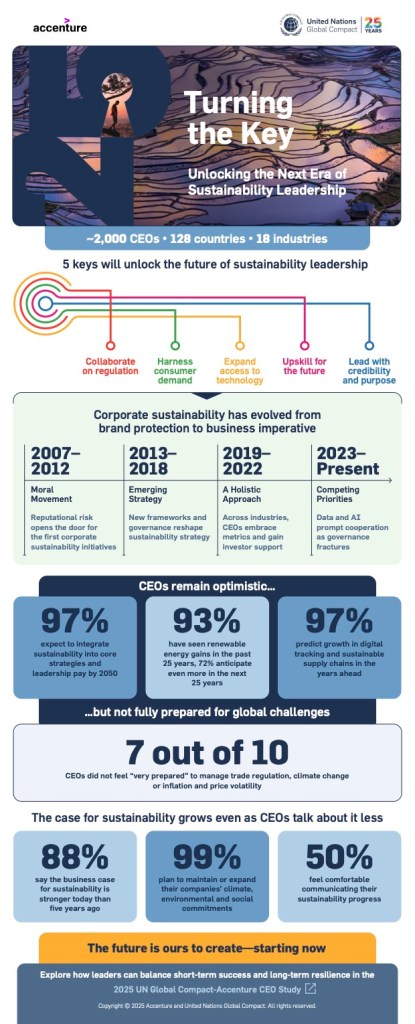
  • Close to 90 percent of CEOs think the case for sustainability is stronger now than five years ago, according to research by Accenture and the United Nations Global Compact, which represents more than 20,000 member companies. Almost all of 2,000 surveyed executives expect to include these metrics in their core strategies and compensation structures by 2050. 

“That makes sense, because being a business leader is not about opinions from one day to another, it’s about building, it’s about investing, it’s about transformation,” said Ingka Group CEO Jesper Brodin, referencing the Global Compact data during a panel discussion at the Nest Climate Campus. Ingka, IKEA’s largest retailer with $47 billion in revenue in 2024, is on pace to meet its 2030 target to halve emissions. A cross-functional committee of business leaders that meets at least eight times annually manages this strategy.

Only half of the CEOs responding to the UN Global Company survey, however, felt comfortable communicating this agenda — a refrain discernible in the other analyses.

“I think the corporate sector has gotten pretty quiet on these issues, whether or not they are moving forward,” said Patagonia CEO Ryan Gellert during a panel discussion at the Nest Climate Campus. “I think there’s a real lack of leadership right now from the business sector, a real lack of leadership response to what we’re navigating.”

Here are three themes of note from the weeklong industry gathering:

Real work continues

Some 100,000 people came to New York to attend more than 1,000 summits, panels, receptions, climate tech pitch sessions and countless face-to-face meetings.

“This week for me, is about finding new people that I have not known before, hearing about new climate initiatives,” said Kate Heiny, vice president of sustainability for Booking Holdings, the company behind travel sites including Booking.com, Kayak and Open Table. “I often look to other industries and not the one that I’m in. I think that learning from other places has always been something that I would look to for growth. So it’s people, it’s ideas.”

That need for connection, validation and fresh perspective was echoed in many of my interviews throughout the week. “I think it has just been great to see that the majority of companies are just plowing on like we are,” said another chief sustainability officer, speaking on background.

“I see very serious people doing really extraordinary things, continuing at full force and momentum,” said Andrew Mayock, who headed the federal government’s sustainability strategy under President Joe Biden. 

Mayock was appointed the inaugural vice chancellor at the University of Colorado Boulder in March. He’s already shaping new master’s programs for integrating sustainability into business, engineering and policy. Mayock is also coordinating development of a new classification from the Carnegie Foundation for the Advancement that will recognize colleges and universities that include climate action as part of their mission.

“I’m really buoyed by being here,” he said.

AI debate gets more nuanced

Plenty of companies in attendance were willing to talk about how artificial intelligence stands to accelerate both their company’s environmental agenda and revenue growth. 

Packaging company Ranpak, which counts Amazon and Walmart among its many big-name customers, is already deploying AI for applications such as rightsizing packages or detecting how much cushioning is needed to protect items in them. “What excites me, frankly, is the stuff that we haven’t figured out yet … the problems that haven’t even been identified yet that can be solved with all of this data,” said David Murgio, chief sustainability officer at the company.  

NVIDIA’s head of sustainability, Josh Parker, downplayed ominous predictions about AI load growth that could strain the U.S. grid, suggesting that the electrification of vehicles and industrial loads is a bigger load factor over time and AI plays an important role in easing bottlenecks.  

“AI is helping us modernize the grid, helping us integrate renewables and batteries,” he said during one panel.

NVIDIA’s influence on the AI ecosystem cannot be understated. Its chips are at the center of data center buildouts by Amazon Web Services, Google and Microsoft, and the company on Sept. 22 announced a deal to invest up to $100 billion in OpenAI’s infrastructure ramp-up. 

Natural gas isn’t going away

The biggest tech companies are spending billions of dollars on the AI data center buildout. To tame the associated emissions they’re investing in creative contracts to keep nuclear power on the grid, support new nuclear technologies and add emerging generation options, such as geothermal.

Here’s the thing few of them are talking about: 40 percent of the electricity powering U.S. data centers comes from natural gas, and it will be the biggest contributor of additional capacity between 2025 and 2030, according to the International Energy Agency.

Meta’s big $10 billion project in Louisiana, as one example, will require three new gas turbines. Elsewhere, natural gas plants that weren’t running at full capacity are being commissioned for more load, said Julio Friedmann, chief scientist for carbon removal advisory firm Carbon Direct. “The thing that people don’t talk about, the hidden aspect of what’s actually happening, is that the easiest thing to do is just ramp up existing natural gas capacity,” he said. 

While the tech firms are investing in as much renewable energy as possible to counter this rise, the Trump administration is making those deals tougher to complete. It plans to stop the retirement of aged coal power plants, for example, and U.S. Department of Energy Secretary Chris Wright last week said data center operators should be prepared to shoulder the burden of their loads by co-locating near specific sources. That’s what Amazon plans to do, for example, near a nuclear plant in Pennsylvania.

Natural gas is a better alternative than coal, although much of the capacity being added is “uncontrolled,” meaning the methane emissions are vented into the atmosphere, Friedmann said. Adding carbon capture and storage to natural gas facilities presents one potential solution, but the U.S. Environmental Protection Agency’s plan to kill the Greenhouse Gas Reporting Program could make it harder — if not impossible — for companies to tap into the 45Q tax incentives for those projects.

“The other thing is that all of this action on natural gas means the prices are going up, which is making all of this more expensive,” Friedmann said. 

The post 3 Climate Week NYC themes you should know appeared first on Trellis.

Procter & Gamble’s long-term chief sustainability officer, Virginie Helias, started her career as a marketer and brand manager, but she doesn’t think consumer products should be priced higher just because they have a lower environmental impact that may have cost more to achieve.

“We don’t price for sustainability, we price for performance,” Helias said in our interview at the Nest Climate Campus, one of 1,000 events scheduled during Climate Week NYC. “I’m trying to hit the magical trifecta of superior performance, sustainability and value creation.”

One example is a new edition of P&G’s NyQuil and DayQuil over-the-counter medication for cold and flu symptoms. The new liquid capsules are 25 percent smaller, which makes them easier to swallow and concentrates the ingredients. They’re sold in a recyclable bottle, instead of single-use blister packs. 

Another innovation, Head & Shoulders Bare, appeals to consumers seeking shampoos free of sulfates, dyes or silicone. It contains just nine ingredients and comes in a lightweight bottle that can be rolled up as the product is used. That cuts out 45 percent of the plastic used for similar bottles and allows consumers to use more of the product.

During an era when the average tenure for chief sustainability officers is roughly four years, Helias has preceded over three distinct phases of P&G’s journey: the development of core sustainability metrics, the integration of this strategy into the company’s core businesses and a new shift that views environmental improvements as a source of value creation.

“I think my biggest asset when I started 15 years ago in this role is that I didn’t know anything about sustainability,” she told me. “The only thing I knew is that it could be a driver for brand building and innovation.”

Business integration required

The first phase of P&G’s sustainability plan — from 2011 to 2017 — was about creating foundation metrics, including the ones highlighted in the company’s 2030 climate goals, according to Helias. 

The company reported mixed progress towards its greenhouse gas reduction commitments in August. While P&G shrank emissions from its own operations and energy use (Scope 1 and 2) by 60 percent since 2010, it’s not on pace to cut emissions from suppliers (Scope 3) by 40 percent per unit of production based on a 2020 baseline. So far, it has reduced them by 9 percent.

Innovations related to water are also central to P&G’s sustainability, which makes sense considering that the division selling products including the Tide and Cascade detergents contributes more than one-third of the company’s profit. 

The company set a goal to improve the efficiency of its production water use by 35 percent against a 2010 baseline. It has made a 26 percent increase, and recycled 3.49 billion liters of water from its facilities during the fiscal year ended June 30, 2024.  

To address these commitments, Helias recruited a “coalition of the willing” — other business leaders inside and outside the company who accelerated the integration of P&G’s environmental priorities into product development roadmaps and partnership initiatives. The work of integrating environmental metrics with other key performance indicators has accelerated since 2021.

“We know that sustainability as a separate path is a dead-end path,” she said.

P&G now challenges suppliers to think about low-carbon technologies as a way to offer superior performance for a product. Companies that help P&G innovate in ingredients or packaging could benefit from better business terms.

“One of the ways we do that is by forming long-term partnerships for offtakes,” Helias said. “So, we help our suppliers derisk their investments.”

One example is P&G’s relationship with PureCycle Technologies, which is commercializing a plastics recycling technology invented by P&G scientists to remove colors and other contaminants that make it tough to use recycled plastics.

P&G decided to license its intellectual property to PureCycle to scale availability across the industry, including to its rivals. The production output of PureCycle’s first plan is sold out for the next 20 years.

What’s needed now: ‘an abundance of ideas’

Helias acknowledged that corporate sustainability practitioners face significant geopolitical and economic headwinds as 2025 winds to a close. She likened this moment for the movement to hitting the 20-mile mark of a marathon, when successful runners must summon new energy to reach the finish line.

Moving forward calls for radical creativity and “an abundance of ideas” that explicitly link environmental improvements to new value creation, Helias said. That’s her priority for 2026, when Helias will have a new boss, incoming president and CEO Shailesh Jejurikar. She now reports to Jon Moeller, who is retiring effective Dec. 31.  

 “What we need to do is to create our own tailwinds,” Helias said, “and those have to be around innovation that delivers superior value and performance, with sustainability as an amplifier of superiority.”

The post How P&G makes the business case for sustainability  appeared first on Trellis.

The opinions expressed here by Trellis expert contributors are their own, not those of Trellis.​

For years, one hurdle to diverting food waste from landfills has been limited collection of this material across the U.S. But new research shows that access to composting in cities across the country has increased by 8.9 percentage points, up from 27 percent in 2020 to nearly 36 percent today.

Composting is a critical tool in the climate change toolbox. It diverts food and other organic waste from landfills, where food waste accounts for 58 percent of landfill methane emissions, the greenhouse gas equivalent of 50 million passenger vehicles. Plus, the finished compost is incredibly effective at enriching soil and promoting carbon sequestration. Since as much as a third of what we send to landfills is food, sending this material to another home is a key sustainability strategy.  

First, though, we need better data. Knowing where people have access to composting programs — and what they’re allowed to put in the bin — is essential for driving food waste diversion efforts and understanding whether compostable packaging can be a viable option across the country. 

The different types of composting access 

Knowing where residents can compost is important, but we also need to know how the program is structured. Residential access to composting collection can be through:

  • Municipally run curbside programs, administered by a resident’s city or county. These are generally considered to be easier to use, as residents typically already access other waste services through their municipalities.
  • Privately run curbside programs, managed by private composting companies that pick up material from residents and take it to a nearby composter or their own composting sites. These programs are often structured as a monthly subscription service (typically in the range of $30/month), and see use from motivated residents.
  • Drop-off programs, which can be managed by the municipality or private companies, often offer multiple drop-off locations, and are typically free but in some cases may include a fee. 

An evolution over the past five years

Five years ago, the environmental nonprofit GreenBlue developed interactive maps and charts of municipally run and privately run composting programs, available on Tableau Public. The study looked at data on program availability and material acceptance in the 1,000 most populous U.S. cities, whose combined population represented approximately 40 percent of the total U.S. population. Cities are key to the composting puzzle. They’re densely populated, they typically offer curbside waste and recycling programs, and some have goals around zero waste or packaging circularity. 

Fast forward to this year and we have an updated dataset to understand the state of composting access today. Expanding the dataset to the 6,233 largest U.S. cities, representing more than 60 percent of the nation’s population, we learned that:

  • Today, 17.8 percent of the measured U.S. population has access to curbside or drop-off programs that accept food waste only (no compostable packaging accepted), up from 16 percent in 2020.
  • 18.1 percent of the measured U.S. population has access to curbside or drop-off programs that accept some form of compostable packaging in addition to food waste, up from 11 percent in 2020.
  • In total, nearly 36 percent of the U.S. population has access to some kind of curbside or drop-off composting program that accepts either food waste only, or food waste and some forms of compostable packaging. This was 27 percent in 2020, resulting in an 8.9 percentage point increase. 

What this means for food waste and compostable packaging 

Clearly, there’s more work to be done. Access to composting programs is not widespread, and if we want to reduce greenhouse gas emissions by diverting food and other organic waste from landfills, more cities and private haulers will need to start offering these services. Cities will also need to see support, advocacy and demand from companies — organizations can advocate for expanded infrastructure through the US Composting Council and Biodegradable Products Institute, and make sure that their own corporate operations and headquarters are signed up for food waste collection. 

At the same time, we can take a moment to celebrate. Composting access is growing, and it’s a more-than-legitimate, not-so-hippie waste management strategy that’s quietly building local soils and economies. As companies lean into composting advocacy, we’ll see big payoffs for the climate, for waste reduction and for local landscapes. 

The post Why composting is more accessible than it seems (and getting easier) appeared first on Trellis.

At a time when it’s hard to find consensus on many issues — particularly in the sustainability space — new research shows a majority of the public want companies to step up and fill the climate change void left by some governments around the world.

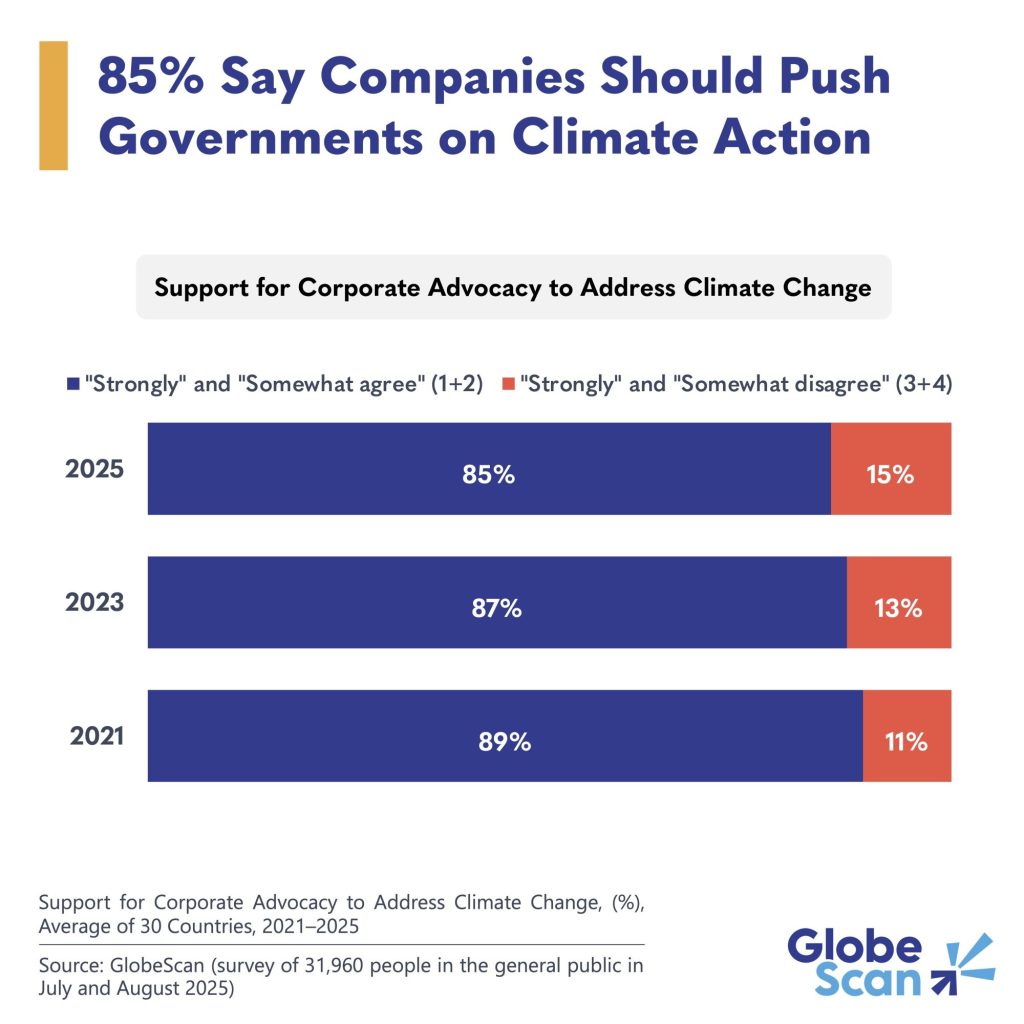
New data from Trellis data partner GlobeScan shows that 85 percent of people around the world believe large companies should actively encourage governments to take stronger action on climate. While the percentage of those who strongly agree has slightly declined over the last few years, the overall consensus remains clear: People expect business to lead on climate advocacy. Only 15 percent of respondents express disagreement, underscoring the enduring public mandate for corporate climate leadership.

Support is especially strong in emerging markets, where citizens are looking to business as a catalyst for progress:

  • Kenya (94 percent)
  • Nigeria (94 percent)
  • Vietnam (93 percent)
  • Indonesia (92 percent)

Even in countries where climate policy is politically sensitive, such as Germany (70 percent) and the Netherlands (72 percent), strong majorities still support corporate engagement. In the U.S., where there has been significant pushback against corporate climate activism, as much as 78 percent of the public want companies to engage the government on climate action.

What this means

The public is not just open to corporate climate advocacy; they expect it. This presents a strategic opportunity for businesses to step into a leadership role that goes beyond internal sustainability efforts. Advocacy can build trust and legitimacy, especially in regions where climate impacts are felt most acutely. At the same time, silence or neutrality may be perceived as indifference. As global attention watches Climate Week NYC and COP 30 this fall, companies have a clear mandate to use their influence to shape policy and accelerate climate action. 

The post 85 percent of people say companies should push governments on climate action appeared first on Trellis.

The opinions expressed here by Trellis expert contributors are their own, not those of Trellis.​

Much attention is paid — justifiably — to the outcomes of companies’ various sustainability efforts: energy consumption, fair labor practices, governance frameworks and water and waste reduction, to name a few. Those outcomes, however, are driven by processes, and those processes by people. So for CSOs, a critical part of the job comes more from the field of communications than environmental science: employee engagement.

It’s no surprise that public discussions of sustainability often cover processes, workflows, product specifications, supply chains and metrics. Those are all incredibly important and they’re clear, measurable ways to hold organizations accountable. Yet at the most basic level, impact isn’t driven just by strategy or technology — it’s driven by people.

I’ve found that behind closed doors at events such as Climate Week NYC, business leaders focus on the people in the organization. Using one’s people right is a big opportunity for every company, and an enormous one for global enterprises, where 200,000-plus human beings can be viewed as simply colleagues — or compatriots. This is true now as AI and other technological advances require ongoing reviews of how tap people for where their unique skills are needed most.

Turning employees into CSO partners involves embedding sustainable thinking not just into corporate processes, but in daily decision-making. This is valuable for several reasons: it can help justify investment, drive timelier decisions, cement a stronger value proposition to clients and cultivate coordinated action across the business.

There are myriad ways to approach this, but I’ve found it helpful to break down engaging with employees into three pieces.

1. Find and leverage natural allies

Thanks to the inherent goodness that drives so many people, most organizations are fortunate to have a core group that already cares deeply about sustainability — even if it has nothing to do with their role. That might be a software engineer passionate about the environment, an HR administrator who volunteers on human rights or project manager concerned about extreme weather. This group may add up to only 10 percent of employees, but it remains a phenomenal, “free” foundation.

The task is to identify those people throughout your organization and consider how to organize them in a meaningful way. At IBM, we did this in my first year by holding a “Global Sustainability Forum” that targeted about 60 employees, ranging from design consultants to infrastructure developers, representing every part of our business that touched on sustainability — regardless whether they viewed it that way. That year we established a network of ambassadors and articulated how sustainability was key to their work. This year we invited broader participation and are expecting almost seven times more participants.

Many companies have a form of sustainability “ambassadors.” Often these focus on volunteering and intermittent projects, items more “apart” from core business than ideal — but these programs do help bring together natural allies. IKEA, for example, has taken this a step further by seeking candidates in their hiring that are enthusiastic about their environmental goals.

2. Don’t invite the rest over — go to where they are

It’d be natural to think the next step involves “bringing over” the remaining 90 percent to your foundation, but creating affinity is difficult and time-consuming, when possible at all. People are busy, understandably, working toward their own KPIs. Instead, an effective strategy should include a narrative that inserts your work into what the others already care about.

For example, CSOs and their teams can aid the KPIs of other teams by assisting with business development, using sustainability angles to promote products or services through channels and platforms and people not already being used. They can also roll up their sleeves, establish regular touchpoints and simply ask their colleagues how they can help. What do sales and product managers need to address client requirements? What language should we be using (we all know sustainability can suffer from jargon)?

Mastercard does this well, with an “Impact Steering Committee” that spans all its business units (including their respective leaders) and BU-specific guides that outline specific actions employees in different roles can undertake to help the company achieve its environmental and social impact goals.

At IBM, one way we did this was developing an AI-powered “Ask Sustainability” chatbot that can help fulfill bespoke data requests we get from clients. However, we didn’t stop there; we integrated the tool directly into an existing “Ask Sales” chatbot, so that this data was easily accessible to sellers through a channel they already use. In this way, my team wasn’t “asking” for anything; we were providing much-appreciated support to our colleagues.

This helped other teams start to see the value prop behind IBM’s sustainability initiatives, and by capturing data on the backend, we also began putting numbers to the “book of business” for which sustainability is a salient issue.

3. Build a beachhead of mindshare

Achieving complete sustainability mindfulness throughout an organization is a never-ending effort, but several tactics can help lock-in incremental progress. Well-crafted self-service tools (such as internal websites) are a great start, letting employees pursue their interest without any roadblocks. It’s imperative that such a site is written to offer help and support, not simply to inform or cajole.

Of course, other proactive tactics such as newsletters and annual activities can help, too. Sometimes external communications — a news story or op-ed — are more effective than traditional internal communications, particularly when those are shared among colleagues.

One of the most impressive examples of proactive tactics might be Patagonia’s Environmental Internship Program, which offers employees from any part of the company two months paid to spend with an environmental group of their choice and “bring back stories, inspiration, and a new commitment” to their mission.

At IBM, we’ve established a new Sustainable Innovation Prize, which awards teams whose work uncovers creative ways to drive and measure long-term value with an added benefit of the chance to ring the New York Stock Exchange closing bell. While the prize may or may not trigger new work, it absolutely incentivizes everyone in the company to consider how their work — in new innovations, product design, AI model development and more — also has a sustainability angle. That’s already an important win, and one I’m excited to reinforce annually.

As Climate Week conversations wrap up in New York, it’s worth reiterating that engaging employees is a key part of driving real change. By identifying and empowering internal allies, collaborating with the others in ways they appreciate and creating regular company-wide touchpoints, CSOs can turn employees into powerful partners in accelerating progress.

The post 3 ways CSOs can engage employees appeared first on Trellis.

Certified cotton that wastes less water and requires fewer chemicals than conventional agricultural practices is better for the planet and farmers.

“However, if short-term financial and reporting goals encourage brands to expand their use of synthetics, even recycled synthetics, then sustainable cotton’s potential will be smothered in its cot,” said Tamar Hoek, senior director of sustainable fashion at Solidaridad Network, in its 2025 Cotton Ranking report.

The report, released Sept. 23 by Solidaridad of the Netherlands and Good On You of Australia, urged brands to use their influence to tilt the market in favor of cotton that’s relatively low emissions or even “climate-positive.”

Fashion brands source a trifling amount of cotton with third-party labeled organic or regenerative practices. Worse, many barely buy cotton at all, instead selecting cheaper synthetics from the murky supply chains of the fossil fuel industry.

By every count, synthetics are encroaching upon cotton’s share of clothing. Polyester and other fabrics make up 59 percent of the fiber mix globally, according to the annual Materials Market report by Textile Exchange, published Sept. 18. In addition, cotton fell to a 19 percent share of overall fibers from 20 percent a year earlier.

The number of brands favoring natural fibers is not enough to offset the fast rise of synthetic-centric brands such as Shein, which has a bigger market share than H&M and Zara combined, noted the Cotton Ranking authors.

Nor are circular synthetics making a dent. Only five brands said that recycled polyester makes up more than one quarter of their overall mix of materials.

Transparency gaps

The report found that only 29 of 100 companies share how much cotton they use, and only 35 explained what certifications they use. Given those gaps, the researchers analyzed product SKUs to determine the fiber mix per brand.

Although 25 companies did report using recycled, certified cotton, it was in small amounts. 

“Our data reveals patterns invisible in traditional reporting,” stated Sandra Capponi, co-founder of Good on You. “For instance, how brands with the highest percentage of certified cotton often use the least cotton overall, or how synthetic reliance concentrates among the industry’s largest players.”

Brand examples

Adidas is probably one of the largest cotton buyers, buying certified cotton only, but that is only 12 percent of its overall fiber mix. Puma similarly reports 99 percent certified cotton, but the material accounts for only 10 percent of its total fibers.

Only 31 of the businesses say that cotton represents at least half of their fiber mix, and only 17 say that cotton is certified.

Brands with the biggest proportion of cotton in their fiber mix were Levi’s, G-Star RAW of Amsterdam, Ralph Lauren, Carter’s and Marc O’Polo of Stockholm.

By contrast, Brooks Sport, Speedo, Shein, Columbia, Lululemon and Adidas used a much higher proportion of synthetics.

Adidas, Amazon, H&M, Jack Wolfskin and C&A are among the brands using the most certified cotton. These include Better Cotton, organic or recycled sources.

The biggest user of cotton by tonnage was Inditex, whose brands include Zara and Massimo Dutti. Gildan, Nike Group, PVH Corp and Adidas followed, in that order.

What to do

Brands can invest in better cotton practices to uplift farmers and benefit the climate, according to the report authors, while synthetics have no such potential. Yet because sustainable cotton, or any cotton, fails to get a fair shake, the health of the soil and climate will suffer along with smallholder farmers, many of whom toil in poverty. The report offered the following recommendations for brands:

Build relationships with farmers: Invest in sound practices and help them withstand future climate stressors.

Create targets for sustainable cotton use: Track these goals and report on progress.

Rely on preferred and natural fibers: Polyester, nylon and other petroleum-derived fibers already have a heavy climate footprint. Even when recycled, they shed microfiber plastics. Sportswear and outdoor brands should especially look for other materials.

Weigh your current materials and reconfigure: Change that ratio of natural-to-synthetic fibers.

Revisit purchasing practices: Take responsibility for sustainability across the value chain. Don’t just stop at inking a certified material supply.

To source sustainably, make pricing fair: Brand purchases often put the onus on suppliers to improve conditions, whatever it costs. However, procurement should bake in fair pricing.

The post Shein’s rise and polyester’s surge threaten certified cotton, report says appeared first on Trellis.

In one crucial way, the fashion industry is stuck in the era of Charles Dickens. Most brands still depend on dirty energy. Worse, the big players lack accountability when it comes to pursuing fossil-free supply chains. That’s according to the latest “What Fuels Fashion” report, from the London watchdog group Fashion Revolution.

Even among the brands and retailers that do disclose their reliance on polluting fuel in their supply chains, few are making adequate progress. The report called out a long list of laggards — plus a handful of leaders in key areas. Household names were in both groups in the examination of 200 brands with at least $1 billion in annual turnover.

“Fashion brands love to promote innovative new products, but the Victorian-era reality of burning coal and wood to manufacture these products is quietly swept under the rug,” said Ruth MacGilp, the fashion campaign manager for another London advocacy group, Action Speaks Louder.

Leaders and laggards

On average, brands disclosed only 14 percent of the indicators that the report tracked from sources available in early 2024.

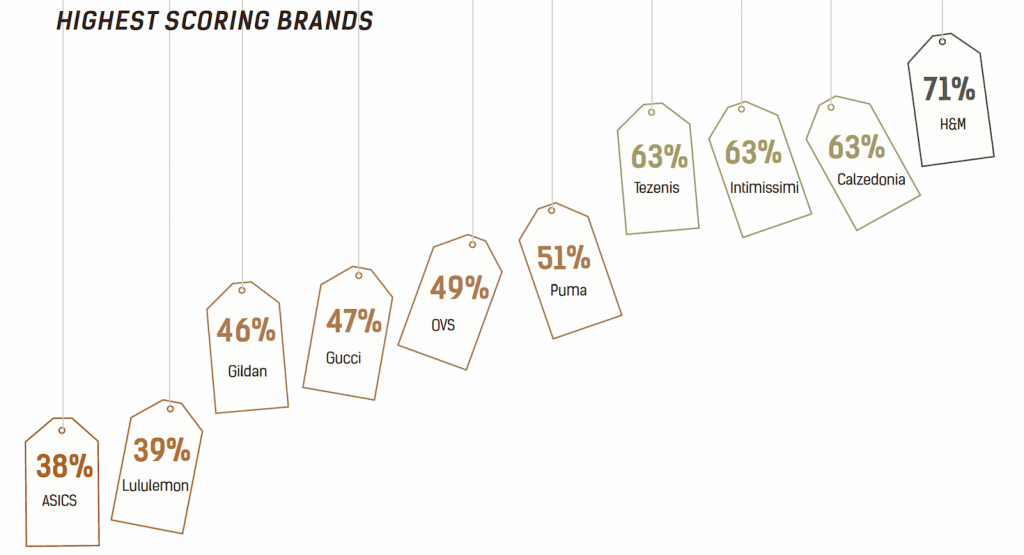
The best actor, with a 71 percent score, was H&M Group. Its numerous efforts to advance low-carbon practices in supply chains includes investing in “brick battery” player Rondo Energy.

Following the Stockholm fast fashion giant was Italian company Oniverse, whose Calzedonia legwear, Intimissimi lingerie and Tezenis swimwear brands reached 63 percent. Sores between 46 percent to 51 percent: Puma, OVS of Italy, Gucci and Gildan. Lululemon (39 percent) and Asics (38 percent) came next.

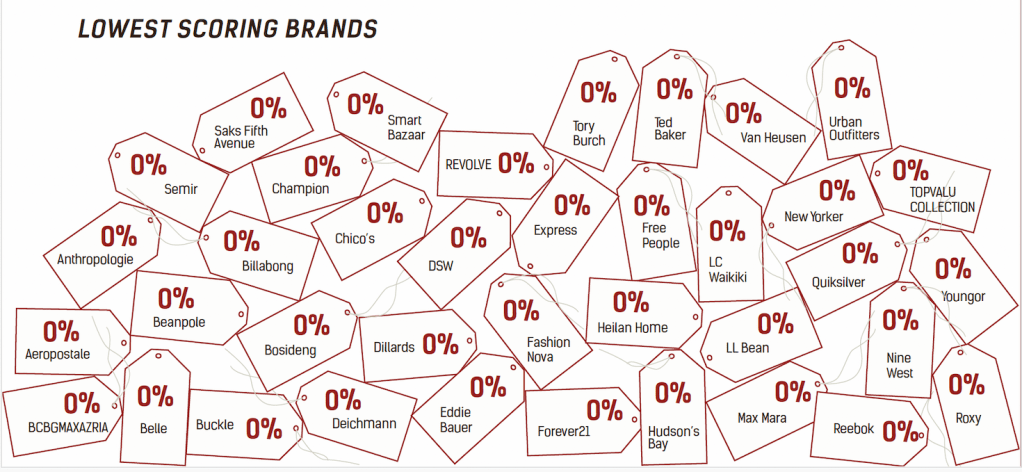
Some 90 brands clustered at the bottom of the report’s rankings. Among the 39 well-known names with a 0 percent rating were Aeropostale, Anthropologie, Eddie Bauer, Forever 21, LL Bean and Urban Outfitters.

‘Clean heat for cool work’

“The path to decarbonization will be won or lost by how fashion tackles heat,” said Fashion Revolution’s Head of Policy and Research Liv Simpliciano, in the report, which described low barriers to electrification, such as adopting heat pumps and electric boilers in dyeing, printing and other processes typically fueled by burning coal, gas or biomass.

“The textiles industry can lead by example,” stated Oxford University Professor of Energy and Climate Policy Jan Rosenow. “Because process heat rarely exceeds 250 degrees Celsius, it has the potential to move entirely away from fossil fuels.”

In 120 pages, the document weighted companies’ activities in terms of accountability, decarbonization, energy procurement, financing and a just transition or advocacy. However, because so few companies disclosed details on key measures, the report speaks to transparency more than sustainability efforts.

Credit: What Fuels Fashion report

Decarbonization

Fashion Revolution prioritized decarbonization as 41 percent of a company’s overall score. For the first time, the report measured progress against companies’ base years for climate goals. It considered time-bound targets, energy consumption and greenhouse gas footprints.

Unsurprisingly, the leaders in this category were roughly the same as in the overall rankings.

Notably, 76 brands scored zero, including Forever 21, Fashion Nova, Reebok and Urban Outfitters, and fewer than a third reported actual emissions reductions against their targets. Better performers such as Puma, American Eagle, Hanes and OVS disclosed emissions by country and showed stronger decarbonization pathways.

Fashion Revolution slammed brands for failing to help suppliers electrify. Only 6 percent shared how they are providing capital to help supply chain players adopt lower carbon equipment. Only 2 percent said they help with renewable energy bills. H&M and American Eagle provided limited transparency on financing, but most remained tight-lipped.

Accountability

OVS, Oniverse and H&M led on accountability indicators overall. Many companies clumped at the bottom with 0 percent transparency scores, ranging from Aeropostale to Kohl’s to Walmart.

Only 7 percent of brands revealed their price on carbon. That’s far lower than in other sectors.

Energy procurement

Only 15 percent of brands detailed suppliers’ energy emissions sources. Instead, the majority masked their fossil fuel dependence, in some cases by leaning on renewable energy credits (RECs) rather than directly switching to low-carbon energy at their facilities, the report found.

Only 7 percent of brands revealed if they’re electrifying any heat-related processes, and a meager 6 percent shared any overall renewable energy targets.

Companies with the highest score, at 62 percent: Asics, New Balance, Ralph Lauren, Decathlon, H&M, Vans, The North Face, Timberland and Gucci.

Workplace equity

Factory workers are often stressed by hot conditions in hot climates. Yet none of the brands disclosed details on heat and humidity that would ensure humane working conditions in a planet-warming future. H&M had the highest score, of 51 percent, followed by Gucci at 43 percent.

Credit: What Fuels Fashion report

7 things brands should do

“What Fuels Fashion” included the following advice for large brands and retailers:

Go big on wind, solar, heat pumps and electric boilers: These and other non-fossil energy technologies can cut emissions now and make it easier for better practices to spread across the industry.

Direct money to where change must happen: Directly fund suppliers and renewable-energy projects, or ink power purchase agreements (PPAs). Brands should advance systemic reforms not only to reduce factory emissions, but to clean up national grids in developing regions, too.

Watch heat and humidity in suppliers’ climates: Wet bulb global temperatures tend to be high where factories are clustered. Companies must watch how conditions change, and then adapt.

Give suppliers stable, long-term contracts: Purchasing practices that suppliers can count on won’t leave them holding the bag, and helps them invest in preferable practices.

Pay fair, living wages: This “most effective adaptation strategy” empowers communities around manufacturing plants to plan ahead and brace for future climate shocks.

Center worker rights: Collective bargaining agreements and other ways to support workers can include people in the low-carbon energy transition.

Do more than you’re forced to do: Compliance should be a floor, not a ceiling. Business practices must meet international standards for advancing climate progress and human rights. Risk-based due diligence needs to revolve around workers.

The post Fashion report slams 90 brands on energy — and tells them what to do about it appeared first on Trellis.

Unilever and other companies are trialling a new framework designed to capture corporate action on climate that goes beyond traditional emissions-based accounting.

The “Spheres of Influence” framework focuses on initiatives that companies take in product development, climate finance and policy engagement. It’s designed to sit alongside — rather than replace — action to reduce value-chain emissions.

“It’s a big fix when it comes to sustainability strategy,” said Matthew Sexton, chief transformation officer at Futerra, the consultancy that developed the framework in collaboration with Oxford Net Zero, a University of Oxford research initiative. Companies can now talk about this kind of work in a way that’s “risk free, rigorous and credible,” he added.

Products, portfolios and policy

The concept, which is also being tested by Oatly, Chanel and the Japanese chemicals and cosmetics company Kao, is built around three spheres in which companies can exert influence:

  • Bringing to market and scaling new low-emissions products and services
  • Channeling finance to a portfolio of climate solutions, including through the purchase of high-integrity carbon credits
  • Public and policy engagement to “foster a more supportive context for climate action”

Caroline Reid, senior sustainability director at plant-based milk company Oatly, heard about the framework at last year’s Climate Week NYC. Oatly was already measuring the extent to which its customers switch from dairy milk to the company’s lower-carbon alternatives, quantifying the emissions avoided in the process. It has a target of avoiding the emissions of at least 0.5 kilograms of carbon dioxide equivalent per liter of oat milk sold by 2030.

“They were talking about how we already do things,” recalled Reid, “but they want to codify it.” Reid and colleagues later provided input into the development of the first formal iteration of the framework, which was released this week as a white paper.

“If you codify it and create a standard, then it’s something that’s way more credible and understood,” added Reid.

Future standards

The paper breaks down each of the spheres into sub-spheres and provides real-world actions that fit in each. Examples within the finance sphere, for instance, include Apple’s Power for Impact project, which funds renewables projects in under-resourced communities, and SteelZero, an initiative under which companies commit to ratcheting up purchases of low-carbon steel.

What the framework doesn’t yet do is quantify the impact of this work or explain how such estimates could be integrated into existing emissions accounting systems, but that’s something that the backers hope a standard-setter will do. “I would love to see this being picked up by the conveyor belt of standards,” said Alice Roche-Naude, sustainability strategy director at Futerra.

Some newer standards and guidelines are already popping up in this space. Companies can earn a “Climate Solutions” qualification from the Exponential Roadmap Initiative, for example, by demonstrating that a product has a footprint that’s at least 50 percent below the market average. Oatly and green-steel manufacturer Stegra are the first two businesses to earn that label.

The post Unilever and Oatly test drive a new framework for capturing corporate climate action appeared first on Trellis.

Only several years remain to stave off catastrophic climate tipping points, according to Global Fashion Agenda (GFA). In a new report, “Fashion CEO Agenda,” the high-profile nonprofit urges executives to take specific short- and long-term steps to align their businesses with the Paris Agreement.

“The cost of not acting on sustainability is greater than the investment needed to address it,” Federica Marchionni, CEO of Copenhagen-based GFA, stated in the report. “Indeed, inaction exposes companies to serious financial losses and reputational harm.”

Released Sept. 25, the report nonetheless found “glimmers of hope,” including the rise of circular business models such as resale, efforts to recirculate textile waste and improvements in workplace equity.

“Fashion must not treat sustainability as a siloed function,” said Marchionni, who previously served as CEO of Lands End and president of Dolce and Gabbana. “It must be placed at the core of how we define success and create value — for society, the environment and the economy. With smart innovation, investment, incentives and regulation, it is possible for profit and conscientious purpose to coexist.”

GFA membership includes scores of brands, with strategic partners such as H&M, Bestseller, Kering, Nike, Ralph Lauren and Target. LVMH Moët Hennessy Louis Vuitton joined on Sept. 22. Other partners include Puma, Lenzing and Zalando. Nonprofits involved include the Apparel Impact Institute, Textile Exchange and the Ellen MacArthur Foundation.

5 foundational priorities

Two years ago, Global Fashion Agenda set the following priorities for sustainability:

Respectful and secure work environments: Supply chain transparency is a responsibility of brands, and along with that comes the support of worker freedoms and protections. Companies should also help to retrain employees as automation changes their work.

Better wage systems: A living wage, collective bargaining support and closing gender pay gaps are among the efforts that brands should plan and share.

Resource stewardship: Companies must set science-based targets to slash climate emissions across all scopes. This includes removing fossil fuels from supply chains as well as preventing freshwater pollution from microfibers and manufacturing chemicals.

Smart material choices: Every fiber in fashion should derive from preferable sources by 2030. These include recycled, regenerative or deforestation-free sources. Investing in next-generation materials now is key.

Circular systems: The industry must design out waste and foster circular materials and business models.

5 ‘priority accelerators’

In addition to the above, the recent report outlined five characteristics that cut across the above priorities to make meaningful, short-term change:

Innovation: Companies should support resale, repair and other circular business models and fund technology R&D. This includes providing help for textile-to-textile recycling and technologies to improve material sorting.

Capital: Industry leaders must “de-risk innovation” and fill in funding gaps to bring new solutions to market. Circularity, clean energy, new materials and AI tools all need support.

Courage: The broader industry will play follow-the-leader if leaders step up to champion sustainability. “Whether reshaping norms around gender equity or circular design, climate action and beyond, these defiant leaders effectively break down barriers and build bridges,” the report authors wrote.

Incentives: Use “carrots” to drive progress. For businesses, the return on investment for efficiency measures can sweeten the business case for driving down energy emissions. On the retail side, incentives such as coupons can motivate consumers to send in used goods for resale.

Regulation: Businesses must promote policies that will transform the industry, such as those that include countries within supply chains.

Practical, short-term actions to take now:

As for how to execute on its recommendations, the report described immediate, practical steps for brands and retailers to take now such as:

  • Disclose suppliers openly across all tiers of manufacturing and logistics.
  • Fix purchasing practices to support fair contracts.
  • Ensure that workers have trusted channels to express grievances.
  • Commit to living wages and expand collective bargaining.
  • Set science-based emission targets and decarbonize supply chains.
  • Manage water use and treatment responsibly in high-risk areas
  • Reduce microfiber shedding through design and monitoring.
  • Shift all key materials to regenerative, recycled or deforestation-free sources.
  • Design out overproduction and grow circular revenue streams.
  • Safeguard workers by retraining them in new skills, and planning for a “just transition” to a low-carbon economy.

The post Global Fashion Agenda report says brands must act faster in climate fight appeared first on Trellis.