
Animal, vegetable or mineral. Most materials derive from one of those categories of nature. But a Chicago startup is cultivating a new class of materials from the fungus kingdom.

Hydefy, in fact, is developing alternatives both leather and fossil fuel-based plastics.

The company just emerged from stealth mode after spending five years quietly formulating its vegan “leather.” In March, it took the wraps off its first branded product, a $1,500 silvery purse by Stella McCartney.

“Our vision is that we will introduce a new option for consumers that they can feel good about,” said Hydefy General Manager Rachel Lee.

A vial of fungus, straight from a cooler. This is where the products originate for both the Nature's Fynd food company and Hydefy materials startup.
A vial of fungus, straight from a cooler that supplies sister companies Hydefy, which makes leather-like material, and Nature’s Fynd, which produces food. Credit: Trellis Group / Elsa Wenzel

Among dozens of startups playing with mycelium, found in the roots of mushrooms, Hydefy has evaded the spotlight. That’s even as its sister startup, Nature’s Fynd, raked in more than $500 million of investments, including from Bill Gates’ Breakthrough Energy Ventures. Nature’s Fynd formulates fungus-based, protein-rich “yogurt” and breakfast patties that sell at Whole Foods and Mariano’s markets. 

The sibling companies share a nearly 50,000 square-foot R&D and production plant in Chicago’s former Union Stock Yards. The irony of being situated in America’s former meatpacking “jungle” is not lost on Lee, who is also a senior director at Nature’s Fynd.

“We started with cream cheese and breakfast patties in 2021, on Valentine’s Day, as our love letter to Earth,” she said. “We were replacing the inside of a cow. Now we can say we’re replacing all the parts.”

In the center, dried Fy resembles dried mushrooms or mangled potato chips. This is how the mycelium looks after cultivation and drying. It's flanked by ground up versions. Credit: Trellis Group / Elsa Wenzel
Dried Fy, whether flakes, powder or pellets, emits an earthy aroma. Credit: Trellis Group / Elsa Wenzel

The quest to bring climate-friendly fungi to the industrial production of fashion and food sprang from NASA research into “extremophile” organisms that could survive in alien conditions. The fungus has traveled to the International Space Station to test its potential for feeding astronauts. Fynder Group, the umbrella company, emerged from research by Mark Kozubal, who in 2009 noticed fungi sprouting from algae sampled from a hot spring at Yellowstone National Park. The Latin name for the fungus strain, by the way, is Fusarium strain flavolapis (flavo means yellow and lapis means stone).

The company was founded in a Bozeman, Montana, garage but eventually relocated to the Windy City.

Hydefy recently invited Trellis to tour its Chicago plant, where it and Nature’s Fynd draw their fungi from the same cooler. The organism is rare — it may not even grow beyond its geothermal origin point in Yellowstone — so backup copies are kept alive in undisclosed locations.
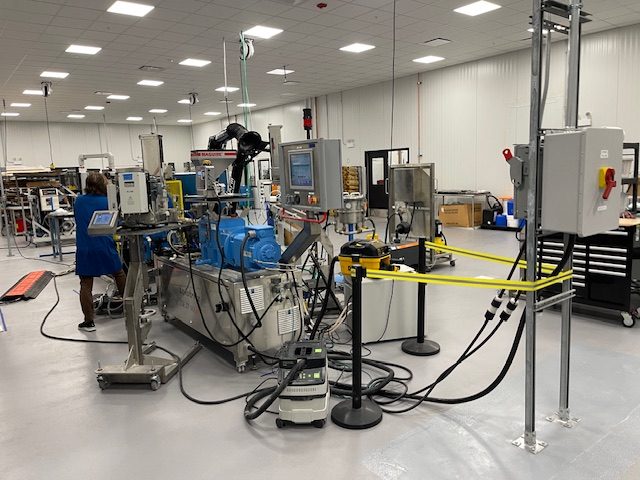
Hydefy adapted this sheet extruder machine to produce wide sheets of its mycelium "leather" material. The equipment normally would produce things like vinyl flooring and mats. Credit: Trellis Group / Elsa Wenzel
An extrusion machine adapted by Hydefy produces wide sheets of mycelium “leather.” Credit: Trellis Group / Elsa Wenzel

From cold storage the microorganisms’ paths diverge, either to a Nature’s Fynd lab-like kitchen or a Hydefy fabrication room. (Sometimes Hydefy recycles scrap fungi from Nature’s Fynd.)

Whatever works

Hydefy takes an “all of the above” approach to fermentation technology. With liquid air surface fermentation, the fungi forms a mat as it grows, Kombucha-like, in trays. Another method is submerged fermentation. In equipment typically found in breweries, fungi grow vertically inside large metal tanks.

Here's what Hydefy's fungus sheets look like on rolls before the final finishing touches, such as for color. Each roll has a slightly different texture, some approximating smooth leather and others with a pebbled texture or a near-suede hand feel. Credit: Trellis Group / Elsa Wenzel
Fungus sheets with different textures — pebbled, smooth, etc. — are stored rolls before finishing touches, such as coloring, are applied. Credit: Trellis Group / Elsa Wenzel

“This process allows us to re-fit existing equipment and grow our network, whether national or global,” Lee said.

The living output, called Fy, comes out wet. Once washed, diced and dried, it resembles potato chips, but with an earthy aroma.

The company crushes those chips into powder, mixing in sugarcane polymers. It forms that powder into pellets, which are fed into an extruder, at which point heat and pressure are added to churn out sheets that are similar in size to fabric rolls.

The machines, which generally produce vinyl flooring and mats, have been customized by Hydefy engineers. (Early on, the company experimented with a panini press.)

There’s a light burning smell as staff tinkers with the equipment. They swap out attachments to produce different sizes and composites of the material. 

The base material comes out a buttery yellow. The company can add colors. 

At a nearby table, team members add texture to the rolls, a process similar to embossing. A finishing layer includes silicone and a bio-based polyurethane from either corn or sugarcane. Hydefy has about 50 different finishing formulations. Notably, when an attache case brought to a trade show in London became unpackaged during shipping, the wear and tear resembled the scuffing typical of animal leather.

Hydefy can customize its material in colors and textures that resemble leather or vinyl, or something new entirely. Credit: Trellis Group / Elsa Wenzel
Hydefy has 50 different finishing formulations. Credit: Trellis Group / Elsa Wenzel

The material can have various hand feels, including pebbled leather, crushed velvet and suede effect. In addition, the company can produce non-leather textures that have, say, a metallic sheen or other patterns, such as the topography of Yellowstone Park. Some of the material smells nearly like leather, although whether Hydefy should mimic that aroma is a point of discussion. So too a perfumed purse: A Nature’s Fynd team member helped give Fy a rose scent.

“Some of our favorite inventions have come from controversial, love-or-hate decisions,” Lee said.

A diversified team

Hydefy employees come from a swath of backgrounds. They include a scientist who used to make fighter jets, a former banker and a fermentation scientist. The team also includes Senior R&D Director Jeremy Gantz, who spent more than seven years in materials innovation at Nike. He is one reason that Hydefy is comfortable eyeing the footwear market. At least three staffers are wearing test shoes made from Fy.

Hydefy's material appears in demo cowboy boots and purses. The printed fabric pattern is visible on the other side through its attached, semi-sheer layer of the fungus material, showing design possibilities that bovine leather can't provide. Credit: Trellis Group / Elsa Wenzel
Some demo products using Fy. The printed fabric pattern is visible on the fabric’s underside, a canvas genuine leather cannot offer. Credit: Trellis Group / Elsa Wenzel

“As an industry, we’re not going to find people who used to work in this because it’s a new category,” Lee said. “That’s why it was more important to look for scientists who have the material science background, or who have the chemistry background, or even who have textile background.”

[Connect with more than 3,500 professionals decarbonizing and future-proofing their organizations and supply chains through climate technologies at VERGE, Oct. 28-30, San Jose.]

The post An inside look at a fungi-forward, faux-leather material maker appeared first on Trellis.

Jigar Shah is concerned about an impending rise in energy costs, but he’s still optimistic about the prospect of America’s clean energy future.

That’s one of the main takeaways from a wide ranging interview with the former director of the Biden Department of Energy (DOE) Loan Programs Office (LPO). Shah, who is now a part-time fellow for the World Resources Institute and consultant for PowerHouse Ventures, spoke with Trellis about the future of U.S. energy.

U.S. energy production

The House passed its version of the reconciliation budget bill on May 22, repealing many clean energy credits created in the 2022 Inflation Reduction Act (IRA) including the clean electricity investment tax credit and advanced manufacturing production credit. Also noteworthy: The legislation tightened the deadline to take advantage of many IRA manufacturing credits — 60 days after the bill’s passage.

And though nuclear energy is exempt from the 60-day rule, the nuclear power production credit expires earlier than planned in 2031.

These credits directly contribute to the affordable development of clean energy production, including solar, wind and battery storage subsidies. Not surprisingly, these proposed cuts, combined with federal agencies slashing funding for decarbonization and clean energy projects, have Shah worried that the U.S. will be unable to meet the necessary minimum energy load by 2030.

“The vast majority of electricity planners think that we need 150 gigawatts of new energy capacity by 2030 to meet all of our economic development goals,” said Shah, “The American Gas Association (AGA) has said very clearly that they do not believe that we can build more than 50 gigawatts of new natural gas in this country by 2030.”

Shah referenced the AGA to emphasize that even the fossil fuel industry is concerned about America’s ability to meet its future capacity needs, especially in light of the growing demands of artificial intelligence (AI). The Lawrence Berkeley National Laboratory projected that by 2028, more than half of all electricity use in data centers will directly support AI use.

To meet this demand, most experts believe, energy production will have to include solar and wind.

Undermining clean energy bipartisanship

The LPO, which provides low-cost funding, was designed to stimulate private sector investment in clean energy projects. But the House reconciliation bill cut all unused credit subsidy funding currently available to the office. This doesn’t just affect Trump administration bugaboos like windmills and solar, but also geothermal and nuclear energy production, which are the rare examples of bipartisan net-zero energy production.

“You’re not going to build nuclear between now and 2030,” Shah said. “Or even new geothermal.” Rather, he believes, existing clean energy technology will have to fill the gaps. “It’ll just be more expensive,” he said.

Moreover, with the LPO hobbled the clean energy industry is set up for a devastating domino effect because the reconciliation bill also cuts all manufacturing and production credits that would help buffer the impact of rescinded funds. 

But Shah doesn’t see this future as inevitable. He is calling for a congressional compromise, one that would allow for at least $100 million in credit subsidies to remain within LPO. Although a fraction of the original $5 billion allocated to the office in the IRA, such a safety net would prevent entire programs, like the DOE’s Advanced Technology Vehicles Manufacturing Loan Program, from shuttering. Just as important, Shah said, it would uphold the LPO’s loan authority, allowing it to maintain deals with utilities and other companies. 

The post Why Jigar Shah thinks America’s clean energy industry isn’t dead yet appeared first on Trellis.

The Department of Energy’s plan to cut $3.7 billion in Office of Clean Energy Demonstrations (OCED) awards strips funding from two startups that have scored high-profile deals with Microsoft and Amazon to decarbonize data center construction.

The DOE cuts came after a financial review ordered by President Donald Trump. So far, it impacts 24 projects — most related to carbon capture and storage — planned by a range of companies that also includes Diageo, ExxonMobil, Kohler and Kraft Heinz. About two-thirds of the projects were signed between Election Day and late in President Joe Biden’s term.

The cuts came as a surprise to the two startups, Brimstone Energy and Sublime Systems. “Given our project’s strong alignment with President Trump’s priority to increase U.S. production of critical minerals, we believe this was a misunderstanding,” said a Brimstone spokesperson.

Sublime, which also talked up its U.S. manufacturing plans in a statement about the cancellation, told Trellis that it is “evaluating various scenarios that leave our scale-up unimpeded.” Through a spokesperson, the company appealed to policymakers who “recognize that investing in American-invented breakthrough industrial technologies can address multiple policy priorities in tandem to the benefit of Americans from all walks of life.”

$15 billion at stake

The DOE is examining close to 180 grants and awards worth approximately $15 billion that would replace fossil-fueled industrial heating equipment, scale up carbon capture and address other hard-to-abate processes.

The agency’s OCED, which is slated for closure, had planned to award $1.6 billion to six projects aimed at reducing the emissions associated with cement by 4 million metric tons annually. The industry accounts for about 5.5 percent of all greenhouse gas emissions.

Four of the projects announced by OCED in March 2024, including those involving Sublime and Brimstone, were terminated by Energy Secretary Christopher Wright on May 30. They are:

  • Brimstone was supposed to receive up to $189 million to build its first commercial-scale factory in an as-yet-undisclosed location. It is closely allied with Amazon, which has backed it through the Climate Pledge Fund. Brimstone uses calcium silicate rocks instead of limestone for production, which cuts emissions and also produces critical minerals such as alumina.
  • Sublime, which announced a deal with Microsoft for a new carbon credit a week before the cancellation, was expecting $87 million to help build a factory in Massachusetts. The company uses an electrochemical process instead of a combustion-driven kiln to make a substance that can replace ordinary portland cement. 
  • National Cement, which is investing $500 million on a plant in California, was anticipating a DOE match of that amount. It’s a multifaceted project: the company wants to commercialize blended cement that uses calcined clay to produce limestone. It also plans a carbon capture and storage installation at the facility.
  • Heidelberg Materials in Louisiana was selected for up to $500 million to install carbon capture technology at a new plant in Mitchell, Indiana. Massachusetts. The company uses an electrochemical process instead of a combustion-driven kiln to make a substance that can replace ordinary portland cement.  

The fate of two other projects is unclear. Roanoke Cement could receive up to $61.7 million for an approach that minimizes the use of clinker, which is the most carbon-intensive part of cement production. Summit Materials, which is developing ways to replace limestone with local clay, has been in negotiations for up to $215.6 million.

The post Low-carbon cement startups allied with Amazon and Microsoft lose federal funding appeared first on Trellis.

The Two Steps Forward podcast is available on Spotify, Apple Podcasts, Amazon Music and other platforms — and, of course, via Trellis. Episodes publish every other Tuesday.

Financial services is high on the list of the most fascinating and challenging sectors for sustainability. Ellen Jackowski, Chief Sustainability Officer at Mastercard, is one of the sector’s leaders. In just a few years at the financial services giant, she’s helped pioneer approaches to using payment systems to inspire, inform and enable change at a mass scale.

Jackowski talks about her company’s role in effecting systemic change in this interview for the Two Steps Forward podcast with me and my co-host, sustainability “solutionist” Solitaire Townsend. Jackowski shares several examples of how the company innovates solutions for its customers and banking partners. Also in this episode, we discuss the state of greenwashing and greenhushing, including how much of it is a distraction from more ambitious sustainability work that companies need to do.

Mastercard’s footprint

Mastercard’s financial footprint is vast. Along with Visa, the two credit card networks control approximately 90 percent of all payment processing outside of China. Mastercard itself can be used at 150 million places around the world, with thousands of banking partners and more than 3.5 billion cards in circulation.

“Our carbon footprint is relatively small for the size of the company that we are,” Jackowski told us. She explained that Mastercard’s sustainability efforts are focused on reducing that footprint but equally on “creating tools and partnerships to influence consumption trends and support a regenerative economy.”

Frictionless choices

It’s important to make the sustainable choice frictionless, Jackowski said. An example of that is working with transit systems around the world — in New York, Singapore and London — to enable riders to tap a credit card on a bus or at a turnstile rather than having to purchase a card, ticket or token. That makes the sustainable choice — transit riding — easier.

“We’re spending a lot of time thinking about which technologies, which sectors, are ready to lean into these new behaviors and new models, where it’s win-win-win for everybody.” In this case, that’s transit riders, transit companies and credit card companies.

Another example is a calculator that allows consumers to see, in their billing statements, the estimated carbon footprint of their purchases alongside the financial cost. Jackowski acknowledged that to maximize the calculator’s impact, Mastercard needs to “work with our merchants to provide that data at the point of transaction or prior,” not after you’ve purchased something. “The role we can play is to provide better information, more insightful information, to inform those choices.”

Strategic, systemic thinking

Jackowski emphasized that such initiatives require collaboration across industries and sectors.

“This can’t be Mastercard sitting in our own little box thinking about the evolution of our business model, moving into more circular business models,” she said. “This takes all sorts of partners and thinkers and stakeholders and actors.”

Still, Mastercard can be an influential connector between merchants and consumers, creating tools to influence behavior and foster a circular economy. She and her team work to address questions such as: “How can Mastercard inspire both merchants on our network and cardholders to want to offer and to also want to purchase more sustainable products and services? How can we inform? How do we provide deeper information?”

She said: “We’re focused on the long game while staying responsive to new data, pressures and trends.”

The Two Steps Forward podcast is available on Spotify, Apple Podcasts, Amazon Music and other platforms — and, of course, via Trellis. Episodes publish every other Tuesday.

The post Mastercard CSO: ‘Making more sustainable choices is a megatrend’ appeared first on Trellis.

For decades, university endowments were judged by a single metric: financial returns. But as climate change and social inequality intensify, the $700-plus billion held in university endowments has become a battleground where fundamental questions about the purpose of institutional capital are being fiercely contested.

Some university endowments have quietly caved under political pressures, willingly reducing investments influenced by climate change or social inequality, or tangibly retreating from greenhouse goals. But others, citing a fiduciary responsibility, are steadfast in seeking favorable market financial returns along with measurable environment and social outcomes. 

America’s most forward-thinking university endowments don’t just allocate capital seeking to avoid harm — they’re actively financing solutions through direct investments. They’re pushing forward the fossil-fuel divestment movement that began on college campuses a decade ago into a new green investing frontier. 

Leaders in the climate capital shift

Today’s leading endowments are moving billions into climate solutions with the understanding that addressing the climate crisis represents the investment opportunity of a generation. 

Harvard University — embroiled with the Trump administration over frozen federal funds and blocking international student enrollment — has a $51 billion endowment that’s made a notable pivot in its direct investment strategy. Beyond its commitment to a net-zero portfolio by 2050, it has allocated capital to climate-focused venture funds and developed a robust shareholder engagement program targeting emissions reductions in portfolio companies. Harvard’s direct investments in sustainable timberland assets have been particularly significant, with the endowment taking ownership positions in forestry projects designed for carbon sequestration alongside sustainable timber production.

Yale’s endowment, meanwhile, pioneered an approach where climate considerations became integrated into manager selection. It actively allocates capital to specialized investment managers focused on renewable energy infrastructure, with direct stakes in North American wind and solar projects.

Confronting inequality through capital allocation

The social justice reckoning of recent years has forced a conversation about how institutional capital perpetuates or confronts systemic inequalities. Here too, endowments are beginning to take direct action as they recognize that diverse investment managers and allocations can be strategically advantageous.

Duke University’s endowment has allocated capital to up-and-coming managers, with a particular focus on increasing the diversity of the investment teams handling their capital. By committing endowment dollars directly to first-time fund managers with diverse backgrounds, Duke is addressing the extreme imbalance of who controls capital in America, where less than 1.5 percent of assets are managed by women and minority-owned firms — despite evidence that diverse investment managers may make better decisions that lead to better performance.

The University of Pennsylvania’s endowment has developed a community investment initiative through which a portion of its portfolio is directly invested in Philadelphia-based businesses, with particular attention to enterprises owned by women and people of color. These investments seek market returns while addressing the racial wealth gap through direct capital allocation.

From negative screens to active financing

The most profound shift we’re witnessing is the movement from merely avoiding harm (negative screening) to actively financing solutions through direct investment strategies. 

Princeton University’s endowment has moved beyond simply excluding fossil fuels to establishing a dedicated allocation for climate solutions within its natural resources portfolio. These direct investments include sustainable agriculture, renewable energy infrastructure and carbon markets.

Washington University in St. Louis has restructured its endowment to include a dedicated “impact investment pool” that makes direct investments in enterprises addressing social and environmental challenges. Importantly, these aren’t segregated, concessionary investments — they’re integrated into the core portfolio with the same return expectations as traditional investments.

Williams College’s endowment has pioneered direct investments in the circular economy, taking ownership positions in companies developing technologies and processes to reduce waste and resource consumption. These investments represent a bet that the economy of the future will reward resource efficiency and sustainability.

Navigating the political crossfire

These direct endowment investments aren’t evolving in a vacuum. They’re developing in an increasingly polarized political environment where terms such as ESG and DEI have become lightning rods for controversy.

Since 2022, more than 30 states have proposed or passed anti-ESG legislation aimed at penalizing financial institutions that consider climate risk in their investment decisions. We’ve witnessed a coordinated campaign against sustainable and justice-oriented investing. University endowments making direct investments in these areas have faced intense pressure from wealthy donors and politically motivated state officials threatening funding cuts.

The University of Texas endowment faced pressure from state officials to maintain investments in fossil fuels, despite the financial case for diversification. In 2023, state law was passed that prohibited divestment, contrary to university wishes. At present, the endowment is prohibited from investing in companies that boycott fossil fuel producers, but still can consider ESG factors it deems material to long-term returns and risks.

Similarly, the University of Florida’s endowment recently faced scrutiny from state officials after making direct investments in renewable energy projects, with critics labeling these investments political rather than financial — although the endowment’s decision was based on projected returns and risk assessment, not ideology.

“What we’re seeing,” notes one investment committee chair, “is the weaponization of fiduciary duty against endowments making direct investments in climate solutions.”

Despite these pressures, many endowments are standing firm, recognizing that their direct investments in climate solutions and social justice aren’t just aligned with their institutions’ values. They’re aligned with their fiduciary duty to protect and grow capital for the long term. Their persistence offers a powerful rebuke to the false narrative that there must be a trade-off between financial prudence and addressing systemic challenges.

The path forward: Transparency and measurement

What these leading endowments have in common is a commitment to measuring and reporting on the real-world impact of their direct investments. Michigan State University’s endowment has developed proprietary metrics to evaluate the carbon reduction achieved through its direct investments in energy efficiency technologies. And Massachusetts Institute of Technology’s endowment has created a framework for assessing how its direct venture investments contribute to climate mitigation.

These measurement approaches are critical because they connect direct investment decisions to real-world outcomes, giving endowment committees the data needed to fulfill their fiduciary duties in a changing world. The transparency around these metrics also helps counter political criticism by demonstrating the empirical basis for investment decisions.

Yet most university endowments remain opaque in their operations and unwilling to disclose details about their direct investments, in a desire to protect proprietary investment information and avoid potential backlash. 

As pioneering university endowments continue to show what’s possible when capital fully embraces its power to shape the future through direct investment decisions, it’s critical that endowment committees, university presidents, students and alumni recognize the political heat around these investments and continue to make the financial case for them. 

Because in the end, what good is preserving financial capital if we destroy the natural and social systems upon which all returns ultimately depend? No amount of political posturing can change the physics of climate change or the mathematics of inequality. The endowments leading this charge understand a simple truth: in the long run, there’s no sustainable wealth creation on an unsustainable planet or in a deeply unequal society. 

[Get equipped with strategies to harness the power of capital for the clean economy transition at GreenFin, Oct. 28-30, San Jose.]

The post The state of university endowments investing in climate change and social justice appeared first on Trellis.

Send news about sustainability leadership roles, promotions and departures to [email protected].

Michael Okoroafor will end a decade-long career at the spice and herb maker McCormick when he retires as chief sustainability officer on July 1. Okoroafor will be replaced by his colleague Kathy Rostkowski, currently the company’s vice president of global sustainability.

Okoroafor departs with McCormick showing good progress on some if not all of the climate goals he helped oversee during his tenure. 

Climate progress

The company, which is headquartered in Hunt Valley, Maryland, has committed to reducing Scope 1, 2 and 3 emissions by 43 percent by 2030, relative to a 2020 baseline. It’s also aiming to hit net zero by 2050. Both goals have been validated by the Science Based Targets initiative.

In 2023, the most recent year for which it has released data, McCormick reported a 40 percent reduction in Scopes 1 and 2 alongside an 11 percent drop in Scope 3. It’s also making strong progress toward goals for sustainable sourcing of ingredients and recycling, but is off course on a commitment to reduce water use.

Rostkowski joined McCormick in 2021 to lead the company’s ESG efforts, known as its Purpose-led Performance Program. She previously spent eight years working in projects, partnerships and engagement roles at the U.S. Agency for International Development.

Rostkowski holds three environmental engineering degrees: a Bachelor of Science from Yale and a Master of Science and PhD from Stanford. She also recently completed the Strategic Chief Sustainability Officer Program at Stanford University’s Graduate School of Business.

McCormick has close to $7 billion in sales and employs 14,000 people in 29 countries.

The post McCormick taps one of its own for upcoming CSO vacancy appeared first on Trellis.

Microsoft remains “pragmatically optimistic” that it will meet its commitment from five years ago to become carbon negative by 2030, despite reporting a 23.4 percent cumulative increase in its total greenhouse gas emissions since that time.

That’s according to the company’s May 29 2025 environmental sustainability report, in which two of the tech giant’s senior executives describe that increase as “modest” compared with its 168 percent increase in energy use and 71 percent growth in revenue over the same time period.

“Microsoft remains steadfast in our dedication to achieving the company’s 2030 environmental sustainability commitments,” said President Brad Smith and Chief Sustainability Officer Melanie Nakagawa in a joint foreword.

Microsoft has promised to cut its emissions in half by 2030, compared with 2020, and to remove more carbon dioxide than it emits during that time frame. It has also promised to be water positive, achieve zero waste and protect ecosystems.

The company doesn’t have a corporate net-zero commitment, as defined by the Science Based Targets initiative, the de facto standards setter. It was one of nearly 250 well-known companies to have its “target removed” in spring 2024, after failing to submit a plan that would meet SBTi’s standard. “We remain engaged with SBTi and hope this entity involves practitioner feedback more comprehensively going forward while maintaining a robust governance process and remaining in close coordination with the Greenhouse Gas Protocol updates,” the company said in a statement responding to questions from Trellis.

Pragmatic optimism explained

Microsoft does have near-term SBTi goals: to cut the emissions intensity for its Scope 3 footprint from things such as productions and use of its products by 30 percent as a percentage of revenue compared with a 2017 baseline year; to avoid an absolute growth in Scope 3, which accounted for 97.3 percent of its footprint in FY2024; and to source 100 percent renewable electricity. 

So far, it has met just the last one, by procuring more than 34 gigawatts in carbon-free energy since 2020 — 19 in 2024 alone. 

The company’s confidence comes from its long experience in creating entirely new markets, Nakagawa said during an interview. Microsoft, which recently celebrated its 50th anniversary, is spending billions to make sustainability a core value. Among other things, it’s buying low-carbon steel, concrete and construction materials. It has allocated more than $793 million for new climate technologies and is now the largest single buyer of carbon removal credits, worth more than 30 million metric tons.

Those investments have helped cut Microsoft’s footprint from purchased energy and its own operations by 30 percent since 2020.

“We remain pragmatically optimistic, and over the next few years, we want to continue to scale these markets, not only to reach our goals and for our benefit, but frankly, for the world,” she said.

Signs of progress

Microsoft actually reported a modest 1.8 percent year-over-year decrease in its carbon footprint for its 2024 fiscal year, which ended June 30. The company disclosed total emissions of 14,857,000 metric tons of carbon dioxide equivalent compared with 15,130,000 for FY2023.

That achievement is barely discussed as part of the report narrative, and that’s intentional. As more countries and regions adopt policies for mandatory corporate disclosure, Nakagawa explained, corporations will be required to report more thoroughly on progress since their baseline year. Companies must show that they are making the sorts of investments that steer emissions reductions in the right direction, she said.

There are also bright spots in Microsoft’s Scope 3 data, i.e., cumulative decreases in emissions related to these categories:

  • Waste generated in operations
  • Business travel
  • Employee computing
  • Downstream transportation and distribution
  • Use of sold products
  • End of life treatment of sold products
  • Downstream leased assets

Most of these categories account for less than 2 percent of Microsoft’s Scope 3 breakdown, except for use of sold products, which adds up to almost 12 percent of the total.

Microsoft’s two biggest Scope 3 categories are purchased goods and services (about 34 percent of the 2024 total) and capital goods (almost 41 percent).

What’s in store

To chip away at its two biggest Scope 3 categories, Microsoft is turning to its suppliers.

For example, the company is adopting a hybrid approach to data center construction that substitutes mass timber materials for concrete. This cuts the embodied carbon footprint of new facilities by 65 percent compared with traditional processes. Microsoft is also adopting chip-level cooling technologies. That one design change will help the company slow down the pace of new construction (because less space is needed for cooling equipment); decrease the amount of energy required for operations; and avoid significant evaporation of freshwater.

Microsoft’s expectations of suppliers are being built into contracts. One of its power purchase agreements with renewables developer Engie, for example, requires that solar panels be reused or recycled. 

Microsoft’s new code of conduct includes a requirement for its biggest supply chain partners to transition to 100 percent carbon-free energy by 2030. So far, 89 facilities that manufacture Microsoft’s hardware — such as tablet computers, gaming consoles or accessories — have bought into renewables. That helped cut 232,000 metric tons of carbon dioxide equivalent.

Next up: a program, coming in July, that will help Microsoft suppliers procure certificates that give them credit by supporting sustainable aviation fuel.

The post Microsoft is not backing off its 2030 climate goal appeared first on Trellis.

It often feels like there’s no area of business that artificial intelligence isn’t about to disrupt. But for those interested in focusing attention on where the technology might have particular impact, a slew of grants from the Bezos Earth Fund provides useful pointers.

The fund has allocated up to $100 million to its AI Grand Challenge for Climate and Nature, designed to identify and accelerate projects that leverage artificial intelligence to tackle pressing environmental challenges. The first recipients, 24 of which received $50,000 each, were announced last week in the areas of sustainable proteins, biodiversity and power grid optimization. 

Moving the needle

The philanthropy, founded by Jeff Bezos in 2020 with a remit to distribute $10 billion in a decade, had previously worked with academic experts to select the three focus areas. Among the selection criteria was the requirement that AI had been applied to create initial prototypes in the domain, explained Amen Ra Mashariki, the fund’s director of AI data and strategies, who added that “a nice nudge with investment and engagement would really scale and move the needle.”

The projects are early-stage by the standards of corporate partnerships, but they signpost future developments worth tracking. Among the successful applicants were:

  • A tool being developed by the University of Leeds in the U.K. that will aid in the transformation of food waste into protein by identifying ideal microbes and fermentation settings. 
  • OLiMPuS, a project from Wageningen University in the Netherlands to build an open-source AI platform to discover plant and fermented proteins that mimic the texture of milk and meat. The platform is designed to accelerate the development of animal-free alternatives and replace trial-and-error approaches with data-driven design.
  • A drone imagery tool that deploys AI to monitor over 500 threatened timber species and detect illegal logging. The system, known as BGCI-US, will offer real-time enforcement data to protect global forests.
  • Simulations of carbon removal strategies, including ocean alkalinity enhancement, developed by Yale University. By speeding up site selection and impact modeling, the simulations have the potential to accelerate deployment of these climate solutions.
  • A Cornell University AI platform that manages electric vehicle charging and discharging in real time, transforming vehicles into a distributed energy storage system. The tool aims to align EV use with grid demand to scale storage of renewable energy.
  • Livestock GPT, a generative AI system to support methane reduction on dairy farms, starting with an open methane data platform. The system, also developed by Cornell University, includes a chatbot that will provide feed and management advice to farmers, particularly in emerging economies.

The organizations will now work with outside experts to develop more detailed proposals for how they will use AI, which must be submitted next month. “We will then select up to 15 to receive $2 million to implement that work,” said Ra Mashiriki.

The full list of grants for the AI Grand Challenge, together with other recipients of the $2.7 billion disbursed so far by the fund, is available on the organization’s programs page.

[Join a vibrant community of leaders and innovators driving cutting-edge tools, business strategies, and partnerships to protect and regenerate nature at Bloom, Oct. 28-30, San Jose.]

The post First 24 Bezos Earth Fund AI grantees tackle food waste, carbon removal and more appeared first on Trellis.

A newly released report from NGO E2 tallied $4.5 billion worth of cancelled clean energy investments in April. This brings total cancellations to $8 billion in the first quarter of 2025. The report’s release coincides with the passage of the House’s version of the Budget Bill, proposed legislation that essentially revokes the majority of clean energy investment and manufacturing credits introduced in the 2022 Inflation Reduction Act.

“If the tax plan passed by the House last week becomes law, expect to see construction and investments stopping in states across the country as more projects and jobs are cancelled,” said Michael Timberlake, communications director at E2.

Four projects were cancelled in April: two in the battery/storage sector, one in EV production and one an offshore wind project:

  • Stellantis (Illinois) — a $3 billion battery plant and large parts distribution hub.
  • SungEel HiTech Co. (Georgia) — a $37 million lithium battery recycling facility.
  • RWE (California, New York, Louisiana) — a $1.1 billion investment from the German wind developer.
  • Juniper Power (Massachusetts) — $170 million in promised investments in a lithium battery storage plants.

Credit uncertainty, combined with the Trump administration’s ever-fluctuating tariffs and supply chain woes, has hit the battery storage and recycling industry particularly hard. In May, battery recycling startup Li-Cycle declared bankruptcy and Atlas Public Policy reported that more battery projects have been cancelled in Q1 2025 than the past two years.

[Connect with more than 3,500 professionals decarbonizing and future-proofing their organizations and supply chains through climate technologies at VERGE, Oct. 28-30, San Jose.]

The post Report: $4.5 billion in clean energy investments cancelled in April appeared first on Trellis.

The Science Based Targets initiative (SBTi) is in the midst of updating its corporate net-zero standard. This might sound like an arcane technical exercise, but what’s decided here will have major consequences for how companies shape, deliver and communicate their climate strategies for the next decade.

For many corporates, version 1.0 of the standard was a helpful reference point. It gave form and discipline to emerging climate strategies and helped boost ambition. But it also had major gaps, particularly around Scope 3 emissions, the role of carbon credits and how to deal with emissions that can’t yet be reduced.

That’s where version 2.0 comes in. The draft proposals are extensive and rightly so. Getting to net zero requires a credible, science-based framework that sets expectations for companies while also giving them the tools to succeed. But as it stands, the draft could improve in three important areas. Here’s why they matter and what needs to change.

Make room for realism when targets are missed

It’s inevitable that some companies will fall short of their near-term targets. This isn’t a smear, but rather an acknowledgement that emissions reduction is challenging and many businesses are working in uncharted waters. Decarbonizing supply chains and operations is complex, particularly in hard-to-abate sectors and setbacks will happen.

What businesses need is a pathway to stay aligned with the SBTi standard when they underperform without letting ambition slip. The draft standard allows this in limited circumstances, but only for Scope 1 emissions. That’s too narrow; Scope 2 and 3 underperformance must be addressed too, with consistent rules and safeguards.

Corrective measures shouldn’t lower the bar. Companies must explain underperformance, show how they’re addressing it and compensate transparently where needed. The use of high-quality carbon credits, whether for reductions or removals, can be part of that toolbox. Not every company needs the same route, but all should be held to the same standard of integrity.

Mandate interim removal targets

One of the most debated parts of the draft is whether to require companies to start purchasing carbon removals before 2050. In climate and business terms, this is a no-brainer. If residual emissions need to be neutralized in the net-zero year and every year after, companies should be building capacity and momentum now. It’s also essential for scaling the market for removals, which are needed to neutralize residual emissions.

What’s proposed in the draft is a halfway step: interim targets that companies can opt into, rather than being required to set. That creates uncertainty for investors and delays the demand signal needed to scale the market.

What’s needed is a clear requirement for companies across all sectors to set annual interim removal targets for Scope 1 and ideally Scope 2 emissions. These shouldn’t be cumulative, but progressive: building year by year, signalling steady investment and delivery.

Furthermore, nature-based removals must be explicitly included. Forests, grasslands and soils have been sequestering carbon for millennia and keeping global temperatures in check. Recognizing their role isn’t just a nod to tradition — it’s a matter of practical sense. They’re scalable, available now and often directly linked to companies’ sourcing landscapes. Their inclusion would make interim targets more feasible and cost-effective, especially for smaller businesses and those in emerging markets.

Take responsibility for ongoing emissions

The third area that needs more work is what to do about ongoing emissions that fall outside targets or yearly emissions while decarbonization is underway.

Here, the draft proposes that companies opt into recognition for taking “beyond value chain mitigation.” In practice, this means that if a company chooses to invest in mitigation outside its footprint, for example, in forest protection or clean energy elsewhere, it can be recognized for doing so.

But recognition alone won’t cut it. All companies should take some level of responsibility for their ongoing emissions, even if it’s modest at first. And reporting on those plans should be mandatory, not optional. SBTi could align with frameworks such as the Voluntary Carbon Market Integrity Initiative on how claims are made.

There’s no need to reinvent the wheel, but there is a need to make sure companies can’t hide in the gaps.

Why this matters now

For companies, the new SBTi standard will set expectations not just for target-setting, but for disclosure, procurement, claims and investor engagement. It will affect how climate leadership is perceived, rewarded and regulated.

And for the rest of us, it will shape whether the private sector helps close the emissions gap in the decisive years between now and 2030, or whether it continues to overpromise and underdeliver.

This isn’t a debate about the fine print. It’s about whether we treat net zero as a long-term badge or a real-time discipline. Whether we build the carbon removal sector with integrity and demand. Whether companies are empowered — and expected—to act beyond their direct footprint.

There’s still time to get this right. The SBTi consultation is open until June 1. If you’re a company with a net-zero target, or thinking of setting one, this is your chance to help shape a more effective, credible and inclusive standard.

[Join a vibrant community of leaders and innovators driving cutting-edge tools, business strategies, and partnerships to protect and regenerate nature at Bloom, Oct. 28-30, San Jose.]

The post The SBTi net-zero update is falling short. 3 ways to fix it appeared first on Trellis.