In a bid to follow the Trump administration’s anti-climate agenda, EPA administrator Lee Zeldin attempted to unilaterally repeal congressionally approved funding from climate programs, including the National Climate Investment Fund (NCIF) and Greenhouse Gas Reduction Fund (GGRF). In response, one of the recipient coalitions of the GGRF, Climate United Fund, sued the agency and Citibank — a.k.a. the financial institution that houses GGRF deposits — for freezing all funds.
The case is important because it is bound to set the tone for similar lawsuits, not to mention precedent when it is ultimately resolved. But it can be difficult to follow the ins-and-outs of weekly updates, which is why Trellis has decided to do it for you.
Oct. 12, 2023: Climate United announces the submission of a proposal to the EPA for participation in the GGRF.
April 4, 2024: The EPA announces that it has chosen three organizations to disseminate the GGRF, with Climate United receiving $6.97 billion. (Power Forward and the Coalition for Green Capital are the other two.)
Oct. 1, 2024: Climate United awards Scenic Hill Solar $31 million from its Electric Drayage Truck program.
Nov. 1, 2024: Citibank is chosen as the keeper of GGRF funds, as a result of the Financial Agent Agreements (FAA) between the bank, Dept. of Treasury and EPA.
Nov. 19, 2024: Climate United announces the launch of its $30 million NEXT program.
Feb. 12, 2025: Zeldin posts on social media that he and his team “found” $20 billion in mishandled taxpayer funds — a snarky reference to the $20 billion NCIF.
Feb. 13, 2025: In an EPA press release, Zeldin calls for a termination of the FAA.
Feb. 18, 2025: Climate United requests funds from Citibank; that doesn’t happen.
March 4, 2025: Zeldin announces that Climate United’s funds are officially frozen.
March 8, 2025: Climate United files a complaint against EPA and Citibank with the U.S. District Court of the District of Columbia.
March 10, 2025: Climate United files a motion for a temporary restraining order against Zeldin, the EPA and Citibank.
March 11, 2025: The EPA sends Climate United a letter of termination, citing the agency’s obligation to “safeguard public funds.”
March 12, 2025: Climate United, the EPA and Citibank are heard in the U.S. District Court for the District of Columbia.
March 18, 2025: The U.S. District Court grants Climate United a temporary restraining order.
March 31, 2025: The U.S. District Court grants Climate United a seven-day extension on its restraining order.
April 15, 2025: Federal judge rules that the EPA unlawfully froze climate and infrastructure funds.
May 19, 2025: The three entities appear in the D.C. District Court of Appeals, with Climate United arguing that the agency should continue to be blocked from unilaterally canceling or rescinding the coalition’s funding.
[Get equipped with strategies to harness the power of capital for the clean economy transition at GreenFin, Oct. 28-30, San Jose.]
https://sustainable-future.org/wp-content/uploads/2025/03/cropped-trellis_favicon_180x180.png3232sustainablefuturehttps://sustainable-future.org/wp-content/uploads/2024/06/Untitled-design-117-300x94.pngsustainablefuture2025-05-29 09:00:002025-05-30 20:48:39Climate United Fund vs. EPA vs. Citibank: A Timeline
Purchasing sustainable aviation fuel (SAF) just got a little easier, thanks to the release of an online platform that allows buyers to quickly compare price and other attributes of different fuels.
Fuels derived from waste cooking oil and other sustainable sources are at the heart of the aviation industry’s efforts to decarbonize, but purchasing SAF is nothing like booking a flight. Buyers, working individually or through the Sustainable Aviation Buyers Alliance (SABA), generally begin by asking SAF suppliers to submit proposals for vetting.
“Those are fairly time-consuming efforts,” said Andre de Fontaine, a managing director at the Center for Green Market Activation, one of the non-profits that runs SABA. “They take somewhere between 18 and 24 months to run.”
Members only
The alliance has moved to streamline the process with today’s launch of SAFc Connect, a platform containing information on carbon intensity, pricing, feedstock and other attributes of SAF certificates for fuels pre-vetted by SABA. The platform is open to alliance members, which include Amazon, Deloitte, Netflix among 32 other companies.
“Instead of running an RFP every year whenever they want to buy SAF certificates, they can now go into a managed database confident that the fuel has been vetted for quality criteria,” said de Fontaine.
At least five SAF providers — Alaska Air, Future Energy Global, International Airlines Group, Targray and Valero — will be part of SAFc Connect at launch. SABA expects up to double that number to come on board in coming months.
Book and claim
The scheme operates on a book-and-claim basis, meaning that buyers can use the certificates to offset Scope 3 aviation emissions without actually flying planes that burn SAF. This approach, also being used in maritime shipping and for rail freight, allows buyers to support sellers even if they cannot directly access the low-carbon transport on offer.
Although de Fontaine would not disclose likely prices, he noted that SABA’s last RFP, while not necessarily predictive of future prices, produced certificates in the range of $300 to $500 per metric ton of carbon dioxide. An economy-class round trip from New York to London creates around 0.6 tons of CO2, according to the International Civil Aviation Organization.
SABA has worked with corporate buyers to aggregate demand for over $400 million in SAF certificates since launching in 2021 and expects members using SAFc Connect to have immediate demand for around $30 million in certificates.
The alliance also recently released an RFP for next-generation sustainable fuels, including “e-fuels,” which can be synthesized from CO2 and water in a reaction powered by renewable energy. The move comes as some environmental groups continue to question the sustainability of fuels made from crops, a class of SAF that is expected to play an important role in the short-term growth of the market.
This story was updated on May 28, 2025 to more accurately reflect the price of certificates in SABA’s earlier RFP.
[Connect with more than 3,500 professionals decarbonizing and future-proofing their organizations and supply chains through climate technologies at VERGE, Oct. 28-30, San Jose.]
https://sustainable-future.org/wp-content/uploads/2025/03/cropped-trellis_favicon_180x180.png3232sustainablefuturehttps://sustainable-future.org/wp-content/uploads/2024/06/Untitled-design-117-300x94.pngsustainablefuture2025-05-28 12:00:002025-05-30 20:48:39Buyers expected to spend $30 million at new sustainable aviation platform
A pioneering scheme to limit the growth of aviation emissions is facing increasing risks of non-compliance as the price of carbon credits rises.
Air travel became the first sector to agree to emissions targets on a global basis when the Carbon Offsetting and Reduction Scheme for International Aviation (CORSIA) was adopted in 2016. Participating airlines must now cap their emissions at 85 percent of 2019 levels — any subsequent growth needs to be offset by purchasing CORSIA-approved carbon credits.
Airlines from countries participating in the first phase of CORSIA — which runs 2024 to 2026 and includes the U.S., European nations and others, but not China and Brazil — will need to purchase between 100 and 150 million tons of credits, according to a report by Allied Offsets, a carbon markets intelligence firm. But that will present challenges, the report concluded, because only 15 million credits currently meet CORSIA’s eligibility criteria.
High-value credits
This mismatch between supply and demand will drive up prices, but it’s not the only factor at work. CORSIA has set a relatively high bar for eligibility through its integrity criteria for credits and by limiting the credit registries involved. As a result, credits that make the cut are now seen as more valuable by all buyers, not just those in aviation. Retirement of CORSIA credits rose 200 percent annually between 2021 and 2024, Allied Offsets found, with airlines accounting for only 6 percent of those.
These forces have already propelled prices upwards. Only a single project has both met the CORSIA criteria and issued credits: a forestry scheme in Guyana that made 4.6 million credits available in February 2024. The price of those credits has since grown from around $5 to $20.
If prices remain high there is a risk that airlines will view CORSIA as too expensive. “Our hypothesis is that there’s a world in which airlines just might not comply,” said Antonia Drummond, head of product at Allied Offsets. Compliance is expected to be higher in countries that have said they will impose penalties on airlines that drop out, which include the U.K. and Canada, and lower in Asia, where the costs of exiting the scheme will be lower. Airlines contacted by Trellis did not return a request for comment on the report’s findings.
No double counting
One deciding factor will be the ability of project developers to obtain the CORSIA-eligible label. There are plenty of projects with the potential to do so: The report estimates that supply could in theory reach 1.8 billion credits by 2027. The sticking point is that countries that host carbon credit projects must ensure that the emissions savings associated with the projects will not be netted again their own national inventories. Countries can do so by issuing what’s known as “Letter of Authorization,” but many, particularly less affluent ones, lack the capacity to formalize the process.
Other carbon experts were more confident that host governments will speed up their processes, allowing supply to catch up. Valerio Magliulo, CEO of Abatable, a company that helps customers navigate carbon markets, pointed to the sums available to host countries. He noted that a clean cookstoves project that was recently issued a Letter of Authorization by the Cambodian government is slated to generate 40 million credits. If these trade at $5 each, the project would be worth $200 million. “I’m pretty sure they’re going to find a way to sign a letter if they can bring in $200 million-plus of income,” Magliulo said.
The financial impact of the credit squeeze will be significant nonetheless. Abatable, which has run its own CORSIA forecast, estimates that the industry will need between 134 and 183 million credits during the first phase of the scheme, at a likely total cost of $1.7 to $3.1 billion. Demand will also increase when the scheme enters its second phase in 2027, at which point China, Brazil, India and others are expected to join.
https://sustainable-future.org/wp-content/uploads/2025/03/cropped-trellis_favicon_180x180.png3232sustainablefuturehttps://sustainable-future.org/wp-content/uploads/2024/06/Untitled-design-117-300x94.pngsustainablefuture2025-05-27 15:04:512025-05-28 08:15:22Airlines face tough choices as cost of emissions-scheme compliance rises
For much of the past two decades, the loudest voices in the debate over carbon capture and storage (CCS) were often the critics: The equipment was too expensive or too prone to breaking down. Perhaps most damning was the accusation that the technology would extend the life of fossil fuels and delay cleaner, longer-term solutions.
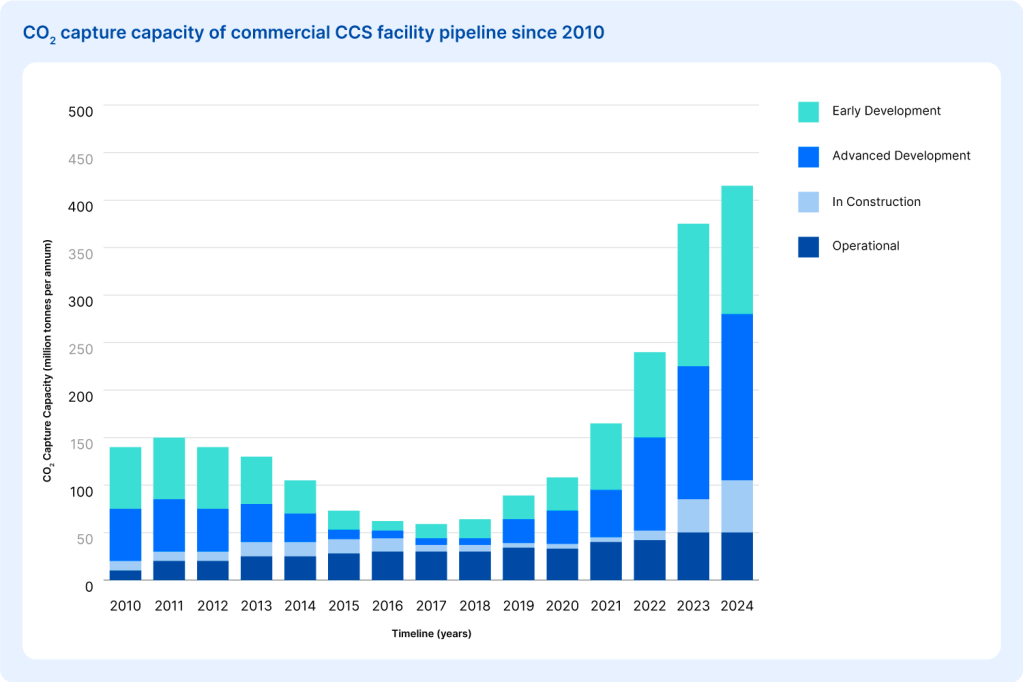
Now the dynamics have shifted. CCS projects are growing at record rates. The technology continues to improve, economic incentives have aligned and the growth of AI and data centers has increased demand. The critics have not been mollified, but the momentum is with the industry — suggesting that any company with hard-to-abate emissions in its supply chain should engage with the arguments.
“It’s been like a snowball rolling down a hill in terms of corporate interest and investment in the sector,” said Jessie Stolark, executive director of the Carbon Capture Coalition, an industry group.
Global growth
CCS offers a seemingly simple decarbonization solution: Rather than replace coal power stations, steel plants and other facilities that rely on fossil fuels, why not capture and store the carbon dioxide that the infrastructure emits? In many cases, this involves pushing the gas over an absorbent material, compressing the captured CO2 and piping it to a geological reservoir for permanent storage.
The idea is simple, but during the first half of the 2010s high costs and technological setbacks led to a decline in the capacity of projects in development. Then the tide turned. A federal CCS tax credit, known as 45Q, was made more valuable in 2018 and more valuable still, as part of the Inflation Reduction Act, in 2022. The number of projects operational or in development globally grew from 392 to 628 between 2023 and 2024, according to the Carbon Capture Coalition. The U.S. is the leader, with more projects than the next four countries — the U.K., Canada, Norway and China — combined.
Source: Carbon Capture Coalition
The Louisiana Clean Energy Complex, a hydrogen production facility under construction in Ascension Parish, illustrates the trend. Air Products, the industrial giant behind the project, says that 95 percent of the 5 million tons of CO2 emitted annually by the facility will be captured and stored, which the company claims makes it the world’s largest capture and permanent sequestration project.
Air Products did not return a request for more information, but an analysis published this month by the capture coalition puts capture and storage costs at between $100 and $200 per ton of CO2. The exact price depends on the maturity of the technology used and the concentration of the gas in the waste stream, with higher concentration streams — which includes hydrogen facilities — tending to have lower costs.
More million-ton projects
Other huge projects are coming soon. In early April, a consortium of companies announced plans for an ammonia plant, also in Ascension Parish, that will capture and store more than 2 million tons of carbon dioxide annually. (The parish is part of “Cancer Alley,” a heavily industrialized area with elevated rates of the disease.) Two weeks later, ExxonMobil revealed plans to capture 2 million tons of CO2 from a natural gas power plant near Houston, Texas.
The bullishness of CCS investors is also evident at the 140,000 square-foot factory opened in Burnaby, British Columbia earlier this month by Svante, a manufacturer of filters that capture carbon dioxide from industrial emissions.
The factory can produce enough filters to capture 10 million tons of CO2 annually and its opening follows a $145 million investment round for the company. A confluence of factors is driving the industry forward, said Claude Letourneau, Svante’s CEO, including tax credits and the green premium that some manufacturers can charge for low-carbon commodities, such as hydrogen.
Smaller companies with innovative solutions are waiting in the wings, hoping to ride the industry’s momentum. Carbon Clean, a London-based startup, has designed a capture unit that fits into a shipping container, which it says is half the size of conventional systems.
“The biggest challenge for implementing carbon capture is the real estate,” said Aniruddha Sharma, Carbon Clean’s CEO “Nobody has any space.” Following a successful test at a fertilizer plant in Abu Dhabi, the company is now working on further tests in Saudi Arabia and Canada.
Companies that have emissions from hard-to-abate sources — fertilizer, steel, cement — in their Scope 3 inventory stand to benefit from the reductions that CCS brings. And there are other reasons for sustainability professionals to track the technology, noted Sangeet Nepal, a technology specialist at the Carbon Capture Coalition.
The rising demand for uninterrupted supplies of low-carbon electricity can be met by gas power plants with CCS attached, for example. In December, ExxonMobil announced plans to build a gas and CCS facility in Texas to supply low-carbon electricity to nearby data centers.
CCS technology is also opening up new classes of carbon credits.
Svante is targeting its technology at pulp and paper facilities, some of which are using credit revenue to fund the installation of carbon capture. One recent project was funded by a purchase by Microsoft of credits covering 3.7 million tons of carbon dioxide over 12 years.
Criticisms linger
This progress has changed the narrative around CCS, but it has not altered the opinions of critics. They continue to question the calculations that underlie the claimed climate benefits of CCS, notably around the issue of where to draw boundaries when assessing the impact of the technology.
CCS equipment requires energy, for instance. Most developers hope to use renewables, thus avoiding additional emissions. But there’s an opportunity cost in doing so because those renewables could be used to replace fossil power plants, argued Mark Jacobson, an energy systems expert at Stanford University.
“You can’t just add things to the grid willy nilly,” said Jacobson. “There’s a queue. If you’re adding stuff and using it for carbon capture, you’re not replacing fossils on the grid.”
In one recent study, Jacobson and colleagues compared global decarbonization scenarios in which renewables were used to power either CCS or electrified versions of industrial facilities. After accounting for health costs due to air pollution from continued use of fossil fuels, along with other factors, they found that annual costs in the CCS scenario were at least nine times greater than the electrification alternative. Because CCS systems do not capture all the carbon dioxide that passes through them, atmospheric levels of the gas were also much higher.
Jacobson’s study is global in scope, but individual projects have also been criticized, including Air Products’ hydrogen facility in Louisiana. In a study published in March, researchers at the Institute for Energy Economics and Financial Analysis, a think tank, claimed that the benefits of the project rest on faulty assumptions about the amount of carbon that will be captured, leak rates of the methane feedstock and other factors. Once the assumptions are corrected, claims the institute, the project becomes a heavy emitter.
Just 10 years ago, debate of this nature played a role in slowing the deployment of CCS. But there is a sense among industry insiders that things have changed. The financial case for the technology has been rewritten. And while the Trump administration appears to have no interest in tackling climate change, backing from oil majors and GOP members in states that house capture projects means that CCS might be one decarbonization technology it can get behind.
“We are making the case,” said Stolark, “and we feel that carbon management squarely fits within this administration’s energy dominance framework.”
https://sustainable-future.org/wp-content/uploads/2025/03/cropped-trellis_favicon_180x180.png3232sustainablefuturehttps://sustainable-future.org/wp-content/uploads/2024/06/Untitled-design-117-300x94.pngsustainablefuture2025-05-27 14:26:562025-05-28 08:15:41Carbon capture hits a growth spurt as financial and other factors align
As you sip your morning coffee, you may not be aware that it could be harder to get that fresh cup in the near future. That’s because some studies suggest a 50 percent reduction in the number of regions suitable to grow coffee in the next two decades due to climate impacts.
Food and agriculture companies are on the frontline of being affected by extreme weather. From impacts on crops, human productivity and animal welfare concerns to plastic packaging bans and human rights issues, agricultural companies face many challenges in their supply chains.
Investments in sustainability to address these issues are not only critical to the financial performance of food and agriculture companies, but essential to their ability to produce and sell products and services globally.
In a recent study by the NYU Stern Center for Sustainable Business (CSB) and Deloitte, researchers found the sector’s investments in tackling material sustainability challenges can drive margin improvements through cost reductions and revenue increases. The study analyzed 12 Return on Sustainability Investment (ROSI) sustainability strategies and surveyed 350 global food and agriculture executives across key segments of the value chain: processing, manufacturing, food services, restaurants and retail. The research highlights the main drivers of revenue growth at each step in the value chain, driven by consumer demand and strengthened through cross-chain collaborations.
A primary motivation: Reduce downside risk
In the survey, 79 percent of respondents reported revenue growth of more than 2 percent from investing in sustainability strategies, and 74 percent saw cost reductions of more than 2 percent. When asked where this value was realized, about 40 percent of companies said their primary motivation for these investments — both within their own operations and those of their suppliers — was to reduce downside risk.
However, many also saw unexpected benefits. At least 35 percent reported improvements in sales and marketing, operational efficiency and supplier relations. For instance, a major food processor that invested in sustainable palm oil sourcing — ensuring compliance with “No Deforestation, No Peat, No Exploitation” policies and improving traceability — achieved both risk reduction and business gains, ultimately realizing a 10-year net benefit of $72 million.
Consumer demand increases
Revenue gains from sustainability aren’t limited to upstream operations. According to CSB’s 2024 Sustainable Market Share Index, consumer packaged goods (CPG) with sustainable attributes accounted for 23.8 percent of market share — an increase of 9.2 percentage points since 2013.
These products are growing faster than their conventional counterparts, with a five-year compound annual growth rate of 12.4 percent, nearly double the 6.8 percent growth rate of the overall CPG market, despite carrying an average price premium of nearly 27 percent. In the food and beverage category specifically, the sustainability premium is even higher — by nearly 10 percent in 2023 — with certain products such as coffee and yogurt commanding premiums of 60 percent and 46 percent, respectively, according to the latest data available.
Highlighting the stakes, a senior vice president within the dairy industry noted, “If we don’t implement practice changes for lower-carbon milk, then our long-term penalty would be much greater because there won’t be a place on shelves for our product.”
Value chain collaboration
The food and agriculture industry is one of the biggest greenhouse gas emitters globally and its supply chains are very complex. This means that different sustainability strategies will have varying relevance for value chain segments. For example, processors selected improving food loss and waste management as a top strategy contributing to revenue increases, while retailers selected sustainable packaging solutions.
However, there are shared priorities that can foster collaboration across supply chain segments. For instance, sustainable and responsible sourcing ranked among the top three cost-reducing strategies in four out of five segments analyzed. Retailers were the exception — they didn’t list it as a top cost-saving measure, but did rank it as a leading strategy for generating revenue.
Considering this, it’s not surprising that 84 percent of survey respondents reported they’re co-investing to fund sustainability initiatives within the value chain. Our results found a positive association between companies that engage in pre-competitive collaboration and/or external partnerships and those that realized more than 5 percent revenue growth.
The future of food
The future of food and its enabling enterprises are dependent on continued access to water, nutrient-rich soil and labor. Robust, well-funded sustainability strategies are critical to maintain these valued resources and to provide opportunities for even greater financial performance. Our research suggests four steps for the industry include:
Act and adapt: Strategically position the company for the future with the agility to adapt to the changing landscape.
Drive progress in the face of uncertainty: Implement sustainability strategies because it’s good business and captures benefits well ahead of regulatory and reporting mandates.
Invest in enabling the environment: Create internal infrastructure to support the success of key initiatives.
Pursue collaboration: Identify the opportunities for co-investment and pre-competitive collaboration to capitalize on synergies in the value chain.
Investing in sustainable and regenerative agriculture practices can enable companies to build more resilient and sustainable food systems that protect the future of their business, the environment and the availability of nutritious products for generations to come.
https://sustainable-future.org/wp-content/uploads/2025/03/cropped-trellis_favicon_180x180.png3232sustainablefuturehttps://sustainable-future.org/wp-content/uploads/2024/06/Untitled-design-117-300x94.pngsustainablefuture2025-05-27 10:00:002025-05-28 08:15:41Sustainable food and ag practices lead to revenue growth for more than 70 percent of companies
The Greenhouse Gas Protocol is considering emissions accounting rule revisions that will make the process of claiming reductions from corporate renewable energy contracts more complicated, especially for companies with smaller electricity loads or highly distributed operations, according to those with knowledge of the discussions.
The GHG Protocol is the nonprofit that manages the guidelines that 97 percent of companies use to calculate and report on greenhouse gas emissions. Many of its rules are being overhauled after a major call for feedback two years ago, including the one covering Scope 2, emissions associated with energy purchases.
Many clean energy buyers agree that an update is overdue: the Scope 2 guidance was originally created in 2015. Those familiar with proposed changes in the current revision, however, worry that making them mandatory will make it tougher for corporate buyers to justify new deals.
Two influential trade groups, the Clean Energy Buyers Association (CEBA) and the American Council on Renewable Energy (ACORE), sent letters to the chair of the GHG Protocol’s standards board urging it not to make the revisions too strict.
“The Clean Energy Buyers Association is deeply concerned with the current direction of the Scope 2 guidance revision process,” the organization’s CEO, Rich Powell, said in a two-page letter, made public May 23. “If the process stays this course, we fear that many corporate clean energy buyers may pull back on investments in clean energy.”
ACORE’s six-page missive, dated April 25 (shared with Trellis but not made public), sounds a similar alarm: “At a time when clean energy companies face significant global and domestic headwinds, an overly restrictive approach for GHG reporting requirements that shrinks the number of voluntary purchasers could be a breaking point for many companies in the clean energy market.”
Why the guidance matters
The current Scope 2 rule lets companies claim emissions reductions by buying enough renewable energy certificates from solar, wind and other zero-carbon sources to match their annual electricity load in the same broad market. For example, a company could claim credits from a wind farm in Nebraska or solar installation in Texas to reduce its U.S. emissions, regardless of where their operations are located.
This framework has inspired hundreds of corporations to sign contracts that put more than 100 gigawatts of clean electricity on the U.S. grid since 2014 — 21.7 gigawatts in 2024 alone.
Both supporters and critics of the methodology say an update is long overdue, and welcome changes that would give corporate claims about renewable electricity purchases more integrity.
“There is a lack of rigor in the current rules,” said Lee Taylor, CEO of REsurety, a firm that facilitates transactions. “The gaps between the dirtiest grids and the clean ones is getting bigger. The carbon intensity of grids is changing. That reality has been true for some time and it’s only growing.”
One revision being considered would require big energy consumers to match actual electricity loads to renewable sources on an hourly basis; those using less than 5 gigawatt-hours per year could still report on a monthly or annual basis.
Another potential modification would narrow market boundaries, requiring companies to make their renewable energy purchases on the same regional grids that serve their physical locations.
Alongside the bigger changes, a subgroup is debating metrics to recognize corporate deals that are “consequential.” That might include, for example, providing a way to account for energy storage installations or to recognize contracts that add more renewables in places where grids are heavily dependent on fossil fuels, even if the buyer doesn’t have a physical presence there.
GHG Protocol declined to comment on the record, citing the ongoing nature of the process.
What buyers would like to see
Corporate renewable buyers, speaking on background, suggested that the future rules be tiered and some elements made optional. This would give sophisticated buyers a framework for making more specific emissions reduction claims without discouraging companies with smaller loads or that are new to corporate renewable procurement from participating, they said.
“I do think the next phase of procurement needs to be more meaningful than just an annual match and putting it wherever the economics make sense,” said Joey Lange, senior managing director for global renewable energy advisory services at consulting firm Trio. “But you can’t penalize the companies that played by the rules to begin with.”
If GHG Protocol makes the suggestions for more hourly matching and narrower market boundaries mandatory, a majority of CEBA’s 400-plus members would face “serious implementation challenges,” the organization said in its letter. “These accounting changes would fundamentally change the practical context of voluntary procurement.”
A separate survey of clean electricity practitioners conducted between November and February underscores CEBA’s position: 80 percent “lacked confidence” they would be able to comply with scenarios being considered.
“There are companies that feel stuck,” said Roger Ballentine, president of consulting firm Green Strategies, which conducted the survey. Uncertainty over both the rule change and broader macroeconomic conditions is paralyzing the market, he said: “If they want to execute a big deal, are they sure that deal will be okay? It really makes it very tough on procurement people to decide what they should do right now.”
Both CEBA and ACORE urged the GHG Protocol standards board to seek more input from corporate practitioners and renewables developers as the technical working group finalizes its draft. Some of their ideas:
Solicit more feedback from corporate practitioners.
Address concerns of renewable energy buyers before a draft is finalized for public consultation.
Accelerate development of metrics for “consequential” deals, so they are aligned with the broader Scope 2 changes.
Offer more clarity immediately about how existing contracts will be recognized, so companies don’t postpone new contract negotiations.
Make some of the stricter proposed revisions optional.
GHG Protocol is expected to publish a draft outlining high-level changes to Scope 2 in the fourth quarter of 2025. Revisions based on that feedback will be circulated in 2026, according to the GHG Protocol website. A final draft isn’t anticipated until 2027, and it’s likely that there will be a grace period before the changes take effect.
https://sustainable-future.org/wp-content/uploads/2025/03/cropped-trellis_favicon_180x180.png3232sustainablefuturehttps://sustainable-future.org/wp-content/uploads/2024/06/Untitled-design-117-300x94.pngsustainablefuture2025-05-23 12:30:002025-05-23 18:08:49What renewable energy buyers should know about proposed Scope 2 accounting changes
When it comes to climate change, the notion that younger generations are more hopeful than older cohorts may not be true.
Recent research from Trellis data partner GlobeScan and brand consultancy BBMG shows there’s a large contrast between younger and older generations when it comes to feeling concerned about climate change. Gen Z is disproportionately carrying the personal and emotional burden of the climate crisis, with more than seven in 10 Gen Z survey respondents saying they’re extremely worried about current and future harm to the environment caused by human activity and climate change.
Along with Millennials, Gen Z is the most likely to say they’re “greatly affected” by climate change, with 49 percent feeling the effects personally compared to just 38 percent of respondents who are Baby Boomers and older. Nearly four in ten (38 percent) Gen Z respondents also reported feeling stressed or anxious most or all of the time — more than double the rate among the oldest generations (17 percent). In short, Gen Z is carrying the emotional weight of the climate crisis more heavily than any other age group.
What this means
The research shows growing disengagement among Gen Z and sustainability professionals can’t afford to leave them feeling hopeless. In addition to feeling more personally affected by climate change than older generations, many are pulling back from sustainable behaviors, asking not how to help, but why they should bother. This isn’t just a moment of doubt — it’s a generational crisis of confidence. The emotional toll is high, the complexity feels overwhelming and the perceived lack of progress is fueling apathy and withdrawal.
This is a call to action for brands, governments and institutions: Gen Z doesn’t need empty promises — they want to see real progress. If sustainability leaders want to re-energize the most climate-conscious generation, they must create meaningful pathways for agency, hope and impact before the disengagement becomes permanent. Several ways to do this include:
Lead with truth: Face challenges with radical honesty and bold imagination.
Make power personal: Focus on small actions, immediate feedback and clear impact that boosts self-efficacy and unlocks momentum.
Create connection loops: Build new relationships between people, products and planet to transform sustainable living into meaningful community.
Invite joy: Enhance positive emotions to make sustainability a source of wellbeing and joy.
Weave new stories: Honor reality and aspirations into new narratives to make sense of today and show what’s possible tomorrow.
Based on a survey of more than 30,000 people in 31 markets July-August 2024.
https://sustainable-future.org/wp-content/uploads/2025/03/cropped-trellis_favicon_180x180.png3232sustainablefuturehttps://sustainable-future.org/wp-content/uploads/2024/06/Untitled-design-117-300x94.pngsustainablefuture2025-05-23 10:00:002025-05-23 18:08:49Why climate anxiety is hitting Gen Z the most and how brands can respond
Microsoft, which usually leaves buying construction materials to its contractors, has signed a long-term contract to buy low-carbon cement by startup Sublime Systems. It will use a new form of environmental credits related to that purchase to claim emissions reductions related to data center construction.
Under the deal, announced May 22, Microsoft will claim 622,500 metric tons of emissions reductions over a six-to-nine-year period against its Scope 3 footprint — which accounted for 96.5 percent of the technology company’s total footprint in its 2023 fiscal year.
For perspective, Microsoft used 605,000 carbon credits that year to make its carbon neutral claim. It has also purchased credits for close to 20 million tons of carbon removal.
Microsoft plans to use Sublime’s cement in data centers, infrastructure and offices wherever geographically possible. Most cement is used within a few hundred miles of where it is produced.
Microsoft’s footprint rose 31 percent between 2020 and 2024, largely because of data center expansion. Concrete and steel are carbon-intensive materials that together contribute 13 percent of global carbon dioxide emissions. With much ado being made about the huge energy appetite of data centers that fuel artificial intelligence, Amazon, Google and Microsoft are all seeking ways to address their construction-related emissions.
Sublime uses an electrochemical process instead of a combustion-driven kiln to manufacture a replacement for ordinary portland cement. The company, spun out of research at the Massachusetts Institute of Technology, has raised $200 million. That includes funding from venture capital firms including The Engine, Lowercarbon Capital and Energy Impact Partners, along with an $87 million award by the Department of Energy in 2024 — funding that so far has not been affected by the Trump administration’s shifting priorities.
“We see a big opportunity to both domesticate and modernize U.S. cement making,” said Sublime CEO and Co-founder Leah Ellis. The U.S. imports more than 20 percent of its cement, and Sublime’s technology could change that locus. Two factories in the Northeast have closed in the past 18 months because of outdated technologies.
Microsoft is the anchor customer for Sublime’s first commercial facility being built in Holyoke, Massachusetts, slated to begin deliveries in 2028. One of the biggest construction companies in the Northeast, Suffolk, announced a $3 million investment on May 21 to buy cement from the factory.
“Sublime’s mission is no less than fundamentally reshaping a cornerstone of the global built environment landscape, and we are proud to support them through our capital, our network and our commitment to building a more sustainable world,” said Jit Kee Chin, executive vice president and chief technology officer for Suffolk’s investment arm, Suffolk Technologies.
Bags of Sublime’s low-carbon cement.Source: Mikhail Glabets Photography
Credits for low-carbon cement and steel
Terms of the Microsoft-Sublime deal weren’t disclosed, but the company is positioning the contract as a way to provide early demand signals for the startup’s first factory, which will produce about 30,000 tons of cement annually. “Microsoft is a market maker,” Ellis said.
Sublime’s first commercial deliveries are slated for 2028; the startup hopes to support a full-scale facility with a capacity of 1 million tons potentially by 2030, she said.
Microsoft is using a new category of environmental attribute certificate (EAC) for concrete and steel to justify its investment. The certificates are legal mechanisms companies use to calculate emissions reductions. One common type is renewable energy certificates, which many businesses use to offset emissions from purchased electricity.
Environmental attribute certificates are used to spur investments in technologies that decarbonize hard-to-abate sectors including aviation, freight rail and maritime shipping. The new ones that will be issued under the Microsoft-Sublime deal are based on a methodology Microsoft developed with carbon management consulting firm Carbon Direct.
“While we prioritize deploying physical material whenever possible, this EAC approach helps both buyers and sellers overcome geographic, supply chain, cost and other barriers that make it challenging to introduce new technologies,” said Katie Ross, director of carbon reduction strategy and market development at Microsoft.
Goal: Scale availability of low-carbon cement
Microsoft’s purchases will be independently verified, although the details of how that will happen haven’t yet been determined, said A.J. Simon, director of industrial decarbonization at Carbon Direct. The certificates will be managed by a book and claim system, similar to what’s in place for sustainable aviation fuel.
The methodology published as a guide for other companies recommends that certificates be vetted using seven criteria, such as whether purchases will complement direct procurement of steel, cement and concrete.
“The intention is to set high-integrity standards for commodity EACs that will improve confidence in this mechanism,” Simon said. “The thresholds for quality in the report reflect Microsoft’s decarbonization; other companies may decide to weight the criteria differently.”
The prepurchase commitments made possible by the EACs act as accelerants for startups, Ellis said. Despite uncertain macroeconomic conditions, Sublime isn’t making big adjustments, and it’s working closely with three of the world’s largest cement producers — Holcim, Amrize and CRH — to focus on the long term. “This isn’t an industry that pivots quickly,” Ellis said.
[Connect with more than 3,500 professionals decarbonizing and future-proofing their organizations and supply chains through climate technologies at VERGE, Oct. 28-30, San Jose.]
https://sustainable-future.org/wp-content/uploads/2025/03/cropped-trellis_favicon_180x180.png3232sustainablefuturehttps://sustainable-future.org/wp-content/uploads/2024/06/Untitled-design-117-300x94.pngsustainablefuture2025-05-22 14:48:422025-05-22 18:08:53How Microsoft’s deal with a low-carbon cement startup will cut its data center emissions
PepsiCo has watered down a suite of key climate, water and packaging commitments, citing a lack of system-wide investment in cleaner technologies and support from policymakers as reasons for the shift.
The company is viewed as a leader in some areas of sustainability, having set a science-based target in 2016 and upgraded the ambition of that target in 2020. And the company’s Climate Transition Plan, released today, reveals areas of solid progress: A commitment to scale regenerative agriculture, for example, has been increased from 7 to 10 million acres by 2030. But several other targets have been revised downward.
The changes are necessary because policies to support sustainability and outside investment in clean technologies have not progressed as fast as was anticipated, Chief Sustainability Officer Jim Andrew told Trellis. “We can advocate, we can collaborate, we can work to try and move forward,” he said, “but there’s only so much that we can do.”
Climate
Interpreting PepsiCo’s new emissions reductions targets is complicated by the company’s decision to move its baseline year from 2015 to 2022. Trellis has attempted to clarify the change by pegging the new commitments to the original 2015 baseline.
Scope 1 and 2: The company’s original goal of a 75 percent cut by 2030 has been changed to 61 percent by the same year. In 2022, these emissions made up 8 percent of PepsiCo’s total emissions of 54 million metric tons of carbon dioxide equivalent.
Scope 3: A targeted 40 percent cut by 2030 has been split into two commitments. Emissions from land use, which constitute almost a quarter of the total, will be downgraded to 27 percent by 2030. The target for other Scope 3 categories, including transportation and purchased goods, remains unchanged.
Net-zero: The target date of 2040 has been pushed back to “2050 or sooner.”
Despite the changes, the goals are aligned with a pathway that limits global temperature increases to 1.5 degrees Celsius and have been validated by the Science Based Targets initiative, the company said.
Packaging
Many major companies, including the Coca-Cola Company, PepsiCo’s long-time rival, have recently backtracked on packaging commitments. PepsiCo’s latest targets add to that list.
Virgin plastic: PepsiCo originally targeted a 20 percent reduction by 2030 in the amount of virgin plastic from non-renewable sources it uses in its packaging, relative to 2020. By 2023, the amount had grown by 6 percent. The company’s new goal is a 2 percent year-on-year reduction through 2030.
Recycled content: A commitment to using 50 percent recycled content in plastic packaging by 2030 has been changed to 40 percent by 2035.
Reusables: A goal of delivering one in five beverage servings through reusable models by 2030 has been abandoned, but the company will continue to explore reuse opportunities and report on its progress qualitatively.
Water
This area of work contains a couple of bright spots for PepsiCo: The company achieved its 2025 goal of improving operational water-use efficiency by 25 percent in high water-risk areas two years ahead of schedule, and retained its commitment to becoming net water-positive by the end of the decade.
On two more granular targets, however, it released less ambitious commitments. The company had committed to reaching “best-in-class” water-use efficiency by 2030, defined as using 1.2 liters of water for every liter of beverage and 0.4 liters for every kilogram of food. It’s now striving for “average” efficiency, defined as 1.4 liters/liter for beverages and 1.7 liters/kilogram for food.
System-wide headwinds
The altered targets were necessary because the broader business climate does not support more ambitious measures, Andrew said. Many of the targets were set around 2020. Expectations at the time about investment in clean technologies and associated policy support have not panned out as hoped, he argued, undermining the company’s ability to stay on track.
“At the time, 2020, the world was a different place,” said Andrew. “There were all sorts of things that in the fullness of time people have learned are going to take longer.”
Electric vehicles are one example cited by Andrew, who noted that cost-competitive EVs don’t exist for some of PepsiCo’s transport needs. “Charging infrastructure doesn’t exist in all the places that you would want,” he added.
On the packaging side, progress in some regions has been stymied by a lack of regulation. India only began to allow recycled material to be used in food-grade packaging in 2023, Andrew noted, and China has still not made the move. “There’s a whole set of policy issues,” he said.
[Join more than 5,000 professionals atTrellis Impact 25 — the center of gravity for doers and leaders focused on action and results, Oct. 28-30, San Jose.]
Monetizing reforestation and other nature-based carbon removal projects is hampered by the difficulty of verifying outcomes such as soil carbon absorption across vast swaths of land and over multiple years. “Accountability is vital for the success of nature-based solutions,” states the Nature-based Solutions Initiative.
Now, AI’s firepower as a problem solver for a host of business challenges because of its ability to analyze — and act on — large amounts of data is being harnessed to provide an answer.
Canadian startup veritree is applying AI to nature-based solutions and carbon credits. Founded in 2022 as a spinoff from apparel company tentree, veritree provides an AI- and blockchain-enabled platform that connects businesses to about 50 nature-based projects in North America and Africa that use geo-sensors, computer vision cameras, satellites and on-the-ground monitoring to track changes.
The sensors and monitors feed data into the veritree AI platform, which then reports progress on such metrics as carbon sequestration and species replenishment.
Businesses using veritree’s solution for AI-verified restoration projects include Samsung, ASML, Hopper, Sunrun and GreenFi in a list that has grown to 300 companies in three years. As of mid-May, those businesses have connected with reforestation projects to plant 100 million trees, according to the company.
Veritree closed a $6.5 million Series A funding round last week led by Pender Ventures and plans to use the capital to roll out projects in Latin America and integrate more auditing technologies into its platform.
“They come to us because their investors want to see progress audited and verified,” said Derrick Emsley, CEO and co-founder of veritree. “Confidence is one of the critical aspects that’s missing in this space right now, particularly in nature-based projects. Our platform is a utility for making sure that the projects that need to be funded have high-quality outcomes.”
The veritree platform “brings accountability to a space that’s long needed it,” said Pender Ventures Partner Isaac Souweine, in a statement as veritree announced its Series A round.
Mangroves in Madagascar
Ever since COP 27 in Egypt in 2022, nature-based solutions have been held up as essential to the climate struggle: reaching Paris goals requires not only reducing emissions but removing carbon already in the atmosphere. Moreover, widespread drought and biodiversity loss have led to a society-wide wake-up call about the need to protect nature.
Some of veritree’s customers, such as GreenFi and Hopper, have built brands around restoring nature. Others have climate goals embedded in strategy, such as ASML, the photolithography chip company, or Samsung, its first customer, which turned to veritree for a carbon sequestration project that replanted 2 million mangroves in Madagascar. Veritree has been named by Deloitte, Forbes and Fast Company as a tech company to watch.
Other companies are also turning to AI technologies for similar purposes: Cultivo gathers data from geo-sensors, satellites and ground-monitoring devices to track progress on nature-based carbon credits, which it lists on the Verra registry of voluntary carbon credits. Blue Sky Analytics offers data-collecting satellites with remote sensing technology to monitor nature-based projects.
Still, the market for nature-based carbon credits is much smaller than the need. According to the U.N. Global Compact and the Intergovernmental Panel on Climate Change, nature-based solutions could provide about a third of the reductions in greenhouse gas emissions needed to reach 2030 Paris goals. Yet, they receive less than 3 percent of global climate funding, said the Boston Consulting Group. A great deal of skepticism persists about voluntary carbon markets because of a lack of confidence in the outcomes. Thus the need for verifiable impact.
AI capital flows elsewhere
To date, AI’s entry into the sustainability world has mostly been in energy optimization.
Certain sustainability problems are such costly bottlenecks that investors know there’s a bankable business case for them. The years-long process of integrating renewable energy projects onto electric grids and optimizing grid efficiency are two such problems. This spring, National Grid Partners announced a $100 million investment in AI startups focused on electric grid efficiency, including AiDASH, Exodigo, Luminance, Sensat and Urbint. Last fall, KKR and Energy Capital Partners announced plans to invest $50 billion in renewable power generation to accelerate AI growth.
Another driver of applying AI to energy optimization is that AI’s huge energy demand is influencing infrastructure decisions, a case of “the tail wagging the dog,” Gupta said in an interview. AI proponents who care about climate want to streamline energy use while investing in AI.
About 2,600 gigawatts of renewable energy is waiting to be connected to U.S. electricity grids, an amount that’s double the existing grid capacity, Ajay Gupta, founder of venture capital firm CLAI vc and a fellow at Stanford University’s Distinguished Careers Institute, noted during San Francisco Climate Week. He listed Rhizome Data and Tapestry at Google X as AI startups trying to address bottlenecks and grid resiliency.
Veritree’s work fits the bill, said Souweine. “Veritree is solving one of climate-tech’s biggest blind spots — trust in nature-based solutions.”
[Join a vibrant community of leaders and innovators driving cutting-edge tools, business strategies, and partnerships to protect and regenerate nature at Bloom, Oct. 28-30, San Jose.]
https://sustainable-future.org/wp-content/uploads/2025/03/cropped-trellis_favicon_180x180.png3232sustainablefuturehttps://sustainable-future.org/wp-content/uploads/2024/06/Untitled-design-117-300x94.pngsustainablefuture2025-05-21 20:50:082025-05-22 18:08:55AI’s latest field to boost: nature-based solutions