Legal scholars are raising the alarm about the European Union’s (EU) decision to weaken its corporate sustainability disclosure, saying that it could well expose companies to climate-related lawsuits.

Thirty-one academics from University of Oxford, University of Cambridge, Utrecht University and other institutions signed on to a letter warning that the EU’s February 2025 Omnibus proposal to scale back the requirements and guidance of the Article 22 Corporate Sustainability Due Diligence Directive (CSDDD) is sure to cause chaos. Specifically, the signees believe that lighter reporting obligations for emissions and more variance in the requirements among EU member states, can only increase reporting mistakes — and, in turn, climate-related litigation.

“If you do not have Article 22 CSDDD, then it is quite unclear what is being expected of companies,” said Associate Professor Thom Wexter of Oxford’s Faculty of Law. “And if [EU member states] don’t capture corporate emissions within their legislative framework, they’ll miss a huge part of their economy.”

This is what organizations in the EU — or doing business within it — need to know about the proposal.

Context and clarification

In the past couple of years, the EU has introduced a pair of complementary regulations to standardize sustainability reporting for corporations:

  • CSRD, or Corporate Sustainability Reporting Directive, which requires companies to disclose Scope 1, 2 and 3 data; and
  • CSDDD, which assesses the impact and inherent risk posed to humanity and the environment by corporate operations and supply chains.

Prior to the Omnibus proposal, CSDDD required companies to “put into effect” a climate transition plan. But now that language will be removed, and that change, the experts argued, falls short of mandating implementation.

Industry appears to favor both CSRD and CSDDD in their original forms. A survey conducted by professional association WeAreEurope found that only 25 percent of responding companies approve of the changes proposed in the Omnibus package.

Obligations will not be met

The European Court of Human Rights ruled in 2024 that all 27 EU member states are obligated to “adopt, and to effectively apply in practice, regulations and measures capable of mitigating the existing and potentially irreversible, future effects of climate change.” But, the letter writers noted, emissions from the largest corporations in each country “are so significant that they are bound to exceed their territorial emissions budgets.”

More to the point, they predict that the differing expectations set by the law of each country and the EU will open up corporations to lawsuits should they fail to comply with either.

Internal market fragmentation

An international human rights case, Milieudefensie et al v. Shell, was the impetus for the creation of CSDDD. In November 2024, the Hague Court of Appeals ruled that Shell was obligated to reduce its emissions. Without any form of guidance, though, there was no way to hold the company accountable.

“Shell complained that the decision only affected them,” said Wetzer. “They were saying it would be much better if the obligation applied across the [entirety of] the economy.” Article 22 and CSDDD were implemented to legally enforce standards across all member states that corporations could use as a baseline.

But now, if the overarching regulatory framework of CSDDD were to be lost, companies would be held to standards imposed by each member state. “A growing number of companies are being sued in court for causing harm, which may be the consequence of the lack of clear regulatory requirements,” noted an assessment by the EU Commission. These companies currently include TotalEnergies, ENI, VW, BNP Paribas, and ING, among others.

“The litigation is going to rise, country by country, to companies operating in different parts of the EU,” said Wetzer.

Encouraging empty promises

CSRD compliance complements CSDDD, but when one is weakened, the symbiotic relationship crumbles. Prior to the Omnibus package, CSRD required transparency in the creation of climate transition plans, and CSDDD insured implementation of those plans. If CSDDD were no longer to require plan implementation, companies with unrealized plans could be accused of greenwashing.

“Without [CSDDD] obligation, there is a risk of encouraging empty promises,” the letter stated. And that could lead to lawsuits regarding misrepresentation.

No guiding regulations will increase costs

The 31 legal scholars are not the only ones who believe that companies that don’t fully commit to climate transitions now will only be creating more work and exposure to financial risk for themselvesin the future.

KPMG U.S. Sustainability Leader Maura Hodge previously told Trellis that regardless of legislative rollbacks, companies should continue to move forward on all emission inventory and mitigation plans, adding the reminder that U.S. state corporate compliance laws, like California’s, still stand.

[Connect with more than 3,500 professionals decarbonizing and future-proofing their organizations and supply chains through climate technologies at VERGE, Oct. 28-30, San Jose.]

The post EU’s Omnibus package heightens legal risk for companies appeared first on Trellis.
The race to commercialize apparel recycling is heating up. On May 20, Reju, a startup within a Dutch engineering and fossil fuel company, announced plans to build a polyester recycling plant in the Netherlands. Its projected annual output: 300 million articles of clothing.

Since its launch 18 months ago, Reju has opened a “Regeneration Hub Zero” demonstration plant in Frankfurt, Germany, which is expected to officially come online this year. The company has also inked partnerships with textile collectors and sorters and spoken with more than 100 brands and retailers to drum up interest for its Reju Polyester product, according to CEO Patrik Frisk.

“We are talking to everybody in the American market, and everybody in the European market,” said Frisk, a former Under Armour chief executive with decades at brands including The North Face, Timberland and Gore-Tex.

The global popularity of polyester, brewed from the fossil fuels that have hastened the climate crisis, has skyrocketed in recent decades, featuring in two-thirds of new clothing. The world churns out 33 million metric tons of plastic-based fibers each year. Only 3 percent gets recycled, according to the Ellen MacArthur Foundation

The waste is a mounting problem for the fashion brands and retailers that are gradually being forced to deal with their materials after end of use, thanks to extended producer responsibility (EPR) regulations in the European Union and California.

Competition

Numerous ventures are throwing fortunes and bold claims behind creating a circular economy for polyester that treats tossed-out textiles as a commodity rather than a liability.

One Reju competitor, Circ, based in Danville, Virginia, shared plans on May 19 to build a $500 million polyester recycling plant in France, backed by the French government and the European Union. Its recycled fibers have appeared in clothes by Zara, Patagonia, H&M and Levi’s.

Ambercycle and Worn Again Technologies also break down mixed textiles, such as the polyester-cotton blends ubiquitous to T-shirts, into raw material for new clothes.

A family affair

One thing that sets Reju apart: family connections. Its parent company, Technip Energies, has been in the polyester business for nearly 70 years. Its technology appears in 40 percent of the world’s 370 steam crackers, the industrial plants cranking out ethylene, a building block of polyester. TEN Zimmer, which Technip bought in 2015, processes polyester and nylon, another recycling frontier for fashion. One thousand polyester plants around the world use its technology.

Technip Energies, which today has a 17,000-person workforce, was formed in 2021 as a spinoff of TechnipFMC, which was created in 2017 when Technip and FMC Technologies merged. Technip Energies’ origins reflect the evolution of the oil and gas industry. In 1958, Technip took shape under the French Petroleum Institute, or IFP, in Paris. FMC Technologies originated in 1883 as an insecticide maker. 

Reju, founded in 2023 and employing 75 workers so far, is part of Technip Energies’ attempts to transition to a lower-carbon future. Those attempts also include investments in blue hydrogen, carbon capture and storage and recycled and biobased chemicals.

Technip Energies’ 2021 sustainability report set net zero deadlines of 2030 for Scopes 1 and 2, and of 2050 for Scope 3. It is not working on those emissions goals with the Science Based Targets initiative (SBTi), however, which in 2022 put on hold its consideration of oil and gas companies.

In 2024, Technip Energies grew revenues by 14 percent, to 6.9 billion euros.

Regional hubs

Not surprisingly, Reju is targeting population centers rife with unwanted, post-consumer clothes.

In the United States, it is finalizing the details of a new plant while collaborating with Goodwill and Waste Management on a garment recycling pilot. In April, Waste Management launched a textile curbside collection service in Troutdale, Oregon, which will be replicated in other cities. Goodwill sorts the apparel and will provide what it can’t sell to Reju.

“Reju has built a credible network of feedstock suppliers, which is often a bigger problem to solve than the chemistry,” said Marcian Lee, an analyst with Lux Research, “so I think it has a good shot at success.”

The polyester trap

Love it or hate it, polyester is functional, durable and cheap. “You have a really good product, a highly efficient system, that’s one of the largest commodities in the world,” Frisk said. It will take a generation to scale a potential replacement. Until then, Frisk added, “we can either continue to put it into the ground or we can burn it.”

Unless of course, we recycle it. Reju breaks down polyester molecules into a monomer, before building it back up again. It uses IBM’s VolCat technology, co-developed with Under Armour while Frisk was its CEO. In 2019, IBM shared with Trellis that, just as VolCat — short for volatile catalyst — could handle polyester bottles coated with milk or other gunk, it can manage the dyes and pigments on polyester clothing.

By returning “to the origin of polyester,” Frisk said, Reju can design lower-shedding synthetic fibers, yarns and fabrics that harm nature less and will be easier to manage at end of use.

No matter the efficiency and scalability of their recycling approaches, Reju and its rivals enter an industry being built from scratch.

“We actually spend less time than you might think on the technology itself, and much more on building out the system, from both a feedstock perspective and the downstream perspective of getting it to actually work as a circular system,” Frisk said.

Reju’s intended new site, at the 1,900-acre Chemelot Industrial Park, is tucked into the southern tip of the Netherlands, between Belgium and Germany. Technip Energies’ board will make the final investment decision, which is expected to fall between $200 million and $300 million.

Laying down the pipes

“The textile industry is essentially catching a free ride on infrastructure that’s been built for other stuff,” Frisk said. “The oil pipes and the refineries and the cracking plants, all of that has been built for different things and we’re only a small part of it at the end,” he said.

“Our post-consumer textile waste stream has to be as robust as the oil pipeline that comes out of the oil ship and goes into a refinery, then ultimately into the polyester plant,” Frisk said. “So that has been the first priority, because if you don’t build that, you will not have anything to sell to the brands or the retailers.”

The next challenge will be convincing brands to pay more for the recycled alternative. “Until we have cost parity the use of recycled fibers is going to remain negligible, even with ties to a heavy polyester use brand,” said Liz Alessi, an apparel sustainability consultant in New York City.

[Join more than 5,000 professionals at Trellis Impact 25 — the center of gravity for doers and leaders focused on action and results, Oct. 28-30, San Jose.]

The post Dutch startup aims to recycle 300 million pieces of polyester clothing a year appeared first on Trellis.

The race to commercialize apparel recycling is heating up. On May 20, Reju, a startup within a French engineering and fossil fuel company, announced plans to build a polyester recycling plant in the Netherlands. Its projected annual output: 300 million articles of clothing.

Since its launch 18 months ago, Reju has opened a “Regeneration Hub Zero” demonstration plant in Frankfurt, Germany, which is expected to officially come online this year. The company has also inked partnerships with textile collectors and sorters and spoken with more than 100 brands and retailers to drum up interest for its Reju Polyester product, according to CEO Patrik Frisk.

“We are talking to everybody in the American market, and everybody in the European market,” said Frisk, a former Under Armour chief executive with decades at brands including The North Face, Timberland and Gore-Tex.

The global popularity of polyester, brewed from the fossil fuels that have hastened the climate crisis, has skyrocketed in recent decades, featuring in two-thirds of new clothing. The world churns out 33 million metric tons of plastic-based fibers each year. Only 3 percent gets recycled, according to the Ellen MacArthur Foundation

The waste is a mounting problem for the fashion brands and retailers that are gradually being forced to deal with their materials after end of use, thanks to extended producer responsibility (EPR) regulations in the European Union and California.

Competition

Numerous ventures are throwing fortunes and bold claims behind creating a circular economy for polyester that treats tossed-out textiles as a commodity rather than a liability.

One Reju competitor, Circ, based in Danville, Virginia, shared plans on May 19 to build a $500 million polyester recycling plant in France, backed by the French government and the European Union. Its recycled fibers have appeared in clothes by Zara, Patagonia, H&M and Levi’s.

Ambercycle and Worn Again Technologies also break down mixed textiles, such as the polyester-cotton blends ubiquitous to T-shirts, into raw material for new clothes.

A family affair

One thing that sets Reju apart: family connections. Its parent company, Technip Energies, has been in the polyester business for nearly 70 years. Its technology appears in 40 percent of the world’s 370 steam crackers, the industrial plants cranking out ethylene, a building block of polyester. TEN Zimmer, which Technip bought in 2015, processes polyester and nylon, another recycling frontier for fashion. One thousand polyester plants around the world use its technology.

Technip Energies, which today has a 17,000-person workforce, was formed in 2021 as a spinoff of TechnipFMC, which was created in 2017 when Technip and FMC Technologies merged. Technip Energies’ origins reflect the evolution of the oil and gas industry. In 1958, Technip took shape under the French Petroleum Institute, or IFP, in Paris. FMC Technologies originated in 1883 as an insecticide maker. 

Reju, founded in 2023 and employing 75 workers so far, is part of Technip Energies’ attempts to transition to a lower-carbon future. Those attempts also include investments in blue hydrogen, carbon capture and storage and recycled and biobased chemicals.

Technip Energies’ 2021 sustainability report set net zero deadlines of 2030 for Scopes 1 and 2, and of 2050 for Scope 3. It is not working on those emissions goals with the Science Based Targets initiative (SBTi), however, which in 2022 put on hold its consideration of oil and gas companies.

In 2024, Technip Energies grew revenues by 14 percent, to 6.9 billion euros.

Regional hubs

Not surprisingly, Reju is targeting population centers rife with unwanted, post-consumer clothes.

In the United States, it is finalizing the details of a new plant while collaborating with Goodwill and Waste Management on a garment recycling pilot. In April, Waste Management launched a textile curbside collection service in Troutdale, Oregon, which will be replicated in other cities. Goodwill sorts the apparel and will provide what it can’t sell to Reju.

“Reju has built a credible network of feedstock suppliers, which is often a bigger problem to solve than the chemistry,” said Marcian Lee, an analyst with Lux Research, “so I think it has a good shot at success.”

The polyester trap

Love it or hate it, polyester is functional, durable and cheap. “You have a really good product, a highly efficient system, that’s one of the largest commodities in the world,” Frisk said. It will take a generation to scale a potential replacement. Until then, Frisk added, “we can either continue to put it into the ground or we can burn it.”

Unless of course, we recycle it. Reju breaks down polyester molecules into a monomer, before building it back up again. It uses IBM’s VolCat technology, co-developed with Under Armour while Frisk was its CEO. In 2019, IBM shared with Trellis that, just as VolCat — short for volatile catalyst — could handle polyester bottles coated with milk or other gunk, it can manage the dyes and pigments on polyester clothing.

By returning “to the origin of polyester,” Frisk said, Reju can design lower-shedding synthetic fibers, yarns and fabrics that harm nature less and will be easier to manage at end of use.

No matter the efficiency and scalability of their recycling approaches, Reju and its rivals enter an industry being built from scratch.

“We actually spend less time than you might think on the technology itself, and much more on building out the system, from both a feedstock perspective and the downstream perspective of getting it to actually work as a circular system,” Frisk said.

Reju’s intended new site, at the 1,900-acre Chemelot Industrial Park, is tucked into the southern tip of the Netherlands, between Belgium and Germany. Technip Energies’ board will make the final investment decision, which is expected to fall between $200 million and $300 million.

Laying down the pipes

“The textile industry is essentially catching a free ride on infrastructure that’s been built for other stuff,” Frisk said. “The oil pipes and the refineries and the cracking plants, all of that has been built for different things and we’re only a small part of it at the end,” he said.

“Our post-consumer textile waste stream has to be as robust as the oil pipeline that comes out of the oil ship and goes into a refinery, then ultimately into the polyester plant,” Frisk said. “So that has been the first priority, because if you don’t build that, you will not have anything to sell to the brands or the retailers.”

The next challenge will be convincing brands to pay more for the recycled alternative. “Until we have cost parity the use of recycled fibers is going to remain negligible, even with ties to a heavy polyester use brand,” said Liz Alessi, an apparel sustainability consultant in New York City.

The post French startup aims to recycle 300 million pieces of polyester clothing a year appeared first on Trellis.

If you’re a sustainability professional, chances are you’ve used or are thinking about using artificial intelligence (AI) for materiality assessments, data analytics or reporting. A recent survey of 500 sustainability professionals found that nearly half of them have begun using or experimenting with AI in their sustainability programs.

Recognizing this growth opportunity, a number of companies are leveraging AI tools that tout the ability to streamline and enhance sustainability-related efforts. As sustainability experts, it’s essential that we get up to speed on these rapidly emerging tools and how to effectively integrate them into our work. It’s also critical for companies to balance investments in platforms with investments in the people to ensure they’re familiar with the latest practices.

Areas primed for AI disruption 

In our scan of the AI-powered landscape, we see the following practices already happening or being ripe for the deployment of AI: 

Benchmarking and goal setting: AI tools are useful in setting robust yet achievable sustainability goals. AI has proven to be particularly helpful in benchmarking against peers and competitors and looking at technological and operational options and their projected impacts. 

Materiality and sustainability risk assessments: AI is well-suited to help companies compile, assess and prioritize potentially relevant risks and develop an initial list of material topics aligned with single or double materiality principles. Using products such as those offered by Datamaran or ClimateAI can help companies identify a portfolio of risks and prioritize and understand the impacts the risks may represent.

Data collection and report development: Sustainability-related data often resides in disparate and disconnected systems within a company’s IT infrastructure. AI is particularly proficient at sorting through large volumes of data to extract and synthesize it. Moreover, AI solutions can also fill in gaps in data sets by using data from comparable companies or interpolating between data points. Companies such as Hershey, Trox and Nortal, for example, already use AI-powered platforms to streamline information collection processes, develop outlines to guide report development processes and even produce first drafts.

Product design and materials selection: As companies work to produce more sustainable products, computer-aided design (CAD) tools have integrated AI-enabled features into their platforms that can shorten product development cycles, model the impacts of desired performance attributes, suggest alternative materials and help gain critical feedback earlier in design processes. French sporting goods manufacturer Decathlon used such a platform to optimize the design of diving fins, resulting in substantial reductions in material usage and the associated carbon footprint. 

Supply chain optimization: Finally, AI tools can model complex supply chains, support compliance and identify areas where organizations can improve their resilience. Supply chain platform provider E2Open, for example, integrates AI into many of its products including a system that models product demand to help users effectively project how much product is needed, resulting in more efficient manufacturing and logistics processes while reducing climate impacts.   

Striking a balance between people, platforms and impact 

Clearly, the introduction of AI-based tools is having a broad and deep impact on corporate sustainability efforts. 

But with these benefits come concerns about the massive computing power required for AI data systems, which increases energy demand and thus climate impact. According to an International Environmental Agency report, the U.S. economy is set to consume more electricity in 2030 for processing data — mostly driven by AI applications — than for manufacturing all energy-intensive goods combined including aluminum, steel, cement and chemicals.

Data scientist Hannah Ritchie put this issue in context by emphasizing the uncertainty around projections for AI data center energy demand. Similarly, Massachusetts Institute of Technology senior scientist Vijay Gadepally has outlined a series of steps that can be taken to reduce energy demand. How we power our increasingly data-hungry economy is an important conversation that needs to continue to be part of the advancement of AI. 

As AI tools become more sophisticated and their analytical capabilities more robust, we’ll see increasingly complex models to support strategic and operational decision-making. Such “digital twins” already in use include modeling supply chains and optimizing products and facilities. Imagine using such approaches to better understand how a company’s sustainability efforts may affect the climate, the local economy, resource availability or other impacts. That is the power AI is already delivering and will continue to bring to corporate sustainability efforts.

[Join more than 5,000 professionals at Trellis Impact 25 — the center of gravity for doers and leaders focused on action and results, Oct. 28-30, San Jose.]

The post 5 ways AI can help streamline sustainability efforts appeared first on Trellis.

Apple’s motion to dismiss a class-action suit over alleged greenwashing has attracted an unusual ally, the Environmental Defense Fund (EDF).

Apple was sued in late February over the carbon neutral label it uses to market several models of its Series 9 Apple Watch. The complaint, which represents seven buyers, alleges that the carbon credits Apple uses to help make that claim — from forest projects in Kenya and China — don’t actually reduce carbon emissions. Apple should have done a better job to make sure they were worthwhile, the plaintiffs said.

EDF’s amicus brief, filed May 15, defends the practices that Apple uses to make its claims, describing the company’s practices in the 25-page filing as “eminently reasonable and consistent with industry practice.” It’s the first time that EDF has weighed in on a corporate legal challenge of this nature, said Elizabeth Sturcken, EDF’s vice president of net-zero ambition and action.

“We’ve filed this amicus brief because Apple is an undeniable climate leader. Investors, employees and consumers are asking for companies to take climate action,” Sturcken said. “Companies need to be able to communicate this leadership. And more broadly, we need to see this leading climate action scale across the private sector, not get penalized.”

The environmental nonprofit acknowledges that concerns about the integrity of credits issued on the voluntary carbon market are warranted, but stricter methodologies by several industry groups are addressing those concerns. Besides, it argues, Apple pursues a “robust” strategy to cut its climate footprint before buying credits in the first place. 

Specifically, Apple reduces the emissions associated with manufacturing the Apple Watch models in question by approximately 75 percent through the use of recycled materials, fiber-based packaging and changes to its shipping methods that favor lower-carbon alternatives. It buys verified carbon credits to cover the remaining 25 percent.

A duty to double-check

One central complaint the plaintiffs make in the class action suit is that Apple didn’t do enough to guarantee that the projects behind the Apple Watches are producing meaningful carbon reductions. One of the initiatives is under investigation, and the suit argues that Apple should have independently verified the credits being issued.

The ability to buy high-quality carbon credits is important for corporations that have set net-zero goals, and finding in favor of the plaintiffs could set a precedent that would “inject significant uncertainty into, and possibly paralyze, the voluntary carbon market,” EDF argues in the brief. “Because few companies have the resources or expertise to engage in comprehensive (and duplicative) investigation of every offset project, plaintiffs’ legal theory would chill corporate action to mitigate climate change.”

In the brief’s conclusion, EDF notes: “Requiring companies to independently verify every single offset project would disincentivize them from using their resources to support precisely the sort of emission-reduction projects society needs to address the climate crisis.” 

Unusual ally

It’s relatively uncommon for environmental nonprofits to support corporations in a greenwashing case, said lawyer Daniel Cherrin, founder and president of North Coast Strategies, which specializes in reputation management.

“EDF isn’t defending Apple’s brand, they are defending a model of climate leadership rooted in transparency, decarbonization and credible use of offsets,” Cherrin said. “The voluntary carbon market isn’t perfect, but it’s working, and despite what many climate activists think, companies like Apple are using it to lead meaningful efforts to slow the impact of climate change.”

Apple declined to comment on the amicus brief, pointing Trellis to the statement it made when the lawsuit was filed that said it is proud of its carbon neutral products.

On May 19, the class action plaintiffs updated their complaint to demand a jury trial in the matter. A hearing on Apple’s motion to dismiss the lawsuit is scheduled for Aug. 27, in U.S. District Court in San Jose, California.

This article was updated to add a quote from EDF’s Elizabeth Sturcken.

The post Why EDF is backing Apple in a class-action greenwashing suit appeared first on Trellis.

Send news about sustainability leadership roles, promotions and departures to [email protected].

Matthew Rusk, head of the Global Reporting Initiative’s North America strategy for the past four years, has moved on. 

Rusk, who exited in April, has taken a part-time role through the end of May as a fellow with the Sustainable Investing Research Initiative, which is assisting GRI with the creation of reporting standards for the financial sector. Rusk hasn’t announced plans for his next full-time position.

Rusk’s last corporate role was as a sustainability and corporate social responsibility manager at Swarovski. He has extensive experience in managing ESG and sustainability initiatives for big entertainment companies: The Walt Disney Co., Dreamworks and Paramount.  

GRI, based in Amsterdam but with community engagement, policy and fundraising staff in the U.S., is not recruiting a replacement but remains committed to “this strategically important market,” a spokesperson said.

GRI was founded almost 30 years ago to create voluntary disclosure standards that corporations use to report emissions reductions, human rights policies and environmental impact information. It’s one of several sustainability-related nonprofits undergoing leadership and and strategy overhauls, along with climate data nonprofit CDP and target-setting standards body Science Based Targets initiative.

As sustainability disclosures become mandatory in regions including the European Union, Singapore and the U.K., GRI has increasingly allied itself with the International Sustainability Standards Board (ISSB), which is part of the International Financial Reporting Standards (IFRS) Foundation. The goal is to harmonize approaches: GRI’s standards are among the most widely used by corporations, while the ISSB’s framework adds the element of financial materiality for an investor-centric audience.

GRI hired a new CEO in February: Robin Hodess, who was previously chief of strategy and impact for The B Team, the nonprofit founded by Richard Branson. The organization’s priorities this year include expanding the educational resources available to corporations.

The post Global Reporting Initiative’s lead North American executive steps aside appeared first on Trellis.

Fifteen months after retiring as Nike’s chief sustainability officer, Noel Kinder will be leading Lululemon’s “impact agenda.” The athleisure giant welcomed him as its new senior vice president of sustainability, less than a week after Esther Speck, vice president of global sustainability for a decade, revealed her planned departure.

Kinder brings 25 years of diverse experience at Nike. In 2018, he slipped into the chief sustainability officer sneakers of innovation legend Hannah Jones, the first in that role. Kinder was tasked with advancing her “moonshot” goal, set two years earlier, to double the company’s business while halving its environmental impact.

How does a company grow while shrinking its footprint on nature? That question echoes Lululemon’s tensions today. The Vancouver company’s sales more than doubled in recent years but so have emissions, steepening the climb toward its 2050 net zero target. Yet the brand has enthusiastically pursued alternatives to virgin fossil-fuel based polyester and nylon, investing in chemical recycling startups ZymoChem and Samsara Eco. Tariffs bring yet another wrinkle to the supply chain picture.

“He brings deep global experience in building and scaling sustainability strategies and goals that drive impact and results,” said Lululemon Chief Supply Chain Officer Ted Dagnese. “Noel’s leadership, global perspective and proven track record will be instrumental as we continue to advance our impact work to create a more circular and sustainable future.” 

In addition to achieving net zero emissions 15 years from now, Kinder is responsible for driving Lululemon toward a closer goal, by 2030, of 100 percent preferred content and end-of-life solutions. The company grew its preferred materials from 44 percent in 2022 to 57 percent one year later.

“Lululemon is a leader in innovation and deeply committed to advancing its sustainability and climate goals,” Kinder said in a May 16 press release. “I look forward to partnering with the talented teams across the company to continue this critical work and create meaningful, lasting change.” 

The Nike journey

While at Nike, Kinder expanded the Beaverton, Oregon, company’s sustainability headcount from 75 to 300; led its “Move to Zero” initiative for zero carbon and waste; and experimented with kelp “leather” and plant-based foam for shoes.

Near the end of his tenure, however, the brand’s sustainability star fell from grace. Sales were flat; emissions were rising. In a terse Zoom call in December 2023, the company axed its sustainable innovation team, according to ProPublica last year. Two months later, with the CSO role demoted to reporting to leaders two ranks below the CEO, Kinder announced his retirement, the report noted.

In the past year, Kinder teamed up with former Adidas President Eric Liedtke on a $125 million public-private partnership to create a site for footwear innovation in Portland’s historic Chinatown neighborhood. “To use the industry that I spent so much time in as the catalyst for that transformation was really icing on the cake,” he told Trellis in August.

In January, Kinder joined the board of Uncaged Innovations, a New York City startup creating a leather alternative from grains. Last year, he joined The Executive Council at o9 Solutions.

While at Nike, Kinder had served for several years as a member of the sustainability advisory council at the New York Stock Exchange and as a steering committee member of the Global Fashion Agenda.

Nike and Lululemon overlap

Nike and Lululemon have both experimented with “next-generation” materials in apparel and footwear. Nike was the apparel industry’s biggest buyer of recycled polyester during Kinder’s tenure, although he has recognized that preferable alternatives may emerge in the future.

The West Coast brands also have significant supply chains in Vietnam. Lululemon makes about 40 percent of its goods there, which brings new complications after the White House levied tariffs on that country.

Kinder moved his family of five to Ho Chi Minh City in 2013 when he became general manager of Nike in Vietnam. He managed a team of hundreds, integrating sustainability into the daily operations. Three years later, Kinder rose to vice president of sustainable manufacturing and sourcing, responsible for one million workers in factories across 42 nations. Two years after that, he became CSO.

Lululemon’s tagline, “Be all in,” parallels the Nike “Just do it” mantra. Watchdog groups, however, have criticized the brands’ embrace of outdoor fitness for clashing with their heavy use of fossil fuel-based synthetic apparel.

The post Former Nike CSO Noel Kinder joins Lululemon appeared first on Trellis.

You don’t have to track every move Congress makes to know that it’s currently debating whether to rescind or prematurely wind down multiple energy credits and funds established by the 2022 Inflation Reduction Act (IRA). The Republican-led House Ways and Means Committee released a proposed budget that included cutting multiple IRA credits including the investment tax credit (ITC) and nuclear power credit, not to mention gutting the Department of Energy’s Loan Program Office (LPO), the hub of the billions of dollars in clean energy grants created in the IRA.

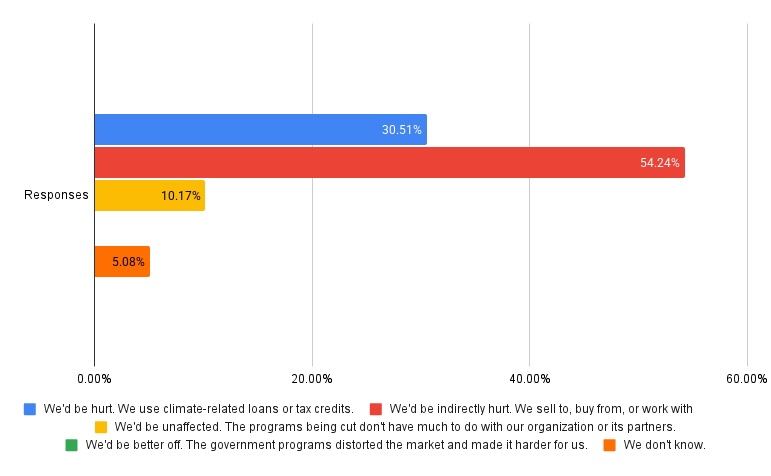
With this new reality in mind, Trellis wanted to know how sustainability professionals felt about these attacks and their potential impact. Of the dozens who responded to our query, some 85 percent told us that that their organization would be negatively affected, directly or indirectly. (The remaining 15 percent were either unsure or said their work would not be affected.)

How would cuts in government loans and credits affect your organization?

Job titles of the respondents included Climate Solutions Lead, Senior Director of Communications, CEO, Net-Zero Strategy Consultant and Founder.

‘Crippled revenue streams’

When asked how the government cuts would affect their organizations, the majority of respondents cited financial hardship.

“As a general contractor that builds buildings, our clients rely heavily on the clean energy credits,” wrote one anonymous responder.

Another explained, “We are part of the emerging CCUS [Carbon Capture Utilization and Storage] industry, and funding cutbacks will cripple that revenue stream for us.”

It’s worth noting that some responses were written with intentional emphasis. A selection:

  • “MY BUSINESS IS BASED ON ENERGY STAR BUILDING CERTIFICATION.”
  • “WE ARE A NON-PROFIT RECEIVING IRA FUNDS THAT ARE SUPPORTING TREE PLANTING IN OUR CITY. THOSE FUNDS ARE AT RISK AND WOULD ELIMINATE THE PLANTING OF THOUSANDS OF URBAN TREES IN AREAS WITH LITTLE TO NO SHADE CURRENTLY.”

The post Trellis Poll: 85% say they’d be hurt by government clean energy credit cuts appeared first on Trellis.

The Two Steps Forward podcast is available on Spotify Apple Podcasts, Amazon Music and other platforms — and, of course, via Trellis. Episodes publish every other Tuesday.

For more than 40 years, Paul Hawken has been an author, entrepreneur, activist and provocateur in sustainability.

In this interview for the Two Steps Forward podcast, Hawken talks about his latest book, “Carbon: The Book of Life,” with my co-host, sustainability consultant Solitaire Townsend, and me. The book, published in March, explores the element’s role in all living systems rather than viewing carbon merely as a climate pollutant. In it, he criticizes the climate movement for objectifying carbon and advocates for a shift in narrative from fear to possibility. He highlights the limitations of technological solutions such as direct air capture and bioenergy carbon capture systems and encourages a focus on local, grassroots efforts and individual actions, stressing the need for gratitude and wonder in our relationship with the natural world.

Also in this episode, Soli and I discuss the role of neurodiversity in sustainability.

In his 1993 book, “The Ecology of Commerce,” Hawken was credited with the self-described awakening of the southern industrialist, Ray Anderson, whose carpet company, Interface, became a poster child of sustainable business. “Blessed Unrest: How the Largest Movement in the World Came into Being and Why No One Saw It Coming,” Hawken’s 2007 bestseller, chronicled what he described as a diverse global movement with no charismatic leader that follows no unifying ideology, and is not recognized by politicians, the public and the media.

A new way to talk about carbon

“We have unfortunately had this language of othering the living world,” Hawken told us. He criticized the climate movement for objectifying carbon, using war-like terms such as “fight,” “combat” and “tackle” to address climate change. He explained that carbon is a flow, not a thing to be manipulated, and the importance of understanding carbon as a part of life and the mysteries of physics and chemistry on Earth is key to addressing the climate crisis.

“You have these silly phrases, like ‘carbon neutrality,’ ‘net zero,’ where carbon is a thing, it’s an object. We have basically isolated and objectified carbon.”

Rather, he said, carbon is life. “Carbon is a flow, and the idea that it’s a thing that we can manipulate is a terrible misunderstanding of carbon — what it is, what it does and where it is. What happens on Earth is so mysterious and wonderful.”

In our wide-ranging conversation, Hawken took on Wall Street, direct air capture, fallacies about renewable energy and the problem of shareholder primacy.

Hope on a grassroots level

He also held out hope, especially for the thousands of grassroots organizations that are addressing the climate and biodiversity crises at the local levels around the world — more effectively, he said, than many national governments or multinational corporations.

“The one thing we know about the living world, about nature, it is not a top-down system. But we’re trying to create top-down systems to address the beauty of the thing that we call life. You don’t read about these organizations, you don’t hear about them, they don’t make the news cycle, but they’re growing and rising.”

Two Steps Forward is available on Spotify Apple Podcasts, Amazon Music and other platforms — and, of course, via Trellis. Episodes publish every other Tuesday.

The post Environmentalist Paul Hawken: ‘We have basically isolated and objectified carbon’ appeared first on Trellis.

A decade and a half ago, Colorado — a fossil fuel-producing state governed by Republican Bill Owens — would have seemed an unlikely candidate to forge a thriving circular economy. But a combination of progressive political leadership, a core of innovative technology developers with access to funding, regional alliances and consumer enthusiasm has shaped an emerging ecosystem of startups, public entities and nonprofits that offer a circular economy roadmap for other states.

At the center of this movement is Laurie Johnson, founder and CEO of Circular Colorado. The former COO of a hauling company and former executive director of Recycle Colorado, Johnson founded Circular Colorado in 2021 with the mission of “establishing Colorado as a leader in developing circular economy solutions.”

“We’re building a model that can be replicated across states and across regions,” Johnson said during an April 29 workshop at Circularity 25 in Denver. “We’d love to see this happen across the country.”

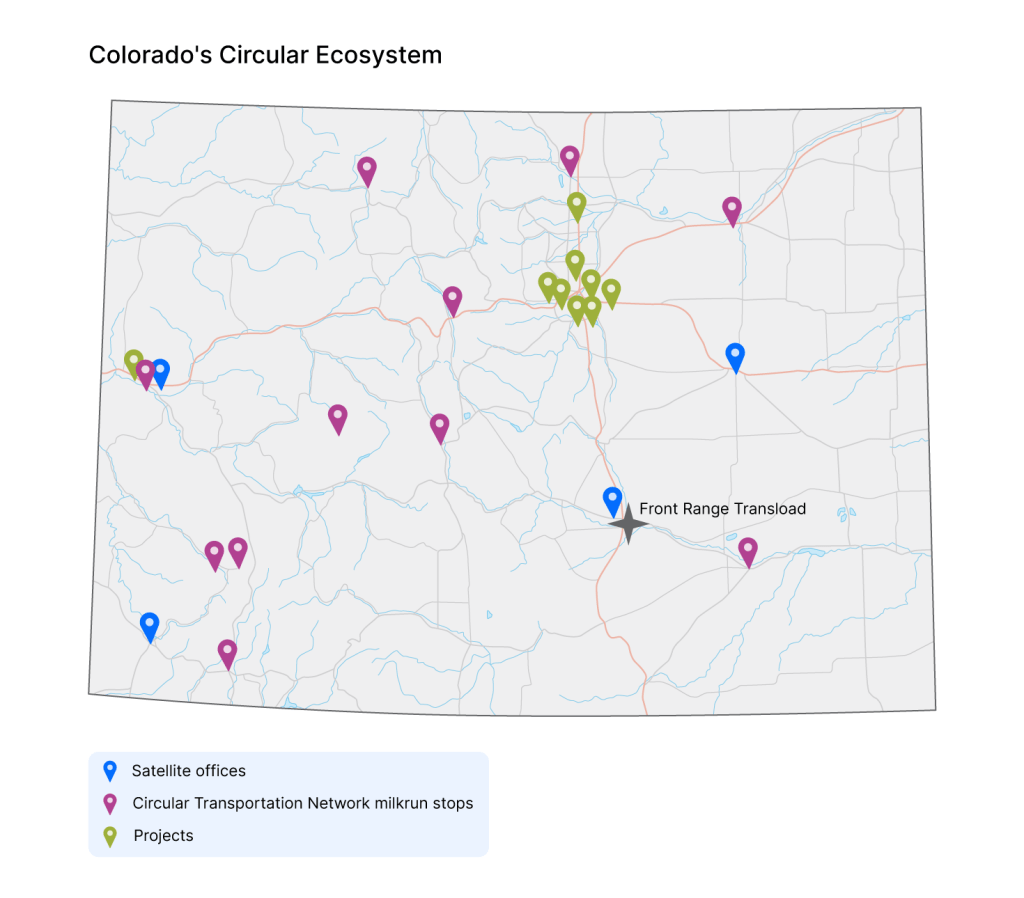
Source: Sophia Davirro/Circular Colorado

Remote communities in mountainous terrain

Colorado’s circular journey began in 2019 with the passage of a waste diversion law for the Front Range, which includes the Denver metropolitan area. At that time the state’s recycling rate for waste materials was stalled at around 16 percent — well below the national average of 32 percent.

The state’s mountainous terrain, isolated rural communities and low population density outside of a few large cities make recycling challenging

The diversion program, which originally assessed landfill tipping fees for haulers and dumpers that totaled $15 million annually, has been succeeded by a statewide program that generates $20 million a year for recycling and other circular initiatives.

The money is funneled into grants awarded and administered by the Colorado Circular Communities (C3) Enterprise, a public-private entity established in 2024 under the aegis of the state’s Department of Public Health and Environment.  

Funding from a dedicated source of revenue means that the C3 program does not have to go through the state legislature to support its grants, said Deputy Director Jeff Stalter of Colorado Circular Communities on the April 29 panel: “We now cover the whole state, and we have money we can spend — it’s not appropriated by the legislature so we don’t have to put out [requests for applications].”

C3 contracted with Circular Colorado to build two additional initiatives:

The Circular Economy Development Center aims to reduce greenhouse gas emissions and protect air and water quality by establishing a fully closed recycling, reuse and remanufacturing system in the state.

The center would “move beyond the recycling industry to embrace the industries of manufacturing, transportation and other sectors that all play a role in circular economy creation,” Johnson said at the time.

The Circular Transportation Network is designed to conquer the state’s sheer geographic expanse, mainly by repurposing delivery trucks that previously deadheaded, without loads, back to their point of dispatch. The returning trucks will serve central aggregation points, including one opened in Pueblo in southern Colorado, on April 22.

The mountain communities and rural towns often have no way to transport recycled materials, said Johnson at Circularity 25. “These trucks would go out and come back empty. Now they deliver recycling that gets aggregated in Pueblo, baled and on to market.”

The market would comprise a homegrown remanufacturing sector that keeps the material in the state and out of landfills, creating new jobs in the process.

“If you want to build manufacturing in your state, what better way to start than with feedstock that’s already available in your state?” said Alice Havill, a founding partner at Fractal Climate and a board member of Circular Colorado.

Tires into barriers

Together, those four programs — Circular Colorado, the Colorado Circular Communities Enterprise, the Circular Transportation Network and the Circular Economy Development Center — form a supportive architecture that is already achieving tangible results.

Pretred, an Aurora, Colorado, company that turns discarded tires into “crumb rubber” for use in highway barriers, received an $11.2 million grant from the Circular Communities Enterprise in February to expand its operations. Colorado typically burns or buries millions of old tires each year.

“Pretred would not be here without support and assist of these individuals and organizations,“ said founder and CEO Eric Davis.

Pretred’s goal is to produce 30,000 barriers a year, using 4 million waste tires from across the state.

Another beneficiary is TERSUS Solutions, which uses a carbon dioxide-based cleaning process to recover and process materials from apparel, sleeping bags, personal protective gear and the like for brands including Patagonia, The North Face and New Balance.

Last year, said TERSUS CEO Peter Whitcomb, the company saved 5 million gallons of water and kept 1.5 million garments out of landfills.

“What’s the frontier? Killing dry cleaning and water-based cleaning,” Whitcomb said.

Encompass the region

All of this is encouraging, but single-state recycling can only go so far in building a truly circular economy: waste knows no state borders, and millions of tons of products that originate in Colorado get discarded in neighboring states, many if not most are much further behind in their circular journey.

Johnson’s ultimate goal is a truly regional ecosystem that includes all types of materials and all forms of recycling. That requires a “sustainable systemic collection system that people actually use,” plus a core of viable reuse and remanufacturing companies to consume and repurpose the full stream of recycled materials. For now, that remains a distant vision.  

During the Circularity 25 workshop, Johnson laid out the structure and roadmap that other states and other organizations can use to begin building the sort of circular ecosystem that is well on the way to operation in Colorado:

  • Explore the challenge
  • Identify the gaps
  • Develop the strategy
  • Organize the players
  • Execute the solution
  • Manage the process to completion

“We assemble the solution,” she said of Circular Colorado. “Site selection, permitting, funding — we’re like the quarterback, the nucleus, the ones who go along and keep everything proprietary and everything moving.”

The tight weave of political support, public-private partnerships and a dynamic leader such as Johnson is unlikely to be exactly replicated elsewhere. But the template has been established.

The post How Colorado became a circular economy model appeared first on Trellis.