One fact often lost in coverage of the enormous electricity appetite of artificial intelligence data centers: At least one-third of the power goes toward keeping the servers, networking gear, hard drives and other gadgets from overheating.

Yet, the market for data center cooling technologies is poised to double over the next seven years, reaching a projected $42.5 billion by 2032. The category includes both massive chillers that air condition entire data center halls to newer technologies that directly cool servers and equipment racks. And with growth in the latter segment expected to quadruple by 2033, dozens of companies are vying for that created revenue, including leaders in entire data center cooling that have been around for decades, such as CooIIT Systems, Boyd Corp. and Motivair.

As the market matures, innovation is heating up around an option known as direct-to-chip cooling, which involves installing a cold plate on top of central processing or graphics processing chips. Essentially, these technologies command servers to run cooler on their own, thus breaking the current reliance on more traditional center-cooling approaches that are notorious water guzzlers.

As sustainability teams continue to collaborate with counterparts in information technology on direct-to-chip cooling options, their work will increasingly shape decisions about the sorts of servers companies buy for their digital operations. For sustainability professionals who want to stay abreast of this industry trend, here are four startups with direct-to-chip offerings that have attracted notable funding and corporate support since 2020. 

Accelsius

Austin, Texas

Backstory: Founded in June 2022 by Innventure, using intellectual property originally developed by Nokia’s Bell Labs. Accelsius is commercializing a product called NeuCool, touting a industry-leading cooling capacity for NVIDIA chips that enables more equipment to be squeezed into data center racks.

Funding: $24 million Series A round in November 2024, led by Innventure; Accelsius already generates revenue. 

Key Alliances: Accelsius has a relationship with the world’s largest data center co-location company, Equinix. It also contributes to a U.S. Department of Energy program for cooler chips.

Alloy Enterprises

Burlington, Massachusetts

Backstory: Created in early 2020 to 3-D print EV parts and other components, Alloy jumped into direct-to-chip cooling in June. Spurred by inquiries from data center customers, it now produces customized copper parts that meet compatibility requirements of ASHRA, a big data center standards setter.      

Funding: $50 million in capital, including $40 million from such investors as Lockheed Martin and Robert Downey Jr.’s Footprint Coalition. 

Key Alliances: None disclosed.

JetCool

Littleton, Massachusetts

Backstory: Spun out of the Massachusetts Institute of Technology in 2019, the company’s first product integrates with PowerEdge servers from Dell Technologies. JetCool is working on a design with new owner, contract manufacturer Flex, that is compliant with servers built to Open Compute Project specifications.

Funding: $17 million in Series A funding in October 2023, led by Bosch Ventures, bringing total backing to $20 million; acquired by Flex in November 2024.  

Key Alliances: Dell, DuPont (which sells its products in Taiwan and Singapore) and Eaton (another sales partner).

Nexalus

Cork, Ireland

Backstory: Born in 2019 from research at Dublin’s Trinity College, Nexalus remains closely tied to the university. Its cooling technology has applications for data centers, gaming and the automotive sector — specifically, Formula 1 racing teams.   

Funding: Nexalus is backed by Science Foundation Ireland, Enterprise Ireland and the Connect Research Center; it also has raised $10 million from private investors.

Key Alliances: Dell, Hewlett Packard Enterprise and Intel are collaborating with Nexalus on data center integrations.

The post 4 hot startups aim to keep AI data centers cool appeared first on Trellis.

When Dow decommissions the natural gas turbines at its Seadrift, Texas, plastics manufacturing site later this decade, it plans to switch on a first-of-its-kind small nuclear plant instead.

The project, awaiting a construction permit from the Nuclear Regulatory Commission that was requested in March, is backed by up to $1.2 billion from the Department of Energy’s Advanced Reactor Demonstration Program. Advanced gas-cooled nuclear technology from X-energy that operates at higher temperatures than legacy equipment will provide the industrial steam Dow needs for plastic pellet production.

Dow owns or contracts services from dozens of gas turbines and other combined heat and power systems across its petrochemical manufacturing footprint. Several years ago, it began evaluating the potential of small modular reactors to help reach its goal of reducing emissions by 5 million metric tons annually by 2030, according to an executive who anaylzes Dow’s capital investments in energy systems.

“Don’t discount the possibility of nuclear,” said Kreshka Young, North America business director for energy and climate at Dow. “There are a huge amount of benefits. It provides clean, firm power, and the cost can be very competitive. I would recommend that people not be afraid to look at it.”

High hopes for small nuclear

X-energy’s technology classifies as a small modular reactor — that is, one with a capacity of less than 300 megawatts. The current pipeline of such reactors is more than 47 gigawatts, which will require an investment of at least $360 billion, according to research firm Wood Mackenzie

Dow’s installation will initially include four X-energy base modules, which have a capacity of about 80 megawatts. The ability to stack the units was important for reliability, Young said. Dow also found the compact size of X-energy’s system — about the dimensions of a gas turbine — appealing. The project is subject to ongoing review and ongoing government funding. “We take a very measured approach to this,” Young said, referring to Dow’s energy investments. “We are not in a situation to write blank checks.” 

Small modular reactors are attractive because the timeline for building them is more predictable and cost-effective than legacy nuclear project development, said Alison Hahn, technical adviser for new nuclear technologies at the Nuclear Energy Institute. That’s because components can be constructed on an assembly line, enabling developers to standardize design and manage several processes in parallel, Hahn said.   

The three largest artificial intelligence and cloud computing companies — Amazon, Google and Microsoft — are all considering advanced nuclear to power their data centers. Amazon was part of a $500 million funding round for X-energy in October 2024, which was increased to $700 million in February. 

“X-energy provides an impactful solution to a critical challenge — and the support Amazon, Dow and other major corporations have provided underscores its potential and merit,” said Ken Griffin, founder and CEO of lead investor Citadel, when the initial funding was announced.

Amazon is looking to deploy up to 5 gigawatts of X-energy’s technology by 2039, starting with a four-unit, 320-megawatt project in central Washington that is being developed by Energy Northwest. The plan calls for the installation to be tripled over time.

The Dow project, however, is likely to be online first — as early as 2028, if project timelines stay on schedule. Its construction permit could be approved within 18 months, thanks to a new executive order by the Trump administration. After construction is complete, Dow and X-energy will need to apply for an operating license. 

The Amazon and Dow commitments atop X-energy’s DOE funding will give backers the confidence to finance X-energy’s manufacturing and supply chain ramp-up as well as the workforce training that will be needed to support operations, said Hahn. 

“Building out that order book allows you to confidently invest,” she said.   

X-energy’s innovation: the ‘pebble bed’

What makes X-energy’s offering unique is the tristructural-isotropic (a.k.a TRISO) fuel used by its reactors — poppy seed-size particles of uranium clumped into billiard-size balls and spread out in a pebble bed. Helium is pumped through the pebbles, and heat is extracted for steam generation. TerraPower, which raised $650 million in June from investors including Bill Gates and NVDIA’s venture arm, uses a similar design.

X-energy’s reactors operate at temperatures higher than lava’s, making them appropriate for energy-intensive processes such as hydrogen production or petroleum refining. The design is explicitly meant to prevent meltdowns.

X-energy will manufacture its TRISO fuel at a facility it’s building in Oak Ridge, Tennessee. The company, which employs about 600 people, is based in Rockville, Maryland. 

The spent pebbles in X-energy’s reactors can be replaced by new ones on a daily basis, so shut down is not necessary, said Harlan Bowers, senior vice president and director for the Dow project. 

“We see that as an advantage,” Bowers said, “but it does pose some additional challenges for the regulator, because most fuels are not moving, so there are some statistical aspects to calculating reactivity within that core. That means there are new techniques that the NRC will have to use to evaluate our safety case and ultimately approve our design.”    

The post Dow and Amazon take a big chance on a small nuclear reactor appeared first on Trellis.

The opinions expressed here by Trellis expert contributors are their own, not those of Trellis.​

Brands tend to get lots of kudos and fanfare when they launch a resale program. For some, this is the completion of the goal — the box is checked and teams will move on to their next marketing strategy task. 

But for others brands that are implementing resale as a circularity tactic within their sustainability strategy, the real work is just beginning. 

With consumer adoption of secondhand on the rise, the sustainability narrative — and goals — of brand-led resale need to evolve to focus on achieving growth and scale. This is because resale programs aren’t actually generating sustainability benefits for the brands behind them until they’ve scaled to a level that results in brands replacing some revenue from the production of new things from the revenue generated by selling the same things multiple times. 

Here are the key milestones on a pathway to scaling a resale program that can generate brand, financial and environmental benefits:

  1. Consistently grow resale sales and inventory supply year-over-year 
  2. Achieve resale program profitability
  3. Incrementally displace the production of new products with the revenue from resale without affecting overall net sales 

When the third milestone is accomplished, a brand can rightly claim that their resale program is generating the sustainability benefits of circularity because it’s disconnecting revenue creation from the consumption of finite resources and production of waste and pollution.

Designed to scale

For brands that are serious about leveraging resale to create growth and impact, three things need to be top of mind:

  1. Program Design (branding, user experience, pricing and incentives, assortment and integration into existing sales channels and returns processes): Great resale program design creates a seamless and frictionless user experience that’s comparable to shopping new and that introduces and/or creates a deeper connection to the main brand. 
  1. Operational Design (warehousing and fulfillment, transportation and shipping, integration into existing systems and processes): Margins are a critical output of the operational design of a resale program, and tradeoffs of vertically integrating a program versus the lighter lift of outsourcing operations should be deeply considered.
  1. Investment to Scale (marketing and PR, innovation and experimentation): Brands need to be ready to leverage their marketing prowess and budgets to build resale awareness and invest in new channel experimentation and expansion. 

Every brand is different — and that uniqueness should carry into the design of its resale program. The point is to meet customers where they are in the resale ecosystem and then take them farther. An illustrative example of how this works is Hand-Me-DÔEN by fashion retailer DÔEN.

Hand-Me-DÔEN is a community-sourced resale program where customers join the resale community by selling their DÔEN garments directly to the brand via a trade-in platform and shipping them to the company’s warehouse near Los Angeles. 

Trade-in is offered daily, but resale drops are only offered quarterly for a few days. Trade-in participants earn early access to shop the pre-loved assortment before it opens to the public. For anyone who is a DÔEN fan, early access means a lot. Every quarter is a fresh start and people have to regain their early access through trade-in again. 

Reflecting on the list above, several factors can be credited with contributing to the success of DÔEN’s resale program:

Program Design: The program increases brand access by bringing new customers to DÔEN without brand dilution. The strategic cadence of resale drops mitigates potential inventory supply challenges. Trade-in is simple and transparent — pricing for trade-in is 50 percent of what the brand can resell the item for, which is presented in the customer’s virtual closet that shows all their past DÔEN purchases.

Operational Design: Vertically integrating Hand-Me-DÔEN’s operations in the retailer’s warehouse allows for total control of assortment and planning and flexible staffing that can ramp up and down as needed.

Investment to Scale: Building the resale program on DÔEN’s main website allows people to use the same e-commerce platform and shopping cart to purchase new and used items together — all in a familiar space. 

In the first year of the program, which started in 2022, over 6,000 preloved garments were sold and the brand accepted 98 percent of the nearly 9,000 garments received from customers through trade-in.

Also in year one, nearly 20 percent of resale purchases came from new customers and the program was financially profitable, with over $1 million in sales. Importantly, this was achieved without including the incremental income derived from customers using the gift cards they’re issued through trade-in in the resale P&L. In the second year, the program grew 11 percent. 

DÔEN has achieved resale growth and profitability — the first two milestones on the way to achieving sustainability benefits for the brand through circularity — but it has not yet displaced production of new products. For a brand that’s barely a decade old, resale inventory supply is relatively limited. “We want to have a robust re-commerce program in 10 to 15 years,” says president Holly Soroca. “We’re building up the groundwork now to set this up to be a long-term part of our business.”

Looking forward

Given current economic conditions and tariff chaos, there may be no better time for brands to harness the now-normalized consumer behavior of shopping secondhand and commit to building and scaling profitable resale programs. When organizations recognize the brand value of resale, they become intentional about program design and “their resale programs are not just on-brand, they are actually brand-accretive in that they embody the brand so well and speak to customers so completely, that they raise the brand up in the eyes of consumers,” notes Brendan Condit, Director of Circular Business Models at Anthesis. 

This is the type of resale program that has the ability to scale economically. What they avoid is a “set it and forget” approach, as characterized by Peter Whitcomb, CEO of Tersus Solutions, who adds: “To thrive, a branded resale program requires constant investment and nurturing. If done well, the most successful brands have seen many years of steady and profitable growth.” These years of steady growth aimed at resale revenue targets will enable brands to displace the production of new things with the revenue of selling used things — and make good on the sustainability promise of resale.

The post 6,000 garments and over $1M in sales: How to tell if a resale program is successful appeared first on Trellis.

Sometimes it’s hard to tell what corporate actions are really making a difference. But according to a survey of more than 800 sustainability experts, these actions are the most impactful over the next five years:

  • Tech innovation and R&D (70 percent)
  • Corporate sustainability-linked compensation (65 percent)
  • Commercialization of sustainability via products and services (65 percent)

Actions such as integrating sustainability within companies (64 percent) and adopting circular economy practices (63 percent) also rank in the top 10 in a list of 23 potential ways that business can drive positive sustainability outcomes, according to the survey by Trellis data partner GlobeScan in collaboration with ERM and Volans.

What this means

Experts are shifting focus from compliance and culture-building toward systemic, performance-driven strategies. The emphasis on technology and commercialization as key levers reflects a growing consensus that sustainability must be profitable, scalable and embedded — and not treated as peripheral.

At the same time, experts are calling on businesses to act as systems integrators, aligning across stakeholders and domains. They also want businesses to anticipate the convergence of expectations around innovation, circularity and supply chains, lead with transparency and embed sustainability into core strategy rather than approaching it as a separate or siloed initiative.

Based on a survey of 844 sustainability practitioners across 72 countries conducted April-May 2025.

The post 5 corporate actions that will make the most impact by 2030 appeared first on Trellis.

An increasingly common narrative in corporate environmental reports is the one about “avoided emissions,” a.k.a. Scope 4. Roughly 2,400 companies reporting to disclosure service CDP in 2022 used some variation of the term — more than 10 percent of those that submitted data.

The challenge with such declarations is that the methodologies used to support them are still nascent compared with other carbon accounting frameworks. The latest organization offering guidance is Quantis, through an online tool called the Avoided Emissions Platform.

Avoided emissions quantify the difference between a historical way of doing things and what the reporting company is doing instead. 

Apple, for example, reported avoided emissions of 41 million metric tons for 2024 as a result of production and design changes; 15 percent of the reduction came from using recycled materials. Tesla touts emissions avoided by opting for an electric vehicle versus a gasoline-powered car.

Quantis’ new resource was developed on behalf of a dozen financial institutions and asset managers that were looking for a way to compare claims and 13 others that were seeking to make statements about avoided emissions. 

Goal: create credible models

The platform includes models for the impact of 65 low-carbon technologies and production approaches, ranging from EVs and alternative fuels to residential heat pumps. 

“In order to reach net zero, we’re going to have to accelerate on climate solutions,” said Anne Deserable, managing director of Quantis. “This initiative allows financial institutions to identify where they can guide investments.”

For example, Mirova, one of the asset management firms that contributed to the tool’s development, uses avoided emissions information to assess the positive climate impact of companies and projects that are part of its investment portfolio. 

“When considering only carbon footprints, a company producing batteries for electric vehicles might look worse than a company in the fast fashion industry with similar size in revenues, while obviously the first one is necessary to the low-carbon transition and the second isn’t,” said Manuel Coeslier, lead for climate and environment at Mirova.

The platform will be used by the firm’s ESG research analysts.

Why companies report avoided emissions

Industrial gas company Air Liquide has calculated the positive climate impact of certain products for years, using internal calculations based on publicly available methodologies, said Guillaume de Smedt, Air Liquide’s deputy vice president of sustainability. 

“We compare the emissions of our products against reference-case technology on the market,” de Smedt said. “The goal has always been the same: to show the concrete, difference our solutions make for our customers and for the planet.”

Air Liquide isn’t using the Quantis tool at this time, but it anticipates doing so. “It won’t necessitate a fundamental shift in our methodology, as our existing processes are already compliant with the core principles of avoided emissions calculations.”

The resource is aligned with existing guidance, starting with that from the World Business Council for Sustainable Development, said Deserable. “It’s important to stress the difference between emissions reductions and avoided emissions,” she said. “We are very clear that this cannot be considered as a reduction of Scope 1, 2 or 3.”

There are about 150 participants using the platform; more are currently testing the calculators. The Avoided Emissions Platform requires a subscription, but Quantis didn’t disclose pricing.

The post New tool standardizes comparison of ‘Scope 4’ emissions claims appeared first on Trellis.

American consumers and businesses are experiencing sticker shock this summer when they open their electricity bills.

A combination of soaring demand from power-hungry data centers, scorching weather and pass-along costs from utility infrastructure investments is driving electricity prices — which had been relatively stable for a decade or so prior to the pandemic — to alarming highs.

The effects of President Donald Trump’s drastic tariffs could push power prices even higher as the raw materials for transmission lines become more expensive and utilities scramble to keep up with the demand of new generation.

New U.S. manufacturing capacity, aided by federal onshoring policies, will further drive increases.

Energy earthquake

According to the U.S. Energy Information Administration, the average retail price of one kilowatt-hour of electricity in the U.S. rose 6.5 percent, to 17.5 cents from 16.41 cents, between May 2024 and May 2025.

Some states have been hit especially hard: ratepayers in Maine saw prices jump 36.3 percent in that period, followed by Connecticut (18.4 percent) and Utah (15.2 percent).

The effects are being felt by Las Vegas Strip merchants and New Jersey homeowners alike.

“Yesterday’s earthquake wasn’t tectonic,” wrote a member of the Midland Park, NJ Facebook group on August 3. “It was every NJ resident opening their PSE&G bill at the same time.”

NV Energy, which serves southern Nevada including Las Vegas, requested a 9-percent rate increase from state regulators earlier this year. The projected cost of its giant transmission project, Greenlink, has nearly doubled, to $4.2 billion from $2.5 billion, and could balloon even more as a result of the administration’s 25 percent tariffs on many relevant products from Mexico.

Don’t blame renewables

It’s often claimed by clean energy opponents — including U.S. Energy Secretary Chris Wright — that more renewable generation on the grid drives higher energy prices, but the data shows otherwise (see this deep dive on Sustainability by numbers for the full picture). Solar and wind, being variable resources, do drive volatility in prices, which helps contribute to public perceptions of a power grid out of whack.

And the Trump administration’s assault on federal support for renewable energy projects is bound to lead to higher prices, according to a recent report from think tank Energy Innovation. Some of the biggest increases will likely come in red states.

The primary driver of price increases, though, is still demand. Looking ahead, the data-center boom — and the resulting demand spike — shows no sign of slowing down.

Annual energy use by data centers will nearly triple, reaching between 74 and 132 gigawatts by 2028, according to a recent forecast by Lawrence Berkeley National Laboratory; that represents 6.7-12 percent of total U.S. electricity demand. Many large operators, like Google and Microsoft, are investing heavily in low-carbon generation to meet their needs. Unfortunately, on the public grid, renewables alone cannot meet future demand growth.

Bloomberg NEF’s New Energy Outlook 2025 found that future load growth will help prolong the hydrocarbon era. Sixty-four percent of the increased generation for data centers will come from fossil fuels, and “added data-center demand could help extend the life of existing coal and gas plants.”

The post Data-center demand sends electricity prices soaring appeared first on Trellis.

The opinions expressed here by Trellis expert contributors are their own, not those of Trellis.​

Imagine a future where you can set reusable packaging out on your porch for collection, bring bottles back to the store to get a hefty deposit, and where curbside composting pickup is just as widely available as recycling collection. This future doesn’t depend on some new miracle material or technological advancement. It depends on the work of today. 

Right now, headlines about mounting global plastic pollution in our oceans, setbacks to flexible plastic recycling, and off-target sustainability goals are widespread. It’s easy to get overwhelmed by these challenges and the daily, immediate pressures of complying with new packaging policies in the U.S. and Europe. But the sustainable packaging industry can’t afford to lose sight of the future it’s working towards. 

That’s why a new animated video from the Sustainable Packaging Coalition paints a clear picture of what sustainable packaging could look like in 2035. If we can see how our work will pay off in less than a decade’s time, we’re more likely to feel motivated and confident in the work being done today. Getting to this future depends on packaging professionals’ capacity to rethink three of the industry’s most stubborn gaps — and to do the work to close them in 10 years.

1. Focus on better packaging policy

New packaging policies are requiring producers to help cover the costs of recovery infrastructure, raising questions: What will this mean for my business? How much will I need to pay in fees? Am I ready to report my data? These are all incredibly important issues to get right, but it’s also worth asking: Which problems will these policies help solve? 

Packaging policy isn’t a silver bullet and it won’t instantly solve problems such as a lack of end-markets or a package not getting sorted correctly at a material-recovery facility. 

The purpose of policies such as Extended Producer Responsibility (EPR) is actually quite simple. It’s to get producers to help create effective collection programs. Seen through that light, two of the most prominent packaging policies — EPR and labeling bills — are the secret sauce behind the future where someone is able to easily and confidently recycle items outside her home, return items at the store for a deposit and recycle plastic film. Policy is going to help us get there. 

2. Aim to use more ‘successful’ materials 

There’s a headline every week, it seems, with new research into the harmful effects of chemicals used in packaging. There’s also a near constant drip of reporting on the scale of the microplastics problem driven by many sources of pollution and plastics, including packaging. And let’s not forget the Global Plastics Treaty that’s intended to tackle the global plastic pollution crisis with a legally binding agreement; negotiations stalled at the end of last year but will resume this month.

Some of the focus on plastic material is reinforced by EPR programs, as they have eco-modulation fees that will incentivize the use of easily recycled materials or those which have a lower environmental footprint. 

Many companies are asking: Do we need to switch materials and is there a more sustainable material? These are good questions to start with, but a better question might be: Which material will be the most successful in my product category? 

Packaging success happens when materials are collected at end-of-life and easy for consumers to sort and dispose of in a safe and low environmental impact way. We need to acknowledge that some materials aren’t viable for certain product categories and to align around which materials can do the job better in those cases.   

If we follow this path, by 2035 we’ll have the right materials doing the right jobs and we won’t have to feel guilty about unrecyclable snack wrappers — we’ll be using recyclable paper ones, instead. We’ll have access to compostable trays for produce to help compost any spoiled items or leftovers and that kombucha bottle, which is highly recyclable, will be made of high levels of recycled content.

3. Use sustainable packaging goals to drive innovation

Sustainable packaging goals — such as getting to 100 percent recyclable, reusable or compostable portfolios — have been hard to reach, and there’s been a fair share of backlash against companies and industry groups for not meeting goals, changing them, changing timelines or eliminating goals. Many companies are wondering: Do we need to rewrite or hide our goals or maybe change our timelines? Delete them and focus on compliance? 

A more future-facing question might be: How can our goals drive innovation? Here’s the reality: The low-hanging sustainability fruit has been picked. What’s left are the most difficult, yet meaningful changes. The opportunities to move to reusable packaging are massive and untapped. It’s the only way companies will meet most of their goals. And, incidentally, gearing yourself up for a system redesign puts you in the best position to tackle those earlier questions about materials and EPR, too. 

By 2035, refillable and returnable packaging will be the best, most sustainable strategy and the one that consumers prefer. Hopefully we, like the character in the video, can receive a cake and candles in a reusable shipper, set empty bottles out on our porches for reuse and — best of all — no longer have to flatten cardboard boxes. 

Staying the course

Taking a moment to get really clear on the future we’re working towards is incredibly valuable. Connecting the dots between what’s on our plate today — materials, EPR and strategic goals — and this future will help teams maintain momentum and remain committed to the work that needs to get done. 

The post Paper wrappers and curbside composting: The next 10 years of sustainable packaging appeared first on Trellis.

Embracing change is necessary as the climate and nature crises move toward irreversible tipping points, and the costs for individuals and the economy rise exponentially. In fact, change is inevitable — whether we choose it or wait until it is forced upon us by nature herself. 

But transitions are filled with uncertainty, and natural evolution has forged in us a short-term, risk-averse attitude. In addition, vested interests and privilege holders who benefit from business as usual are resisting change. We are seeing all this play out today. In our conflicted, polarized and confused world, the old is failing and the new is not yet emerging at the scale and pace necessary.

In this environment it’s critical to frame a clear, concrete and inspiring vision that fundamentally drives change. Generic narratives and vague aspirations won’t drive action and may contribute to deeper cynicism and the feeling that change is not possible. The world has adopted relevant and measurable goals for climate, such as maintaining the average global temperature rise well below 2°C and “halting and reversing biodiversity loss” — or becoming “nature positive,” for short.

Against this backdrop of urgency, the article “14 Sustainability clichés to retire in 2025,” published by Trellis on July 30, suggests that we abandon some key terms that represent goals vital to achieving a sustainable future. I argue that this is not what we need. What we need, instead, is to ensure that companies, organizations and governments use them correctly.

The terms in question include “net-zero emissions,” “nature positive” (initially defined in a 2021 paper then adopted the next year in the language of the Mission of the Global Biodiversity Framework of the U.N. Convention on Biological Diversity), and “circularity” in the context of circular economies, commonly defined as a strategy to “reduce, reuse and recycle” in order to live within the world’s natural resource limits. 

Confusion and cynicism

Dismissing these well-defined and broadly adopted terms means also dismissing the ambition they signify, and the goals, targets and pathways that drive action — that are, in fact, crucial to mobilizing and merging efforts. Listing them alongside generic adjectives like “green” and “ecofriendly” while calling for them to be “retired” or “ditched” is dangerous. It runs the risk of feeding confusion and cynicism — and worse, undermining action — at a time when representatives of the status quo are already actively seeking to derail the momentum on sustainability.  

The specter of a post-truth world is upon us — one in which emotion and personal belief shape public opinion more than objective facts do. But facts matter. The planet is finite, and we need to come to terms with living within its boundaries. So when we witness attempts to undermine ambition or blatantly misuse important terms, our collective response must be to defend both the terms and their ambition, and call out those who intentionally misuse them.

If we believe that decarbonizing our economy, halting and reversing biodiversity loss and reducing overconsumption and waste are key pillars of a sustainable, safer, more prosperous and equitable future, do we really think that erasing language (and the targets they represent) like net-zero emissions, circular economy and net-positive biodiversity will help advance the climate, nature and waste agendas?

We must resist this temptation, because the only alternative is to begin afresh with new terms and new definitions that will themselves have to follow a long and arduous path to political and societal acceptance — a process that humanity simply does not have time for, given the current runaway climate change and collapse of crucial ecosystems and the benefits that nature provides. The real issue is not with the terms themselves, but rather with the way they are used. Unsubstantiated words and claims should be opposed without hesitation. The clearer the definitions, the easier it is to call out their misuse.

Measurable ambition to drive action

That’s why we were so careful in defining the term “nature positive” from the start, and in expanding upon it in the recently published Becoming Nature Positive. It’s also why we are now finalizing metrics and guidance to credibly and practically measure nature-positive outcomes, with the help of a group of global companies from the most relevant sectors and with oversight from a group of leading technical organizations that will ensure credibility. 

At the Nature Positive Initiative we are strong advocates of measuring concrete action and outcomes. Still, I believe that the use of inspirational language like nature positive — not as a slogan, but as a clear vision and a measurable goal — is essential to draw people in. More important, in defining the aspiration to less expert audiences, such language galvanizes action at the scale required to achieving our collective sustainability goals. 

The post ‘Nature positive’ is not a slogan – it’s an inspiring ambition and a measurable goal appeared first on Trellis.

The opinions expressed here by Trellis expert contributors are their own, not those of Trellis.​

The role of a modern-day CSO can seem like it has an ever-expanding remit. In addition to traditional work around reporting and compliance, many of us now focus on strategy, innovation and business transformation. Like the chief digital officers of the early aughts, the best CSOs are catalysts. They spearhead efforts to capture cutting-edge data on risk and operations, and embed it into business processes.

So it’s not surprising that the latest to-do on many CSOs list is how we should be thinking about AI.

Of course, one intersection between AI and sustainability stands out: energy costs and emissions. But because a CSO’s success relies so heavily on cross-functional data collection and advocacy, AI can also be a key tool in identifying opportunities, automating efficiencies, making cases for action and helping organizations become resilient against risks so they can deliver value for quarters, years and decades to come.

To help the sustainability community understand this tension, here’s how I’m thinking about it.

Making work more efficient

First, the obvious point: AI can be enormously helpful with core sustainability work, by, for example, reading utility bills globally and categorizing spend data within various reporting frameworks — and automatically handling the currency and unit conversions along the way. This kind of streamlined reporting can accelerate progress on corporate goals that may involve renewable energy, waste and water commitments.

The opportunities to plug AI into businesses for more sustainable operations are nearly limitless. At IBM, for example, new AI-powered maintenance module is helping us monitor, maintain and optimize operations with fewer people hours. It helps us boost energy efficiency, minimize unneeded repairs and replacements and reduce waste. The module is estimated to save us 10,000 people hours per year.

AI has also reduced costs and energy use in our cloud workloads and an AI-driven natural language processing model is helping our emissions reporting platform analyze documents and categorize spend by type of emission. It’s also helping with planning and forecasting. That platform has helped reduce reporting costs by 30 percent.

We’re also using AI to help solve a pain point that comes up so often among CSOs behind closed doors: the dramatically increasing number of client inquiries. Banks, manufacturers and government agencies all have procurement criteria or reporting needs that increasingly cause them to ask: How many and what scope of emissions are attributable to our engagement? What circularity options do we have? How do your goals align with a specific framework? Rather than have a relatively small team handle these queries manually, we now have an AI assistant that pulls information from various sources and offers quick, custom answers on such questions.

Adopting AI intentionally

This moment is custom-built for CSOs to influence their internal peers. Any company’s adoption of AI will come with significant energy needs, which are closely aligned with both costs and emissions. CSOs have the wind at their backs as they tap their cross-functional connections with CIOs, COOs and CFOs to make sure their company is pulling every lever possible to minimize AI’s energy consumption.

Those levers involve everything from how power is sourced, to what chips and infrastructure are used, to the size and architecture of selected AI models, and how these models are tuned and deployed. Without CSO involvement, decision makers may focus only on maximum performance, speed or minimizing fixed costs.

It’s still early days to point to dramatic outcomes in this area, but my office has worked closely with IBM’s research teams — that develop our models—and product teams to explore how we can measure energy use in a robust and comparable way, and then how we can integrate improvements into products and articulate the sustainability and lower costs as a software selling point. The point is for CSOs to be a voice at the table and to bring relevant data into consideration.

A CSO can articulate trade-offs others might not be thinking about with water, energy, ongoing total and variable costs and more. They may raise the idea of sufficient performance or speed and help avoid choices that “lock in” challenging pathways when considering longer-term corporate goals. That influence may help an organization choose a more lightweight implementation of AI without raising downstream challenges on costs or progress toward goals or regulatory requirements. For example, a company could use a smaller AI model that handles 90 percent versus 95 percent of initial customer-support inquiries a millisecond slower, but at significantly lower compute costs, reduced need for storage infrastructure, and correspondingly lower need for energy, cooling and maintenance.

CSOs at companies actually building AI models or infrastructure can take an even more muscular approach, emphasizing the design, development and use of models, chips and more that balance realistic business needs with reasonable costs and environmental impacts. At IBM, the best example of this is an approach that favors smaller, less-energy intensive models designed for specific purposes compared to a more energy-hungry, one-size-fits-all option. Nokia’s Head of Sustainability has also discussed his role in this area, pointing to energy-efficient hardware choices, small models and an end-to-end review of the environmental impact of AI systems.

Driving growth and innovation

As CSOs face increasingly expansive missions, AI can help them drive growth, innovation and revenue.

For example, the AI assistant I mentioned above is much more than just a time-saver for my team. It gives our sales team a competitive edge by providing them bespoke, up-to-date information so they can respond to requests for proposals and supplier questionnaires faster. And, by capturing which sellers are requesting the data and why, the assistant brings hard data and visibility to sustainability’s “book of business” and sheds light on the highest-potential business development opportunities.

AI also frees up teams to work on higher-value initiatives. Our AI-powered “Safer Materials Adviser,” for example, detects PFAS compounds in parts, components or formulations, and is being further developed to help source substitutes. This has applications for our own workflows such as chip design, but also for other companies involved in clean energy and packaging. We’re working with Nestlé to use AI to speed up development of environmentally friendly packaging.

For CSOs, taking steps to mitigate the energy challenges posed by AI are table stakes. This moment calls for much more than that and CSOs can rise to the opportunity to shape their organizations’ AI adoption so that it drives sustainable, long-term outcomes.

The post IBM’s sustainability chief: 3 strategic ways I’m using AI today appeared first on Trellis.

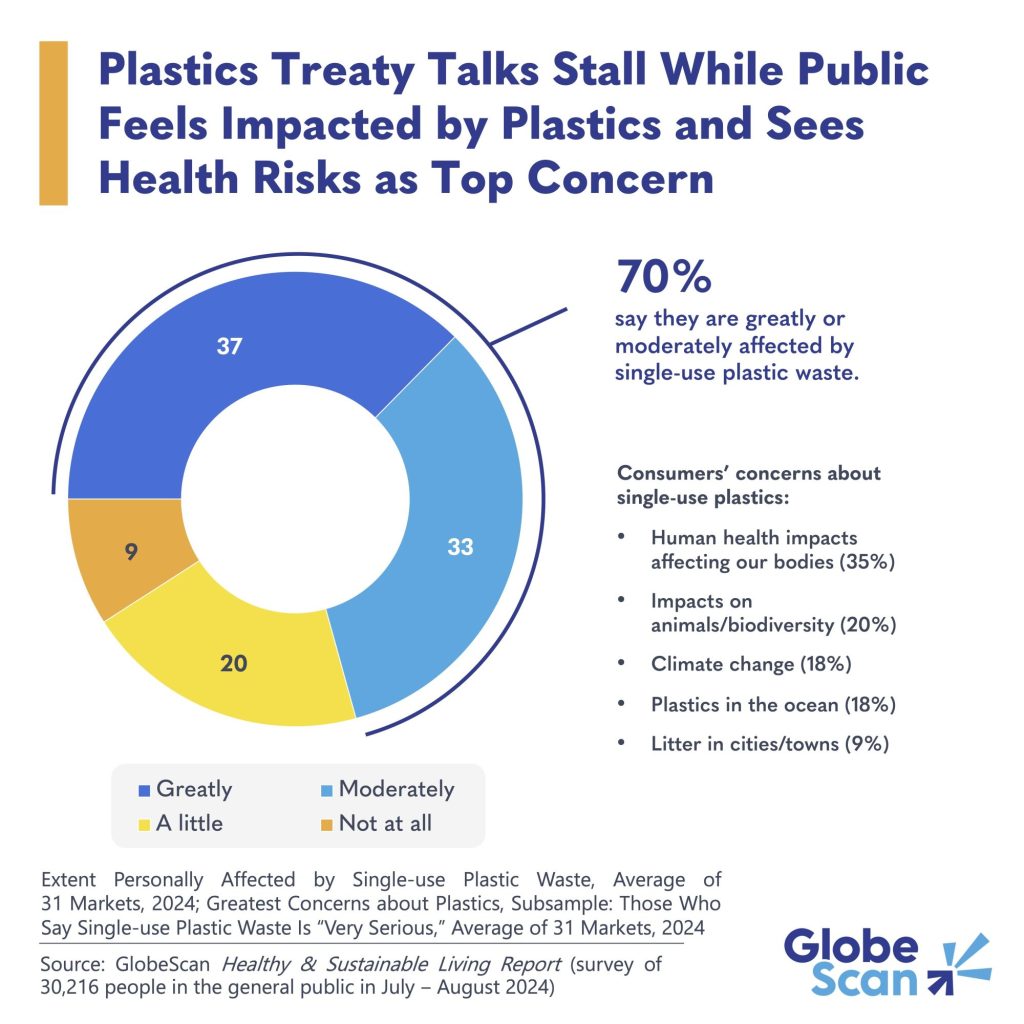
The plastics treaty talks that convened on August 5 in Geneva look like the last chance to deliver a meaningful global deal to stem the tide of plastic that is infiltrating our bodies, overwhelming our landfills and devastating our oceans. If successful, it would be the world’s first coordinated legal framework for tackling plastic pollution at scale.

If not? Well, read on. 

The background

Launched in 2022 by the U.N. Environment Assembly, the talks seek a legally binding global treaty to end plastic pollution. The goal is to address plastics across their full life cycle — from design and production to use and disposal.

Negotiators have met five times so far, most recently in Busan, South Korea, in December. That session, meant to finalize the treaty, collapsed without agreement on a single article — including the treaty’s objective.

Where are we now?

The current “Chair’s Text” — the draft agreement guiding negotiations — reflects a deeply divided process. Though it includes measures to improve waste management, on the whole it avoids the most controversial issues: limits on plastic production, regulation of toxic chemicals and how to pay for it all.

“There’s a clear majority of countries that have made statements committing to strong measures on chemicals of concern and limiting the production of plastics,” said Sam Winton, a researcher studying the treaty process who is attending the talks. “But there are a small number of countries that consider those topics completely out of the scope of the Treaty.”

This resistance comes primarily from oil-producing nations — reportedly led by Saudi Arabia and including Russia and Iran — and plastic-exporting economies that want to focus only on downstream solutions, such as recycling. Meanwhile, ambitious countries — including coalitions led by Rwanda and Mexico — are pushing for upstream controls and legally binding global targets on the use of harmful chemicals and products.

Following a July meeting in Nairobi, the Trump administration issued a statement opposing production limits: “We support an agreement that focuses on efforts that will lead to reducing plastic pollution, not on stopping the use of plastics.” 

What’s at stake?

Over 460 million metric tons of plastic are produced annually, of which 20 million end up in the environment. Plastics contaminate virtually every ecosystem on Earth, driving biodiversity and ecosystem loss. Globally, the production, use and waste management of plastics is responsible for 4 percent of total greenhouse gas emissions.

But this treaty is about more than environmental protection. It could reshape markets, supply chains and regulations for years to come.

For businesses, an agreement would mean:

  • Tighter rules for plastic packaging and product design
  • Restrictions on hazardous chemicals in plastic goods
  • A global push toward reuse, refill and alternative material
  • Increased costs through extended producer responsibility (EPR) laws, such as those in California, Colorado and five other states

What will Geneva focus on?

The Geneva session will center on four unresolved issues:

Scope and ambition

Will the treaty cover only waste or the entire plastic life cycle — including how much plastic is made and how? The current draft leans toward a voluntary, national-level approach. Many countries say that’s not good enough, and that a global, enforceable agreement is needed.

Plastic production

Proposals include setting global targets to reduce the production of primary plastic polymers. Petrochemical-producing nations strongly oppose this, seeing plastics as a growing market for fossil fuels in a world in which demand for energy production will fall in the coming years.

Chemicals and products of concern

More than 16,000 chemicals are used in plastics, many with unknown health effects. Some countries want to begin phasing out the worst offenders. Others — including industry groups — oppose these moves, citing cost and supply chain complexity. Specific chemicals of concern won’t be decided at these talks, but negotiators could agree to begin to develop a list ahead of future meetings.

Finance and implementation

Developing countries such as the Philippines, with weak to nonexistent recycling systems, want support to implement the treaty, including technical assistance and a dedicated funding mechanism. Wealthier countries prefer to work through existing platforms such as the Global Environment Facility (GEF). Who pays — and how much — remains unresolved.

What are the possible outcomes?

There are four broad scenarios for how the Geneva talks could end:

  • Low ambition: A weak treaty focused on voluntary, national-level waste measures. This would be relatively easy to reach but risks being ineffectual.
  • High ambition: A legally binding global treaty covering chemicals, product bans and production limits, along with a roadmap for implementation. This is what many countries want, but it faces stiff opposition in certain quarters.
  • Middle-ground package deal: The most likely scenario: a compromise that trades stronger commitments in one area (such as chemicals) for softer language in another (such as production). Behind-the-scenes negotiations will be key to achieving this.
  • No agreement: If talks fail entirely again, the process could collapse. That could cause some countries to pursue separate high-ambition treaties outside the U.N. Others may fall back on national or regional regulations — creating a patchwork of compliance risks for global businesses.

Why this matters

The treaty’s outcome will set the direction for plastic regulation, innovation and compliance over the next two decades. A robust agreement would accelerate the shift away from single-use plastics, force businesses to rethink packaging and material choices and create new reporting and transparency requirements across supply chains.

Even companies not directly involved in plastic production would face new obligations as part of EPR schemes, product bans or chemical phase-outs.

“It is very likely that an ambitious, successful treaty will impact various parts of your operations, probably some parts that you haven’t already thought of,” said Winton. 

The post As plastics treaty talks enter the final round, here’s what to expect appeared first on Trellis.