Google’s chief sustainability officer, Kate Brandt, isn’t just responsible for the company’s emissions reduction and environmental conservation agenda — a mission complicated by a planned $85 billion investment in artificial intelligence infrastructure in 2025 alone.

Her team is tasked with dreaming up ways to use AI in applications that help other companies, cities and individuals cut emissions at least 1 gigaton annually by 2030.

Brandt recently celebrated her 10th anniversary with Google, which she joined after leaving her position as chief sustainability officer for the federal government. She reports to Ben Gomes, chief technologist for learning and sustainability, a direct reflection of the growing importance of Google’s sustainability team to innovation. Her team doesn’t have explicit revenue goals, but money-making potential is considered in the design review process.

“We have been an AI-first company since 2017, and we’re really in a moment now where we need to figure out how to develop AI in a bold and responsible way,” Brandt told me in the latest episode of the Climate Pioneers interview series. “I really see the work we do on sustainability as being squarely within that mission.”

One example of that boldness: A company policy, since May 2020, to not use AI for oil and gas applications — in contrast to its primary rivals in cloud computing services, Amazon and Microsoft. 

“But really, a lot of the work is more oriented around not the negative screen, but the positive application,” Brandt said. “Having things like our gigaton aspiration enables us to align product areas across the company — from Google research to Google Deep Mind cloud and other teams — around the opportunity space of using this technology as a climate solution.”

Forerunner: Google Earth

Many applications championed by Google’s sustainability team build on decades of work on such widely used services as Google Maps and Google Earth, the latter of which was overhauled at the end of July with a major AI capability called AlphaEarth Foundations. The new “virtual satellite” tracks crop health, deforestation, water resources, new construction and other environmental changes, by accessing dozens of public data sources including optical satellite images, radar and climate simulations.

Other apps the sustainability team has had a hand in developing or revising are one that helps pilots minimize condensation trails; a fuel-efficient router in Google Maps; the Green Light city traffic optimization resource; and a solar planning tool that helps developers pick better sites and contributed to reducing greenhouse gas emissions by 6 million metric tons in 2024.

“We’re seeing huge opportunities to drive that kind of positive change, and we need to keep going,” Brandt said. “Furthermore, we see AI as a very powerful tool when it comes to climate resilience and adaptation.” Two high-profile examples are FireSat for wildfire detection and the Google Flood Hub for local riverine flooding. 

Dilemma: How to tame AI infrastructure

Brandt is also regularly included in high-level discussions about decreasing the energy and water appetites of Google’s data center infrastructure and investing in lower-carbon energy resources such as geothermal and advanced nuclear technologies.

“I really orient the discussion toward the idea that the work is squarely within the company’s mission, within our objective to be bold and responsible in how we deploy AI,” she said. “I think that really resonates.”

Her advocacy has paid off in new training methods for AI models that speed the process by 39 percent and in big improvements in AI chip efficiency. Google’s latest custom-built AI processor, Ironwood, which launched in April, offers double the performance per watt of technology announced in 2024.

Despite these efforts and Google’s big investments in solar, wind, geothermal and nuclear power — 60 deals in 2024 alone — the company’s greenhouse gas emissions have increased by 51 percent since its 2019 baseline year. Still Google remains committed to its “moonshoot” pledge to cut its carbon footprint 50 percent by 2030.

“These really big challenges that we’ve taken on that have a societal benefit to them — the point isn’t necessarily a check-the-box or a 100 percent achievement,” Brandt said. “It’s sort of inherently meant to be hard, to drive us to try new things, to find unusual partnerships, to innovate.”

Watch the Kate Brandt interview and check out past Climate Pioneers episodes.

The post Google’s Kate Brandt plays a central role in its AI strategy appeared first on Trellis.

Like its closest rivals in artificial intelligence and cloud computing, Amazon’s greenhouse gas emissions rose in its latest ESG reporting update. And like Microsoft and Google, the company is committed to its existing goal, which commits it to becoming net zero by 2040 through the Climate Pledge framework it co-created in 2019.

Amazon’s sustainability chief, Kara Hurst, points to investments in climate technologies such as Rivian’s electric delivery vans, Amazon’s expansive purchases of clean energy and the joint action it is mobilizing with the 549 other signatories (as of December 31, 2024) in the Climate Pledge as reasons to remain “firm” even when progress is less than linear.

“No matter what we’re faced with in the future, we’ll remain steadfast in our commitment to sustainability and continue to invest, innovate and obsess over our progress each year, with the same intensity and focus that has defined Amazon from Day One,” she said in Amazon’s 2024 sustainability report.

Watch this metric: carbon intensity

Amazon’s emissions have grown 34.4 percent since its 2019 baseline year, to 68.3 million metric tons of carbon dioxide equivalent for 2024. For comparison, in their most recent environmental update from earlier this summer, Google disclosed a cumulative emissions increase of 51 percent, to 15.2 million metric tons since its 2019 baseline, while Microsoft recorded a 24.3 percent increase since 2020, to 14.9 million metric tons.

As its emissions totals illustrate, the magnitude of Amazon’s e-commerce operations — more than 10 billion items delivered within 48 hours in 2024 — add a complexity to the Seattle company’s net-zero pledge that neither Microsoft nor Google faces. Scope 3 emissions from the company’s supply chain are about 74 percent of the total. 

Amazon doesn’t break out the carbon footprint associated with data centers that power Amazon Web Services. It does, however, closely monitor another metric, carbon intensity, which measures grams of CO2 equivalent per dollar of merchandise sales. For 2024, that number was 72.6 grams, off 40.9 percent — from 122.8 grams — in 2019. During that timeframe, Amazon’s total revenue more than doubled to $638 billion.

Targeted Climate Pledge recruitment  

Amazon studies carbon intensity so it can gauge the effectiveness of investments and efficiency measures across its supply chain. As 2040 draws closer, the company’s sustainability team is looking to collaborations between Amazon and other signatories to the Climate Pledge, especially big suppliers, to scale that work.

“We are heavily encouraging our suppliers, especially our top-emitting suppliers to join us in the Climate Pledge,” said Sally Fouts, Amazon’s director of the Climate Pledge. “And if they can’t commit to the pledge, we still work with these companies in other ways.”

In 2024, 76 companies joined the pledge — an average year for new signatories, said Fouts. Two of them were Amazon’s high-emitting suppliers, Crane Worldwide Logistics and Shorr Packaging. There was also a specific push to recruit businesses from Asia Pacific and the high-emitting fashion industry; among those to take the leap: jeans maker DL1961 and fashion designer Stella McCartney. 

“Our decision to join the Climate Pledge reflects our deep commitment to bold, science-based targets,” said DL1961 CEO Sarah Ahmed. The company already closely tracks the carbon footprint of its jeans, and it uses waterless processes and recycled fabrics or those harvested from organic and regenerative sources to drive down emissions. Its goal is to cut its footprint in half by 2030.

Growing priority: collective action

Amazon is recruiting in specific supplier categories with the aim of creating working groups that can share best practices or collaborate on specific projects. Six projects were launched in 2024, involving 16 signatories, making a total of 19 initiatives now up and running, Fouts said, including a few focused on one of Amazon’s biggest emissions categories, transportation and logistics.

One example is Laneshift, created to accelerate the installation of electric vehicle charging infrastructure in cities throughout Brazil, India and Mexico. Several Climate Pledge companies are supporting a 370-kilometer EV freight corridor in India between Bengaluru and Chennai. Another is Joule, which is building a charging network across Bengaluru and matching the electricity consumption with renewables.

“If we can get those companies that have a vested interest and may play a different role in that ecosystem of getting that network off the ground, then we can hopefully move faster,” said Fouts.  

Amazon has deployed more than 10,000 EVs in India, on the way to realizing a larger aspiration of putting at least 100,000 electric delivery vans on the road worldwide by 2030. It had deployed 31,400 as of Dec. 31, and delivered more than 1.5 billion packages in 2024 using electric vehicles.

Brooks Running, among the first 40 companies to become a Climate Pledge signatory in 2020, benefits from these collaborations, said Dave Kemp, director of corporate responsibility for the footwear maker. 

Brooks’ involvement with the Climate Pledge has enabled it to participate in contracts that reduced emissions related to aviation and maritime shipping and that enabled renewable energy investments in its supply chain. “It helped unlock partnerships and collaboration we wouldn’t have thought about or had access to,” Kemp said.

Branding blitz

Amazon is also counting on its Climate Pledge Friendly labeling program — which sellers can use to market products covered by more than 60 eco-certifications — to make a dent in its Scope 3 emissions. Amazon carried more than 2.2 million Climate Pledge Friendly products in 2024, compared with 250,000 in 2021, when the program began.

In 2024, Amazon customers purchased more than 1.7 billion products carrying the label, an increase of 48 percent from 2023. That includes 75,200 businesses that use Amazon for procurement, up from 18,000 in 2022. 

Another data point Amazon touts in its 2024 report: 38.8 million customers switched to Climate Pledge Friendly brands in 2024 after buying other options in the same category in the previous two years.

Looking forward, Amazon is encouraging more sellers to qualify products under the labeling program. It’s also stepping up its support of those selling preowned or refurbished products, said Cameron Westfall, head of product and engineering for the Climate Pledge Friendly program. 

“One of the things that we’re super excited about is that getting Climate Pledge Friendly is more impactful for those brands that are less discoverable on their own,” Westfall said. “So small businesses end up being some of the biggest beneficiaries of investing in sustainability.”

The Climate Pledge Friendly concept can also be applied to delivery and packaging options that surface during the checkout process. “We are starting to embed that more, and you’ll start seeing it more on the site,” Westfall said.

The post Amazon’s secret weapon for countering higher emissions: fellow Climate Pledge signatories appeared first on Trellis.

My recent column, “No, corporate sustainability is not dying,” prompted a wave of thoughtful responses on LinkedIn from sustainability professionals across sectors and borders. And, while most agreed on the general diagnosis about the profession, there was debate over the causes and prognosis.

Of course, this was hardly a representative sampling. Trellis readers — and my LinkedIn followers — trend heavily toward sustainability professionals in the trenches. They live the confusing and confounding moment I wrote about, every day.

Following is a synthesis of the 100 or so LinkedIn comments, including some of the more striking and pithy insights.

Not dead — but definitely ailing

“100% agree, Joel,” wrote Jim Hartzfeld, longtime sustainability strategist and protégé of the legendary founder of Interface, Ray Anderson, about my hypothesis. “Not dead but evolving out of ‘the end of the beginning’ phase of this inevitable transformation.”

Others echoed this sense of a maturing field. Catherine McKalip-Thompson, sustainability manager at Bechtel, who formerly ran the a White House environmental task force under Bill Clinton, offered a memorable metaphor: “Figuratively, sustainability is in its late twenties. The total optimism and drive are maturing into a more pragmatic stage.”

RepRisk’s Jonny Hardaker added: “I often think of the contrast between tech, where the mantra ‘fail fast, fail often’ is celebrated in the pursuit of disruption, and sustainability, which seems to be ‘fail once and face the executioner!’ There’s always going to be a learning curve when trying something new and complex that’s never been done before.”

But the maturity of the field also brings a more sobering reflection on the slow pace of progress. Auden Schendler, former senior vice president for sustainability at Aspen One and author of “Terrible Beauty: Reckoning with Climate Complicity and Rediscovering Our Soul,” was characteristically blunt: “The problem: most consultants in this field, most journalists and almost every practitioner is making their paycheck doing the same thing we were all doing 20-plus years ago,” he wrote. “Voluntary operational greening, targets, reports, efficiency — was never going to achieve sustainability in any form. So, time for something new.”

Hype, hope and headwinds

“Unfortunately, ‘not dead’ does not mean ‘fully vibrant,’” warned BSR CEO Aron Cramer. “Many companies are reining in ambition, communicating less and some are withdrawing resources.” He noted that the corporate greenhushing trend has contributed to policy backsliding: “That silence contributes to policy retreats that increase costs, delays and uncertainties.”

Cramer sounded simultaneously optimistic and ominous: “The companies that stay the course will be rewarded. And those that don’t will regret it.”

Several commenters noted that the profession’s early enthusiasm has largely given way to box-checking. “Progress has been diverted to reporting and calculations without adequate budget, courage or support for genuine innovation and solutions,” noted Catherine Greener, a decades-long veteran in the field.

Microsoft’s Matthew Sekol agreed. “There are definitely companies that are pivoting to integration, but there are those that are lost in the metrics and those using the push[back] as a convenient excuse to halt efforts.”

Mark Coleman, of engineering consultancy TRC Companies, provided a somewhat more encouraging view: “A ‘pendulum of extremism’ has taken over politics and the airwaves, leaving many business and society leaders uncertain on how best to weigh their options. There is a zone of pragmatism where progress is measured and can effectively be made.”

And Sara McKinstry, senior sustainability advisor at the corporate reporting service Labrador, offered a historical reminder of the profession’s ups and downs: “It wasn’t dead during the Reagan, Bush I and Bush II years and it’s not dead now … Certain political voices, louder than ever, may try to push everyone’s heads into the sand, but the global challenges we face are only getting worse. As the great Kelly Clarkson sings, ‘What doesn’t kill you makes you stronger.’ So too for corporate sustainability. We are tired but we never give up.”

Performative sustainability is dead — and that’s OK

There was a shared recognition that the era of performative sustainability — the kind built around slogans, slide decks and press releases — may be over.

That includes the language we use, as my colleague Elsa Wenzel recently noted. “The word ‘sustainability’ has become stretched so thin and contorted it no longer holds the weight of this moment,” said Justin Adams, formerly of BP and The Nature Conservancy. “Perhaps it’s time to let it go — or at least reframe it.”

Sustainability communications expert Catherine Cruveillier agreed: “What has started to die is the jargon and the abstraction. And that’s a good thing. More jargon needs to die so we can get where we want to be.”

Strategic integration is the new frontier

While the headlines may focus on setbacks, many professionals pointed to promising developments, notably the quiet embedding of sustainability into business strategy, operations and governance.

“Quiet, steady — and often — ambitious work is being done every day,” wrote Alexis Fuge, director of sustainability strategy at Sandisk. “While folks aren’t shouting their goals from the rooftops, we are expending energy to embed targets, metrics and working norms into the everyday operations of businesses worldwide.”

Madrid-based Iñigo Jodra, another sustainability veteran, noted a shift from lofty goals to real strategies: “Companies now face a logical calibration of their sustainability targets: from the initial, top-down and aspirational ones to those supported by tangible, profitable, sustainability-driven strategies and operating models that leverage factors such as circularity and climate risk management.”

As always, money talks. “If we see climate and equity performance moved from corporate impact reports into executive comp … we can say sustainability efforts are evolving,” said Dune Ives, an independent board director and former CEO.

Rob Shelton, who penned some of the earliest articles on what was then called “green business,” offered perspective via U.S. Admiral Hyman Rickover: “Good ideas are not adopted automatically. They must be driven into practice with courageous impatience … so a continuous effort is required.”

Or, as consultancy CEO Simon Mainwaring put it: “There is not a slight chance it is dead with this amazing cohort of practitioners in this chain. We’re not that easy to kill.”

The post Is corporate sustainability dying? 100 executives respond appeared first on Trellis.

Google is investing an undisclosed sum in Energy Dome, a startup developer of long-duration battery technology that pairs with solar, wind and other intermittent renewable sources to provide clean power around the clock.

Energy Dome’s CO2 Battery uses liquid carbon dioxide to store electricity as it is generated. When the power source shuts off, the gas expands, running turbines to release energy to the grid. The initial edition of the technology can dispatch 20 megawatts for up to 10 hours. A future version would provide five times that capacity, according to the company’s founder and CEO, Claudio Spadacini. 

Google plans to support “multiple” commercial deployments of Energy Dome’s technology — already being used commercially in Sardinia, Italy — the company said in a July 25 blog post. Generally, these installations would be sited near solar and wind facilities. “Solar is very suitable and quite predictable,” said Spadacini.

Google didn’t disclose the locations that would be touched by the new partnership, and it declined further comment about terms of the relationship. 

Strong commercial potential

“Long-duration energy storage has the potential to commercialize much faster than some of the other advanced clean energy technologies in our portfolio,” said Google energy strategists Ainhoa Anda and Michelle Chang in the blog. “This means we can use it in the near term to help the electricity system grow more flexibly and reliably, alongside other tools we’re developing, such as data center demand response.”

Energy storage deployments are expected to grow 35 percent for 2025, with a projected 94 gigawatts of additional capacity, according to researcher BloombergNEF. Currently, the most dominant technology for stationary applications related to renewable energy are lithium-ion chemistries.

The price of that technology is appropriate for applications requiring less than four hours of backup electricity during peak demand hours but is tougher to justify for long-duration applications, said Sam Jaffe, principal analyst at consulting firm 1019 Technologies. The artificial intelligence buildout offers one compelling use case.  

“The data center boom is coming, and that is an ideal application for longer duration storage paired with solar,” said Jaffe. “You could do a completely renewable data center that way.”

Innovation: Using CO2 to reduce CO2

Energy Dome’s technology involves a tent-like structure resembling an enclosed sports center that needs a lot of space: 10 acres for the small version of the battery. Still, that’s less than 10 percent of the space in a typical solar-plus-storage installation, Spadacini said. 

Competitive approaches include flow batteries, which use electrolytes to offer increased capacity, hydrogen fuel cells and pumped hydropower. The U.S., for example, has at least 100 gigawatts of pumped hydro, much of it located next to nuclear sites. 

One advantage of Energy Dome’s technology is the well-established supply chain of equipment for liquid CO2. “We are not dependent on made-in-China products,” said Spadacini. That makes the technology eligible for some of the incentives offered under the One Big Beautiful Bill Act

One challenge will be making sure that Energy Dome’s systems are kept leak-free. “CO2 is a very small molecule and will want to escape,” Jaffe said.

The backstory

Energy Dome was founded in 2019 with seed funding. The Italian startup announced an $11 million Series A raise from 360 Capital and Barclay’s in November 2021, and has raised more than $135 million in all.

The company employs about 90 people, with a small U.S. office in Cambridge, Massachusetts. Founder Spadacini, a mechanical engineer and serial entrepreneur, has also been involved with startups focused on biogas and geothermal applications.

Google is Energy Dome’s first publicly announced corporate contract. Engie is the startup’s partner in Italy. The company’s first U.S. contract is with utility Alliant Energy, which plans to use Energy Dome’s technology for a storage project that can keep 18,000 Wisconsin homes online for up to 10 hours.

The post This Google-backed startup makes bbatteries that last up to 24 hours appeared first on Trellis.

The opinions expressed here by Trellis expert contributors are their own, not those of Trellis.​

The artificial intelligence revolution is driving energy demands that could reach 400 terawatt-hours by 2030, up from fewer than 100 terawatt-hours in 2020. What makes this moment particularly consequential isn’t just the scale of these energy demands, but how they’re reshaping the landscape of corporate climate commitments for companies outside the tech elite.

The new energy pecking order

The “Magnificent Seven” — Apple, Microsoft, Amazon, Alphabet, Meta, Tesla and Nvidia — account for roughly one-third of the S&P 500’s total market capitalization. These companies possess something that most other corporations don’t: the financial resources and strategic leverage to secure dedicated clean energy sources for their operations, no matter the cost. 

Microsoft, for example, has signed a 20-year agreement to restart Pennsylvania’s Three Mile Island Unit 1 reactor. Amazon announced $334 million in investments for small modular nuclear reactors. This isn’t corporate virtue signaling; this is securing competitive advantage through energy infrastructure control.

When the world’s most valuable companies purchase their way to carbon-free electricity through long-term nuclear contracts, they create a two-tiered system where a company’s sustainability efforts become increasingly correlated with market capitalization.

The grid under siege

Energy demand for data centers could increase by as much as 165 percent by 2030, according to a Goldman Sachs analysis. Most electricity consumed by data centers currently relies on fossil fuels. While the MAG-7 secures clean energy through private agreements, the broader electrical grid is being strained to accommodate the growing demands of everyone else.

This creates a cascading effect that undermines the sustainability efforts of virtually every other industry. In Northern Virginia, for example, the region’s concentration of data centers has forced utilities to keep fossil fuel plants online to meet demand. When utilities must fire up additional gas plants to meet AI-driven electricity demand, the carbon intensity of the entire grid increases, making it more difficult for all grid-connected companies to achieve their emissions reduction targets.

Consider the math: Companies are still committing to Net Zero but only reducing emissions by 30 percent on average by 2030, falling short of the 43 percent reduction required to limit global warming to 1.5 degrees Celsius. These already insufficient results become even more challenging when the electrical grid itself becomes more carbon-intensive due to AI’s energy demands.

When utilities must fire up additional gas plants to meet AI-driven electricity demand, the carbon intensity of the entire grid increases,

Proponents of AI expansion will tell you the technology’s potential to drive efficiency gains could offset energy consumption. But that argument represents optimistic forecasting and ignores the immediate realities of deployment: training AI models consume thousands of hours of electricity and generate hundreds of tons of carbon dioxide. It’s like the Jevons Paradox but applied to AI: improvements in efficiency lead to increased consumption — not conservation.

Other companies find themselves in a difficult position. They face rising electricity costs as utilities struggle to meet AI-driven demand, limited access to clean energy sources that are increasingly locked up in long-term contracts with tech giants, and stakeholder pressure to maintain ambitious climate commitments. The result is a growing gap between stated intentions and achievable outcomes.

This is particularly acute for manufacturing companies, which typically operate on thinner margins than tech firms and cannot easily absorb increases in energy costs. When the price of electricity rises due to grid strain, and when clean energy sources become less available due to tech sector capture, these companies face a choice between seeking to achieve their climate commitments and maintaining their competitiveness.

Facing reality

The uncomfortable truth is that we’re witnessing the emergence of a bifurcated approach to corporate sustainability. Companies with sufficient capital and strategic importance can secure clean energy sources and maintain credible climate commitments. Everyone else must compete for increasingly scarce and expensive clean electricity while operating in a grid environment that is becoming more carbon-intensive due to AI-driven demand.

Recent innovations such as in-memory computing, optical data transmission and more efficient AI models such as China’s DeepSeek, which reportedly consumes 10 to 40 times less energy than comparable models, demonstrate that AI’s energy consumption is not immutable. Yet the dominant approach remains focused on scaling up energy supply rather than optimizing demand.

For non-tech-giant companies, the path forward requires several strategic adjustments:

  • Sustainability commitments must be recalibrated to reflect grid realities. Companies will have trouble achieving agreed to science-based targets on a grid that’s becoming more carbon-intensive due to factors beyond their control. This doesn’t mean abandoning climate goals but rather setting targets that account for systemic constraints.
  • Companies must invest more heavily in direct energy efficiency measures and on-site renewable generation. When clean grid electricity becomes less available, the next best option is to reduce dependency on the grid altogether.
  • Corporate climate advocacy must shift toward systemic solutions rather than individual commitments. The Science Based Targets initiative aims to commit 20 percent of the global economy to fully validated science-based targets by 2025, but these targets become meaningless if the underlying energy infrastructure cannot support them.

Broader implications

What we’re observing in the AI energy boom is a microcosm of broader challenges in addressing climate change through market mechanisms. When critical resources — in this case, clean electricity — become scarce, they flow to the highest bidders rather than the most socially beneficial uses. Hyperscalers like Google and Amazon aren’t villains in this story; they’re rational actors responding to market incentives. But their rational behavior creates externalities that undermine the climate commitments of virtually every other company.

As AI’s inevitable development continues, energy implications must be addressed at a systemic level rather than left to individual corporate procurement strategies. This requires policy interventions to ensure that clean energy deployment keeps pace with AI-driven demand and that access to clean electricity isn’t determined solely by purchasing power.

The companies driving AI development have the resources to reconcile these tensions for themselves through private energy agreements. For everyone else, the path forward requires acknowledging that sustainability in the age of AI will be more challenging, more expensive and more dependent on systemic solutions than we’ve been willing to admit.

The post How the AI energy reckoning will reshape corporate climate commitments appeared first on Trellis.

Kids wear out onesies, footed PJs and T-shirts at an exhausting rate. (For parents, anyway.) And like most of fashion, children’s clothing hasn’t typically featured the circular economy staples of durability, reuse and recycling. 

But with the industry facing a sustainability reckoning — and big brands having been slow to capitalize on expectations that used children’s apparel sales will grow 11 times faster than fashion overall — Carter’s, H&M Group and Gap Inc. are taking varied approaches to address the waste, chemicals and carbon footprints of their kidswear.

They’re doing so in a fast-expanding ecosystem fueled by increasingly concerned parents:

That said, few consumers will pay a huge premium for clothing that makes healthful claims.

To support their net zero goals, validated by the Science-Based Targets initiative, the following best-selling names in kidswear focus less on product end-of-use. Instead, they’ve made headway on their materials footprints through things such as organic-cotton certifications and investment in textile recycling startups. Here’s a snapshot of how three best-selling children’s brands approach these efforts:

Carter’s

The 160-year-old Atlanta company holds a roughly one-fifth market share for children’s clothing, including its namesake brand and Osh Kosh B’Gosh. With 1,200 U.S. stores and wholesale partnerships with Amazon and Walmart, its sales reached $2.8 billion last year.

Carter’s sustainability strategy centers around safety, durability and sourcing, according to Anu Piduru, senior director of sustainability. 

By this fall, 99 percent of its clothing will have Oeko-Tex 100 certification. That label reflects testing of every part of a garment — including zippers, buttons, prints and labels— for the absence of 1,000 chemicals of concern, such as PFAS, bisphenol-A and heavy metals. This exceeds most regulatory requirements.

Carter’s maintains a restricted substances list for finished products and is rolling out the same for manufacturing, in alignment with respected standards.

The company’s small organic-cotton Little Planet line has taken off over the past four years, according to Piduru, “The biggest draw is the sustainable aspect, the certified organic cotton and the recycled materials that go into those products,” she told Trellis. Little Planet meets the Global Organic Textile Standard, which ensures organic fibers with “clean” chemistry.

The company wants to use cotton — which makes up 70 percent of its fiber mix — that is 100 percent sustainably sourced by 2030, enabled in part by the Better Cotton standard.

In May, Carter’s rebooted its KidsCycle takeback initiative; what was once as a mailback program has now expanded into (some) stores. In the most recent full year of the program, Terracycle helped Carter’s downcycle 22,467 pounds worth of products into bedding and sports equipment.

According to Piduru, Carter’s is still trying to understand its customers’ perception of brand sustainability and circular business models. That’s especially important, she said, because kidswear production cycles aren’t at a fast-fashion pace. “We don’t just kind of turn and burn through these designs,” Piduru said.

Carter’s hasn’t jumped into branded resale, partly because so many informal and third-party networks exist for people to keep kids’ clothes in circulation. For example, tens of thousands of Carter’s items sell each year on eBay, ThredUp and elsewhere. 

“As a mom myself, I know that children’s clothes in general are getting probably more used or used by more people than adult clothing is,” Piduru said. “You buy one shirt as an adult, and you might wear it once and donate it once, but I’ve got kids’ clothes that have been handed down to us by nieces and nephews and siblings.”

Eventually, though, “Circularity in childrenswear makes sense given its shorter lifecycles,” said Tasha Lewis, a North Carolina State University professor of human sciences who researches sustainability in fashion.

Gap Inc.

The San Francisco company, which had $15.1 billion in revenue last year, sells one-fifth of all baby clothes in the U.S., according to IBIS World. Relevant brands for the under-18 set include Gap Baby, Gap Kids, Old Navy and Athleta.

Gap Inc. got rid of PFAS in 2023, ahead of state regulations. It keeps restricted substances lists both for finished products and manufacturing.

Leaning heavily on natural fibers, Gap reached 98 percent cotton from “sustainable sources” in 2024, toward a 100 percent goal this year. That includes Better Cotton-certified material. Forty percent of its polyester is recycled, toward a 45 percent goal for 2025. As with H&M, however, it’s unclear, exactly where such preferable materials appear within children’s clothing.

Notably, Gap Inc. recently invested in Ambercycle, producer of textile-to-textile recycled polyester. It also committed to secure 10,000 tons per year of recycled polyester from textile-to-textile recycling startup Syre. And the company’s participation in the ThredUp resale marketplace kept 848,800 pieces of apparel out of landfills in 2024. That was mostly from its Athleta brand, the company said.

“As the resale revolution continues to gain momentum, participating in re-commerce is not only good for our planet, but good for business,” said Mark Breitbard, Gap Inc.’s president of specialty brands, in 2020.

H&M Group

Stockholm-based H&M Group, with 4,338 stores in 2024, accounts for 5-9 percent of the kids’ apparel market, according to Future Market Insights.

It’s not easy to determine exactly how much of the privately held group’s $24 billion in annual sales last year came from its juvenile offerings, but in its H&M retail stores, non-adult clothes appear to take up at least 10 percent of floor space. 

Although a fast fashion mainstay, the company seeks to become fully circular. “That means reducing waste and emissions across the value chain, and creating new business models that keep garments in use longer,” said CEO Helena Helmersson said in 2023.

As for resale, the H&M Pre-Loved line has since 2023 offered used clothing for all ages in partnership with ThredUp. H&M is also a majority owner of the European secondhand site Sellpy.

Meanwhile, H&M is also investing in recycled materials. For example, last year it co-launched startup Syre. It also recently revived its support of cotton-recycling startup Circulose and and has invested in lab-grown cotton startup Galy.

In 2024, 89 percent of the materials across H&M’s brands were recycled or “sustainably sourced,” toward a goal of 100 percent by 2030. All of its cotton is recycled, organic or otherwise sustainably sourced through programs such as Better Cotton. Ninety-four percent of its polyester is recycled, toward a 100-percent goal for 2025.

H&M was ahead of the curve 30 years ago in publishing its restricted materials list. The brand went PFAS-free more than a decade ago. It has demonstrated leadership in chemical management within its supply chain, backed up with well-respected third-party standards. However, like Gap, H&M has not focused on consumer-visible certifications such as OEKO-TEX.

One exception: its small collections of infant apparel with C2C Gold Certification from 2023. These organics could be composted at home, according to the standard overseen by the Cradle to Cradle Products Innovation Institute.

The post How Carter’s, H&M and Gap are making kidswear more sustainable appeared first on Trellis.

Sometimes it takes a lawsuit to get things done.

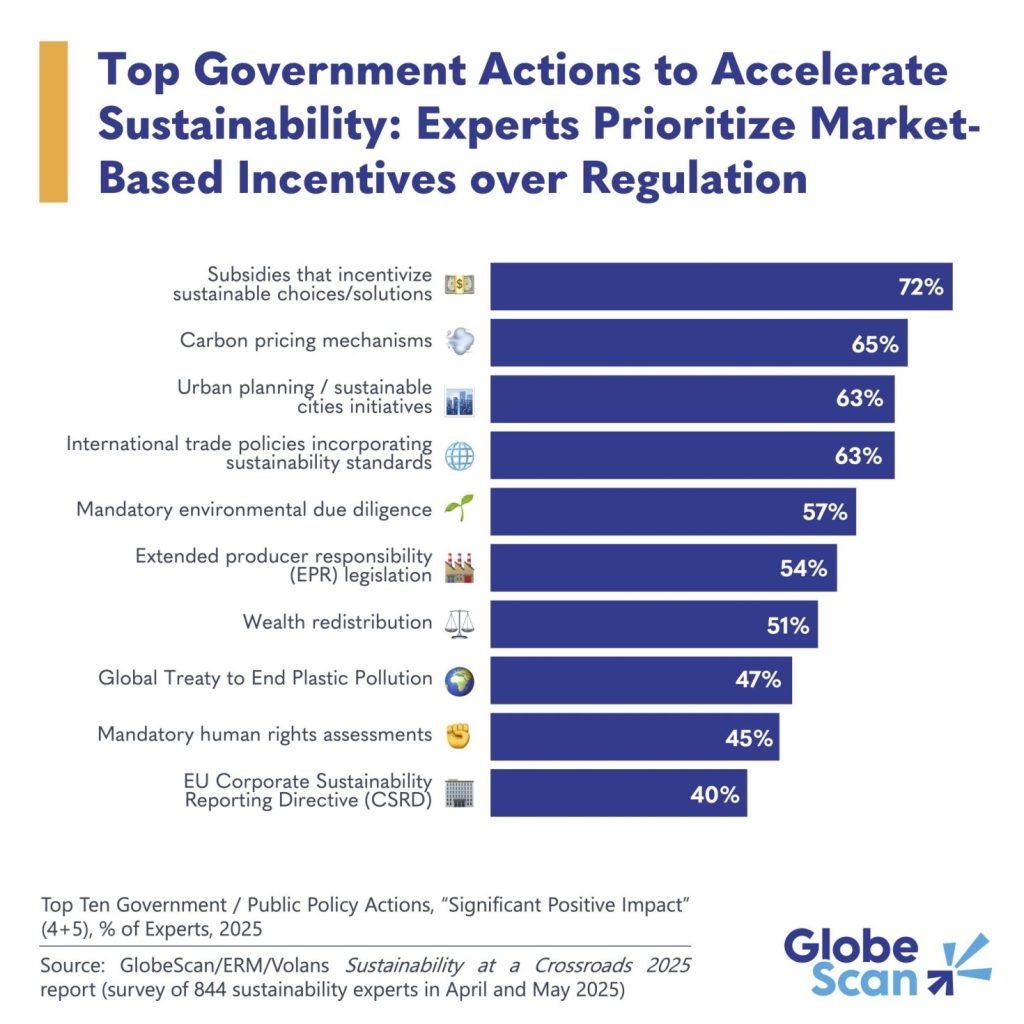
Many sustainability experts say judicial action is one of the most powerful tools civil society can use to drive sustainability outcomes in the near term, according to a global survey by Trellis data partner by GlobeScan in collaboration with ERM and Volans. This view has gained significant traction in light of the International Court of Justice’s historic advisory opinion on climate change issued in July, which declares that a clean, healthy and sustainable environment is a fundamental human right.

The ICJ’s landmark ruling affirms that countries have legal obligations to prevent environmental harm under international law. Crucially, the ruling finds that states failing to meet their climate commitments are in breach of international law and that they must cooperate to achieve concrete emissions reduction targets. This reframes climate action as a legal imperative rather than a policy preference, and elevates the strategic importance of litigation, legal systems and accountability mechanisms in the global sustainability agenda.

Alongside legal avenues, experts also point to education and leadership development, policy advocacy and media scrutiny as top civil society strategies to accelerate progress. In contrast, less structured or symbolic approaches, such as NGO campaigns, public protests or boycotts are seen as less impactful in achieving systemic change.

What this means

The ICJ’s advisory opinion may be a turning point for climate justice. Although technically not legally binding, it sends a powerful message that could reshape international climate negotiations and jurisprudence. For the more than 3,000 pending climate lawsuits globally, the ICJ’s affirmation of legal obligations offers fresh momentum and potential legal precedent for holding governments and corporations accountable.  

For businesses and policymakers, this means climate litigation risk is rising. The advisory opinion may also influence the tone of negotiations at COP30, fueling increased pressure for enforceable targets and climate finance for vulnerable countries.

Looking ahead, legal action may no longer be a last resort and could instead become a primary lever in the sustainability toolbox. Companies would be wise to monitor evolving legal norms, proactively align with international commitments and embed climate risk into their governance and strategy before courts and public pressure force their hand.

Based on a survey of 844 sustainability practitioners across 72 countries conducted April-May 2025.

The post See you in court: Judicial action is key driver of sustainability outcomes appeared first on Trellis.

Klean Kanteen helped to popularize plastic-free, reusable water bottles, weathering two decades by focusing on durable products rather than chasing aggressive growth. Ideals of serving “people, planet and profit” have helped the certified B Corporation endure recent challenges including tariffs that are uniquely hurting smaller businesses. In addition, the brand is adapting from a 2024 buyout and competing against copycats and the persistence of single-use plastic.

“We maintain by staying core to who we are and why we originally started, and not deviate too much from that,” said Global Product Manager Hunter Shoop. 

Standing against plastic

Privately held Klean Kanteen, which does not release sales figures, is navigating its share of the growing, $1.45 billion global market for stainless steel bottles. That will reach $2.08 billion by 2032, according to Data Bridge Market Research.

That said, with two supplier plants in China, Klean Kanteen has found the erratic tariff policies of the Trump administration a challenge. “They’ve jumped from single digits to triple digits, so it’s a pretty large impact on the business,” Shoop said. So far, Klean Kanteen has capped price increases to about $2 on certain products. Its 27-ounce bottles now list for $21.95.

The tariffs have not hurt Klean Kanteen’s sustainability efforts, though, which include working with suppliers to monitor their renewable energy usage and carbon footprints, according to Shoop.

Nevertheless, the Chico, California, business continues to swim upstream in its mission to provide alternatives to single-use plastic:

  • Disposable plastic water bottle sales skyrocketed by nearly 3,000 percent between 1997 and 2021 in the United States, according to the Container Recycling Institute. 
  • People toss more than two-thirds of the 86 billion bottles sold annually. 
  • That $4.34 billion worldwide plastic bottle market will hit $6.46 billion in 2032, according to Fortune Business Insights.

Northern California roots

A father, son and daughter took over Klean Kanteen 19 years ago from Robert Seals, a Northern California sculptor who shaped the initial steel vessel. He had made Klean Kanteen a fixture at green festivals, music fairs and grocery co-ops. As some of the first stainless steel refillable options on the market, they appealed to consumers who considered single-use plastic water bottles severely uncool. (Shout out to my early-aughts model from Solar Festival in Hopland, California.)

The company had a headstart against mainstream fears over the health harms of drinking out of plastics, such as cancer, infertility and poor brain development. That gained momentum in 2008, when Walmart yanked plastic bottles containing toxic bisphenol-A from its shelves. Klean Kanteen also rode the wellness wave as bring-your-own-bottle hydration became the norm for gym rats and elementary schoolers.

In February 2024, the family-owned company allowed a third party to take over a controlling stake. That English investor, Think Better Group, is a mission-focused brand-holding group for sustainable products. It’s part of ABN AMRO SIF of Amsterdam, a $571 million institutional impact fund. Its other holdings include Ecoriginals diapers, Colonna Coffee and Minor Figures beverages.

“They’re bringing in some optimization and things like that, but for the most part, we still get to run independently, and it’s business as usual,” Shoop said.

The staff of roughly 40 people often sees the co-owner siblings, Michelle Kalberer and Jeff Cresswell, as the first in the building each day. “Their desks are literally out in the open in the middle of our offices,” Shoop said.

Pursuing certifications

“Everything that we do is around sustainability, trying to drive our footprints down, monitoring and measuring with third-party certifications,” Shoop said.

For instance, Klean Kanteen aligns its climate emissions reductions with those of the Science-Based Targets initiative, although it’s not formally pursuing validation. The goals include a 58.8 percent drop in emissions from Scopes 1 and 2 from a 2016 baseline by 2030, and a 30 percent Scope 3 reduction compared with 2019. The company is also Climate Label Certified.

By contributing 1 percent of gross sales to the 1% for the Planet program, Klean Kanteen has supported 135 nonprofits over 20 years. It will reach $5 million in giving this year, according to Caroleigh Pierce, who leads the company’s partnership and community engagement efforts.

Prizing durability

Making long-lasting, durable products that can be repaired and ultimately recycled underpins Klean Kanteen’s materials and design choices.

“When at all possible, we try and make our products so they can be repaired,” Shoop said, “or making sure that they could also be disassembled for proper end of use.”

A single-wall, non-insulated bottle remains Klean Kanteen’s best seller, especially in Europe. However, insulated bottles are increasingly popular, and an oven- and microwave-safe reusable food box also sells well. 

The company has spruced up bottle designs with colors and patterns, customizing caps for different beverages, but it hasn’t wildly diversified its product lineup. 

Strong sales of replacement kits for lids and their silicone gaskets reflect that customers are buying in to Klean Kanteen’s circularity strategy. How-to cleaning and maintenance videos encourage lifetime use.

Materials and safety

In addition to the circular-economy focus of durability, Klean Kanteen introduced 90 percent recycled steel in all products several years ago. 

“There are other brands that are starting to dabble a little bit here, a little bit there, but we made a commitment to jump all in,” Shoop said. The company worked with the raw steel manufacturer, not just the sourcing managers.

That recycled content, certified by Intertek, includes reclaimed steel from sources such as industrial equipment and even used kitchen appliances and tableware. The steel, a rust-proof alloy of 18 percent chromium and 8 percent nickel, doesn’t leach chemicals or flavor the water it holds, according to the company. 

In addition, Klean Kanteen introduced a Klean Coat finish several years ago to prevent color chipping and dents. The finish is applied by spraying a powder of electrically charged polyester resins that is then heat-cured. 

The company uses the GreenScreen for Safer Chemicals standard to ensure the coating is free of lead, BPA and phthalate chemicals.

Unlike aluminum bottles, stainless steel bottles have no plastic lining. Instead, an electropolish finish smoothes out microscopic irregularities inside each bottle.

Klean Kanteen uses a chemical hazard analysis for its bottle components and packaging as well.

Its focus on chemical safety is reflected in partnerships with the Environmental Working Group and the Breast Cancer Fund. 

Small hangtags for retail displays comprise much of Klean Kanteen’s packaging footprint, although plastic bags wrap products that are shipped. The company tried biobased plastic packaging but reverted to recycled petroleum plastic, which was more likely to be recycled.

Lots of sales happen online, including from Amazon. That said, “We’re not losing sight of our roots and where we started,” Shoop said. “So we’re still in those organic grocery stores and the smaller chains.”

The post How Klean Kanteen steeled the water bottle market appeared first on Trellis.

The potential impacts of unchecked climate change — flooding, drought, resource scarcity, even lawlessness — are certainly familiar to Trellis readers. But seeing such catastrophes actually unfold provides a deeper perspective, highlighting how individuals and societies might cope — or not! — under the strain of environmental collapse. 

With that in mind, we’ve curated nine films that professionals in the sustainability field are bound to enjoy — or at least enjoy hate watching. Are we suggesting a screening for your next offsite? Not necessarily. Would we show up? We look forward to the e-vite.

Mad Max

For those unfamiliar with this Mel Gibson-before-he-lost-it classic from 1979, a quick catch-up: Max is a former policeman navigating a lawless society in a world ravaged by ecological collapse and resource scarcity. At its core, Mad Max asks what happens when communal guardrails vanish and violence reigns, ultimately standing as a warning about the fragility of society. Gritty and iconic, a little funny and a lot terrifying, the movie once held the Guinness World Record for the highest box-office-to-budget ratio.

Waterworld

Upon its release in 1995, Waterworld was the most expensive movie ever made (budget: $175 million) — and a box office flop. (Then again, so was The Wizard of Oz.)  But even if you’re not a Kevin Costner fan, this action-packed thriller is worth a watch. Set in a future in which the ocean has submerged most of the planet, the film follows a mutant survivor who encounters all sorts of obstacles as he seeks dry land. In a nutshell: Resources are scant, refuge is elusive and the argument for fighting rising sea levels at all costs is clear and convincing. 

WALL-E

As charming as it is sobering, Pixar’s WALL-E (2008) follows the eponymous robot as he dutifully tries to clean up an Earth destroyed by waste. After stumbling upon remnants of human life, he’s taken on an eye-opening galactic journey. With minimal dialogue —but a lot of beeping and booping — and powerful imagery, this family-friendly multiple Oscar winner delivers a harsh message about climate change in a gentle manner suitable for even the youngest viewers.

The Age of Stupid

On a planet that lies in ruins, a lone archivist reflects on why humans failed to act when they still had the chance. This 2009 blend of documentary footage, dramatized accounts and animation draws a clear line between today’s decisions today and tomorrow’s consequences, reminding viewers that the window for meaningful change is finite. In the words of one Financial Times reviewer, The Age of Stupid offers “the wisdom of hindsight, today.”

Snowpiercer

After a failed climate intervention leaves the world frozen, the last survivors find shelter aboard a perpetually moving train segregated by class. When the lowest rung of humans decides to take over the elite’s front car, things take a revolutionary turn. Snowpiercer uses its dystopian setting to explore a present truth: that climate disasters often deepen existing societal divides. Visually striking and thematically bold, the 2013 film challenges viewers to question who should hold the power when the world stops turning. Wrote The New York Times in its review: “​​Planetary destruction and human extinction happen a half-dozen times every summer. It’s rarely this refreshing, though.”

Don’t Look Up

Two astronomers discover an impending, literally Earth-shattering disaster and set about spreading the word — only to be met with apathy and disdain. The star-studded cast (Leo!, JLaw!, Streep!) of Don’t Look Up (2021)adroitly dramatizes the consequences of ignoring such urgent real-life issues as climate change denial and media sensationalism, wrapping a now-or-never call to action in an edge-of-your-seat story. 

How to Blow Up a Pipeline

This Independent Spirit Awards winner (for best editing) from 2022 follows a group of young activists as they plan to sabotage fossil fuel infrastructure. Through the lens of radical action, How to Blow Up a Pipeline communicates the gravity of the climate crisis, particularly as perceived by our youth. Inspired by understandable real-world frustration with institutional inaction, it raises controversial yet compelling questions about civil disobedience, violence and environmental justice.

The End We Start From

Set in a near-future London submerged by catastrophic flooding, The End We Start From (2023) follows a new mother fighting for her baby’s survival. As infrastructure collapses, her journey turns into a personal tale about the quiet ferocity of motherhood. The movie received nine nominations at the 2023 British Independent Film Awards, a testament to its emotional depth and atmospheric storytelling. 

Flow

In this animated, wordless odyssey from 2024, a cat navigates another post-apocalyptic, submerged world. Crisis, in the movies at least, often makes for strange bedfellows, and along the way our protagonist finds companionship in a dog, a lemur, a capybara and a bird. Together they drift past drowned cities and tangled ruins, the destruction stunningly rendered. Flow, infused with feelings of cooperation and resilience, earned an Oscar, the first Latvian movie to do so.

The post 9 meaningful movie nights for the sustainability minded  appeared first on Trellis.

When RMI surveyed carbon market participants over the past couple of years, the non-profit heard tales that will be familiar to anyone who has navigated the ecosystem’s confusing array of document and data types. Project developers reported spending up to 60 percent of their time dealing with requests for data. Buyers said due diligence could take as long as 18 months.

In July, the organization unveiled its solution: an open-source framework designed to “bring structure to the vast universe of carbon credit data.”

The potential benefits of RMI’s Carbon Crediting Data Framework (CCDF) are already evident in a pilot catalogue of carbon credits developed by Centigrade, a startup that is partnering with the non-profit. On display are climate projects ranging from fuel-efficient cookstoves in Guatemala to forest conservation in Mississippi. Potential buyers and other users can click through to a wealth of information, presented in standardized form for each project. Data points include number of available credits, estimated price and ratings from third-party agencies.

Hundreds of data fields

Underneath the hood of Centigrade’s system is a framework based on at least 570 fields, grouped into categories and sub-categories. The fields were chosen by RMI’s Carbon Markets Initiative team and integrate methodologies from major registries, including Verra and Puro.earth; quality criteria from the Integrity Council for the Voluntary Carbon Market; and templates for suppliers, such as those developed by Frontier, a coalition of carbon removal buyers.

Widespread adoption of the framework would bring multiple benefits, said Bonnie Lei, an RMI principal. Project developers could make a single set of data available for potential buyers, eliminating the duplicative effort of replying to several different sets of questions. And buyers could assemble candidate projects in a data room for easy comparison. 

Making it easier for buyers to assess credit quality is a focus of the project, added Lei. Free-to-access databases of credits already exist, including one developed by the Climate Action Data Trust, a stakeholder initiative founded by the World Bank and others. But the CCDF is designed to extend these projects by providing additional data. 

“You really need to be able to go into these sets of fields that get into understanding the emissions components of the credit,” said Lei. “As well as the social, environmental dimensions, which we believe are really important and distinguishing for credits.”

One schema to rule them all

To realize the vision of a unified data framework, the CCDF’s backers now need to persuade market players to back it. One wrinkle here is that RMI’s framework is not the only game in town. Sixteen schemas have been submitted to the Carbon Data Open Protocol (CDOP), a stakeholder initiative designed to develop a common data framework. The project is co-chaired by RMI, which has submitted the CCDF alongside the others. Lei said she expected the different options to be inputs into a single framework that will be published in stages, with the first release planned for Climate Week NYC in September.

If and when the CDOP committee reaches an agreement, adoption will still be a challenge. “There are real costs in terms of coordination and implementation to pulling off this sort of standardization,” said Grayson Badgley, a research scientist at CarbonPlan, a nonprofit that analyzes climate solutions. “Everyone already has their systems in place and I’d imagine changing things comes with all sorts of edge cases and risks. First and foremost, the incentives and benefits of standardization need to outweigh those costs.”

It’s also worth noting that data standardization does not inevitably mean that project developers will share all the information needed to fully evaluate projects. “It’s equally important that everyone can access the actual project and credit data itself,” said Badgley. “That would help make sure that everyone — buyers, sellers, researchers — has the ability to study and evaluate the performance of both individual projects and the market as a whole.”

The post RMI takes aim at the messy data that plague carbon markets appeared first on Trellis.