
A growing number of consumer products companies are experimenting with packaging that can be reused or refilled, but their tests usually start with niche brands. Personal care company Kiehl’s is breaking that mold, offering refillable options for several of its most popular products, including its best-selling Ultra Facial Cream and Ultra Facial Oil-Free Gel Cream.

A half-dozen items comprise the Kiehl’s Refillery program, which gives customers the option to refill in store or to buy pouches to refill existing containers two to three times, depending on the product. In addition to the two facial creams, they include the Creme de Corps body moisturizer, Grapefruit Bath and Shower Liquid Cleanser, Amino Acid Shampoo and Amino Acid Conditioner.

Sales of the refillable packaging, which is offered alongside traditional options. doubled in 2024, and the refill stock keeping units (SKUs) accounted for 16 percent of transactions for the six products, said Maggie Kervick, vice president of sustainability and corporate responsibility for Kiehl’s. The 174-year-old brand, which started in New York’s East Village, was acquired by L’Oreal in 2000. 

“I’m not allowed to share specific sales figures,” Kervick said, “but what I can say is that last year we saw a huge acceleration on refills.”

What makes a refillable packaging candidate

The Kiehl’s refill program launched in April 2021 with hair and body products because consumers often buy them in bigger containers before transferring them to smaller ones that fit in a shower or on a vanity top. The company expanded the program to include its best-selling face cream in part to bring scale to the data it collects.  

There are three major considerations for Kiehl’s product teams when they ponder a refillable version:

  • Whether the ingredients of a particular formula are sensitive to air exposure or have a limited shelf life after they’ve been opened. 
  • When the product might be updated for other reasons.
  • How frequently a product needs to be replenished.

With those things in mind, “We can start to offer a solution knowing that they’re the products that people really want, that are well established and beloved,” Kervick said.

Person's hands pumping product into a container.
An associate dispenses product from a Kiehl’s in-store refillery.

In-home strategy: Refillable pouches

Kiehl’s two-pronged approach features refills completed by associates in the Refillery section of company stores and the sale of products in multi-material, light plastic pouches.

The 150-milliliter facial cream pouch refills the original 50-milliliter jar three times and results in a 61 percent reduction in packaging materials, according to Kervick. Similarly, the shampoo pouch refills the original bottle twice and reduces the product’s plastic footprint by 81 percent.

Any brand offering refill options, though, needs to be flexible with its approach, said Jamie Hall, co-founder and chief customer officer at consulting firm Pentatonic.

“Convenience remains absolutely paramount to either channel,” said Hall, referring to in-store and in-home options. “Both work, and you have to be able to do both, but both will not appeal to all parties.”

Environmental impact: An ‘imperfect’ option 

The downside of Kiehl’s current in-home option is that the multi-material makeup of the pouches means they aren’t readily recyclable, rendering them an “imperfect solution,” Hall said. Kiehl’s doesn’t translate plastic reductions into emissions reductions, at least not publicly.

Kiehl’s evaluated and tested many other materials, including a paper-based option, before opting for lightweight plastic. (The main challenge with paper is evaporation for water-intensive products.) In 2026, the company will transition to a monomaterial, plastic film that “will allow them not necessarily to be recycled but to be designed into the system we are all hoping that we will get to,” Kervick said.

Kiehl’s standard format containers contain 38 percent post-consumer recycled content.

The brand is also lightweighting its jars and switching from PET (polyethylene terephthalate) plastic to PP (polypropylene), a move motivated by extended producer responsibility legislation being adopted by states such as California, Oregon and Colorado. “I think we see refills as one of our key levers to help drive things like source reduction,” she said.

That lightweighting process is challenging, because many consumer brands promote hefty packaging as part of their value proposition. “I think the traditional model of weight equals luxury has taken a while to shift,” Hall said, pointing to liquor brands as an example. L’Oreal, for one, is beginning to address packaging intensity across its entire portfolio.

Creating the refill pouches also required Kiehl’s to change how packages are filled; that meant pulling the process into its production rather than having that step handled externally. The company is “working through some of the technical challenges around the filling, making sure it’s a secure process,” Kervick said.

Logistics is one of the biggest obstacles for companies seeking to introduce refill options, said Nicole Smith Ray, senior manager in the climate change and sustainability services practice for EY. “How do you engage the consumer?” she said. “How do you get the right reverse logistics?” Another worry for some brands is losing control of their identity as packaging gets simpler and lighter, she said.    

Refills as customer recruitment strategy

Kiehl’s prices its refill pouches so customers wind up with a discount versus what they’d pay for the same amount of product in regular packaging. For example, they pay $70 for the Ultra Facial Cream pouch at retailers such as Sephora, and $117 for jars.

The brand’s team is tracking traditional metrics as it evaluates progress, including sales margin and customer adoption. It’s also closely studying the product mix in different retail settings. Kiehl’s product marketers in South Asia, for example, see refills as a way to engage customers that aren’t active, Kervick said. 

The post Inside Kiehl’s program to sell its popular facial cream in refillable containers appeared first on Trellis.

It’s not news that it’s a particularly challenging moment to be a sustainability professional. Compliance demands and complex regulatory landscapes have stretched resources thin. The shifting political climate in the U.S. has raised questions about some companies’ commitment to sustainability. And several executive orders from the current administration have left some professionals feeling as though their work has been sidelined — or even outlawed. What may surprise you, though, is the large number of people who remain interested in this career path. 

As a sustainability job search coach, I’m still seeing people get hired in this field every day. And I’m often asked about what corporate sustainability work is like and what experience is necessary to be a competitive job applicant. While there are multiple factors to consider, there are six top questions that I ask my clients to help them determine if a career in corporate sustainability is right for them, and what types of roles they should pursue. 

Answer these questions as honestly as you can and I invite you to let me know of other questions you think should be added to this list.

1. Which sustainability issues do you want to work on?  

This is perhaps the most important question I ask my clients, because their answer will affect every other decision they make. Different companies work on different issues depending on what’s material to their business. 

While virtually every company in the world has the opportunity to work on reducing their carbon emissions, a clothing retailer such as Patagonia will have more opportunities to reduce waste and advance the circular economy than an accounting firm would. If you’re eager to work on human rights or deforestation, a company that procures problematic materials or sources from areas of concern would be a good choice.  

Considering what sustainability issues you’d like to work on will help you determine the impact you’d like to make — and therefore the companies you’d like to work for.  

2. How direct of an impact would you like your work to have? 

Some corporate sustainability work delivers a sense of direct, tangible impact. It’s rewarding when your waste diversion project launches, your solar panels are installed or your decarbonization goal gets approved. Other work happens behind the scenes: greenhouse gas accounting, ESG data management or reporting and disclosure. 

Corporate sustainability teams vary greatly in size and how they divide up responsibility for different work streams. Some roles are more generalist and involve a bit of everything, while others are more specialized. 

Consider how tangible the impact of your work needs to be. That assessment will help you determine which team structures and roles would be the best fit for you.  

3. How ambitious does the organization you work for need to be?

Consultants Steve Rochlin and Jeff Senne recently published an article that describes how companies define the purpose and role of sustainability for their organizations. The authors explain that companies exist on a continuum somewhere between “box checker” and “impact and purpose focused.”

Innovative work by leading companies often inspires newcomers, but often causes them to limit their job search to only the most high-profile, purpose-driven organizations. However, it’s important to understand that there are huge impact opportunities in helping “box checker” companies grow into something more. For example, I have friends who specialize in taking companies “from zero to 15 mph” and gain immense satisfaction from building programs entirely from scratch.  

Advancing sustainable business practices delivers social and environmental benefits at companies of all types — regardless of where they are on their sustainability journey or what motivates their efforts. Thinking about how much a company’s level of ambition or motivation matters to you can help you determine which companies you’d like to work for. 

4. Are you (very) comfortable with change?

The past six months have been an important reminder that nothing in this profession stays the same for very long. For example, current and proposed changes to cornerstone legislation such as the Inflation Reduction Act (IRA) and the Corporate Sustainability Reporting Directive (CSRD) have put many clean energy, resilience and environmental justice projects on indefinite hold and the way companies communicate about sustainability has changed virtually overnight. The landscape of tools that we use for analysis, data management, goal setting and reporting is famous for its state of constant evolution. And while the profession is maturing and we’re starting to see more consistent career pathways emerge, the skills required for success are always shifting. It’s common for people to need to change companies in order to grow into the next level of responsibility.  

People with balanced perspectives on change and a track record of adaptability tend to flourish in corporate sustainability, such as Google’s CSO Kate Brandt. Consider how well you respond to change because it’s a constant in this profession. 

5. Are you a (very) patient team player?

Implementing systemic change across a global organization is both a long game and a team sport. Developing key stakeholder relationships, socializing business cases and operationalizing new processes can take months, if not years. Progress often happens in fits and starts. 

The most effective corporate sustainability professionals are able to build and maintain partnerships that balance making progress on long-term objectives while addressing short-term priorities. Consider how patient and collaborative you are, as these attributes are critical drivers of success. 

6. Do you have the skills you need to be successful?

There are a lot of misconceptions out there about what skills corporate sustainability requires. I’ve had people tell me they’re not qualified to work in sustainability because they don’t have a background in climate science or they don’t have a policy degree. Neither of these things will prevent you from working in this space.  

This is multifaceted work with many kinds of roles. While the profession is becoming more specialized and many positions do require experience with specific tools or frameworks, there are still plenty of roles that are accessible to candidates with relevant transferable skills. Most corporate sustainability teams look for applicants with strong communication, problem-solving and cross-functional collaboration skills and value experience in project management, data analytics or reporting.   

Assess which roles align best with your current experience and identify whether targeted upskilling is necessary before launching your job search. There are hundreds of providers offering courses on sustainability training that can help you build expertise.   

Corporate sustainability is deeply rewarding work for professionals who have clarity of purpose and are adaptable, patient, collaborative and driven. While the current environment is undeniably challenging, we have weathered similar storms before — and both the people and the profession have emerged stronger for it.  

The post Is a corporate sustainability career right for you? Ask yourself these 6 questions appeared first on Trellis.

Cotopaxi breaks the backpack status quo, replacing the sober earth tones typical of trail gear with a trippy patchwork of colors stitched together from material that would otherwise go to waste.

The Pucci-like color blocking not only brings attention to the Salt Lake City-based outdoor brand’s totes and satchels, it also reflects a pillar of its sustainability strategy. The multicolored panels often come from deadstock, “pre-consumer” leftovers of garment production — fabric rolls, unsold merchandise and canceled orders.

Deadstock appears in roughly 60 percent of the company’s products, says Cotopaxi Vice President of Sustainability and Impact Annie Agle, specifically, in its nylon-and-polyester Del Día bag and polyester Teca jacket collections. That’s up from 36.6 percent in 2023.

“There’s a lot more of a business case for the commercial upside of circularity” than for decarbonization, Agle said, referencing the challenges presented by Trump’s topsy-turvy tariffs and attacks on environmental, social and governance (ESG) activity. What she sees as the sustainability space’s failed “tactical” approach to chasing net zero targets has come at the expense of more creative solutions.

“Everything was about pushing reductions everywhere possible, which I think is great, but if you look at Cotopaxi, for example, our entire carbon inventory is under 40,000 tons of carbon,” she said. “That is a penny in the bucket.”

So Cotopaxi is homing in on circularity operations, from a two-year-old resale program to big-picture, alternative business models.

“How do we produce fewer things while still creating a sense of abundance? How can we deliver newness through resale? How can we ensure affordability on non-tariff items that are from products that have already cleared customs? There are a lot of clever concepts that will allow us to pivot successfully during these times.”

Dealing in deadstock

Last year, Cotopaxi worked some 101,182 yards of leftover fabric — roughly 1,000 football fields worth —into its collections, according to its 2024 impact report, released April 22. That helped the private company to meet its goal of every item containing either recycled, repurposed or third-party certified “responsible” materials. 

“While the textiles themselves might not have huge amounts of other sustainability features, it still decouples us very successfully from fossil fuels, by using what’s available,” Agle said. “In many situations, that fabric would almost certainly end up in landfill or incineration.”

Deadstock could amount to 6.3 million tons out of the 35 million used to produce fashion each year, according to the Ellen MacArthur Foundation, while overproduction could contribute as much as 20 percent of the textile industry’s greenhouse gas emissions.

In the decade ahead, Cotopaxi is striving to phase out “harmful or high-impact materials” as it emphasizes low impacts to nature, transparency and traceability, as well as ethical practices in its supply chain. 

Manufacturing and materials contribute the majority of Cotopaxi’s climate emissions. The company says it’s already on track to meet its Science-Based Target initiative (SBTi) net zero goal for 2040. Its carbon intensity score, a measure of carbon dioxide per unit of revenue, is less than 1 percent.

Cotopaxi's limited Renovo collection used upcycled materials.
Cotopaxi’s limited Renovo collection uses upcycled materials. Credit: Cotopaxi

Two llamas and a mission

Cotopaxi was purpose-driven from its start in 2014, certifying as a B Corporation a year later. It donates 1 percent of revenues to environmental groups through the nonprofit 1% for the Planet. 

Founder and Chairman Davis Smith, raised largely in Latin America, named the company after an Ecuadorian volcano. Early on, he bought a pair of llamas on Craigslist to build buzz on college campuses. Cotopaxi grew to profitability around 2019 and exceeded $140 million in sales in 2023.

The company has made several recent leadership hires, including promoting CFO and COO Lindsay Shumlas to CEO in December, and enlisting former Hoka President Wendy Yang as executive chair.

Patchwork ‘here to stay’

The company’s circularity strategy also includes product repairs and the Más Vida resale program. In 2024, its secondhand sales saved roughly 4 metric tons of materials from being wasted and 43 metric tons of CO2 from being emitted, according to Cotopaxi. That’s equivalent to about 27 round-trip flights from New York City to London. Cotopaxi also partnered with Portland Garment Factory on a capsule collection of upcycled clothing last year.

“Tier 2 for us is definitely where we see the most amount of emissions, the most amount of water use,” Agle said, of the supply chain impacts of circularity. “With deadstock, all of those inputs, all of that energy, all of that water, all of that chemistry has already been used. So using what we have definitely decreases new water usage.”

“The patchwork approach to reusing materials is here to stay,” said Cynthia Power, a fashion circularity consultant in New York state and host of the Untangling Circularity podcast. “Deadstock is a great option to lessen impact for as long as it’s a by-product of the textile industry.”

Power advised companies to experiment with circular business models and materials. “Those programs are going to take time to evolve and actually work, so they may not cut emissions tomorrow,” she said. “But if brands can refine and grow them over time, we can create an actual pathway to producing less new stuff, which is a huge goal that feels impossible to most right now.”

More brands seeking a circularity advantage are looking to deadstock. For example, pre-consumer leftovers made up 14 percent of Reformation’s sourcing in 2024, nearly double the amount from the previous year. The North Face crafts its Remade collection of jackets from spare parts of damaged apparel in the Tersus Solutions plant in Englewood, Colorado. Eileen Fisher’s Mended collection takes a similar approach to blouses.

Even Shein, the direct-to-consumer fashion juggernaut and perhaps the industry’s biggest polluter has embraced deadstock. It partners with Aloqia, formerly Queen of Raw, to help source it. So does Cotopaxi. 

Agle, though, expressed little love for fast fashion’s modest circularity plays. “Do I think for a company like that, it’s enough to only pursue a solution like that? No,” she said.

Instead of such incrementalism, Cotopaxi strives for a “holistic” approach to repurposing waste. “Making the choice to not design for trend is a choice we made, and it’s a really significant choice,” said Agle.

The post Deadstock is key to Cotopaxi’s circularity strategy appeared first on Trellis.

AstraZeneca has won approval from the U.K. government for a low-carbon version of its Trixeo Aerosphere, a widely used therapy for chronic obstructive pulmonary disease (COPD).

The first-of-its-kind device replaces the conventional propellant found in most inhalers — which emit significant amounts of greenhouse gases — with HFO-1234ze(E), a next-generation alternative with a 99.9 percent lower climate change impact, according to the company. 

The UK’s Medicines and Healthcare products Regulatory Agency approved the new device for clinical use on May 9. 

Clinical trials demonstrated that the updated formulation delivers the same dose and therapeutic effect as the original version, ensuring that safety and effectiveness are not compromised.

“Inhaled medicines delivered by pressurized metered-dose inhalers (pMDIs), like Trixeo Aerosphere, are the most-used medicines in respiratory care; they’re nearly 80 percent of all global inhalers used,” Caterina Brindicci, senior vice president and global head research and development, respiratory and immunology at AstraZeneca, told Trellis in an email. “This global first demonstrates that clinicians and health systems can benefit without compromise — they can select the treatment that best addresses their patients’ needs whilst also supporting environmental goals.”

The new Trixeo will become available in the U.K. in the second half of 2025.

Health care’s large footprint 

Inhalers are essential for millions of patients with respiratory issues; they are also a surprisingly large contributor to healthcare emissions. Pressurized inhalers like Trixeo typically use hydrofluorocarbon propellants, which are potent greenhouse gases. Inhaler emissions currently account for 3 percent of the U.K.’s National Health Service (NHS) carbon footprint and about 0.04 percent of total global emissions.

The wider life sciences sector is similarly carbon-intensive. A 2019 study found that pharmaceutical companies produce, on average, 48 metric tons of CO2-equivalent per $1 million in revenue — about 55 percent more emissions per dollar than the automotive industry. In total, the healthcare sector is responsible for roughly 4.5 percent of global greenhouse gas emissions, much of it tied to pharmaceutical production, procurement and use.

AstraZeneca’s move is part of its Ambition Zero Carbon strategy, which aims to transition its entire pressurized inhaler portfolio to the new propellant by 2030. 

“We’re investing over $500m to transition our portfolio of medicines delivered by pMDIs to the next-generation propellant, at no additional cost to patients or the healthcare system,” Brindicci said. 

Coming to the U.S.

Regulatory reviews are underway in the European Union and China, Brindicci said, for Breztri Aerosphere — the brand name under which Trixeo is sold in many markets. AstraZeneca is also working to bring the next-generation propellant inhaler to U.S. markets, though it could not confirm a timeline.

“The transition of Trixeo to the propellant with near-zero [climate impacts] means that healthcare professionals can focus on optimising outcomes for their COPD patients based on clinical need, while also supporting climate goals,” said Omar Usmani, professor of respiratory medicine at Imperial College London, in a statement. “Clinicians and their patients shouldn’t feel that they have to choose between the most appropriate treatment and the planet.”

Trixeo is not the first attempt to reduce inhaler emissions. Dry powder inhalers — which don’t require propellants — already offer a lower-carbon alternative and are widely prescribed. However, they aren’t suitable for all patients. Children, older people and patients with difficulty breathing may struggle to use dry powder devices effectively, and some patients feel more secure using a pressurized inhaler during acute episodes.

Biotech giant GSK is also working on low-carbon versions of pressurized inhalers. The company aims to begin regulatory submissions this year for a next-generation version of its Ventolin (salbutamol) inhaler using a low-GWP propellant. Ventolin, used by 35 million patients worldwide, accounts for 49 percent of GSK’s total carbon footprint.

The next-generation devices must remain chemically stable, deliver the correct dose and have a long enough shelf life to be viable in the real world — all while meaningfully releasing their impact on the planet. ​​ 

With the U.K. green light of AstraZeneca’s Trixeo, the regulatory path is clearer. The door is now open for others to follow and for the healthcare sector to continue to reduce its climate footprint.

The post AstraZeneca’s low-carbon inhaler virtually eliminates climate impacts appeared first on Trellis.

While the current political environment may be changing when it comes to environmental efforts (pass the plastic straw, please), a recent poll shows demand for sustainable products in the U.S. is strong—and growing.

When Trellis data partner GlobeScan asked hundreds of U.S. consumers about their purchasing habits in March, nearly half of Americans (49 percent) reported purchasing an environmentally-friendly product in the last month, up from 43 percent in August. Over one-third of respondents wanted to buy a sustainable product but were hindered by factors including price, limited awareness and lack of availability, highlighting a substantial unmet demand. Only a small minority—15 percent—expressed no interest in sustainable products. (Previous GlobeScan research shows U.S. consumers identify sustainable products by recycled/recyclable packaging, certifications or labels and the materials and ingredients in the product.)

What this means

Despite a shifting and sometimes hostile political climate, Americans’ interest in sustainability remains resilient. There is a clear and growing opportunity for brands to meet consumer demand by making sustainable products more available and accessible. This demand-driven momentum strengthens the business case for sustainability as consumers increasingly see the marketplace as a way to express their environmental and social values. Brands that empower consumers with credible and meaningful sustainable choices will be best positioned to earn consumer trust, build loyalty and capture market share.

Based on a survey of more than 1,000 Americans conducted March 25—March 28, 2025.

The post Survey: Nearly half of U.S. consumers say they buy sustainable products appeared first on Trellis.

Efforts by the dairy industry to address the warming caused by methane are gaining momentum, with more companies disclosing data, releasing action plans and reporting progress in reducing emissions of the potent greenhouse gas.

Agriculture creates close to 40 percent of human-caused methane emissions and livestock is responsible for most of that. With plant-based alternatives making only limited inroads into the market, companies with science-based targets are in need of methods for cutting the methane released from cattle burps and manure.

The good news is that the company with perhaps the industry’s most ambitious methane commitment appears to be on track. Danone announced this week that it had reduced methane emissions from its fresh milk supply by 25 percent since 2020, keeping it on course to hit the targeted 30 percent reduction by 2030.

Methane alliance

Danone’s announcement was one of a flurry from members of the Dairy Methane Action Alliance, an industry collaboration convened by the Environmental Defense Fund and Ceres, two climate non-profits. Alliance members commit to disclose methane emissions as a step toward creating an action plan for reducing them. The group, which includes Starbucks and Nestlé, meets every other month. 

Other alliance developments include:

  • Three more companies — Agropur, Idaho Milk Products and Savencia Fromage & Dairy — joined the group.
  • Lactalis USA and Danone published two of the industry’s first-ever dairy methane action plans. 
  • Bel Group, Clover Sonoma, General Mills and Starbucks also disclosed their dairy methane emissions.

Danone is tackling its methane challenge on multiple fronts, said Chris Adamo, the company’s head of global sustainability impact and B corp. Notable progress has come in lower-income countries, where there is more scope to cut emissions by making dairy farms more productive. This includes working with farmers to source more nutritious feed and introducing breeds of cattle that produce more milk. Danone is also partnering with Sistema, a company that has developed a modular biodigestor that smaller farms can use to process manure into fertilizer and biogas.

Danone generated $31 billion in sales in 2024, but smaller dairy companies are deploying similar tactics. Clover Sonoma sources 100,000 gallons of milk daily from 27 farms close to its headquarters in Petaluma, California. The company is on track to hit its target of cutting methane intensity by 10 percent by 2026, thanks in part to helping its suppliers access government funding for technology that processes manure and reduces emissions.

Feed additives

Neither Danone nor Clover Sonoma, though, is yet deploying another much-discussed methane-reduction approach: feed additives, which studies suggest can cut methane emissions by as much as 90 percent.

“When we jumped into the project, we had some hope that feed additives might be one of the effective levers to drive some change,” said Michael Benedetti, Clover Sonoma’s vice president of sustainability, quality and regulatory. And, in fact, a trial of a seaweed-based additive resulted in a more than 50 percent reduction. But regulatory and sourcing challenges have prevented the company from further pursuing the solution.

Costs are an issue for Danone, noted Adamo; additives are a “pure cost to the farm or to us,” he said. Other mechanisms the company is working on have their own benefits, such as reduced labor due to better manure processing.

Feed additives could still play a role, however, especially as more companies begin to disclose methane emissions and, if they choose to follow Danone’s lead, set reduction targets. There are still plenty of gains to be made using other methods, particularly by improving productivity in low and middle income countries, said Katie Anderson, senior director for business, food and forests at the Environmental Defense Fund. Elsewhere, additional mechanisms are going to be needed, she added: “We have a lot of tools today and we need to use them fully, but we’ll also need more to reach a 30 percent across-the-globe target.”

The post Companies behind dairy industry’s first methane targets show early success appeared first on Trellis.

Send news about sustainability leadership roles, promotions and departures to [email protected].

HMTX Industries, a privately held maker of vinyl flooring for healthcare and residential construction, in March moved responsibilities for environmental sustainability and social impact programs, managed for the past nine years by Chief Sustainability Officer Rochelle Routman, to the sales and marketing executive it hired in December.

Routman signaled her departure from HMTX with a recent title update on LinkedIn. There was no formal external announcement by her or the company. However, HMTX’s sustainability and impact team now sits under Trevor Stromquist, senior vice president of sustainability, sales and marketing excellence, a corporate spokesperson confirmed.

During a nine-year tenure, Routman managed a organization-wide effort to improve disclosures about the environmental impact and health considerations associated with the material used in the company’s products. 

HMTX was one of the first vinyl flooring companies to create health and environmental product declarations and complete a number of high-profile certifications, including the Just and Declare labels from the International Living Future Institute, which examine criteria such as chemicals content and employee working conditions.

“These efforts helped boost the entire sector as the other flooring companies got on board,” Routman said.

Before joining HMTX, Routman spent four years with another flooring company, Mohawk Industries, where she developed its sustainability program. Her move to the flooring industry followed more than a decade of work as an environmental specialist for utilities including Georgia Power and Southern Company, where she prepared one of the company’s first sustainability reports and presented it to the board. 

Routman’s first involvement in the sustainability field was at Lockheed from 1990 to 1999, where she succeeded in making colleagues be less reactionary about environmental issues. “That was my main goal: to get people to think ‘beyond compliance’,” Routman said. “At the time, the term was ‘pollution prevention,’ which today would be somewhat equivalent to ‘circularity’ or ‘energy or waste reduction’. The metrics were the same, but the words were different.”

Routman was recognized for her pioneering work in 2014 as part of the inaugural cohort of the Women in Sustainability Leadership Awards. Five years later, she co-founded the alumnae association that took over the awards program in the 2020 timeframe. That group focuses on creating mentorship opportunities for up-and-coming sustainability professionals who identify as women.

What’s next? Routman is exploring board opportunities with both nonprofits and corporations.

For now, she has some words of advice for future leaders. “Avoid playing it safe in your career,” Routman said. “Your skills and talents are most needed in the industries that have the greatest environmental or social impact. Don’t be shy about seeking out these opportunities.”

The post Flooring company HMTX eliminates CSO position  appeared first on Trellis.

GE’s Ecomagination initiative, launched May 9, 2005, certainly turned heads. Here was the world’s ninth-largest company, a 113-year-old conglomerate founded by Thomas Edison, inventor of the first commercial light bulb, putting sustainability front and center in its new corporate strategy.

It seems, 20 years later, paradoxically overhyped and underappreciated.

At first glance it appeared to be a slick marketing campaign, complete with fun TV commercials (such as this one, aired during the 2011 Super Bowl, featuring an electric cow). But Ecomagination turned out to be much more than that.

On the occasion of the 20th anniversary of Ecomagination’s debut, I’ve been reflecting on GE’s bold initiative and its implications for today’s companies. What did Ecomagination teach us about heavily marketed sustainability strategies? What impact did it have on GE’s business and reputation? How would an Ecomagination-like initiative fare in today’s complex business and political environment?

And what are the lessons learned from the entire effort?

What was Ecomagination?

When GE’s then-CEO Jeff Immelt took the stage at George Washington University in Washington, D.C., to announce Ecomagination, the company was seen as a laggard in sustainability, if not an outright eco-villain.

The company — which at the time manufactured everything from lightbulbs to aircraft engines to large healthcare devices such as those used for MRI and CAT scans — had a long and unenviable environmental reputation. Over a 30-year period starting in the mid-1940s, GE released more than a million pounds of toxic PCBs into the upper Hudson River, a byproduct of its nearby manufacturing of electrical capacitors. Over time, PCBs contaminated nearly 200 miles of the Hudson, making it the nation’s largest Superfund site. (In 2015, GE announced that it had removed the majority of the toxins, at a cost of more than $1 billion.)

At the same time, GE’s business customers were seeking to reduce their energy spend along with their greenhouse gas emissions. Immelt and his team saw a significant business opportunity that might also dig the company out of its reputational hole.

So GE committed to:

  • Double its annual revenue from “clean technology” products, from $10 billion in 2005 to at least $20 billion by 2010, “with more aggressive targets thereafter”
  • More than double its research investment in cleaner technologies, from $700 million in 2004 to $1.5 billion in 2010
  • Reduce its greenhouse gas emissions 1 percent by 2012 and the intensity of its greenhouse gas emissions 30 percent by 2008, both compared to 2004. (Based on the company’s projected growth, GE said its emissions would have otherwise risen 40 percent by 2012.)

Given the company’s environmental history, GE’s announcement was met with skepticism. Critics called it “greenwashing,” among other epithets, noting that the company continued to operate in polluting sectors such as coal and oil. Moreover, Ecomagination included technologies that would make oil sands production and natural gas fracking marginally cleaner, which sustainability experts and activists saw as fundamentally misaligned with true climate leadership.

GE was, though, also ramping up production of wind turbines, solar inverters, electrified locomotives and a dozen or so other truly cleaner technologies.

What went right?

The company made clear that Ecomagination was unabashedly about growing revenue. Its goal was to drive business growth through clean technology, energy efficiency and environmental stewardship, while also improving GE’s own operational footprint.

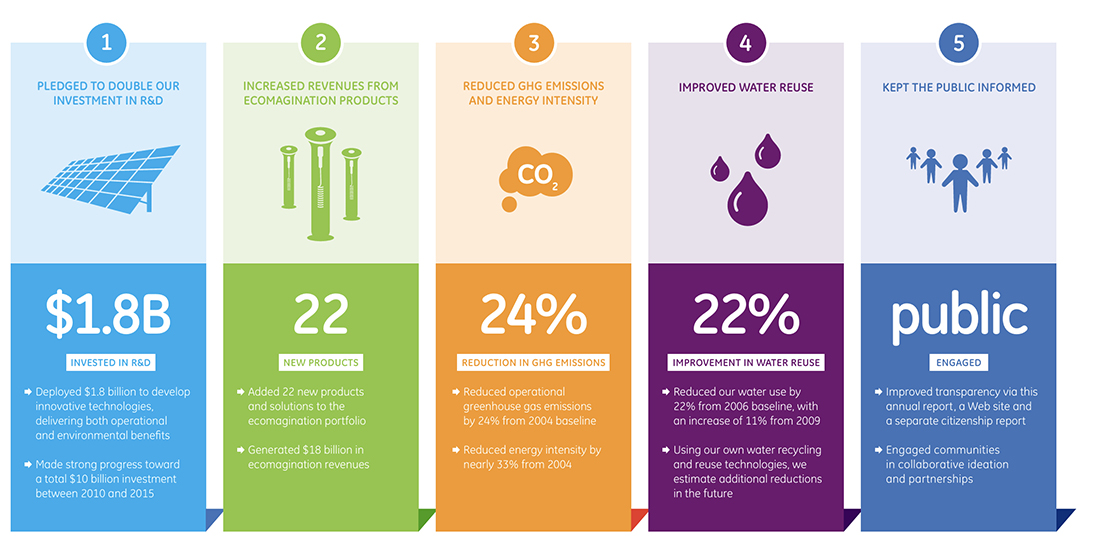
In that regard, the company exceeded its goals. By 2010, five years after launch, GE claimed $85 billion in cumulative Ecomagination revenue. (The company used a third party to assess and certify whether products and associated revenue met the Ecomagination standard.) It also could boast impressive gains in reduced emissions, water use and other metrics.

Ecomagination’s 5-year status report

A 2010 progress report on Ecomagination from GE, showing results of the first five years of the initiative.
From GE’s 2010 progress report on Ecomagination, showing results of the first five years of the initiative.

One key success factor was that Ecomagination goals were owned by the entire company leadership. “This was GE board-level approval; the biggest champion was the chairman and the CEO,” Deb Frodl, the company’s chief marketing officer at the time and later head of Ecomagination, told me recently.

Money talked. The fact that GE could show impressive revenue growth from its greener products from the get-go gave the program solid momentum, internally as well as externally.

Moreover, it won over some critics, including Mindy Lubber, CEO of Ceres who, in a previous role, led the U.S. Environmental Protection Agency in the Northeast region, including overseeing litigation related to the Hudson River cleanup. Lubber was one of GE’s eight-member Ecomagination Advisory Board.

“For the CEO of one of the largest multinational companies to sit through four- and six-hour meetings and followups to make sure input was heard and goals were clear, I think that stayed pretty consistent,” Lubber told me.

What could have gone better?

Policy support, for starters. “We thought federal policy and smart regulation would follow, and that didn’t happen,” said Frodl. “Cap-and-trade didn’t happen. The Clean Power Plan didn’t happen. There was just nothing to give us the tailwinds.”

There was also a messaging muddle. The initiative’s broad scope — encompassing both breakthrough technologies and incremental efficiency improvements — blurred the line between what was truly game-changing and what was business-as-usual. And the company’s unwillingness to divest from its “dirty tech” businesses or prioritize emissions reductions beyond legal requirements fueled skepticism about the depth of its commitment.

What was the outcome?

By the time Ecomagination was shuttered in 2017, it had achieved significant results in business growth, R&D investment, emissions reductions and other key metrics. According to Frodl, writing in 2017, during Ecomagination’s 12-year life, GE:

  • Invested $20 billion in Ecomagination solutions
  • Generated $270 billion in revenue
  • Reduced greenhouse gas emissions and freshwater that saved the company more than $480 million
  • Saved customers more than $3 billion in energy and water costs while helping them reduce more than 5 gigatons of greenhouse gases

But even those stats belie the greater changes in GE, said Frodl. “I honestly believe that it changed the company for the good. It culturally changed the mindset to be ‘We’re innovating some of the world’s most efficient technologies.’”

Could Ecomagination exist today?

It would be difficult, particularly in the United States, where political forces are keeping corporate sustainability initiatives low-key, and in Europe, where aggressive greenwashing rules would likely tamp down some of the bold commitments GE made in 2005.

That doesn’t mean it couldn’t happen, said Lubber. “It should happen in most large businesses. Informed, stakeholder input that’s done in the right way, that’s not about throwing bombs on street corners but about hearing each other, is a helpful thing.”

What were the learnings from Ecomagination?

Business first, sustainability second: Ecomagination was explicitly a growth strategy, not an environmental mission. GE’s leadership was upfront about saying that the initiative’s goal was to capitalize on the emerging demand for cleaner technologies.

Rebranding vs. reinvention: Much of the early success came from rebranding existing products (such as wind turbines and efficient turbines) as Ecomagination products rather than fundamentally transforming the business or divesting from polluting sectors. The approach, though, did raise questions about the depth of the company’s commitment to sustainability.

Scale and impact discrepancy: While Ecomagination generated billions in revenue and notable environmental progress, the achievements were modest relative to GE’s overall scale. For example, its Ecomagination Challenge, an open-innovation process that solicited ideas from individuals and start-ups to identify potential energy ventures for GE to invest in, led to $140 million of investments, a mere blip considering GE’s $37 billion energy business.

Skepticism and legacy issues: Despite public commitments and transparent reporting, GE continued to face scrutiny from environmental groups — especially around legacy pollution issues, such as the Hudson River cleanup. The company’s marketing prowess sometimes outpaced its substantive change.

Innovation and collaboration, within limits: Ecomagination’s open innovation efforts fostered collaboration and generated thousands of ideas. But the scale and timeline for these innovations to materially affect GE’s core business highlighted the challenge of integrating breakthrough sustainability into large, established firms.

In the end, the cautionary tale of Ecomagination is that even well-publicized, well-funded and board-backed corporate sustainability initiatives can fall short of transformative change if they prioritize business growth over systemic environmental impact, rely heavily on rebranding and fail to fully address legacy issues.

Still, Ecomagination demonstrated the potential of aligning profit with purpose in business, while reminding today’s leaders of the need to balance ambition, transparency and genuine transformation.

The post GE’s Ecomagination at 20: Lessons for today’s sustainability leaders appeared first on Trellis.

The House Ways and Means Committee released its initial proposal for a budget reconciliation bill, and it includes massive cuts to clean energy tax credits established by the 2022 Inflation Reduction Act (IRA). 

The proposed cuts come on top of reductions proposed by the Energy and Commerce, Natural Resource and Transportation committees. They include:

  • Early phase-out of clean energy credits. Originally scheduled to function through 2032, the Clean Electricity Production Tax Credit and Clean Electricity Investment Tax Credit would begin to fall away in 2029, leaving renewable energy projects with fewer years of financial incentives and companies with net-zero targets with fewer low-carbon options to power their operations.
  • Pullback of Department of Energy loans. Rescinding unspent billions in funds from the Loan Program Office would severely limit the impact of the Advanced Technology Vehicle Manufacturing Loan Program, which bolsters American auto manufacturing; the Energy Infrastructure Financing Reinvestment Program, which subsidizes new clean energy projects and the revitalization of communities affected by legacy energy production; and the Tribal Energy Loan Program.
  • Shrinking the Greenhouse Gas Reduction Fund. While the EPA continues to be tied up in court as it attempts to defund the $20 billion allocated to “America’s green bank,” provider of clean energy and technology loans to local businesses and communities, the proposal would repeal any still-unobligated funds.
  • Limiting the Advanced Manufacturing Credit. Businesses taking advantage of this credit, which supports the development of a domestic supply chain for renewable energy technology and energy storage components, would be prohibited from importing components or raw materials from “foreign entities of concern” — most critically China, causing companies like Ford, which announced the construction of a $3.5 billion electric vehicle battery plant in Michigan as a result of the credit, to reevaluate any current projects. 

These four examples are but a fraction of the climate funding negatively impacted by the committee’s proposal. That said, companies can still lobby for the continuation of IRA credits until the House vote. In the meantime, we here at Trellis have a question for our readers:


(function(t,e,s,n){var o,a,c;t.SMCX=t.SMCX||[],e.getElementById(n)||(o=e.getElementsByTagName(s),a=o[o.length-1],c=e.createElement(s),c.type=”text/javascript”,c.async=!0,c.id=n,c.src=”https://widget.surveymonkey.com/collect/website/js/tRaiETqnLgj758hTBazgd1uuJk4iKoGtDb_2B58w95Nq5tapjNJQ_2BywV7NkQwH_2BI5G.js”,a.parentNode.insertBefore(c,a))})(window,document,”script”,”smcx-sdk”); Create your own user feedback survey

The post House reconciliation bill targets clean energy: what you need to know appeared first on Trellis.

CDP, the most widely used platform for environmental disclosures, is laying off one-fifth of its workforce as it invests in innovations that the organization said will better serve disclosing companies and users of its data.

The organization did not provide specifics on which departments would be affected, beyond saying that the cuts will not be focussed on specific regions and will take place this year. As of March 2024, CDP employed 541 people in 15 countries, according to its most recent annual report.

The cuts come after a challenging year for the organization, which receives disclosures from more than 23,000 companies annually. A new questionnaire, which combined previously separate requests for information on climate, forests and water, proved time-consuming for companies to navigate, as did a new portal for submitting data. Annual scores assigned to companies by CDP — based on their disclosures and typically delivered before the winter holidays — were not sent out until February.

Rising costs

Operating costs have also been growing faster than income, noted Shannon Joly, CDP’s chief marketing and communications officer. The need to cut spending to address rising costs, together with the decision to shift spending toward improved technology and processes, is behind the layoffs, she said.

The overhaul of how CDP ingests and exports data will be driven by several new arrivals. Former Mastercard public policy lead Sherry Madera took over as CEO in October 2023. She has since brought in Ian Brocklehurst, a product and data expert with experience at the London Stock Exchange who now runs CDP’s product work, and Chief Growth Officer Kari Stoever, who has a background in external relations.

Joly said the organization aspires to cut the time it takes to submit to CDP by 70 percent. One strategy will be a “use case” approach to disclosure. Rather than asking all companies to answer a similar set of questions, CDP will tailor its requests to suit the needs of the disclosing company. That could mean focusing on the data required under the European Union’s Corporate Sustainability Reporting Directive or on a specific set of questions posed by a major investor. 

Global fragmentation

In parallel, Brocklehurst will modernize the systems that customers such as Bloomberg use to access information from CDP, which now holds what the organization says is the world’s largest collection of data on environmental action. “We need to make sure that we’re servicing clients as they would expect from any kind of data provider,” said Joly. The platform used for public access to CDP disclosures, which has been unavailable for several months, will be open again in coming months, she added.

Providing streamlined access to sustainability data is particularly important at a moment when policies and standards relating to disclosure are in flux, noted Joly. “We’re operating in a world of more and more global fragmentation,” Joly said, which reinforces the need for CDP to retain its position as a provider of a “global, independent baseline” for sustainability data. 

The post CDP slashes workforce to address rising costs of upgrades and innovation appeared first on Trellis.